Open this page in a new tab

Tell Masos

Tel Masos

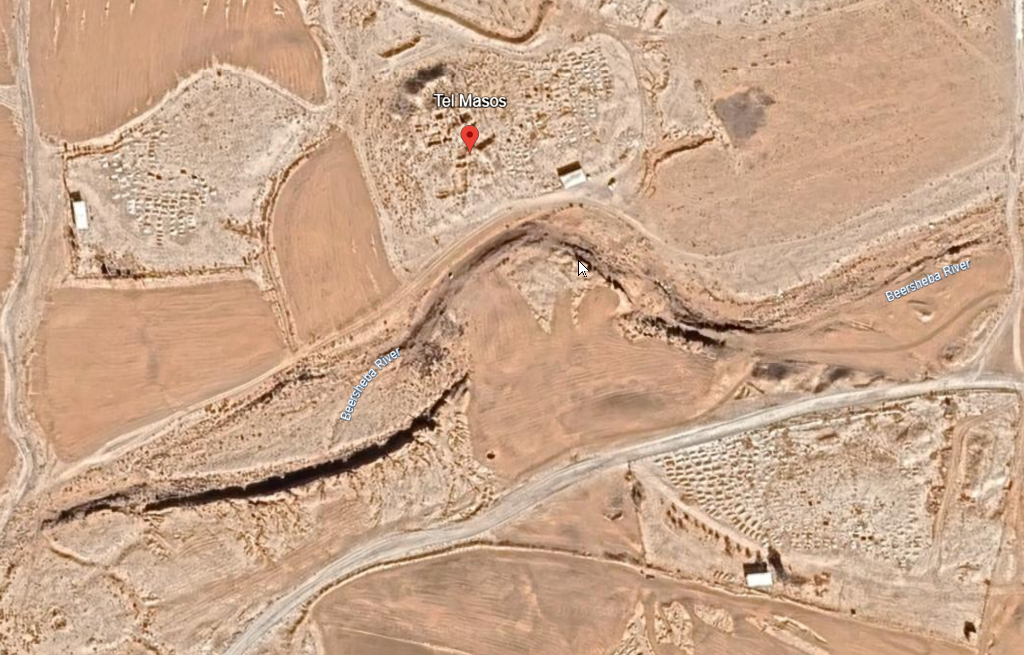
click on image to explore this site on a new tab in govmap.gov.il


Names
Transliterated Name Source Name
Tel Masos Hebrew תל מסוס
Horma Hebrew חרמה
Tel Mashush Arabic تل مشوش
Khirbat al-Mashush Arabic خربة المشوش
Khirbat el Mashash Arabic خربة المشاش
Introduction
Introduction

Tel Masos (Arabic Hirbet el-Meshash) is situated on the edge of Wadi Beer-sheba, approximately 12 km east of the modern town of Beer-sheba. The site is one of the largest in the Valley of Beer-sheba and consists of three separate settlements: the main settlement of the Chalcolithic period (ca 3200 B.C.) and Iron Age I (1200–1000 B.C.), which covers about 15 acres; a smaller settlement 100 meters to the west of about 1¼ acres, which includes the remains of a Syrian Nestorian monastery and a caravanserai of Iron Age II (ca 600 B.C.); and a third area, located 600 meters to the southwest of the main settlement, comprising an enclosure of about 4¼ acres in which remains from the Middle Bronze Age (18th century B.C.) were found. Though it consists of three separate locations, the whole site is known today by the name “Tel Masos.”

The importance of Tel Masos for the understanding of the “Settlement Period” of the Tribes of Israel in Canaan was first recognized by the late Y. Aharoni while he was conducting surface surveys in the region during the early 1960s. As a result of these surveys, excavations in the Valley of Beer-sheba were undertaken, including those at Tel Masos. The site was excavated for three seasons, in 1972, 1974, and 1975, under the direction of Y. Aharoni, V. Fritz, and the author.

Tel Masos is not a lofty mound containing a multitude of layers from many periods of history, but a group of single-period sites scattered around several wells. This concentration of settlements indicates the importance of the location in antiquity: here the east-west route passed Wadi Beer-sheba and crossed the north-south path from the Judean hills toward the Central Negev and the Araba.

In the course of time, the crossroads shifted from Tel Masos to Tel Malhata, six km to the east, and back. An examination and comparison of the periods during which the two sites were occupied enable us to follow the shifting to and fro of the crossroads and to establish the periods during which different road systems were used.

The History of Occupation

The earliest settlement discovered by the excavators at Tel Masos dates from the Late Chalcolithic period. The remains of the period dating from the end of the Chalcolithic and the beginning of the Early Bronze Age were found completely covered by the settlement of the Iron Age I period (the period of the Settlement of the Tribes of Israel—ca 1200 B.C.). The Chalcolithic settlement is about 15 acres in area. The same Late Chalcolithic/Early Bronze Age period is also found at Tel Malhata. The two settlements formed part of a larger complex of similar settlements along Wadi Beer-sheba, and one may assume the existence of smaller settlements between these two.

The inhabitants of Tel Masos lived in caves dug in the loess soil. This kind of underground housing was common in the culture of Beer-sheba. One such cave has been excavated at Tel Masos; its pottery assemblage points to the end of the Chalcolithic and the beginning of the transitional phase to the Early Bronze Age.

Six hundred meters to the southwest of the main settlement, the remains of a fortified enclosure from Middle Bronze II were discovered. This fort, which protected the route running through Wadi Beer-sheba, was occupied for only a short period in the middle of the 18th century B.C. It stood at one extremity of the chain of settlements of western Wadi Beer-sheba, together with a similar fort at Tel Malhata. The function of the two forts was to protect the end of the route which connected the Shefela (coastal area) with Transjordan. From both Tel Masos and Tel Malhata the route branched northwards to the Judean hills and Hebron, one of the more important towns in south Canaan at that time. After the middle of the 18th century B.C., the protective function passed from Tel Masos to the fort at Tel Malhata, a conclusion drawn on the basis of the assemblage of stratified pottery: Tel Malhata was occupied from the later part of the 18th to the beginning of the 16th century B.C.

During the entire Late Bronze Age (1600–1200 B.C.) there was no settlement at Tel Masos or at neighboring Tel Malhata. Only at the beginning of the 13th century was intensive settlement activity resumed around the wells of Tel Masos. The first Israelite settlement occupied the same loess hill on which the Chalcolithic/Early Bronze Age I settlement of the late 4th millennium had been built. A number of families, probably belonging to the tribe of Simeon, settled on the spot, and the old route along Wadi Beer-sheba came back into use.

The settlement built at the beginning of the Israelite Settlement period was abandoned around 980–970 B.C. However, the wells continued to serve the population, which now shifted to Tel ‘Ira, about 3 km north of Tel Masos. At that time, Tel Malhata served as the junction from which the road branched northward. The strata at Tel Malhata form a continuum from the beginning of the 10th century to the end of the Iron Age, at the beginning of the 6th century. In the middle of the 7th century, the wayside station at Tel Masos was revived and a caravanserai was built near the wells. This building activity was connected with the revival by the kings of Judah of a trade and defense system in the Valley of Beer-sheba. The defenses were directed against the Edomites. However, Edomite pottery found at both Tel Masos and Tel Malhata indicates that some trade was also conducted with the Edomites themselves. So far, three ostraka have been found at Tel Masos, all containing lists of names of men from the Kingdom of Judah; thus, in addition to trade, some administrative activities were conducted at Tel Masos.

During the Persian period a caravanserai or fort existed at Tel Masos, but it was completely destroyed by later building activities. Pieces of locally produced pottery from this period, and one red-figured Attic sherd, testify to the existence of a settlement during the 4th century B.C.

The last permanent settlement at Tel Masos before the group of wells turned again into a Bedouin center was a Syrian Nestorian monastery built on the ruins of the Persian fort after the Arab conquest of Palestine in A.D. 632. It is well known that the Omayyad khalifs favored the Nestorians and bestowed various privileges upon them. A number of inscriptions in Syriac, as well as the pottery found at the site, make it possible to date the monastery to the end of the 7th and the beginning of the 8th century A.D. The monastery served as a stopping place for travelers and may have engaged in missionary activities. A 10th-century source mentions that such monasteries were built by Nestorians at crossroads and that their help to travelers was connected with missionary activities.

The fact that, from the Middle Bronze Age onwards, there were periods during which the crossroads at Tel Masos was active and the site occupied, testifies to the existence of a route which some central power or government was interested in maintaining. The longest gap in the occupation of the site was during the Late Bronze Age (1600–1200 B.C.), supporting the view that the road from the Shefela to Transjordan shifted. It ran from west to east, starting from Tel Gerar (Arabic Abu Horeira), going on to Tel Shari‘ya, to Tel Halif toward the Judean hills, and from there by way of Devir (Arabic Hirbet Rabud) to Hebron and on to the central part of the mountains toward Jerusalem and Jericho. We will discuss further below, in connection with the process of settlement at Tel Masos, the question of why the route through the Valley of Beer-sheba came back into use at the end of the Late Bronze and the beginning of the Early Iron Age.

Identification

Tel Masos is in the Negev desert, approximately 12 km (7.5 mi.) east of Beersheba, on the north bank of the Beersheba Valley (map reference 146.069). The site, in Arabic called Khirbet el-Mashash (Ruin of the Cisterns), is near several active wells. Although Tel Masos had been known since the earliest surveys of the Beersheba region, it was only after the 1962 survey, conducted by Y. Aharoni, that it became evident that the entire area contains a complex of sites: a Middle Bronze Age II enclosure (c. 4 a.); a ruin of a Nestorian monastery of the Byzantine period (some 300 sq m) built on an Iron Age III fortress (c. 1 a.); and a large settlement from the beginning of the Iron Age (c. 15 a.) that was built over a Late Chalcolithic settlement (15–17.5 a.).

Aharoni suggested identifying the site with Hormah, mentioned with Arad in the account of the "ascent to the heights of the hill country" and the settlement from the south (Num. 14:44–45; Dt. 1:44; and the parallel in Num. 21:1–3). Objections to this identification were raised by various scholars, among them M. Kochavi and N. Na'aman. The proximity of Hormah to Arad in the biblical descriptions of the historical conquest and the settlement attempts in the south, its close proximity to Arad in the list in Joshua 12:14 and in the account in Judges 1:16–17, and its location in the eastern Negev in 1 Samuel 30:30 reinforce the proposed identification of Aharoni. On the other hand, the equation of Tel Masos and Hormah with H3mj, mentioned in the later Execration texts and in an inscription found in the Sinai mines from the reign of Amenemhet III, poses an archaeological difficulty because the Middle Bronze Age settlement at Tel Masos was established later— during the Thirteenth Dynasty.

Excavations

Three seasons of excavations were carried out at the site from 1972 to 1975, under the direction of Y. Aharoni, V. Fritz, and A. Kempinski, on behalf of the Institute of Archaeology at Tel Aviv University. Excavations were resumed in 1979, as part of the salvage operations conducted in the Beersheba Valley on behalf of the Israel Department of Antiquities and Museums and Ben-Gurion University of the Negev, directed by A. Kempinski. The four campaigns uncovered about one-tenth of the Iron Age I town, one-fifth of the Iron Age III fortress, most of the Nestorian monastery, and a few segments of the Middle Bronze Age II enclosure. Chalcolithic remains were reached in every place excavated below the Iron Age I and III strata, as well as in several pits discovered by chance in the gorge between the Iron Age I settlement and the Iron Age III fortress.

Maps, Aerial Views, Plans, and Illustrations

Maps

Normal Size

  • Fig. 2 Location Map from Kempinski (1978)
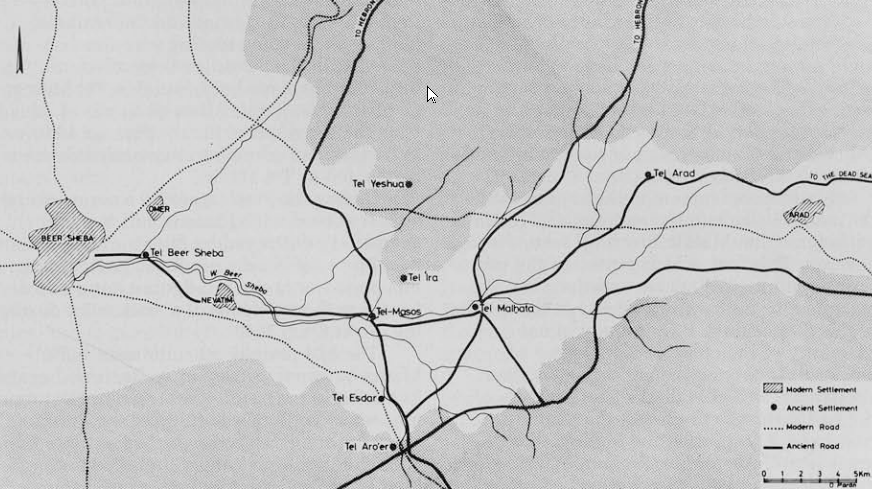
Magnified

  • Fig. 2 Location Map from Kempinski (1978)

Aerial Views

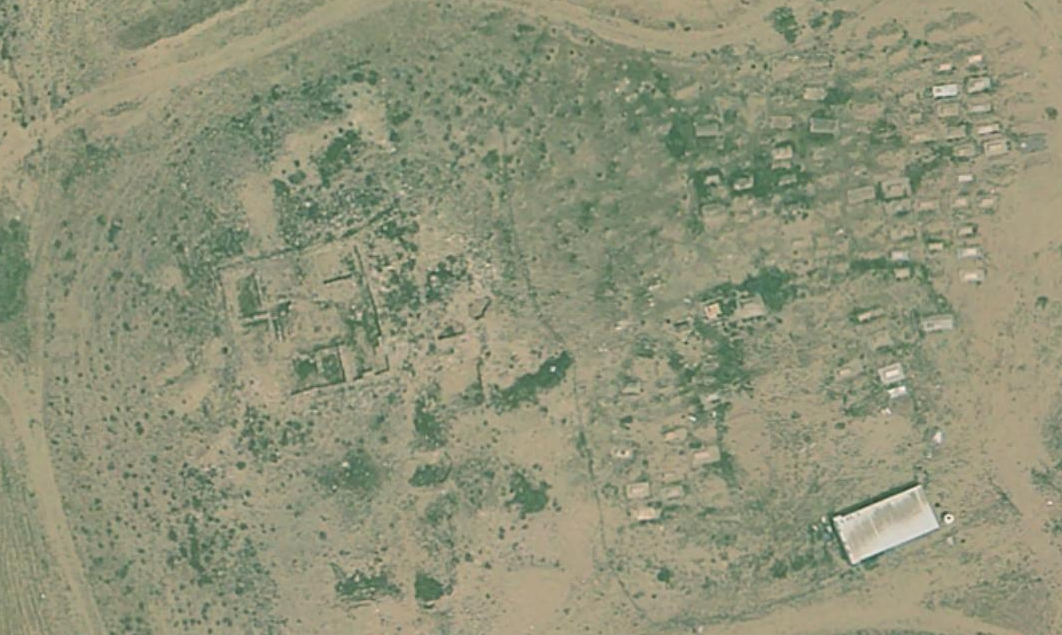
  • Tel Masos in Google Earth
  • Tel Masos on govmap.gov.il

Plans

Site Plans

Normal Size

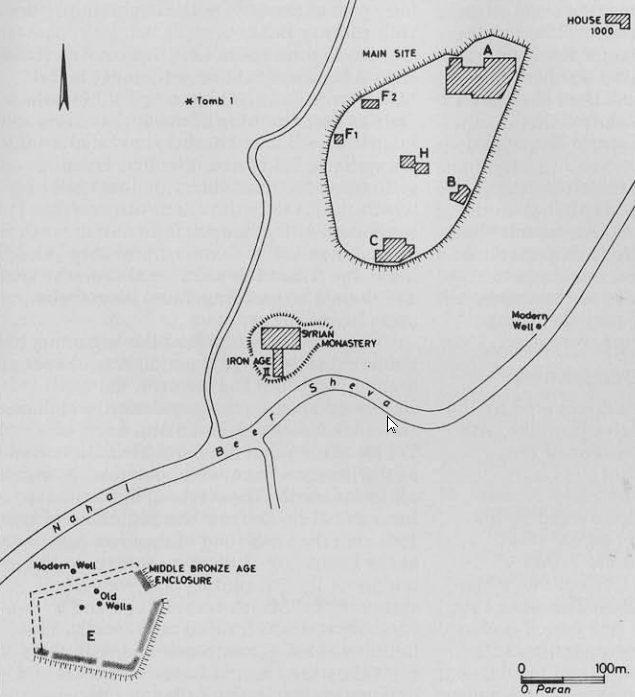
  • Fig. 1 Site Plan from Kempinski (1978)
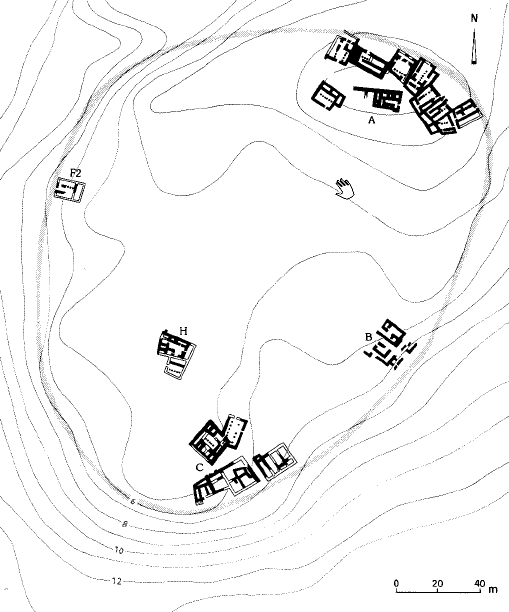
  • Plan of Stratum II Settlement plan from Stern et. al. (1993 v. 3)
Magnified

  • Fig. 1 Site Plan from Kempinski (1978)
  • Plan of Stratum II Settlement plan from Stern et. al. (1993 v. 3)

Area Plans

Area A

Normal Size

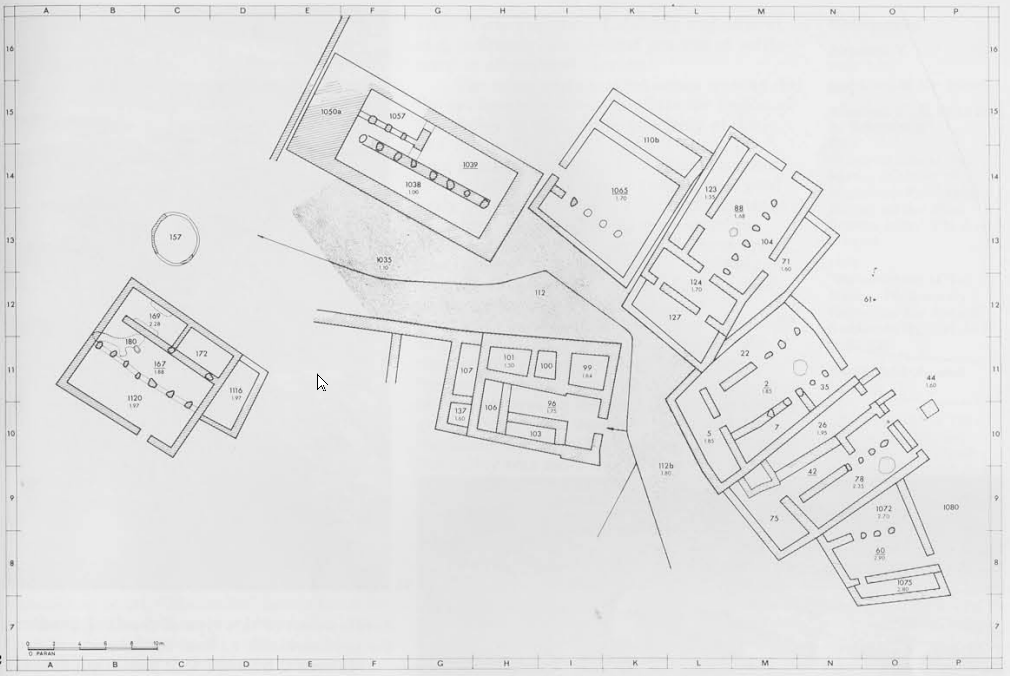
  • Fig. 12 Area A. Stratum II plan from Kempinski (1978)
Magnified

  • Fig. 12 Area A. Stratum II plan from Kempinski (1978)

Illustrations

Normal Size

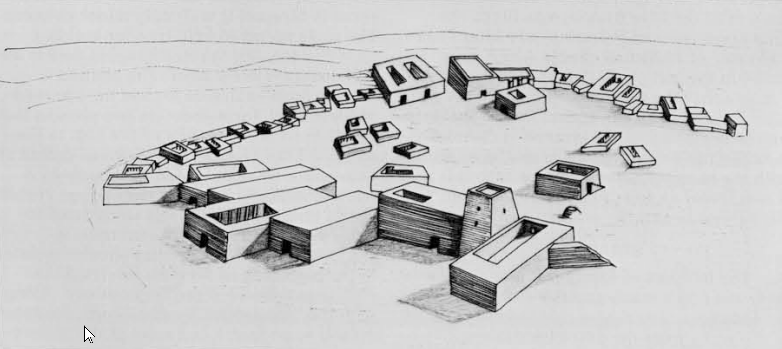
  • Fig. 11 Artists's reconstruction of the settlement of Stratum II from Kempinski (1978)
Magnified

  • Fig. 11 Artists's reconstruction of the settlement of Stratum II from Kempinski (1978)

Archaeoseismic Chronology
Stratigraphy

Iron Age (Israelite) Stratigraphy of Tel Masos

Stratum Period Date Description
III B Iron Age I end 13th–mid 12th c. BCE This stratum is divided into two phases, III A and III B. The earlier, III B, features cooking pits and baking ovens all over the excavated areas. No trace could be found of buildings of any sort. It seems that this stratum represents the coming of the first Israelites, who chose to settle on the loess hills around the group of wells. The next stage, Stratum III A, features buildings and groups of buildings all over the site. The basic form of building in this stratum is a house which already has the features of the four-room house of Stratum II.

The pottery of these two phases is identical, and must be related to the Canaanite pottery from the end of the Late Bronze Age in the southern Shefela.

The climatic conditions in the Valley of Beer-sheba seem to have been different from those existing today. An analysis of the animal bones found in Stratum III showed that sheep and goat accounted for only two-thirds of the animal stock, while cattle made up the other third; today, Bedouin farms in the region consist almost entirely of sheep; cattle-herding is rare. The high percentage of cattle shown in the excavations indicates that vegetation was more abundant in the area then than it is now, as otherwise the cattle would not have had sufficient pasture.

On the basis of the ceramic evidence, both phases of Stratum III can be dated to the end of the 13th and the middle of the 12th century. The main indications are the carinated bowls, cooking pots and craters from the end of the Late Bronze Age. Since the Philistines reached Palestine only after 1180, a number of Philistine sherds which were found in the last phase (III A) of this stratum indicate that the settlement was destroyed after the middle of the 12th century. The date for the beginning of the stratum is corroborated by the discovery of a scarab marked with the name of Seti II (around 1205 B.C.). It was found on top of the debris of Stratum III, but not in situ.
III A Iron Age I end 13th–mid 12th c. BCE
II Iron Age I mid 12th–mid 11th c. BCE The builders of Stratum II planned the settlement on a much grander scale than their predecessors. Sometimes they reused remains of old walls from the previous stratum. There is no proof of the existence of a cultural or ethnic gap between the population of the two strata: the focal pottery tradition is carried on, the plans of the houses develop, sometimes based on plans from Stratum III. In area C it seems that the beginnings of the large building (no. 480), built according to the Egyptian-Canaanite plan and techniques, were present in Stratum III, and continued to serve in Stratum II with only minor changes. The same seems to hold true for building no. 419 + 411, but the stratigraphic details are still not completely clear. The abundant pottery finds enable us to date the life span of Stratum II, throughout its two phases, II A and II B, from the middle of the 12th to the middle of the 11th century. Pottery sherds of “Midianite” bowls, similar to those which were found in Timna, are the earliest vessels in this stratum. The vessels were dated in Timna to the 13th and 12th centuries; it seems that in Tel Masos they should be dated to the beginning of Stratum II—from the middle to the end of the 12th century. Along with the “Midianite” bowls, locally produced vessels were found, but most of the pottery comes from the end of the stratum. A few bichrome and black-on-red imported vessels from the Phoenician coast complete the assemblage.

The settlement of this stratum already shows a conscious attempt at layout. The settlement was destroyed either by an enemy attack or by an earthquake.
I Iron Age early 10th c. BCE The remains of Stratum I which lay open for three millennia were almost completely washed away by erosion. From the little that remained, one can discern the following changes: in area C, a fort appeared on top of public buildings nos. 480 and 411. It faced the wells and served as the “strong tower” into which the inhabitants fled in case of a nomad attack. The erection of this fort marked a deterioration in the security situation in the Valley of Beersheba, and the beginning of a process which ended in about 950 B.C. with the building of fortified cities all along the valley.

Most of the houses built on top of the ruins of Stratum II show the four-room plan. There is no evidence that the settlement was encircled by a protective belt of houses as was the case in Stratum II (see below, p. 35). It seems that the “strong tower” sufficed for protection.

The pottery finds point to the destruction of the settlement at the beginning of the 10th century, possibly around 990–980, the beginning of David’s reign in Jerusalem. At that time the Simeonite Negev was being neglected, and was attached to the territory of Judah.

After the destruction of the settlement in Tel Masos, its inhabitants moved to the neighbouring Tel ‘Ira (Biblical Ramoth Negev? —Joshua 19:8) 3 km. to the north, and joined its population. Tel ‘Ira was occupied during the entire Iron Age, and was one of the larger sites in the northern Negev.

Chronological Divisions

The Iron Age in the Southern Levant

Bronze Age of the Levant

Pharaohs/Egypt

Stratum IIA Earthquake (?) - Iron I - mid 12th–mid 11th century BCE

Discussion

Discussion

References
Kempinski (1978)

Introduction

Tel Masos (Arabic Hirbet el-Meshash) is situated on the edge of Wadi Beer-sheba, approximately 12 km east of the modern town of Beer-sheba. The site is one of the largest in the Valley of Beer-sheba and consists of three separate settlements: the main settlement of the Chalcolithic period (ca 3200 B.C.) and Iron Age I (1200–1000 B.C.), which covers about 15 acres; a smaller settlement 100 meters to the west of about 1¼ acres, which includes the remains of a Syrian Nestorian monastery and a caravanserai of Iron Age II (ca 600 B.C.); and a third area, located 600 meters to the southwest of the main settlement, comprising an enclosure of about 4¼ acres in which remains from the Middle Bronze Age (18th century B.C.) were found. Though it consists of three separate locations, the whole site is known today by the name “Tel Masos.”

The importance of Tel Masos for the understanding of the “Settlement Period” of the Tribes of Israel in Canaan was first recognized by the late Y. Aharoni while he was conducting surface surveys in the region during the early 1960s. As a result of these surveys, excavations in the Valley of Beer-sheba were undertaken, including those at Tel Masos. The site was excavated for three seasons, in 1972, 1974, and 1975, under the direction of Y. Aharoni, V. Fritz, and the author.

Tel Masos is not a lofty mound containing a multitude of layers from many periods of history, but a group of single-period sites scattered around several wells. This concentration of settlements indicates the importance of the location in antiquity: here the east-west route passed Wadi Beer-sheba and crossed the north-south path from the Judean hills toward the Central Negev and the Araba.

In the course of time, the crossroads shifted from Tel Masos to Tel Malhata, six km to the east, and back. An examination and comparison of the periods during which the two sites were occupied enable us to follow the shifting to and fro of the crossroads and to establish the periods during which different road systems were used.

The History of Occupation

The earliest settlement discovered by the excavators at Tel Masos dates from the Late Chalcolithic period. The remains of the period dating from the end of the Chalcolithic and the beginning of the Early Bronze Age were found completely covered by the settlement of the Iron Age I period (the period of the Settlement of the Tribes of Israel—ca 1200 B.C.). The Chalcolithic settlement is about 15 acres in area. The same Late Chalcolithic/Early Bronze Age period is also found at Tel Malhata. The two settlements formed part of a larger complex of similar settlements along Wadi Beer-sheba, and one may assume the existence of smaller settlements between these two.

The inhabitants of Tel Masos lived in caves dug in the loess soil. This kind of underground housing was common in the culture of Beer-sheba. One such cave has been excavated at Tel Masos; its pottery assemblage points to the end of the Chalcolithic and the beginning of the transitional phase to the Early Bronze Age.

Six hundred meters to the southwest of the main settlement, the remains of a fortified enclosure from Middle Bronze II were discovered. This fort, which protected the route running through Wadi Beer-sheba, was occupied for only a short period in the middle of the 18th century B.C. It stood at one extremity of the chain of settlements of western Wadi Beer-sheba, together with a similar fort at Tel Malhata. The function of the two forts was to protect the end of the route which connected the Shefela (coastal area) with Transjordan. From both Tel Masos and Tel Malhata the route branched northwards to the Judean hills and Hebron, one of the more important towns in south Canaan at that time. After the middle of the 18th century B.C., the protective function passed from Tel Masos to the fort at Tel Malhata, a conclusion drawn on the basis of the assemblage of stratified pottery: Tel Malhata was occupied from the later part of the 18th to the beginning of the 16th century B.C.

During the entire Late Bronze Age (1600–1200 B.C.) there was no settlement at Tel Masos or at neighboring Tel Malhata. Only at the beginning of the 13th century was intensive settlement activity resumed around the wells of Tel Masos. The first Israelite settlement occupied the same loess hill on which the Chalcolithic/Early Bronze Age I settlement of the late 4th millennium had been built. A number of families, probably belonging to the tribe of Simeon, settled on the spot, and the old route along Wadi Beer-sheba came back into use.

The settlement built at the beginning of the Israelite Settlement period was abandoned around 980–970 B.C. However, the wells continued to serve the population, which now shifted to Tel ‘Ira, about 3 km north of Tel Masos. At that time, Tel Malhata served as the junction from which the road branched northward. The strata at Tel Malhata form a continuum from the beginning of the 10th century to the end of the Iron Age, at the beginning of the 6th century. In the middle of the 7th century, the wayside station at Tel Masos was revived and a caravanserai was built near the wells. This building activity was connected with the revival by the kings of Judah of a trade and defense system in the Valley of Beer-sheba. The defenses were directed against the Edomites. However, Edomite pottery found at both Tel Masos and Tel Malhata indicates that some trade was also conducted with the Edomites themselves. So far, three ostraka have been found at Tel Masos, all containing lists of names of men from the Kingdom of Judah; thus, in addition to trade, some administrative activities were conducted at Tel Masos.

During the Persian period a caravanserai or fort existed at Tel Masos, but it was completely destroyed by later building activities. Pieces of locally produced pottery from this period, and one red-figured Attic sherd, testify to the existence of a settlement during the 4th century B.C.

The last permanent settlement at Tel Masos before the group of wells turned again into a Bedouin center was a Syrian Nestorian monastery built on the ruins of the Persian fort after the Arab conquest of Palestine in A.D. 632. It is well known that the Omayyad khalifs favored the Nestorians and bestowed various privileges upon them. A number of inscriptions in Syriac, as well as the pottery found at the site, make it possible to date the monastery to the end of the 7th and the beginning of the 8th century A.D. The monastery served as a stopping place for travelers and may have engaged in missionary activities. A 10th-century source mentions that such monasteries were built by Nestorians at crossroads and that their help to travelers was connected with missionary activities.

The fact that, from the Middle Bronze Age onwards, there were periods during which the crossroads at Tel Masos was active and the site occupied, testifies to the existence of a route which some central power or government was interested in maintaining. The longest gap in the occupation of the site was during the Late Bronze Age (1600–1200 B.C.), supporting the view that the road from the Shefela to Transjordan shifted. It ran from west to east, starting from Tel Gerar (Arabic Abu Horeira), going on to Tel Shari‘ya, to Tel Halif toward the Judean hills, and from there by way of Devir (Arabic Hirbet Rabud) to Hebron and on to the central part of the mountains toward Jerusalem and Jericho. We will discuss further below, in connection with the process of settlement at Tel Masos, the question of why the route through the Valley of Beer-sheba came back into use at the end of the Late Bronze and the beginning of the Early Iron Age.

Can Tel Masos Be Identified ?

Two sites in the Valley of Beer-sheba can be identified with certainty: Beer-sheba and Arad. In Beer-sheba, the old name was maintained throughout the entire Roman-Byzantine period and was carried on into Arabic as Bir es-Saba. The excavations at Tel Sheba, about 3 km east of the modern town of Beer-sheba, showed that a very important fortress stood there at the beginning of the Israelite and Judean kingdom. The discovery of an ashlar altar confirmed the use of the site as a central place of worship for the region at the time of the Judean kings.

The second settlement is Tel Arad, which is identified with ancient Arad, which served as a fortress during the period of the Judean kingdom as well as during the Persian and Hellenistic periods. The site continued to serve as a fortress in Roman-Byzantine times and is one of the forts of the Roman limes. The name has been preserved unchanged by the Bedouins in the vicinity for about 12 centuries, ever since the destruction of the last wayside station which still existed in the early Arabic period. During the excavations, the identification was confirmed by an offering bowl on which the name of the fortress is inscribed several times.

Tel Masos is situated approximately midway between these two sites and should therefore be identified on the basis of sources relating either to Beer-sheba or to Arad.

Biblical sources often mention a town by the name of Hormah alongside Arad. Hormah belonged to the tribe of Simeon and is apparently the easternmost town of Simeon. In a number of verses in Numbers and Deuteronomy, a tradition seems to have been preserved which testifies to the attempt of the Tribes of Israel to invade Canaan from the south, climbing from the Valley of Beer-sheba toward the Judean hills. Hormah is mentioned in this context as the main point on the way to the mountains, the very place at which the Israelites were defeated in their attempt to ascend. According to the Biblical historiographer, all of these attempts failed; the one which succeeded was an attack from the opposite direction. In Judges 1 we read:

(16) And the children of the Kenite, Moses’ father-in-law, went up out of the city of palm trees with the children of Judah into the wilderness of Judah, which lieth in the south of Arad; and they went and dwelt among the Amalekites.

(17) And Judah went with Simeon his brother and they slew the Canaanites that inhabited Zephat and utterly destroyed it. And the name of the city was called Hormah.
Here too, Arad and Hormah are mentioned together.

This passage seems to record an authentic tradition concerning the coming of two groups of settlers to the Arad-Hormah region. The first were the Kenites, who came together with people from the tribe of Judah and settled in the midst of the Amalekites; the second group were the Simeonites, who, together with another group of people of Judah, were believed by the author of the Book of Judges to have conquered and destroyed an (imaginary?) locality named Zephat and changed its name to Hormah.

Hormah is mentioned for the last time at the beginning of David’s reign, when he was ruling in Ziklag as the vassal of the Philistines. He sent spoil which he took from the Amalekites to various towns in the northern Negev and southern Judean hills, including Beth-el and Hormah (I Samuel 30:26–30). Hormah is not mentioned again in Biblical sources after David’s time.

We saw above that the region of the Tel Masos–Tel Malhata crossroads was the place from which people usually went up to the Judean hills, and we will therefore try to locate Hormah on one of these two sites.

A most important document concerning the history of the Valley of Beer-sheba at the end of the 10th century B.C. is the list of towns in the Negev drawn up by Shenosheq I. The list is very detailed and mentions every small village and fort. The region east of Potis (modern Patish) and Beer-sheba (Hagar Abram = Fort of Abraham in Shenosheq’s list) up to Arad is well documented and does not mention Hormah. This is of importance in connection with the question of whether Tel Masos or Tel Malhata should be identified with Hormah. Today the results of the excavations enable us to make the choice. While Tel Masos was settled at the beginning of the 13th century, Tel Malhata was not settled before the beginning of the 10th century. In the middle of the 10th century Tel Masos was already abandoned, while Tel Malhata continued to be occupied until the end of Iron Age II in the 6th century. Thus, the absence of the name Hormah in Shenosheq’s list (925 B.C.) corresponds to the abandonment of Tel Masos approximately 50 to 70 years earlier. If Tel Malhata had been the settlement called Hormah, it would be mentioned in the Egyptian list, as it was settled at that time and destroyed by the Egyptian army. Thus Tel Masos can be identified with the Biblical Hormah.

The Stratigraphy and the Most Important Findings in the First Israelite Settlement

Three main strata have been found at the principal mound of Tel Masos. They have been clearly identified in all the excavated areas of the site, and show similar qualities.
Stratum Period Date Description
III B Iron Age I end 13th–mid 12th c. BCE This stratum is divided into two phases, III A and III B. The earlier, III B, features cooking pits and baking ovens all over the excavated areas. No trace could be found of buildings of any sort. It seems that this stratum represents the coming of the first Israelites, who chose to settle on the loess hills around the group of wells. The next stage, Stratum III A, features buildings and groups of buildings all over the site. The basic form of building in this stratum is a house which already has the features of the four-room house of Stratum II.

The pottery of these two phases is identical, and must be related to the Canaanite pottery from the end of the Late Bronze Age in the southern Shefela.

The climatic conditions in the Valley of Beer-sheba seem to have been different from those existing today. An analysis of the animal bones found in Stratum III showed that sheep and goat accounted for only two-thirds of the animal stock, while cattle made up the other third; today, Bedouin farms in the region consist almost entirely of sheep; cattle-herding is rare. The high percentage of cattle shown in the excavations indicates that vegetation was more abundant in the area then than it is now, as otherwise the cattle would not have had sufficient pasture.

On the basis of the ceramic evidence, both phases of Stratum III can be dated to the end of the 13th and the middle of the 12th century. The main indications are the carinated bowls, cooking pots and craters from the end of the Late Bronze Age. Since the Philistines reached Palestine only after 1180, a number of Philistine sherds which were found in the last phase (III A) of this stratum indicate that the settlement was destroyed after the middle of the 12th century. The date for the beginning of the stratum is corroborated by the discovery of a scarab marked with the name of Seti II (around 1205 B.C.). It was found on top of the debris of Stratum III, but not in situ.
III A Iron Age I end 13th–mid 12th c. BCE
II Iron Age I mid 12th–mid 11th c. BCE The builders of Stratum II planned the settlement on a much grander scale than their predecessors. Sometimes they reused remains of old walls from the previous stratum. There is no proof of the existence of a cultural or ethnic gap between the population of the two strata: the focal pottery tradition is carried on, the plans of the houses develop, sometimes based on plans from Stratum III. In area C it seems that the beginnings of the large building (no. 480), built according to the Egyptian-Canaanite plan and techniques, were present in Stratum III, and continued to serve in Stratum II with only minor changes. The same seems to hold true for building no. 419 + 411, but the stratigraphic details are still not completely clear. The abundant pottery finds enable us to date the life span of Stratum II, throughout its two phases, II A and II B, from the middle of the 12th to the middle of the 11th century. Pottery sherds of “Midianite” bowls, similar to those which were found in Timna, are the earliest vessels in this stratum. The vessels were dated in Timna to the 13th and 12th centuries; it seems that in Tel Masos they should be dated to the beginning of Stratum II—from the middle to the end of the 12th century. Along with the “Midianite” bowls, locally produced vessels were found, but most of the pottery comes from the end of the stratum. A few bichrome and black-on-red imported vessels from the Phoenician coast complete the assemblage.

The settlement of this stratum already shows a conscious attempt at layout. The settlement was destroyed either by an enemy attack or by an earthquake.
I Iron Age early 10th c. BCE The remains of Stratum I which lay open for three millennia were almost completely washed away by erosion. From the little that remained, one can discern the following changes: in area C, a fort appeared on top of public buildings nos. 480 and 411. It faced the wells and served as the “strong tower” into which the inhabitants fled in case of a nomad attack. The erection of this fort marked a deterioration in the security situation in the Valley of Beersheba, and the beginning of a process which ended in about 950 B.C. with the building of fortified cities all along the valley.

Most of the houses built on top of the ruins of Stratum II show the four-room plan. There is no evidence that the settlement was encircled by a protective belt of houses as was the case in Stratum II (see below, p. 35). It seems that the “strong tower” sufficed for protection.

The pottery finds point to the destruction of the settlement at the beginning of the 10th century, possibly around 990–980, the beginning of David’s reign in Jerusalem. At that time the Simeonite Negev was being neglected, and was attached to the territory of Judah.

After the destruction of the settlement in Tel Masos, its inhabitants moved to the neighbouring Tel ‘Ira (Biblical Ramoth Negev? —Joshua 19:8) 3 km. to the north, and joined its population. Tel ‘Ira was occupied during the entire Iron Age, and was one of the larger sites in the northern Negev.

Tel Masos at its Peak

Stratum II is the main stratum at Tel Masos, the settlement reaching its peak during its life span. It is also the best excavated and enables us to observe for the first time the way in which an important settlement was planned and built during the 12th and 11th centuries B.C.

The principal guideline for the builders in Stratum II was the idea of enclosing the center of the settlement by a belt of buildings on the edge of the hill. By joining the outer houses together a defense belt evolved. This method of fortification arose from early forms of defense. It is also found in nomadic camps, which tend to be encircled by a chain of tents protecting the center of the camp. The Israelite settlers may have used the same type of camp structure while they were still in their semi-nomadic state before settling at Tel Masos. Indeed, in Stratum III some features indicate that the fringe of the settlement may have been encircled by a belt of this kind.

The defense belt has been well identified in Area A. We can discern the main details of the construction: the belt of buildings stretches along the outskirts of the settlement; the outer court of each house is defended on both sides by its neighboring houses. In Area A the belt is interrupted by a public building which is also flanked on both sides by protruding structures that project toward the slope of the hill and thus defend the building’s outer courtyard. The thick walls and the remains of a staircase podium on its west side indicate that the building had several stories and may have served as a local fort to which the people fled when threatened by danger.

This kind of defense was precarious and could withstand only attacks from small groups of nomads. Since the doors of the houses opened onto the outside of the settlement, a stronger attack could easily break in through these openings. At that period no attempts to seriously fortify the settlement in the manner used during Iron Age II are discernible. After the year 1000, however, new defense structures developed: the four-room houses were built facing inward so that their backs served as a casemate wall for the whole settlement.

The basic building unit of Stratum II is the four-room house. It contains three storage or living rooms that surround an open inner courtyard. This plan evolved from the three- and two-room houses in Stratum III, which seem in turn to have originated from the basic plan of the tent or hut used by the semi-nomadic Israelite population before their settlement. The tent, similar to the contemporary Bedouin tent, consisted of a room open on its broad side toward an outer court.

The four-room house of Stratum II is similar in its main lines to the typical Israelite house that served both the urban and rural population throughout Iron Age II. Those found at Tel Masos are the earliest known examples of this type of house and represent well-documented evidence of the process of development of this type of dwelling from the semi-nomadic stage to final settlement.

In Area C a complex of public buildings formed the main entrance. In Areas B and F the defense belt of houses runs toward this public complex, encircling the whole settlement. In Area C we discern the continuation of the planning principle of the Canaanite town from the Late Bronze Age: the main public buildings are concentrated near the main entrance into the settlement.

The buildings in the public complex are interesting in themselves; they seem out of place in such a rural settlement. To the west of the settlement entrance stands a fort-like construction (building no. 411) that features a large courtyard. This courtyard is joined on its west side by a small fort or tower with decorative offsets. Parts of the fort are built according to the building techniques used in Egypt and the southern Shefela: brick walls built on a brick basement without a stone base. The decorations of the outer walls also point to influences from Egypt and the southern Shefela. Next to this fort another building was unearthed (building no. 480). It is 15 × 15 meters in size and has an Egyptian-Canaanite plan, very much like building no. 1500 at Beth Shan. On the east side of the entrance to the settlement a building with elongated rooms was found, possibly a storage building.

This complex of public buildings may have had its beginning in Stratum III, dating from the first half of the 12th century during the period of Egyptian rule over southern Canaan. At that time, during the reigns of Rameses III, Rameses V, and Rameses VI, the way through the Valley of Beer-sheba regained its importance for both trade and military purposes. It is also possible that the whole complex was built by the Philistine rulers, who inherited parts of the Egyptian administrative apparatus in south Canaan after 1150 B.C. In any event, the construction of such a highly developed complex of public buildings near the main entrance testifies to the existence of a central government that took the trouble to develop the settlement, thereby imposing on it its own architectural style. This style, however, appeared only in the public buildings; the private houses continued to be built according to the local four-room plan.

In the center of the settlement only a few buildings have been uncovered; perhaps relatively large empty spaces were left there. In the central Area H two adjoining buildings were found, in one of which a room for ritual purposes containing rich finds from the whole life span of Stratum II was revealed. Stone figurines that might stem from the semi-nomadic period, luxury vessels from the Phoenician coast, “Midianite” bowls from the southern Araba, and an ivory head of a lion from the coastal region all came to light. These objects, together with the copper implements that were found, testify to the wide range of commercial ties that Tel Masos enjoyed from the southern Araba to the coastal region to the north and to Phoenicia. The opinion that Tel Masos was an important center of the copper trade is supported by the chemical analysis of the copper artifacts found here: most of the ore is from the mines of Fenan and Timna. In Areas A and C proof that copper was worked on the spot was found: in Area C a crucible was discovered and in Area A a workshop with some remains of ore.

The settlement was not confined to the inside of the circle formed by the defense belt: houses were found spread out as far as 300 meters away from the defense chain. One of them (no. 1000) was excavated and found to belong to the Stratum II period. This means that the fortified settlement served only as a nucleus for a wider, scattered settlement. It could well be that part of the population even retained its former semi-nomadic way of life in the vicinity of Tel Masos.

Tel Masos and the Israelite “Settlement Period”

The excavations at Tel Masos further our understanding of the settlement process of the southern tribes (the Simeonites, Hovavites, Yerachmielites, Kalebites, and others) and, indirectly, the general process of settlement in all parts of Canaan.

The main question that arises is: why did the settlement wave sweep into the region of the Valley of Beer-sheba precisely at the end of the 13th century B.C.? There is only a partial answer. We may assume that the region of the southern Judean hills gradually became overpopulated, partly because of natural increase and partly because of the arrival of new immigrants from Transjordan (the tribes of Judah and Kaleb?). This region was classic ground for a semi-nomadic way of life in the Late Bronze Age, and the Canaanite urban settlements were restricted to areas that lay along the one main route through the Judean hills. With the growth of the semi-nomadic population, the food supply in the area was no longer sufficient, and some groups descended from the mountains into the fertile Valley of Beer-sheba. At that time the valley was more humid than it is today and richer in vegetation.

The existence of various tribes and clans in the mountainous area, some of them old inhabitants and some newcomers—the latter presumably more aggressive—caused a serious deterioration in the security situation along the main international route through the Judean hills toward Jericho. The trade caravans could no longer count on safe transit. Thus, while part of the semi-nomadic population was descending to the valley, the main trade route shifted to the same area, creating more opportunities for the new valley settlers. So it was that the road that had been abandoned in the 17th century at the end of the Middle Bronze Age again came into use at the end of the Late Bronze Age in the 13th century.

Stern et. al. (1993 v. 3)

Excavations

Chalcolithic Period (Stratum IV)

The stratum IV settlement is attributed to the end of the Chalcolithic period and the beginning of the Early Bronze Age I. Pottery characteristic of the Early Bronze Age I, such as ledge handles and hole-mouth jars, was recovered. The site at this time was part of a system of settlements along the Beersheba Valley. Its exact nature is still unclear; the excavations indicate that the inhabitants lived in a kind of pit dug into the loess soil—an observation that requires further clarification.

Middle Bronze Age

Remains of a Middle Bronze Age fortress were found about 600 m southwest of the Iron Age I site. Two phases can be distinguished. A fortress was erected in the first; its remains are probably to be found in building 806, near trench 1. Bricks and brick fragments taken from it were reused in the later rampart. After this fortress was destroyed, the area was resettled as an enclosure fortified with a five-sided rampart. The rampart had a moat and its outer face was lined with stream pebbles. A retaining wall built of massive stones was erected at the base of the rampart, facing the moat. Pottery analysis indicates no occupation or chronological gap between the fortress's two phases. The earliest vessel discovered here is a juglet sherd of the Ginossar type, characteristic of the Middle Bronze Age IIA, but also known from the first phase of the Middle Bronze Age IIB. This date (first half of the eighteenth century BCE) is confirmed by the analysis of the rest of the pottery. The dating of both stages of the fortress to the beginning of the Thirteenth Dynasty suggests that Tel Masos may have been a way station, controlled by the block of city-states crystallizing at that time in the southern Shephelah and along the southern coast of Canaan.

Iron Age I

Introduction

Five areas (A, B, C, F, H), all with Iron Age I remains, were excavated on the mound. A survey was conducted up to several hundred meters around the mound to determine the type of the contemporary structures dispersed throughout the vicinity. An attempt was also made to locate the site's cemetery by digging section trenches around the mound up to 1 km (0.6 mi.) away. The results point to a core settlement established at the end of the thirteenth century BCE on the mound's summit (area A). In the twelfth and eleventh centuries BCE (stratum II), as the settlement developed, groups of houses were erected near the core. One of them, house 1000, was completely excavated; it contained only a few finds because of heavy erosion. A similar (unexcavated) house was located on the other side of the valley, near tomb 1.

Stratum III

The first permanent settlement at the site was probably established after seminomads had occupied huts and tents over a period of time (stratum IIIB). It was concentrated in two focal points: a complex of crowded structures in area A; and a fortresslike structure built in the Canaanite-Egyptian technique in area C (stratum IIIA). The area A complex was built in a bow shape along the edge of the mound, probably part of a ring of structures that surrounded all of area A. Several of these were broadhouses with a courtyard in front, characteristic of the transition from tents or nomad huts to permanent dwellings. Others were three-room houses, which evolved in stratum II into the four-room house of Tel Masos. Some of the houses were erected on top of pits and remains of floors from stratum IIIB. The brick structures in area C (the fort and building 480 next to it) were also built over stratum IIIB pits. The two complexes were probably related.

Stratum II

After the destruction of the stratum III structures in area A, the settlement was rebuilt on a larger scale. It appears that a large population settled first along the mound's edge, forming a kind of ring surrounding the area. The stratum III structures in area C were then incorporated in the new buildings of stratum II. The extent of the site at this time was determined by the topography of the hill covered by the Iron Age I settlement.

In areas A and B, sections were cut toward the area outside the settlement in order to clarify its boundaries. The settlement pattern of a dense ring of structures in area A was first established in stratum IIIA. Its origin seems to have been earlier defense techniques characteristic of nomadic and semi-nomadic tribes.

The most noticeable characteristic of stratum II architecture is the appearance of four-room houses along the site's entire defense ring. Some houses had entrances facing outward from the settlement, while others faced inward. A central building (1039) was uncovered in area A. Judging from the thickness of its walls, the structure stood two to three stories high. Its ground floor served as a storeroom, which in the excavators' view is similar to the storeroom units that appear later in the Iron Age II throughout the country. The sudden destruction of stratum IIA buried several of the four-room houses in the debris from the buildings' second stories; the builders of stratum I had to level the area and erect their structures on top of this debris, which reached a height of 1.7 m in some spots. This situation allowed the reconstruction of the ground floors of two buildings, as the floors had been built as a high stone socle and the houses' pillars and lintels, which were built of massive stone slabs, had all collapsed in the same direction.

In area C, there is evidence that the public buildings (the fort and building 480) were in use until the end of stratum IIA. Here, too, the area was leveled after the destruction and most of the structures were built on top of the debris. A structure excavated in the 1979 season is an exception to this rule. It was first built in stratum IIA, when it was joined to building 480. When building 480 was destroyed, this structure was enlarged and covered parts of the large ruined brick building. The implication of this discovery is that after the destruction of stratum II (by enemy or earthquake?), several private houses were renovated at the same time as the public buildings—associated with the central administration on the Coastal Plain—were leveled and covered by private dwellings
. In area C, the main approach to the settlement seems to have passed between the public buildings.

A building used partly for cultic purposes was found in area H. The structure possessed elements of the four-room house and showed traces of influence from the Bronze Age courtyard house. At its western end was a cultic room containing a basin and many cultic vessels.

In areas B, F1, and F2, probes were carried out to determine the size of the site. Area B was very badly eroded. In stratum II, two stages were discerned in all the excavated areas; it seems that the stratum lasted approximately one hundred years.

Stratum I

A fundamental change took place in the settlement pattern and regional role of the site in stratum I. The public buildings in area C were destroyed and private houses were erected on the ruins. A fortress was built as well, with a plan similar to that of fortresses built in the Negev at the end of the eleventh and the beginning of the tenth centuries BCE. The settlement plan was also completely altered, from a settlement protected by a defense ring of structures to one with a central fortress and houses sparsely dispersed throughout the site. Several older houses in area A continued to be used in stratum I, as was the central building (1039), which was almost unaltered. The house with the cultic room in area H was destroyed, but there are signs of a continuation of (cultic?) activity there in stratum I, as well as in the poststratum I level, when several storage jars and a flask were buried there (late tenth or even early ninth centuries BCE). In area C, a fortress (c. 15 by 17 m) was built on top of the earlier ruins. Its walls (c. 2 m thick), with watchtowers at all four corners, surrounded a paved courtyard. Several four-room houses were built nearby. A striking similarity exists between the fortress with its adjacent structures and other central Negev settlements, such as Horvat Ritma. Stratum I was short-lived and it appears that the inhabitants abandoned the site and moved to neighboring Tel Malhata.

Iron Age III

A fortress from the Iron Age III was uncovered on a small mound 200 m west of the Iron Age I settlement. Its size and nature were not fully clarified, as the section probe was cut in the direction of the exposed wadi to the east, where the fortifications had been almost completely eroded. Four phases were found in the fortress, all dating from the seventh century BCE. The small amount of data collected here showed a homogeneous layout of living chambers along a paved street. The finds include three ostraca bearing personal names, as well as some Edomite vessels, which represent the rise of Edomite influence (through population infiltration?) in the Beersheba Valley toward the end of the seventh century BCE. It appears that the fortress lasted no more than fifty to seventy years and was destroyed by a violent conflagration, possibly during the Edomite invasion close to the time of the destruction of the kingdom of Judah.

Nestorian Monastery

The last permanent structure to occupy the area was a monastery in the Umayyad period. According to the remains of Syriac inscriptions, the building was first built by Nestorian monks in the late seventh and early eighth centuries CE. Several inscriptions on plaster include verses from the New Testament in Syriac. The monastery was rectangular in plan, with a small entrance and a crypt for burials. The church had a rectangular apse, typical of Syrian churches. The living quarters were built around a rectangular courtyard. Remains of a staircase were found, indicating that the monastery had a second or even a third story.

Raphael and Agnon (2018)

Period Age Site Damage Description
Iron I 1200-1000 BCE Tell Masos Damage in Storage House 2102 (Area C, Level II). In House 480 (Area C1), debris thickness of 1.50 m (Level III), dating to the end of the 13th–second half of the 12th century BCE. House 2004 (Area A, Level II) of the second half of 12th–end of the 11th century BCE had walls preserved to 1.30 m due to the debris of the upper floor that covered the entire house. No ash or weapons (apart from a dagger) were discovered. “The house was probably destroyed in an earthquake” (Givon 1996: 9–10). House 167 had debris 0.80 m thick (Fritz and Kempinski 1983: 22–23). Houses were built very closely, with outer walls often touching those of the neighboring house. Site abandoned and resettled only in the mid-7th century BCE.

Archaeoseismic Effects
Stratum IIA Earthquake (?) - Iron I - mid 12th–mid 11th century BCE

Effect                              Location Image(s) Description
  • Debris (due to collapsed walls)
Area A

  • "The sudden destruction of stratum IIA [in Area A] buried several of the four-room houses in the debris from the buildings' second stories; the builders of stratum I had to level the area and erect their structures on top of this debris, which reached a height of 1.7 m in some spots. This situation allowed the reconstruction of the ground floors of two buildings, as the floors had been built as a high stone socle and the houses' pillars and lintels, which were built of massive stone slabs, had all collapsed in the same direction." - Aharon Kempinski in Stern et. al. (1993 v. 3:987)

  • "House 2004 (Area A, Level II) of the second half of 12th–end of the 11th century BCE had walls preserved to 1.30 m due to the debris of the upper floor that covered the entire house. No ash or weapons (apart from a dagger) were discovered. “The house was probably destroyed in an earthquake” (Givon 1996: 9–10). House 167 had debris 0.80 m thick (Fritz and Kempinski 1983: 22–23). Houses were built very closely, with outer walls often touching those of the neighboring house. " - Raphael and Agnon (2018:775)
  • Debris (due to collapsed walls)
Area C
  • "In area C, there is evidence that the public buildings (the fort and building 480) were in use until the end of stratum IIA. Here, too, the area was leveled after the destruction and most of the structures were built on top of the debris. A structure excavated in the 1979 season is an exception to this rule. It was first built in stratum IIA, when it was joined to building 480. When building 480 was destroyed, this structure was enlarged and covered parts of the large ruined brick building. The implication of this discovery is that after the destruction of stratum II (by enemy or earthquake?), several private houses were renovated at the same time as the public buildings—associated with the central administration on the Coastal Plain—were leveled and covered by private dwellings." - Aharon Kempinski in Stern et. al. (1993 v. 3:987)

  • "A fundamental change took place in the settlement pattern and regional role of the site in stratum I. The public buildings in area C were destroyed and private houses were erected on the ruins. In area C, a fortress (c. 15 by 17 m) was built on top of the earlier ruins." - Aharon Kempinski in Stern et. al. (1993 v. 3:987-988)

  • "Damage in Storage House 2102 (Area C, Level II). In House 480 (Area C1), debris thickness of 1.50 m (Level III), dating to the end of the 13th–second half of the 12th century BCE" - Raphael and Agnon (2018:775)
  • Collapsed walls (destroyed)
Area H
  • Collapsed walls (destroyed)
Site-wide
  • "The settlement was destroyed either by an enemy attack or by an earthquake." - Kempinski (1978)

Archaeoseismic Intensity Estimates
Stratum IIA Earthquake (?) - Iron I - mid 12th–mid 11th century BCE

Effect                              Location Image(s) Description Intensity
  • Debris (due to collapsed walls)
Area A

  • "The sudden destruction of stratum IIA [in Area A] buried several of the four-room houses in the debris from the buildings' second stories; the builders of stratum I had to level the area and erect their structures on top of this debris, which reached a height of 1.7 m in some spots. This situation allowed the reconstruction of the ground floors of two buildings, as the floors had been built as a high stone socle and the houses' pillars and lintels, which were built of massive stone slabs, had all collapsed in the same direction." - Aharon Kempinski in Stern et. al. (1993 v. 3:987)

  • "House 2004 (Area A, Level II) of the second half of 12th–end of the 11th century BCE had walls preserved to 1.30 m due to the debris of the upper floor that covered the entire house. No ash or weapons (apart from a dagger) were discovered. “The house was probably destroyed in an earthquake” (Givon 1996: 9–10). House 167 had debris 0.80 m thick (Fritz and Kempinski 1983: 22–23). Houses were built very closely, with outer walls often touching those of the neighboring house. " - Raphael and Agnon (2018:775)
  • VIII+
  • Debris (due to collapsed walls)
Area C
  • "In area C, there is evidence that the public buildings (the fort and building 480) were in use until the end of stratum IIA. Here, too, the area was leveled after the destruction and most of the structures were built on top of the debris. A structure excavated in the 1979 season is an exception to this rule. It was first built in stratum IIA, when it was joined to building 480. When building 480 was destroyed, this structure was enlarged and covered parts of the large ruined brick building. The implication of this discovery is that after the destruction of stratum II (by enemy or earthquake?), several private houses were renovated at the same time as the public buildings—associated with the central administration on the Coastal Plain—were leveled and covered by private dwellings." - Aharon Kempinski in Stern et. al. (1993 v. 3:987)

  • "A fundamental change took place in the settlement pattern and regional role of the site in stratum I. The public buildings in area C were destroyed and private houses were erected on the ruins. In area C, a fortress (c. 15 by 17 m) was built on top of the earlier ruins." - Aharon Kempinski in Stern et. al. (1993 v. 3:987-988)

  • "Damage in Storage House 2102 (Area C, Level II). In House 480 (Area C1), debris thickness of 1.50 m (Level III), dating to the end of the 13th–second half of the 12th century BCE" - Raphael and Agnon (2018:775)
  • VIII+
  • Collapsed walls (destroyed)
Area H
  • VIII+
  • Collapsed walls (destroyed)
Site-wide
  • "The settlement was destroyed either by an enemy attack or by an earthquake." - Kempinski (1978)
  • VIII+
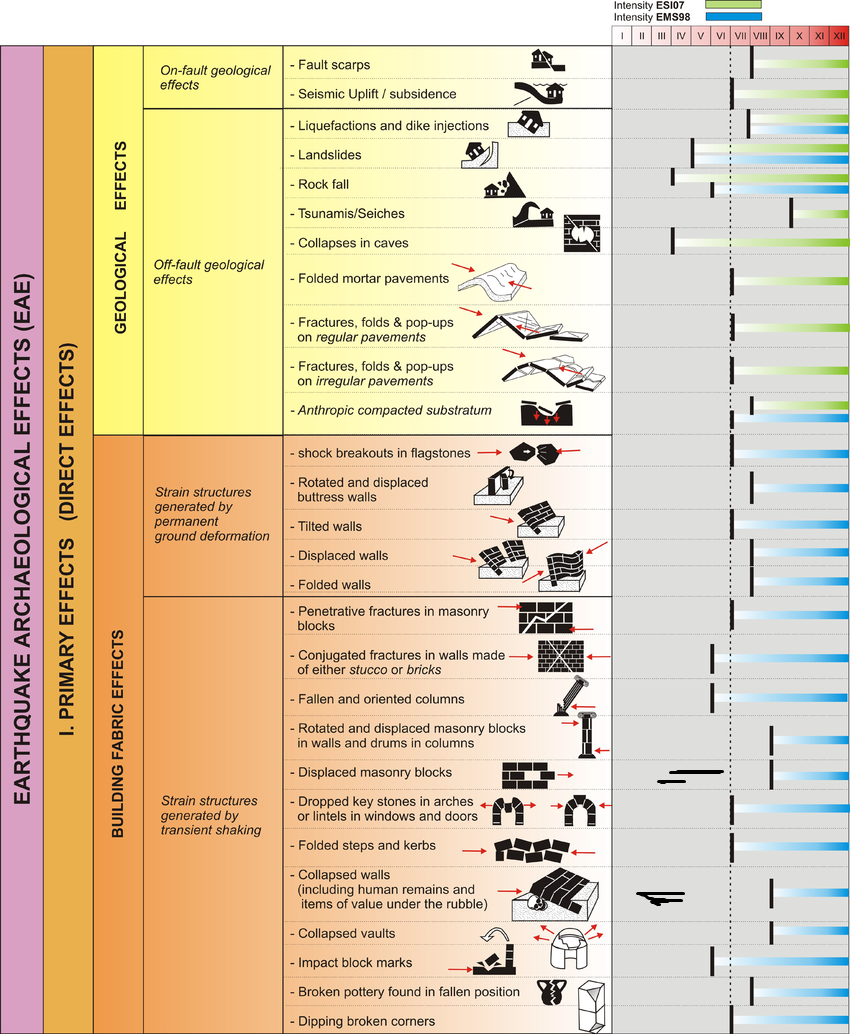
The archeoseismic evidence requires a minimum Intensity of VIII (8) when using the Earthquake Archeological Effects chart of Rodríguez-Pascua et al (2013: 221-224).

Notes and Further Reading
References

Bibliography from Stern et al. (1993 v. 3)

Main publication

Fritz, V. and Kempinski, A. (1983) Ergebnisse der Ausgrabungen auf der Hirbet el-Msas (Tel Masos) 1972–1975 (Abhandlungen des Deutschen Palästinavereins 1–3), Wiesbaden.

Other studies

Aharoni, Y. et al., IEJ 22 (1972), 243.

Aharoni, Y. et al., IEJ 24 (1974), 268–269.

Aharoni, Y., ZDPV 89 (1973), 197–210.

Aharoni, Y., ZDPV 91 (1975), 109–130.

Aharoni, Y., ZDPV 92 (1976), 83–104.

Aharoni, Y., RB 81 (1974), 89–91.

Aharoni, Y., TA 1 (1974), 64–74.

Aharoni, Y., TA 2 (1975), 97–124.

Aharoni, Y., TA 4 (1977), 136–148.

Aharoni, Y., BA 39 (1976), 55–76.

Crüsemann, F., ZDPV 89 (1973), 211–224.

Crüsemann, F., ZDPV 94 (1978), 68–75.

Tel Aviv University, Institute of Archaeology (1973, 1975) Excavations in the Negev: Beersheba and Tel Masos, Tel Aviv.

Giveon, R., TA 1 (1974), 75–76.

Giveon, R. (1978) Impact of Egypt on Canaan, Freiburg, 107–109.

Fritz, V., ZDPV 91 (1975), 30–45, 131–134.

Fritz, V., ZDPV 92 (1976), 83–104.

Fritz, V., ZDPV 96 (1980), 121–136.

Fritz, V., IEJ 26 (1976), 52–54.

Fritz, V., Antike Welt 8/4 (1977), 31–41.

Fritz, V., BASOR 241 (1981), 61–73.

Fritz, V., Archaeology 36/5 (1983), 30–37, 54.

Fritz, V. and Kempinski, A., Archiv für Orientforschung 33 (1986), 109–112.

BIAL 23 Review Supplement (1986–1987), 45–46.

PEQ 119 (1987), 156–157.

IEJ 38 (1988), 281–282.

Qadmoniot 83–84 (1988), 116 (Hebrew).

ZDPV 104 (1988), 167–171.

BASOR 279 (1990), 89–95.

Fritz, V., Johannes Gutenberg Universität Forschungsmagazin 1 (1985), 37–42.

Kempinski, A., BAR 2/3 (1976), 25–30.

Kempinski, A., BAR 3/1 (1977), 39.

Kempinski, A., BAR 7/3 (1981), 52–53.

Kempinski, A., RB 83 (1976), 67–72.

Kempinski, A., Expedition 20/4 (1978), 29–37.

Kempinski, A. (1990) La protohistoire d'Israel (ed. E.-M. Laperrousaz), Paris, 299–337.

Sheffer, A., TA 3 (1976), 81–88.

Lemaire, A. (1977) Inscriptions Hébraïques 1: Les Ostraca, Paris, 275.

Brandl, B., Scripta Hierosolymitana 28 (1982), 371–405.

Ahlström, G. W., ZDPV 100 (1984), 35–52.

Oren, E. D., Journal of the Society for the Study of Egyptian Antiquities 14 (1984), 48–49.

Edelman, D., JIVES 47 (1988), 253–258.

Finkelstein, I., JIVES 47 (1988), 241–243.

Weippert (1988) Ortsregister.

Bibliography from Stern et al. (2008)

Main publication

Givon, S. et al. (1996) The Excavations at Tel Masos 1979, Tel Aviv (English abstract).

Other studies

ABD 4 (1992), 709–710.

Daviau, P. (1993) Houses, Sheffield, 164–169, 419–420.

Fritz, V., BAR 19/3 (1993), 58–61, 76.

Fritz, V., OEANE 3 (1997), 437–439.

Figueras, P., Aram 6 (1994), 288–289.

Herzog, Z. (1994) From Nomadism to Monarchy, Jerusalem, 122–149.

Herzog, Z. and Singer-Avitz, L., TA 31 (2004), 209–244.

Finkelstein, I. and Zilberman, Y. (1995) The Pitcher is Broken, in G. W. Ahlström Festschrift (JSOT Suppl. Series 190; eds. S. W. Holloway and L. K. Handy), Sheffield, 213–226.

Finkelstein, I., ZDPV 118 (2002), 109–135.

Jericke, D. (1997) Die Landnahme im Negev (Abhandlungen des Deutschen Palästina-Vereins 20), Wiesbaden.

Mazar, A., Levant 29 (1997), 157–167.

Bietak, M. and Kopetzky, K. (2000) Synchronisation, Wien, 116.

Givon, S., JSRS 11 (2002), ix.

Artzy, M. (2003) Saxa Loquentur, Münster, 15–23.

London, G., AASOR 58 (2003), 69–84.

Magness, J. (2003) The Archaeology of the Early Islamic Settlement in Palestine, Winona Lake, IN, 57–58.

Tebes, J. M., Aula Orientalis 21 (2003), 63–78.

Wikipedia pages

Tel Masos