
Khirbet Hamrat Ifdan
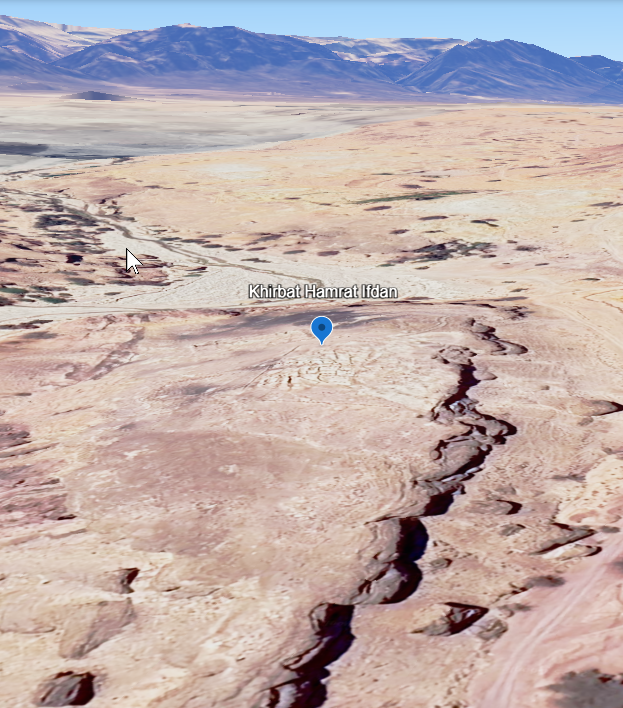 Khirbet Hamrat Ifdan in Google Earth
click on image to explore this site on a new tab in Google Earth
| Transliterated Name | Source | Name |
|---|---|---|
| Khirbat Hamrat Ifdan | Arabic |
- parsed from Levy et al. (2002)
The term Feinan refers to the area around Wadi Feinan, which drains into the eastern part of Wadi Arabah c. 50 km south of the Dead Sea and c. 50 km north of Petra. Wadi Feinan is formed of three merged tributaries—Ghuweir, Sheiqar, and Dana—and its westernmost portion, which drains into the Arabah, is called Wadi Fidan. The wadi is mostly a low, broad basin, 100–200 m above sea level, with the upper wadis to the east and southeast rising to over 1,100 m. It is a dry desert climate, with a mean monthly rainfall of 17 mm, falling to 0–0.1 mm in June–September. In the upper reaches of the wadi, juniper and oak trees grow on the lower slopes, while to the west, the sandy edges of the wadi are home to acacia and tamarisk.
Before the Rift Valley was formed, about 30 million years ago, when the Arabian plate started to move northwards in relation to the African plate, Feinan was part of the sedimentary copper deposit of Timna‘-Feinan-Eilat-Abu Khusheiba, which is now divided by Wadi Arabah. The movement of the rift has been about 107 km so far, exactly the present distance between Feinan and Timna‘. Together, they form the largest copper production area in the southern Levant.
The Feinan area has been settled more or less continuously since the Paleolithic period, with intensive exploitation of the copper sources from the beginning of the Early Bronze Age in the mid to late fourth millennium BCE; the latest smelting site so far discovered dates from the late Ayyubid–early Mameluke period. Surveys and excavations have investigated copper mines, smelting sites, settlements, cemeteries, hydrological and field systems, and Byzantine churches. The huge mound at the center of the area, Khirbet Feinan, has not been excavated: its visible stone ruins, including a large central rectangular structure, other buildings, and streets, appear to date to the Roman–Byzantine periods.
Feinan is mentioned twice in the Bible, as one of the tribes of Edom (Pinon, Gen. 36:41) and as a road station probably in Wadi Arabah (Punon/ Pinon, Num. 33:42–43). It is possible that pwnw in the inscriptions of Ramesses II in the thirteenth century BCE, referring to a region inhabited by Shasu nomads, should be identified with Feinan. In the Roman–Byzantine periods, the area was called Phaino. Eusebius (The Martyrs of Palestine) describes the harsh conditions in the mines of Phaino/Feinan in about 300 CE, where Christians, slaves, and criminals were sent to work. In the Byzantine period, Feinan became the seat of a bishopric under the metropolitan city of Petra within Palaestina Tertia. Its latest known bishop is recorded on a building inscription dated to 587–588 CE.
The first western scholar to relocate the ruins of Feinan and associate them with Pinon and Phaino was M. Lagrange in 1897. A. Musil made the first detailed description of Feinan and its vicinity, following his visit in 1898. In the 1930s, F. Frank and N. Glueck discovered ancient copper-smelting sites north of Wadi Feinan. Geologists and engineers (H. D. Kind, T. D. Raikes) working in the Feinan and Wadi Arabah area in the 1960s and 1970s described ancient mining sites. The Feinan area was included in the wider surveys of G. King and B. MacDonald. Since 1983, the Deutsches Bergbau-Museum, Bochum, has studied ancient copper mining, ore exploitation, and metallurgical technology in Feinan, discovering more than 250 ancient mines. They have traced the development of copper metallurgy at Feinan from the use of copper ores for beads in the Pre-Pottery Neolithic period, through the first intensive use in the Early Bronze Age, to industrial-scale mining and smelting of the Iron Age and Roman–Byzantine periods. A. Hauptmann has calculated approximately 200,000 tons of copper slag (producing a yield of 20,000 tons of copper) in the Feinan district, dating to the Iron Age and Roman–Byzantine periods alone. Their work has managed to distinguish Feinan copper from deposits elsewhere, based on lead isotope ratios, although it is still difficult to distinguish between Feinan and Timna‘ copper. Restricted excavations at Barqa el-Hetiye and Khirbet en-Nuh ̣as were carried out in 1990 (V. Fritz).
A new phase of survey and excavation by the Council for British Research in the Levant began in the mid-1990s. It comprised several multi-disciplinary projects. Their combined aims were to explore long-term land use, human adaptations, and social change; and to integrate geomorphological, paleoecological, archaeological, and hydrological studies to construct a model of landscape and human development for the past 10,000 years in Wadi Feinan. A regional survey of early prehistoric sites (B. Finlayson and S. Mithen) found a wide range of open sites and rock-shelter occupation dated to the Middle Paleolithic and Neolithic periods. There are indications that floodwater farming began in Wadi Feinan already in the Chalcolithic period or in the Early Bronze Age, perhaps using a complex of circular catchments, cairns, and terrace walls, although the principal use of the field system was in the Nabatean and Roman periods, when it is thought that the entire agricultural landscape was managed as a single integrated system. A substantial Iron Age site (Wadi Feinan 424) at the center of the region was associated with a field system of boulder-built walls. The independent Jabal Ḥamrat Fidan Project (T. E. Levy, R. B. Adams, and M. Najjar) has been studying the role of copper ore procurement and early metallurgy and its social context in Wadi Fidan from the Neolithic period to the Iron Age. In 2002, the project renewed excavations at the Iron Age copper-working site of Khirbet en-Nuh ̣as. For later periods, palynology shows that Roman–Byzantine agriculture and mining greatly impacted the Feinan landscape in terms of deforestation; and geochemistry indicates that Roman–Byzantine mining severely polluted the landscape. Industrial pollution had already begun on a small scale in the Early Bronze Age, increased significantly in the Iron Age and the Nabatean period, and intensified dramatically in the Roman period. Its effects are still apparent in the modern ecology of the area.
Archaeological excavation and the radiocarbon dating of fifty-two samples have made it possible to trace the exploitation of the ore deposit over a period of nine thousand years. The earliest settlements belonged to the Pre-Pottery Neolithic period, when copper ores ("greenstones") were utilized for making beads and for cosmetic purposes. The ores were traded as far as 'Ain Ghazal in Transjordan and Jericho in ancient Palestine. Samples of pure copper ores have also been found at Tell Wadi Feinan (sixth/fifth millennium), some 2 km (1 mi.) west of the ruins of Feinan. Pyrometallurgy developed in the middle of the fourth millennium. Metal was smelted on a small scale inside of settlements ("household metallurgy"). High-grade secondary ores were used that left only very small amounts of slag. Copper ore was also traded to Abu Matar, Shiqmim, Wadi Ghazzeh, and Tell Maqass/'Aqaba, where it was smelted inside the Chalcolithic settlements.
At Feinan, mining and smelting peaked in the Early Bronze Age II—III (first half of the third millennium). New technologies, such as the use of manganese oxide for fluxing, increased the exploitation of ores considerably. Twelve slag heaps in the area of Feinan point to a large-scale copper production that was the basis for the export of metal to cities in the Levant. The survey produced only sparse evidence for metal production there in the Middle Bronze Age. As at Timna', production increased again in the Late Bronze Age. Excavations at Barqa el-Hetiye/Feinan revealed Midianite pottery from the thirteenth/twelfth centuries BCE.
Innovations in mining and smelting developed during the Iron Age IIB and IIC, and copper was produced on an industrial scale. The industry was organized by the Edomite towns on the Jordanian plateau, such as Buseirah and Umm el-Biyara. Remote parts of the ore deposit were made accessible by sinking shafts as deep as 70 m. Smelting was concentrated at two major centers—at Khirbet en-Nahas ("ruins of copper") and at Feinan—and led to the formation of the largest slag heaps in the southern Levant. This copper boom, which is paralleled in other copper districts in the Old World, arose in a period when the popularity of iron and steel increased.
Major mining activity resumed centuries later, in the Roman period (first century BCE—fifth century CE). By then the richest minerals appear to have been so completely exhausted that the Romans had to resort to low-grade copper ore. The church fathers Eusebius and Hieronymus (see Geerlings, 1985) describe the cruelty of the work in the mines of Feinan (" damnatio ad metallam"). One of the most impressive technological monuments is the mine at Umm el-Amad (6,600 sq m), some 15 km. (9 mi.) south of Feinan. It is the only complete mine known from the Roman period. The Romans transported the ore over a distance of 12 km. (7 mi.) to a central site located very close to the ruins of Byzantine Feinan. The large amount of metal produced here is demonstrated by the 50,000-70,000 tons of slag left behind.
After 500 CE, Feinan's role as a major copper supplier in the southern Levant ended; however, textual evidence and the remains of churches and a monastery indicate that the town maintained a certain importance as the bishop's see in the Early Byzantine period. In the Mamluk period, some minor mining and smelting activities took place there.
The copper produced at Feinan throughout history is characterized by a low trace-element content—except for lead, which sometimes ranges up to the percent level. This indicates that high-purity copper must not necessarily derive from native copper, clearly distinguishing Feinan copper from the copper-arsenic-antimony alloys found at Chalcolithic sites such as Nahal Mishmar, Shiqmim, and Tell Abu Matar. The lead isotope ratios are clearly different from ore deposits in Cyprus, Anatolia, and the Aegean Sea, but it is difficult to distinguish between Timna' and Feinan.
- Khirbet Hamrat Ifdan in Google Earth
Khirbet Hamrat Ifdan in Google Earth
click on image to explore this site on a new tab in Google Earth
| Stratum | Period | Date | Description |
|---|---|---|---|
| I | Iron Age–Islamic | Iron Age to Islamic periods | Represents occupations spanning from the Iron Age through the Islamic periods. |
| II | Early Bronze IV | ca. 2300–2000 BC | Represents the Early Bronze IV occupation of the site. |
| III | Early Bronze III | ca. 2500–2300 BC | Represents the primary occupation of the site during the Early Bronze III. |
| IV | Early Bronze I–II (possible) | Early Bronze I, possibly Early Bronze II | Represents the first use of the site, with a mixture of pottery from the Early Bronze I and possibly Early Bronze II. |
Large-scale excavations were carried out at Khirbat Ḥamrat Ifdān (KHI; 30°39′41″ N, 35°23′33″ E) in 1999 and 2000 (Levy et al. 2002; Muniz 2006). These excavations revealed the best-preserved Early Bronze Age III–IV (EB III–IV; ca. 2500–2000 BC) copper manufactories in the ancient Near East. Thousands of casting moulds (final product and ingot), copper objects, ceramic vessels, and artifacts related to the EBA metallurgical process came to light. Sometime after the EB III occupation at the site, but before the EB IV period (ca. 2300 BC), the site suffered a massive earthquake that effectively sealed over 70 rooms, courtyards, and other architectural features at the site. This “Pompeii effect” has made KHI a unique site in the history of Old World metallurgy and the archaeology of the southern Levant.
The 2011 excavation at KHI had two primary objectives. First, we wanted to further clarify the stratigraphy from past seasons at KHI. Second, we sought to provide a basis for the regeneration and new geo-referencing of the spatial data collected during past seasons. In order to meet our first objective we planned a small probe with a 1 meter wide baulk adjacent to what was identified as Area H in the 1999 and 2000 seasons (Fig. 9). Based on the results of this season’s excavation, we confirmed the division of the site into four strata.
| Stratum | Period | Date | Description |
|---|---|---|---|
| I | Iron Age–Islamic | Iron Age to Islamic periods | Represents occupations spanning from the Iron Age through the Islamic periods. |
| II | Early Bronze IV | ca. 2300–2000 BC | Represents the Early Bronze IV occupation of the site. |
| III | Early Bronze III | ca. 2500–2300 BC | Represents the primary occupation of the site during the Early Bronze III. |
| IV | Early Bronze I–II (possible) | Early Bronze I, possibly Early Bronze II | Represents the first use of the site, with a mixture of pottery from the Early Bronze I and possibly Early Bronze II. |
The second objective was initiated using our aerial photography system, coupled with GPS and Total Station readings at the site. Once all of the spatial data has been integrated with aerial imagery taken during the 2011 season, the complete KHI dataset will be ready for more detailed spatial analysis.
The 2011 excavations at KHI took place over nine days of work at the site using the ELRAP recording system (Levy and Smith 2007). Unlike the earlier large-scale excavation, every locus was sieved completely so as to try to retrieve as much excavated material as possible, especially lithics. One artifact of particular note was a copper axe found sealed under the upper layer of mud-brick collapse (Fig. 8). Below the collapse were layers that contained large amounts of ash. The collapse provides further evidence for the earthquake identified in previous excavation seasons (Levy 2002: 425) (Fig. 9). The copper axe is very similar in form to one of the Khirbat al-Batrāwī copper axes described by L. Nigro (Nigro 2010) and other axes found in past seasons at KHI (Levy et al. 2002). The formal similarity between the axes suggests that KHI was the production site for these axes before distribution to other EB III settlements.
| Effect | Location | Image | Description |
|---|---|---|---|
|
Area Q |
|
- Earthquake Archeological Effects chart
of Rodríguez-Pascua et al (2013: 221-224)
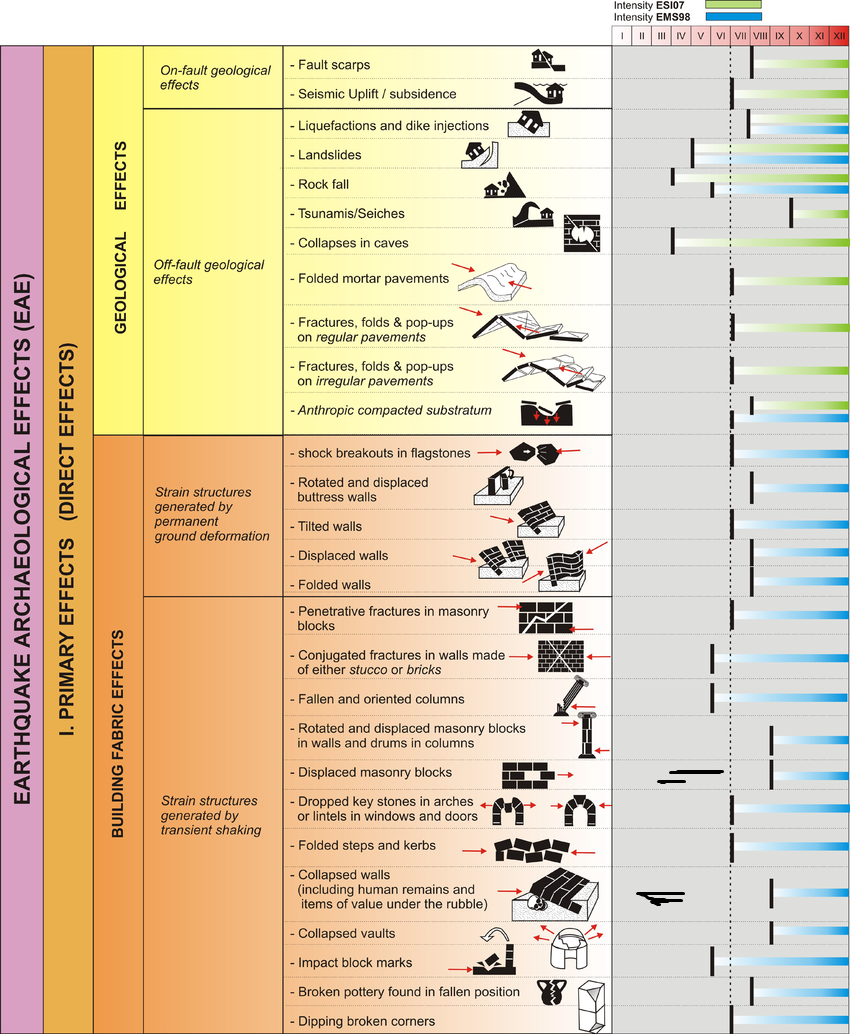 Earthquake Archeological Effects (EAE)
Rodríguez-Pascua et al (2013: 221-224)
| Effect | Location | Image | Description | Intensity |
|---|---|---|---|---|
|
Area Q |
|
|
Barker, G. W., et al. (1998). "Environment and Land Use in the Wadi Faynan, Southern Jordan: the Second Season of Geoarchaeology and Landscape Archaeology (1997)." Levant 30(1): 5-25.
Findlater, G., et al. (1998). "The Wadi Faynan Project: the South Cemetery Excavation, Jordan 1996: a Preliminary Report." Levant 30(1): 69-83.
Finlayson, B. and S. Mithen (1998). "The Dana-Faynan (South Jordan) Epipalaeolithic Project: Report on Reconnaissance Survey, 14–22 April 1996." Levant 30(1): 27-32.
Freeman, P. W. M. and L. M. McEwan (1998). "The Wadi Faynan Survey, Jordan: a Preliminary Report on Survey in Area WF2 in 1997." Levant 30(1): 61-68.
Jenkins, E. (2018). WF16 Excavations at an Early Neolithic site in southern Jordan: stratigraphy, chronology, architecture and burials. - open access
Jones, I. W. N. (2021). "The southern Levantine earthquake of 418/419 AD and the archaeology of Byzantine Petra." Levant: 1-15.
Levy, T. E. et. al. (2012). "The 2011 Edom Lowlands Regional Archaeology Project (Elrap): Excavations and Surveys in the Faynan Copper Ore District, Jordan
Annual of the Department of Antiquities of Jordan 56.
McQuitty, A. (1998). "The Wadi Faynan Project: a Preface." Levant 30(1): 1-3.
Wright, K., et al. (1998). "The Wadi Faynan Fourth and Third Millennia Project, 1997: Report on the First Season of Test Excavations at Wadi Faynan 100." Levant 30(1): 33-60.
Adams, Russel, and Hermann Genz. "Excavations at Wadi Fidan 4: A
Chalcolithic Village Complex in the Copper Ore District of Feinan,
Sotuhern Jordan." Palestine Exploration Quarterly 127 (1995).
Fritz, Volkmar. "Ergebnisse der Grabungen in Barqa el-Hetiya im Gebiet von Fenan, Wadi el-Araba (Jordanien)." Zeitschrift des Deutschen
Palaslina-Vereins (in press).
Geerlings, Willem. "Zum biblischen und historischen Hintergrund der
Bergwerke von Fenan in Jordanien." Der Anschnitt 5-6 (1985): 158-
162.
Hauptmann, Andreas, et al. "Archaometallurgische und bergbauarcha'ologische Untersuchungen im Gebiet von Fenan, Wadi Arabah."
Der Anschnitt 5-6 (1985): 163-195.
Hauptmann, Andreas. "The Earliest Periods of Copper Metallurgy in
Feinan." In Old World Archaeometallurgy, edited by Andreas Hauptmann et al., pp. 119-135. Der Anschnitt, Beiheft 7. Bochum, 1989.
Hauptmann, Andreas, et al. "Early Copper Produced at Feinan, Wadi
Araba, Jordan: The Composition of Ores and Copper." Archeomaterials 6.1 (1992): 1-33.
Hauptmann, Andreas, et al. "Chalcolithic Copper Smelting: New Evidence from Excavations at Feinan/lordan." Proceedings of the 29th
International Conference on Archeometry. Ankara, 1995.
Knauf, E. Axel, and C. J, Lenzen. "Edomite Copper Industry." In
Studies in the History and Archaeology of Jordan, vol. 3, edited by
Adnan Hadidi, pp. 83-88. Amman, 1987.
Najjar, Mohammed, et al. "Tell Wadi Feinan: The First Pottery Neolithic
Tell in Southern Jordan." Annual of the Department of Antiquities of Jordan 34 (1990): 27-56.
R. Adams, The Development of Copper Metallurgy during the Early Bronze Age of
the Southern Levant: Evidence from the Faynan Region, Southern Jordan (Ph.D. diss.), Sheffield 1999
A.
Hauptmann, Zur frühen Metallurgie des Kupfers in Fenan, Jordanien (Der Anschnitt Beiheft 2
Veröffentlichungen aus dem Deutschen Bergbau-Museum 87), Boxhum 2000
ibid. (Review) Paléorient 27/1 (2001),
195–197
B. de Vries, AJA 96 (1992), 510–512
H. Hauptmann, Archeometallurgia: Ricerche e prospettive:
Atti del Colloquio Internazionale di Archeometallurgia, Bologna-Dozza Imolese, 18–21.10.1988. (ed. E.
Antonacci Sanpaolo), Bologna 1992, 145, 265
id. (et al.), Archeomaterials 6/1 (1992)
id. (& G. Weisgerber), SHAJ 4 (1992), 61–66
id., BASOR 314 (1999), 1–17
id. (et al.), Paléorient 26/2 (2000), 113–130
E.
A. Knauf, ABD, 2, New York 1992, 780–782
B. MacDonald, The Southern Ghors and Northeast ‘Arabah
Archaeological Survey (Sheffield Archaeological Monographs 5), Sheffield 1992
1–33
T. Engel, Vegetation
History and Archaeobotany 2 (1993), 205–211
id., AJA 98 (1994), 529
S. Shalev, Antiquity 68/260 (1994),
630–637
S. I. Ruben, Levant 28 (1996), 213–214
id. (et al.), ADAJ 41 (1997), 433–452
G. W. Barker et
al., Levant 29 (1997), 19–40
30 (1998), 5–25
31 (1999), 255–292
32 (2000), 27–52
R. Khouri, Jordan
Antiquity Annual, 1, Amman 1997, nos. 20–21
2, Amman 1998, nos. 61–63
A. McQuitty, AJA 101 (1997),
497–498
id., Levant 30 (1998), 1–3
K. I. Wright, ibid. 29 (1997), 253–255
H. A. Mohamed & C. O. Hunt,
AJA 102 (1998), 573–574
Z. Zayadine, NEAS Bulletin 43 (1998), 25–26
G. Findlater, PEQ 131 (1999), 200;
F. B. Pyatt et al., JAS 27 (2000), 771–778
Science News 158/18 (2000), 280
R. Gophna & I. Milevski, TA
30 (2003), 222–231
C. S. Ehrlich, ASOR Annual Meeting 2004, www.asor.org/AM/am.htm
H. D. Kind et
al., Levant 37 (2005), 169–195.
K. Wright et al., Levant 30 (1998), 33–60.
V. Fritz, ZDPV 110 (1994), 125–151
112 (1996), 1–9
id., Beer Sheva 15 (2002), 93–102
P. Bienkowski,
The Land That I Will Show You: Essays on the History and Archaeology of the Ancient Near East (J. M.
Miller Fest.
JSOT Suppl. Series 343
eds. J. A. Dearman & M. P. Graham), Sheffield 2001, 198–213
T. E.
Levy et al., ADAJ 47 (2003), 247–277
id., Antiquity 78/302 (2004), 865–879
Artifax 20/1 (2005), 5
BAR
31/3 (2005), 14
I. Finkelstein, TA 32 (2005), 119–125.
- download these files into Google Earth on your phone, tablet, or computer
- Google Earth download page
| kmz | Description | Reference |
|---|---|---|
| Right Click to download | Master kmz file | various |