Open this page in a new tab

Jerusalem - Temple Mount

The Holyland Model of Jerusalem depicts Jerusalem during the late Second Temple period. The Temple Mount and Herod's Temple are shown in the middle. View from the east.

Click on image to open a high res version in a new tab

Berthold Werner - Wikipedia - Public Domian


Transliterated Name Language Name
Temple Mount
Jerusalem's holy esplanade
Har haBayīt Hebrew הַר הַבַּיִת‎
Haram esh-Sharif Arabic الحرم الشريف‎
Introduction
Chat GPT Summary

The Temple Mount is a monumental platform in the Old City of Jerusalem that has served for millennia as one of the most significant religious and historical sites in the world. In antiquity, it housed the First Temple, traditionally attributed to Solomon, and later the Second Temple, extensively rebuilt during the reign of Herod the Great. The mount is enclosed by massive retaining walls, including the well-known Western Wall, and has been the focal point of Jewish ritual life, pilgrimage, and national memory. Archaeologically, the platform represents a layered architectural complex, combining Iron Age foundations, Herodian expansion, Roman-period structures, and later Byzantine and Islamic additions.

Following the destruction of the Second Temple in 70 CE, the Temple Mount underwent several transformations under successive empires. During the early Islamic period, it became the site of the Dome of the Rock and the al-Aqsa Mosque, both of which remain major religious monuments today. The platform continues to be central to Judaism, Islam, and Christianity, and its archaeological landscapes—including subterranean passages, vaulted halls, and adjacent bridge structures such as Wilson’s Arch—reflect a long continuum of construction, destruction, renovation, and reinterpretation. Its religious, cultural, and political significance makes it one of the most sensitive and studied heritage sites in the world.

Jerusalem - Introduction Webpage

Maps and Aerial Views

Maps

General Maps

Normal Size

  • Topographical map of Jerusalem from Stern et al (1993 v. 2)
  • Map of the Old City and its environs from Stern et al (2008)

Magnified

  • Topographical map of Jerusalem from Stern et al (1993 v. 2)
  • Map of the Old City and its environs from Stern et al (2008)

Jerusalem in different periods

Normal Size

  • Fig. 2 - Map of Iron Age Jerusalem from Finkelstein et. al. (2011)
  • Map of Jerusalem at the end of the First Temple period from Stern et al (1993 v. 2)
  • Map of Jerusalem at the end of the Second Temple period from Stern et al (1993 v. 2)
  • Map of Jerusalem in the Roman period from Stern et al (1993 v. 2)
  • Map of Jerusalem in the Byzantine period from Stern et al (1993 v. 2)
  • Map of Jerusalem in the Early Arab period from Stern et al (1993 v. 2)
  • Map of Jerusalem in the Crusader period from Stern et al (1993 v. 2)

Magnified

  • Fig. 2 - Map of Iron Age Jerusalem from Finkelstein et. al. (2011)
  • Map of Jerusalem at the end of the First Temple period from Stern et al (1993 v. 2)
  • Map of Jerusalem at the end of the Second Temple period from Stern et al (1993 v. 2)
  • Map of Jerusalem in the Roman period from Stern et al (1993 v. 2)
  • Map of Jerusalem in the Byzantine period from Stern et al (1993 v. 2)
  • Map of Jerusalem in the Early Arab period from Stern et al (1993 v. 2)
  • Map of Jerusalem in the Crusader period from Stern et al (1993 v. 2)

Aerial Views

Normal Size

  • Jerusalem's Temple Mount in Google Earth
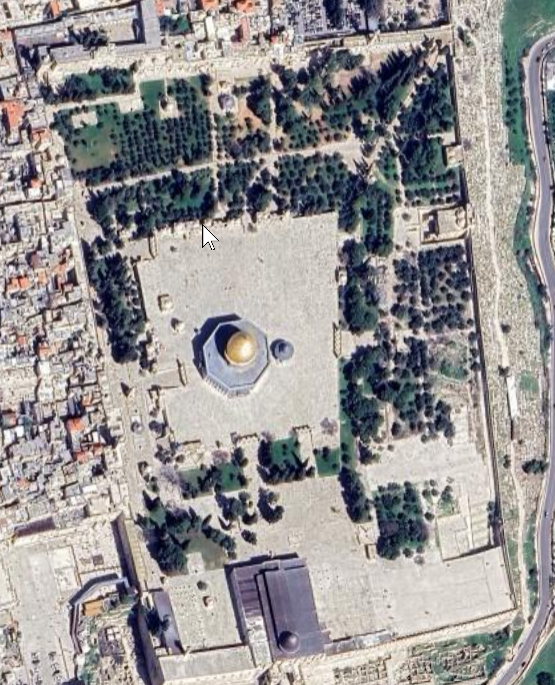
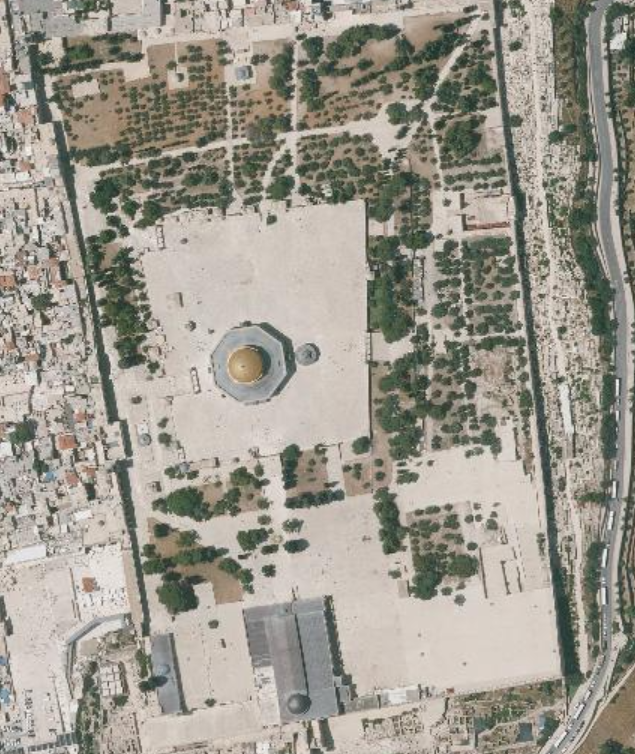
  • Jerusalem's Temple Mount on govmap.gov.il
Magnified

  • Jerusalem's Temple Mount in Google Earth
  • Jerusalem's Temple Mount on govmap.gov.il

Textual Chronology
Crucifixion Quake - 26-36 CE

Discussion

Discussion

363 CE Earthquake

Discussion

Discussion

Textual Seismic Effects
Crucifixion Quake - 26-36 CE

Effect                               Location Image Description
  • Broken Lintel
2nd Temple
  • "And the veil of the temple was torn in two from top to bottom" - Gospel of Mark

  • "And, behold, the veil of the temple was rent in twain from the top to the bottom; and the earth did quake, and the rocks rent" - Gospel of Matthew

  • "The sun was darkened, and the veil of the temple was torn down the middle." - Gospel of Luke

  • "In the gospel we often mention we read that the immense Temple lintel fell and broke into pieces" - Gospel of the Hebrews

  • "In like manner, the Gospel of the Nazarenes says that at the death of Christ the Temple lintel of great size was broken" - Gospel of the Hebrews

363 CE Earthquake

Effect                               Location Image Description
  • Collapsed Walls (stones of foundations collapsed)
  • Foundation Damage
  • Fatalities
  • Injuries
  • Fire
Temple Mount
Descriptions

  • "fearful balls of fire burst forth with continual eruptions close to the foundations, burning several of the workmen and making the spot altogether inaccessible. And thus the very elements, as if by some fate, repelling the attempt, it was laid aside." - Ammianus Marcellinus

  • " a mighty earthquake tore up the stones of the old foundations of the temple and dispersed them all together with the adjacent edifices. Terror consequently possessed the Jews on account of the event; and the report of it brought many to the spot who resided at a great distance: when therefore a vast multitude was assembled, another prodigy took place. Fire came down from heaven and consumed all the builders' tools: so that the flames were seen preying upon mallets, irons to smooth and polish stones, saws, hatchets, adzes, in short all the various implements which the workmen had procured as necessary for the undertaking; and the fire continued burning among these for a whole day. ... thus was the temple, instead of being rebuilt, at that time wholly overthrown" - Socrates Scholasticus

  • "the Jews themselves were impelled by the consideration that the time had arrived for rebuilding their temple. When they had removed the ruins of the former building, they dug up the ground and cleared away its foundation; it is said that on the following day when they were about to lay the first foundation, a great earthquake occurred, and by the violent agitation of the earth, stones were thrown up from the depths, by which those of the Jews who were engaged in the work were wounded, as likewise those who were merely looking on. The houses and public porticos, near the site of the temple, in which they had diverted themselves, were suddenly thrown down; many were caught thereby, some perished immediately, others were found half dead and mutilated of hands or legs, others were injured in other parts of the body. ... some maintain that flame burst from the interior of the temple, as the workmen were striving to force an entrance, while others say that the fire proceeded directly from the earth." - Sozomen

  • "Then first came a great earthquake, fit to strike terror into the hearts of men quite ignorant of God's dealings; and, when still they were not awed, fire running from the excavated foundations burnt up most of the diggers, and put the rest to flight. Moreover when a large number of men were sleeping at night in an adjacent building it suddenly fell down, roof and all, and crushed the whole of them." - Theodoret of Cyrus

  • "during the night there was such a mighty earthquake that the ancient foundation stones of the temple flew up, and all of them scattered by the intensity of the earthquake. Also the houses that were near the place were uprooted, and the news of the ruin spread out in the whole land. Then in another day, fire fell down from the sky, destroying all the work of the architects, masons, and all kinds of instruments of work. One could see the hammers, tongs, axes, and hatchets, and in short all the work that had been prepared by them for the building was burning in the fiery blaze; the fire burnt the instruments throughout the entire day." - Pseudo-Dionysius of Tell-Mahre

  • "while they had still only laid bare the foundations, fire issued forth from them and destroyed those on the site. The fire consumed the building (operations) and destroyed them" - Chronicon Anonymum Ad Annum 846

  • "The Jews obtained permission to rebuild the Temple in Jerusalem and to make sacrifices there. They brought about 3,000 modius (?) of lime. A strong wind blew through the air; the earth shook; the stones of the old foundations arose; fire came down from the sky and devoured the levers, axes and all tools of the trade." - Michael the Syrian

Textual Intensity Estimates
Crucifixion Quake - 26-36 CE

Effect                               Location Image Description Intensity
  • Broken Lintel (equivalent to arch damage)
2nd Temple
  • "And the veil of the temple was torn in two from top to bottom" - Gospel of Mark

  • "And, behold, the veil of the temple was rent in twain from the top to the bottom; and the earth did quake, and the rocks rent" - Gospel of Matthew

  • "The sun was darkened, and the veil of the temple was torn down the middle." - Gospel of Luke

  • "In the gospel we often mention we read that the immense Temple lintel fell and broke into pieces" - Gospel of the Hebrews

  • "In like manner, the Gospel of the Nazarenes says that at the death of Christ the Temple lintel of great size was broken" - Gospel of the Hebrews
  • VI+
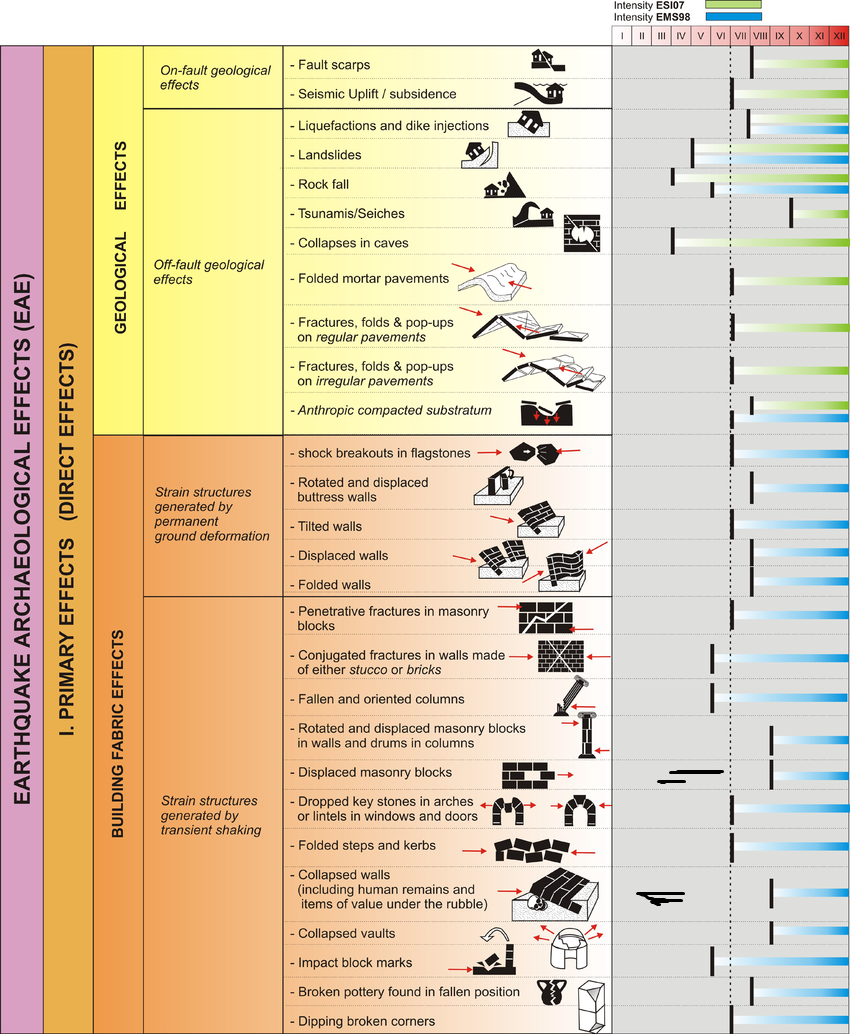
The archeoseismic evidence requires a minimum Intensity of VI (6) when using the Earthquake Archeological Effects chart of Rodríguez-Pascua et al (2013: 221-224). Temple Mount may be subject to a site effect due to a low shear velocity fill underneath the large Herodian paving stones.

363 CE Earthquake

Effect                               Location Image Description Intensity
  • Collapsed Walls (stones of foundations collapsed)
  • Foundation Damage
  • Fatalities
  • Injuries
  • Fire
Temple Mount
Descriptions

  • "fearful balls of fire burst forth with continual eruptions close to the foundations, burning several of the workmen and making the spot altogether inaccessible. And thus the very elements, as if by some fate, repelling the attempt, it was laid aside." - Ammianus Marcellinus

  • " a mighty earthquake tore up the stones of the old foundations of the temple and dispersed them all together with the adjacent edifices. Terror consequently possessed the Jews on account of the event; and the report of it brought many to the spot who resided at a great distance: when therefore a vast multitude was assembled, another prodigy took place. Fire came down from heaven and consumed all the builders' tools: so that the flames were seen preying upon mallets, irons to smooth and polish stones, saws, hatchets, adzes, in short all the various implements which the workmen had procured as necessary for the undertaking; and the fire continued burning among these for a whole day. ... thus was the temple, instead of being rebuilt, at that time wholly overthrown" - Socrates Scholasticus

  • "the Jews themselves were impelled by the consideration that the time had arrived for rebuilding their temple. When they had removed the ruins of the former building, they dug up the ground and cleared away its foundation; it is said that on the following day when they were about to lay the first foundation, a great earthquake occurred, and by the violent agitation of the earth, stones were thrown up from the depths, by which those of the Jews who were engaged in the work were wounded, as likewise those who were merely looking on. The houses and public porticos, near the site of the temple, in which they had diverted themselves, were suddenly thrown down; many were caught thereby, some perished immediately, others were found half dead and mutilated of hands or legs, others were injured in other parts of the body. ... some maintain that flame burst from the interior of the temple, as the workmen were striving to force an entrance, while others say that the fire proceeded directly from the earth." - Sozomen

  • "Then first came a great earthquake, fit to strike terror into the hearts of men quite ignorant of God's dealings; and, when still they were not awed, fire running from the excavated foundations burnt up most of the diggers, and put the rest to flight. Moreover when a large number of men were sleeping at night in an adjacent building it suddenly fell down, roof and all, and crushed the whole of them." - Theodoret of Cyrus

  • "during the night there was such a mighty earthquake that the ancient foundation stones of the temple flew up, and all of them scattered by the intensity of the earthquake. Also the houses that were near the place were uprooted, and the news of the ruin spread out in the whole land. Then in another day, fire fell down from the sky, destroying all the work of the architects, masons, and all kinds of instruments of work. One could see the hammers, tongs, axes, and hatchets, and in short all the work that had been prepared by them for the building was burning in the fiery blaze; the fire burnt the instruments throughout the entire day." - Pseudo-Dionysius of Tell-Mahre

  • "while they had still only laid bare the foundations, fire issued forth from them and destroyed those on the site. The fire consumed the building (operations) and destroyed them" - Chronicon Anonymum Ad Annum 846

  • "The Jews obtained permission to rebuild the Temple in Jerusalem and to make sacrifices there. They brought about 3,000 modius (?) of lime. A strong wind blew through the air; the earth shook; the stones of the old foundations arose; fire came down from the sky and devoured the levers, axes and all tools of the trade." - Michael the Syrian

  • VIII+
  • IX+
  • ?
  • ?
  • ?
Foundation damage suggests a minimum Intensity of IX (9). Temple Mount may be subject to a site effect due to a low shear velocity fill underneath the large Herodian paving stones.

Notes and Further Reading
References
Wikipedia pages

Temple Mount

  • from Wikipedia - click link to open new tab


kmz's for Site Visits
kmz's

kmz Description Reference
Right Click to download Master Jerusalem kmz file various