Crucifixion Quake


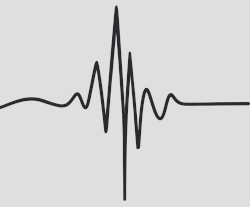
In an
allegorical
passage, the
Gospel of Matthew
describes an earthquake occurring at the moment of Jesus’ death on the cross and another about 36 hours later, just
before the discovery of the empty tomb at
Golgotha. None of the other
canonical
Gospels mention these earthquakes. However, Matthew,
Mark,
Luke
report the tearing of the
curtain of the
Second Temple
at the moment of Jesus’ death. Neither Matthew, Mark or Luke distinguish whether the inner or outer curtain was torn.
A copy of the largely lost and
apocryphal
Gospel of the Hebrews
— reputedly originally composed by
Matthew the disciple
between ~33 CE and ~40 CE — was consulted by
Jerome in 398 CE.
Jerome relates that this gospel states that the
lintel
of the Second Temple broke at the moment of Jesus’ death, implying
that seismic activity caused the damage. Such a failure of the
lintel could account for the tearing of the outer Temple curtain,
something described in the canonical Gospels of Matthew, Mark, and
Luke, although none of these accounts specify whether the inner or
outer curtain was torn. Damage to a lintel is a common seismic
effect, as the lintel is one of the structurally weakest points in
a building.
The
Jerusalem Quake, identified in Dead Sea sedimentary records
and dated by
Williams et al. (2012) to between 26 and 36 CE—that is,
during the prefecture (governorship) of
Pontius Pilate—is further constrained by modeling
work presented by
Williams (2004). That analysis indicates the
Jerusalem Quake was capable of causing damage to the Second Temple during this
interval. This opens two possibilities: either the
Gospel of Matthew preserves the correct timing of a real
earthquake that occurred at the moment of Jesus’ death, or an earthquake that took place within the same
governorship was later chronologically aligned with the
Crucifixion in order to coincide with the narrative of Jesus’
death.