Open this page in a new tab

Mamistra

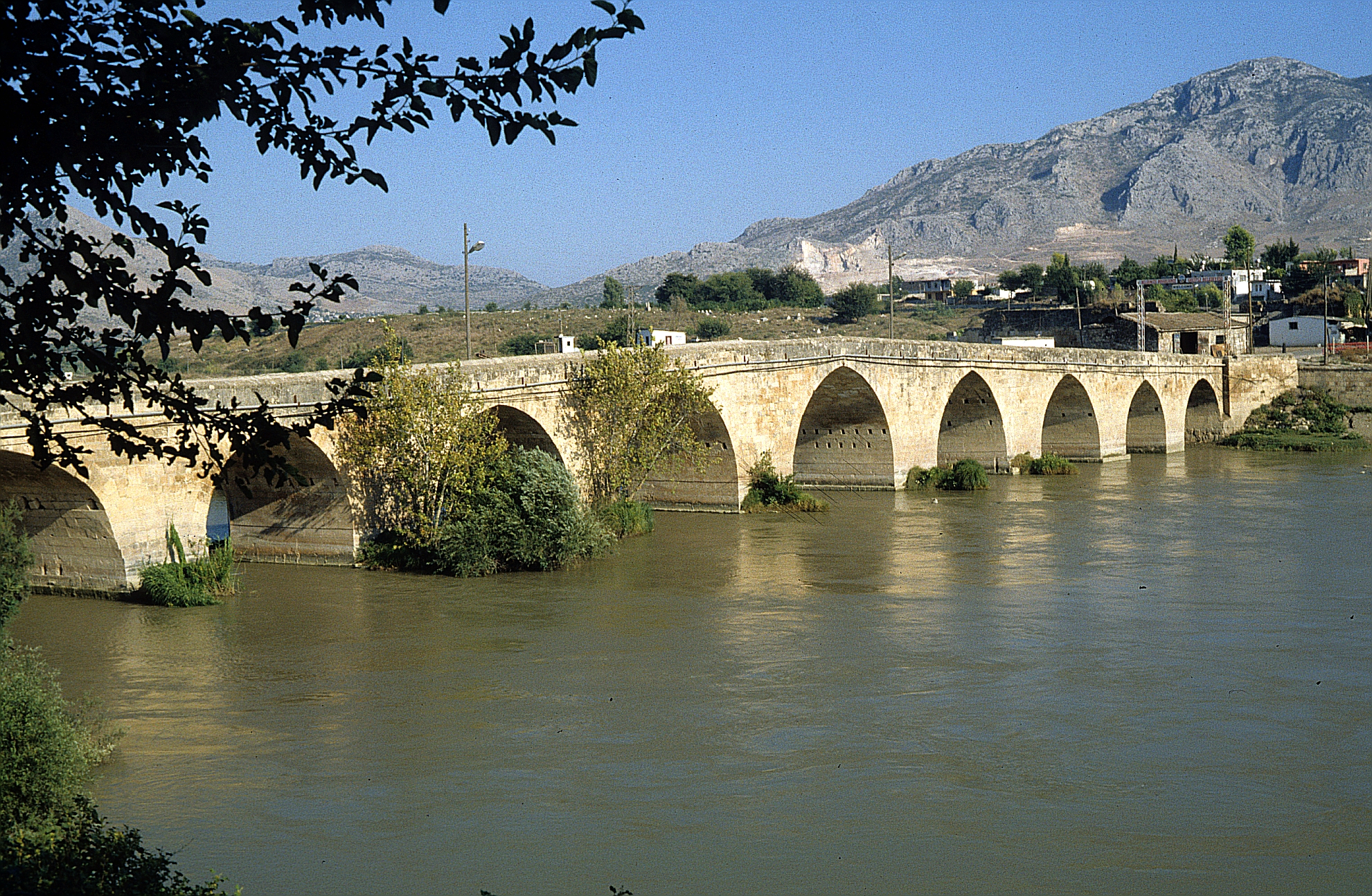
 Roman bridge in Misis-Mopsuestia over the Pyramus River [aka Ceyhan River]

Click on Image to open a higher resolution magnifiable photo in a new tab

Wikipedia - Klaus Peter-Simon - CC BY 3.0


Names
Transliterated Name Source Name
Yakapınar, Yüreğir Modern Turkish
Mamista, Manistra, Mampsista Byzantine Greek
Mopsuestia, Mopsuhestia Greek Μοψουεστία and Μόψου ἑστία
Mopsou Greek Μόψου
Greek Μόψου πόλις
Greek Μόψος
al-Maṣṣīṣah Arabic
Msis, Mises, Missis, Messis, Mam(u)estia Armenian
Introduction
Mopsuestia from The Princeton Encyclopedia of Classical Sites
Aerial Views
Aerial Views

Aerial Views

  • Mamistra in Google Earth

Textual Chronology
13 November 1114 CE Mamistra Earthquake

Discussion

Discussion

29 November 1114 CE Marash Earthquake

Discussion

Discussion

Textual Seismic Effects
13 November 1114 CE Mamistra Earthquake

Effect                                   Location Image(s) Description
  • collapsed walls
Mamistra
  • "on the Ides of November, an earthquake at Mamistra destroyed a part of the city" - Fulcher of Chartres

  • "not long afterwards testimony from the town of Mamistra, previously ruined with its citizens and the greater part of the town on the feast of St Brice [13 Nov. 1114 CE], increased their fear. " - Walter the Chancellor

  • "Then the East was shaken by so tremendous an earthquake that it completely destroyed buildings especially in Cilicia, at Malmistra, and all the fortresses in the surrounding area, and in some places nothing was left standing. Men wandered through the fields fearing that they would be swallowed up by the earth. [JW: Andrea Dandolo appears to have amalgamated the 13 and 29 November earthquakes together]" - Andrea Dandolo

29 November 1114 CE Marash Earthquake

Effect                                   Location Image(s) Description
  • collapsed walls
  • fatalities due to collapsed walls
Mamistra
  • "not long afterwards testimony from the town of Mamistra [regarding the 29 November 1114 CE earthquake], previously ruined with its citizens and the greater part of the town on the feast of St Brice [13 Nov. 1114 CE], increased their fear. " - Walter the Chancellor

  • "on this night Samosata, Hisn-Mansur, Kesoun, and Raban were destroyed. On the other hand, Marash was destroyed in such a frightful manner that as many as forty thousand persons died; it was a populous city and yet not one person survived. The same thing happened to the town of Mamistra, where a countless number of men and women perished." - Matthew of Edessa

  • "A great number of cities were ruined: Antioch collapsed, as well as Mecis [Mamistra], Hisn-Mansur, Kayˇsum, Ablastha, R’aban and Samosata." - Chronicle of Smbat Sparapet

Textual Intensity Estimates
13 November 1114 CE Mamistra Earthquake

Effect                                   Location Image(s) Description Intensity
  • collapsed walls
Mamistra
  • "on the Ides of November, an earthquake at Mamistra destroyed a part of the city" - Fulcher of Chartres

  • "not long afterwards testimony from the town of Mamistra, previously ruined with its citizens and the greater part of the town on the feast of St Brice [13 Nov. 1114 CE], increased their fear. " - Walter the Chancellor

  • "Then the East was shaken by so tremendous an earthquake that it completely destroyed buildings especially in Cilicia, at Malmistra, and all the fortresses in the surrounding area, and in some places nothing was left standing. Men wandered through the fields fearing that they would be swallowed up by the earth. [JW: Andrea Dandolo appears to have amalgamated the 13 and 29 November earthquakes together]" - Andrea Dandolo
  • VIII+
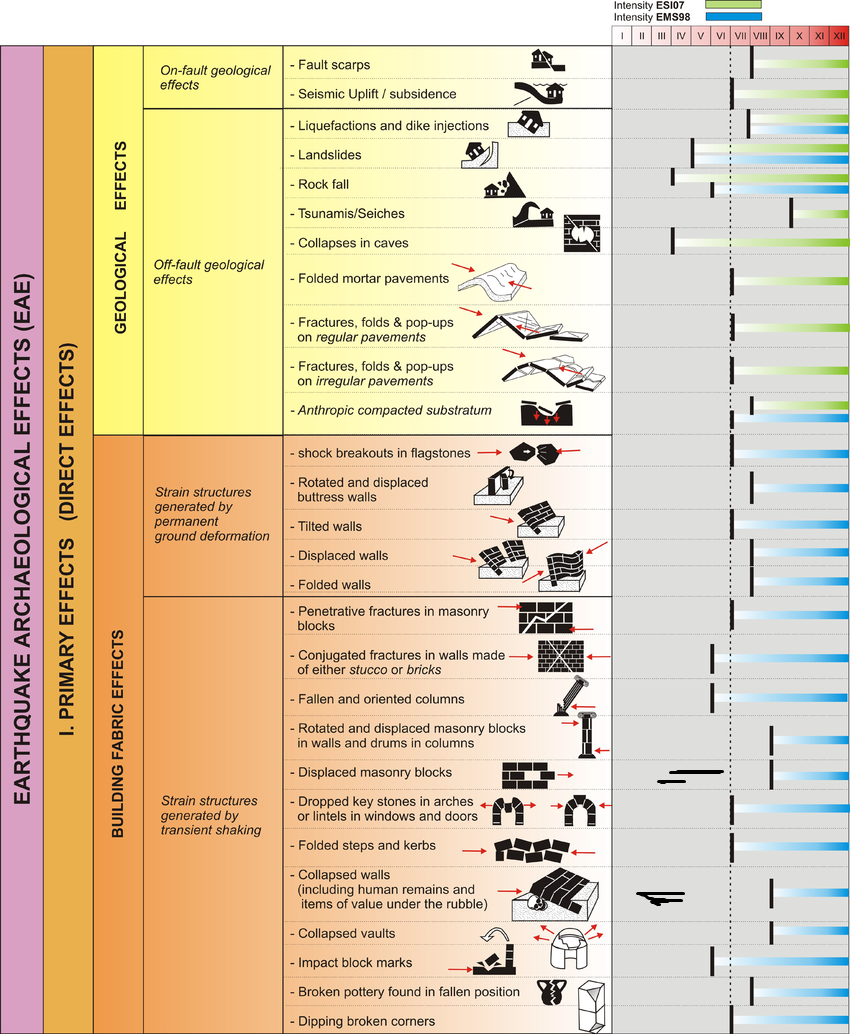
This evidence requires a minimum Intensity of VIII (8) when using the Earthquake Archeological Effects chart of Rodríguez-Pascua et al (2013: 221-224).

29 November 1114 CE Marash Earthquake

Effect                                   Location Image(s) Description Intensity
  • collapsed walls
  • fatalities due to collapsed walls
Mamistra
  • "not long afterwards testimony from the town of Mamistra [regarding the 29 November 1114 CE earthquake], previously ruined with its citizens and the greater part of the town on the feast of St Brice [13 Nov. 1114 CE], increased their fear. " - Walter the Chancellor

  • "on this night Samosata, Hisn-Mansur, Kesoun, and Raban were destroyed. On the other hand, Marash was destroyed in such a frightful manner that as many as forty thousand persons died; it was a populous city and yet not one person survived. The same thing happened to the town of Mamistra, where a countless number of men and women perished." - Matthew of Edessa

  • "A great number of cities were ruined: Antioch collapsed, as well as Mecis [Mamistra], Hisn-Mansur, Kayˇsum, Ablastha, R’aban and Samosata." - Chronicle of Smbat Sparapet
  • VIII+
  • VIII+
This evidence requires a minimum Intensity of VIII (8) when using the Earthquake Archeological Effects chart of Rodríguez-Pascua et al (2013: 221-224).

Notes and Further Reading
References

References from Wikipedia

  1. Harry Thurston Peck, Harpers Dictionary of Classical Antiquities (1898), Mopsuestia
  2. Charlton T. Lewis, Charles Short, A Latin Dictionary, Mopsuestia
  3. Vailhé, Siméon (1911). "Mopsuestia" . Catholic Encyclopedia. Vol. 10.
  4. Normand Robert, La Cilicia. In: Annals of Geography. 1920, vol. 29, No. 162. p.p. 426-451
  5. Missis and its Roman bridge
  6. GREEK ANTHOLOGY, § 9.698
  7. Procopius, On Buildings, §5.5.1
  8. Jump up to: a b Stephanus of Byzantium, Ethnica, § M459.1
  9. Eusebius, Chronography, 97-98
  10. Annuario Pontificio 2013 (Libreria Editrice Vaticana, 2013, ISBN 978-88-209-9070-1), p. 933
  11. Jump up to: a b Edwards, Robert W. (1987). The Fortifications of Armenian Cilicia: Dumbarton Oaks Studies XXIII. Washington, D.C.: Dumbarton Oaks, Trustees for Harvard University. pp. 198–200, 284. ISBN 0-88402-163-7.
  12. Edwards, Robert W., "Mopsuestia" (2016). The Eerdmans Encyclopedia of Early Christian Art and Archaeology, ed., Paul Corby Finney. Grand Rapids, Michigan: William B. Eerdmans Publishing. p. 168. ISBN 978-0-8028-9017-7.{{cite book}}: CS1 maint: multiple names: authors list (link)
  13. Langlois, V. (1861). Voyage dans la Cilicie et dans les montagnes du Taurus, exécuté pendant les années 1852-1853. Paris. p. 451.{{cite book}}: CS1 maint: location missing publisher (link)
  14. Missis and its Roman bridge
  15. Athenaeus, Deipnosophists, §6.234b

Wikipedia pages

Mopsuestia


Mopsucrene


Yakapınar, Yüreğir