Open this text page in a new tab Open earthquake page in a new tab

Article by Neuhauser et al (2021) on the Comet of 760 CE

Introduction and Summary

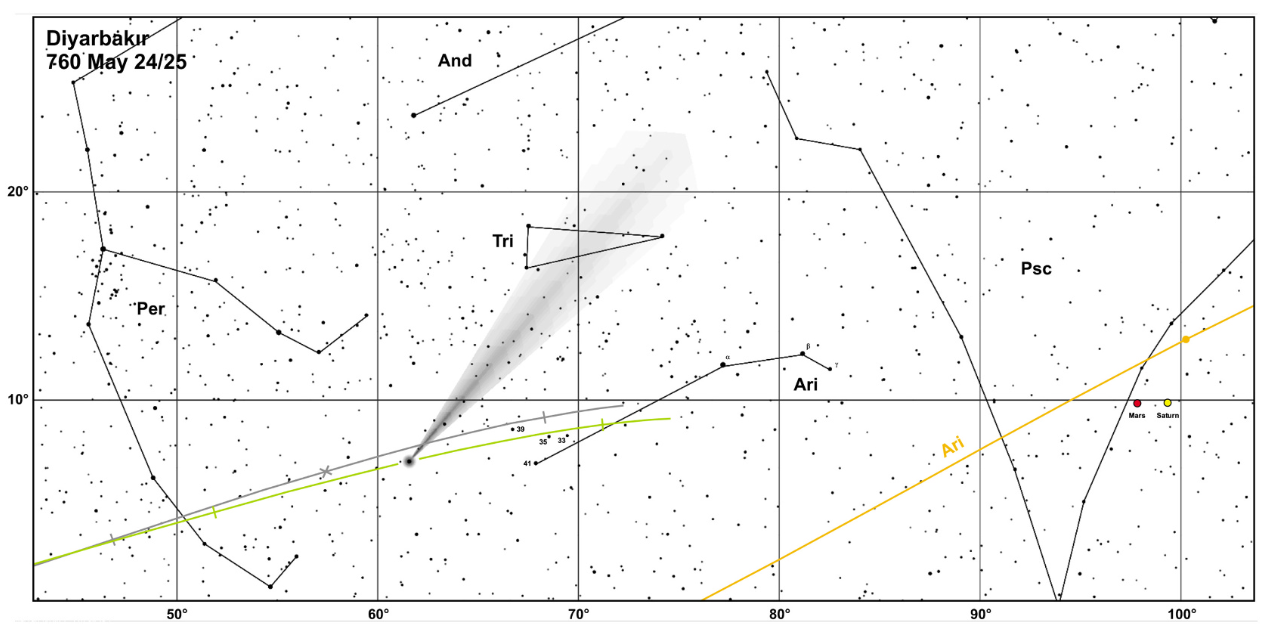
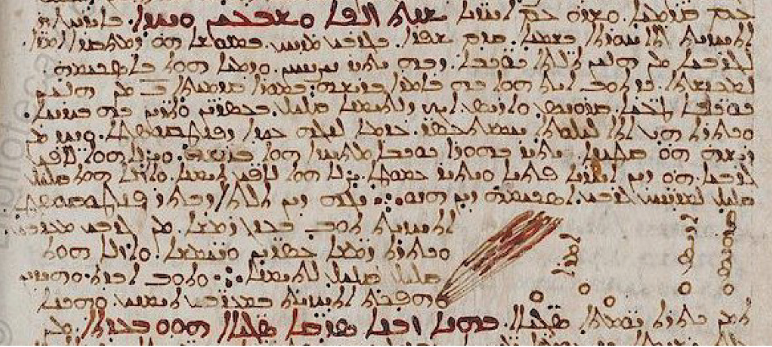
Neuhauser et al (2021) identified Halley's Comet (1P/Halley) as a comet described by Pseudo-Dionysius of Tell-Mahre (Chronicle of Zuqnin), Theophanes, Agapius of Menbj, Nu'aym ibn Ḥammmad, Michael the Syrian, and Chinese, Japanese and Korean sources. They performed astronomical calculations (least squares fitting of Keplerian orbital solutions) to fit "date corrected" historical reports paying close attention to the position and locations of celestial objects described in the sky by Pseudo-Dionysius of Tell-Mahre and Chinese sources. Despite chronological inconsistencies (month and year) among the sources (possibly due to scribal errors) which they had to "correct", they identified the comet as 1P/Halley and obtained a precise perihelion time (760 May 19.1 ± 1.7) and an inferior conjunction between the comet and Sun (June 1.8) which is about one day different from a previously published orbit (760 May 31.9, Yeomans and Kiang, 1981). Based on their orbital model, philological arguments, and the way the drawing is embedded in the text, Neuhauser et al (2021:7) suggest that Pseudo-Dionysius drew the comet, 3 stars (Ari aka Aries), and two planets (Mars and Saturn) from an observation made in the early morning (~3 am ?) on 25 May 760 CE. Their reconstruction of the night sky when and where they suggest the comet was drawn is shown below (Fig. 2) along with a reproduction of the drawing and text by Pseudo-Dionysius (Fig. 1).
Night Sky Ps. Dion. 25 May 760 CE

Fig. 2 - A comparison with Fig. 1 shows that the original drawing is for a date around 760 May 25 in the early morning (2:40 h local time, 0 h UT): both Sun (NE) and Moon were under the horizon at that time, 1P/Halley was ~7° above the NE horizon. IAU constellations are indicated in black, the ecliptic in orange with dots at the borders of zodiacal signs. The planets Mars (0.7 mag, red dot) and Saturn (0.5 mag, yellow dot) are still close to each other. The position of the comet is indicated on our own new (green) orbit (and as grey cross on the old orbit, JPL, YK81); both orbits start on May 17. The drawing (Fig. 1) was not used for orbital reconstruction. Here and in all other figures, the comet plasma tail pointing away from the Sun is displayed, while observation and drawing regard the dust tail. This and all other such figures are drawn with Cartes du Ciel (v3.10).

Ps. Dion. text with the comet

Fig. 1 - Syriac text and drawing: The relevant Syriac text from the Chronicle of Zuqnın (finished AD 775/6) on the comet AD 760 (1P/Halley) – from the middle of the first line shown to the middle of the last line – with a drawing embedded in the text (Vatican Library, Vat. Syr. 162, folio 136v): the comet to the left, the three brightest stars of Aries (α, β, and γ Aries) in the center, and the planets Mars and Saturn as Ares and Kronos to the right, as identified in the Syriac caption. The drawing fits best for around May 25 given the relative position of Ares/Mars east (left) of Kronos/Saturn, both west of Aries. See Fig. 2 for a comparison with a computed position of 1P/Halley for May 25 at 0 h UT.

Background and Biography
Background and Biography - Pseudo Dionysius of Tell-Mahre author of the Chronicle of Zuqnin

Background and Biography - Theophanes

Background and Biography - Nu'aym ibn Ḥammmad

Background and Biography - Agapius of Menbij

Background and Biography - Michael the Syrian

Excerpts
Literal English Translation of the Chronicle of Zuqnin from Neuhauser et al (2018)

The year [SE] one thousand seventy one (AD 759/760).
In the month of iyyōr (May)5 a white sign was seen in the sky,
before early twilight (Syriac: šafrō), in the north-east [quarter],
in the Zodiac [sign] which is called Aries (emrō), to the north from these three stars (kawkbē) in it, which are very shining.
And it resembled in its shape a broom, while it was still in the same Aries (emrō) at its edge/end/furthest part (rīšeh)6:
in/at the initial degree (mūrō)7 [of] the second8 [sign] (i.e. Taurus) from these wandering stars (kawkbē), Kronos (Saturn) and Ares (Mars), like somehow a bit to the south, on [day] 22 in the same month.
And the sign itself remained for fifteen nights, until dawn (nōgah)9 of the feast of Pentecost.
And [at] its one end/tip (rīšōh), the narrow one, a very bright star (kawkbō) was seen at its head/end/tip (rīšeh).10 And it was tilting to the north side, but the other wide and very dark one was tilting to the south side,
and it was going bit by bit to the North-East [direction].
Its shape is as follows [now 4 points forming a rhomb meant as pointing to the drawing, which is embedded in the next lines, Fig. 1].
However, at the beginning (nōgah)11 of [the] third [day] after Pentecost, it was seen again at evening time, from the north-west [quarter].
and it remained for twenty-five evenings.
And it was going bit by bit to the south:: [actually 4 points forming a rhomb meant here as a break].
And it again disappeared.
And then it returned [and] was seen in the south-west12 [quarter],
and thus there it remained for many days.
Footnotes

5 Chabot (1895), Harrak (1999), and Hayakawa et al (2017) read "adar/odor” and gave “March” here (“odor” is the correct West-Syrian transliteration here, while “adar” is East-Syrian); in Syriac, the words for March (odor) and May (iyyor) are written very similar: ‘DR and ‘YR, respectively. We came to the conclusion that iyyor is given here in the MS:

  1. epigraphically, the Syriac letter /d/ (as in odor) should have a tail, which is not found in the MS

  2. there is no space between /y/ and the following /r/, the two letters are ligatured, but if it were /d/ (as in odor) there should be a space (as seen in all occurrences of this letter in the month name ‘DR = odor)

  3. because of a dot underneath the /y/, the letter was thought to be /d/, i.e. reading ‘DR = odor, however, in five occurrences of the month name ‘YR in the MS, four do not have this diacritical dot, one (folio 150v) has it as a thick one, which should be thin – the chronicler was by no means consistent in using diacritics and symbols. Michael the Syrian also gives iyyor as month of the first sighting (Section 4d).

6 The Syriac word rıseh mainly means “its head”, but “its tip, its edge, its end, its furthest part” etc. and such meanings are also attested in dictionaries (e.g. Sokoloff, 2002). See below for a discussion of position 2.

7 The Syriac muro from Greek moira for degree is also attested in Ptolemy’s Almagest for degree.

8 Harrak (1999) gave “in the first degree (of the Zodiacal circle), the second”; Hayakawa et al.: “in the first degree (of the sign), two (degrees)”; see below for a discussion of position 2.

9 Chabot: “la veille”; respectively “eve” in Harrak (1999); the comet was seen in the morning, as mentioned before; for nogah, see footnote 11.

10 An alternative translation could be “and its one end/tip, the narrow one, was very bright; a star was seen at its head/end/tip”, but it does not work because in the MS there is a punctuation between qaṭıno (“narrow”) and yatır bahuro (“very bright”). Hayakawa et al. (2017) brings a punctuation in their transliteration that is in many places inconsistent with the autograph, in particular they overlooked the punctuation by translating “And one end of it was narrow and duskier, one star was seen in its tip”, and they confused the meaning by rendering “duskier” instead of “very bright”: the original word bahuro means “dim” in old Syriac, but later also “bright” after Arabic influence; Chabot (1933) emended bahuro into nohuro, which just means “bright”, but this emendation is not necessary; the first letters (/b/ and /n/) are also quite different in Syriac. The translation by Hayakawa et al. (2017) is not satisfactory: “duskier” would be in contrast to the “star” at this end (comet head), and it would not be in contrast to what is later given as “wide and very dark” (the other end); the drawing also clearly shows a “very bright star”, the comet head; see below for our discussion of the drawing.

11 For the Syriac nogah, instead of “beginning”, Hayakawa et al. (2017) gave “dusk”, which is not attested in Syriac dictionaries; the word nogah does mainly mean “dawn” (see above), but this is not possible here, because the observation was in the “evening time”. Harrak (1999) gave “eve”. Our translation “at the beginning” follows oriental calendars, where the 24 h-day begins with sunset, e. g. nogah d-shapto meaning “Sabbath vespers”, which happen in the evening after sunset. In the report on a bolide in AD 754, the Chronicle of Zuqnın gave the timing as “on Tuesday, when Wednesday was dawning (nogah) ... In the same evening ...”, i.e. it uses nogah here for the beginning of the oriental 24 h-day (D.L. Neuhauser et al., 2018b, event 5, p. 77, Harrak, 1999, p. 196).

12 Lit. west southern

English Translation of the Chronicle of Zuqnin from Harrak (1999)

759-760 The year one thousand and seventy-one: In the month of Adar (March), a shining sign was seen in the sky1 before dawn on the northeast side which is called Ram in the Zodiac, to the north of the three most shining stars. Its shape resembled a broom. On the twenty-second day of the month, it was still in the Ram at its head, in the first degree (of the Zodiac circle), the second after the wandering stars Kronos and Ares,2 somehow slightly to the south. The sign remained for fifteen nights, to the eve of the Pentecost feast. At one of its ends, which was narrow and more shining*3 a star was seen and was turning toward the North. The other side, which was large and darker, was turning toward the South. The sign was moving little by little toward the Northeast. This was its form (Vat.sir.162 137r-136v):

Drawing of Comet in 760 CE by Pseudo Dionysius of Tell-Mahre Drawing of Comet in 760 CE by Pseudo Dionysius of Tell-Mahre - redrawn by Harrak Left - original drawing of a comet in 760 CE by Pseudo-Dionysius of Tell-Mahre (Vat.sir.162 137r-136v)

Right - redrawn comet by Harrak (1999:198)


On the eve of the third day after Pentecost*, the sign was seen again in the evening in the Northwest, and it remained for twenty five evenings. It moved little by little to the South and then it disappeared. Then it reappeared in the southwest, where it remained in this way for many days.

During this time, many schisms took place in the church because of leadership. The eastern monasteries made John Patriarch, while neither the cities of the Jazira nor all the monasteries approved him. The people of the West and Mosul approved George. Because of this the entire Church became troubled.4
Footnotes

1 A brief mention in Theophanes 431: A.M. 6252 (760-761).

2 Following Ptolemy, the ancients believed that there were seven "wandering stars", Syriac | | (i.e. planets): The Moon, Mercury, Venus, the Sun, Mars (=Ares), Jupiter and Saturn (= Kronos), all revolving around the earth.

3 | | : See Manna, Dalil, 54, for its meaning.

4 See above pp. 193ff and 216ff.

The comet is referred to later in the text (as 'the broom').
The year one thousand and seventy-five [A.G. 1075 = 1 Oct. 763 to 30 Sept. 764 CE]: A severe plague among horses took place in the whole land. ... This disease spread throughout all the nations and kingdoms of the earth, to the point that people were left without horses. The effect of ’the broom’ seen a short while before, was clearly seen in reality, as it swept the world like a broom that cleans the house.

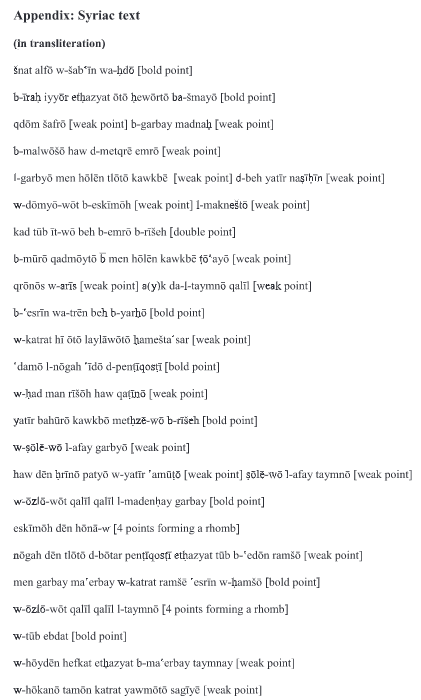
Transliteration of the Chronicle of Zuqnin from Neuhauser et al (2021)

Transliteration of the Chronicle of Zuqnin from Neuhauser et al (2021)

English Translation of Theophanes from Mango and Scott (1997)

[am 6252, AD 759/60]

Constantine, 20th year
Abdelas, 6th year
Paul, 6th year
Constantine, 7th year

... In the same year a very bright comet appeared for ten days in the east and another twenty-one days in the west.b
Footnotes

b Cf. Ps.-Dion. Chron. 63-4, AG 1071.

English Translation of Theophanes from Turtledove (1982)

ANNUS MUNDI 6252 (SEPTEMBER 1, 760— AUGUST 31, 761)

... In the same year a brilliant apparition appeared in the east for ten days, and again in the west for twenty-one.

English Translation of Theophanes from Mango and Scott (1997) - embedded


English Translation of Theophanes from Turtledove (1982) - embedded


English Translation of Nu'aym ibn Ḥammmad from Neuhauser et al (2018)

“We saw the comet rising in Muḥarram in the year [Anno Hijra, AH 145 = AD 762/3] with the dawn from the east, and we would see it during the dawn for the rest of Muḥarram; then it disappeared. Then we would see it after the sunset in the twilight, and afterwards between the north and the west for two month or three. Then it disappeared for two or three years.38
Footnotes

38 This report by Nu'aym ibn Ḥammmad then continues with:

Then we saw a mysterious star with blazing fire the length of two degrees, according to what the eye saw, near Capricorn, orbiting around it like the orbit of a planet during the months of Jumada [July] and [some of the] days of Rajab [Oct] and then it disappeared.

(as translated by Cook, 1999 with his additions in brackets, dated by him to AH 145 = AD 762/3)
This and the following reports definitely do not belong to the comet in AD 760.

English Translation of Agapius of Menbij from Neuhauser et al (2018)

In this year [ AD 760] the star with a tail appeared, and it was in Aries before the Sun, and the Sun was in Taurus. It proceeded until it was under the rays of the Sun, then went behind it and stayed 40 days. (Cook, 1999; Vassiliev, 1911)

English Translation of Agapius of Menbij from Vasilev (1909) and Cook (1999)

In this same year, a comet [appeared]. It was in Aries, in front of the sun, when the sun was in Taurus. It went on until it came beneath the rays of the sun; then it went behind and remained for forty days.
In this year the star with a tail appeared, and it was in Aries before the sun, and the sun was in Leo. It proceeded until it was under the rays of the sun, then went behind it and stayed 40 days23.
Footnotes

(23) I can't find the footnotes in this article.

Cook (1999:136) notes that this observation is probably from Theophilus of Edessa himself. Neuhauser et al (2021:17) wrote the following about the Sun being in Leo:
Note that Cook (1999) incorrectly gave “and the Sun was in Leo”, while the text clearly gives Taurus, see Vassiliev, 1911.

English Translation of Agapius of Menbij from Vasilev (1909) - embedded


English Translation of Michael the Syrian from Neuhauser et al (2021)

And in this year in the month of iyyor (May), a comet star [kawkbo qumiṭus – the latter obviously from the Greek kometes] was seen before the Sun in Lamb (Aries), when the Sun was in Taurus. It looked like a pillar/column [‘omudo] and was extending its rod40 to the south. It moved close to the Sun for twenty days, and became below the rays of the Sun for three days. Thereafter, it was behind the Sun for forty days. Due to its appearance, fear gripped everyone
Footnotes

40 What is translated as “rod” points to the tail. Chabot translated it as “chevelure”, i.e. “lock of hair” (Chabot, p. 524 n.3). The 16th century Edessan manuscript emended the term sabuqo (“rod”) to sobqo (“emission”), and Chabot interpreted this word as (curled) hair.

English Translation of Chinese Texts from Neuhauser et al (2021)

Understanding historical observations from China - Neuhauser et al (2021:5-6)

In imperial China, court astronomers observed the sky all day and night in order to notice changes2; owing to this practise — among other transients — comets were recorded in observing logs. While the original night reports for the 8th century are not extant, later compilations or copies thereof are available, which are shortened and may suffer from scribal errors. These include: Jiu Tang shu (JTS) by Liu Xu et al. (945) from AD 945, Tang hui yao (THY) by Wang Pu et al. (961) from AD 961, and Xin Tang shu (XTS) by Ouyang Xiu et al. (1061) et al. from AD 1061, i.e. the astronomical chapters of the History of the Tang dynasty (Tang shu), as well as the collection Wenxian tongkao (WHTK) by Ma Duanlin from AD 1317. Extracts for comets were published by Pingre (1783) in French as well as by Hsi (1957, only for 1P/Halley AD 837), Ho (1962, see also Hasegawa, 1980 for comments and additions), Kiang (1972), Xu et al. (2000), and Pankenier et al. (2008), all in English.

For general information about astronomy in imperial China, please refer to the detailed monographs by Needham and Wang (1959) and Sun & Kistemalcer (1997, henceforth SK97), and short summaries also in Kiang (1972), Clark and Stephenson (1977), Stephenson (1994), Xu et al. (2000), Stephenson and Green (2002), and Pankenier et al. (2008).

Since the Han dynasty (206 BC to AD 220), the sky was structured into about 283 asterisms of various sizes with almost 1500 stars in total (down to 6th mag and a few fainter ones, these are of course incomplete); a Chinese asterism3 can contain one, few or many stars; the stars of an asterism were combined by lines (skeletons). While this system had a strong continuity since the Han, some details changed later (not only in Korea and Japan, also in China).

The term zing, often rendered as star(s), can be combined to, e.g. ke zing as guest star(s) or hui zing as broom star(s). Classical Chinese word morphology does not distinguish between singular and plural.

The names of 28 asterisms are also used for the 28 lunar mansions (LM), which are right ascension ranges from the determinative (or leading) star of one LM to the next, omitting the south polar region which was not visible from the Chinese mainland, while the north circumpolar region was of special importance known as the enclosure (yuan) named Ziwei' or Zigong', see Stephenson (1994), SK97, and Ho (2003, p. 144). For a list of the 28 LMs and their determinative stars, see, e.g., SK97, Xu et al. (2000), Stephenson and Green (2002), or Pankenier et al. (2008). Given this equatorial system, hour angles of objects can be given as a certain number of du (0.9856°) East of the respective determinative star.

There also exist Chinese star charts from the time of the Tang dynasty, namely the Dunhuang maps (manuscript Stein 3326 dated AD 649-684 by style of characters, mentioning of an astronomer of that time, style of clothing shown in a figure, and usage of two taboo characters), where more than 1300 stars in 257 asterisms are drawn with skeleton lines, apparently in azimuthal projection (Bonnet-Bidaud et al., 2009).4

Separations on sky including comet tail lengths are given in certain old Chinese linear measures, which can be converted to angles such as 1 chi being about 1° (Stephenson and Green, 2002; Kiang, 1972 gave 1 chi = 1.50 ± 0.24°), 1 can being 0.1 chi, and 1 zhang =10 chi (see Ho, 1966; Kiang, 1972; Wilkinson, 2000; Stephenson and Green, 2002).

Sometimes, in addition to or instead of a celestial position given as one coordinate, angle, or separation, the compilations of observing records list the general direction as azimuth, which can be specified in terms of several different compasses; the precision of the compass used (e.g. 4- or 24-point) then defines the uncertainty or azimuth range of such a position.

The observing dates are specified by name of the emperor, year with a multi-year reign period, lunar month, and then usually the day count in a 60-day-cycle (ganzhi) - a continuous counting was achieved prior to the advent of the imperial period in 221 BC; sometimes, instead of or in addition to the day count (1-60), the age of the Moon is given; the luni-solar calendar had 12 lunar months starting on the second new-moon after winter solstice (i.e. in January or February), plus seven intercalary months in 19 years (called just "x-th intercalary month" located after the "x-th" month), like the Meton cycle; these rules were in use since a calendar reform during the Han.

The normal Chinese 24 h-day ran from midnight to midnight, but in astronomical records, for observations after midnight, the former date is given (some late sources may have modified the date to the new civil date). The night was separated into five watches of equal lengths per night, which changed during the year.

Footnotes

2 Such observations were performed, because it was thought that they identify dangerous political trajectories (astrology, but also weather rules etc., e.g. from the Han dynasty: "320 stars can be named. There are in all 2500 ... All have their influence on fate", Needham and Wang, 1959, p. 265), or can indicate misgovernment ("any anomalous happenings in nature ... were construed as signs of warnings by heaven toward the misbehaviour or misgovernment of the ruler of man", also from the Han, Wang Yiichuan, 1949, Bielenstein, 1984). The dramatic appearance of comet Halley in 12 BC, for example, was interpreted by both Gu Yong and Liu Xiang as a sign that the Western Han dynasty was in danger of collapse; the two writers each identified different court factions as responsible for the peril the dynasty faced, and both held that if the right actions were undertaken the sign would vanish and the dynasty would likely survive; neither writer saw the future as fixed or determined, though both associated it with an elevated likelihood of disastrous political events (Chapman, 2015).

3 Groups of stars (xing cang) were given certain names, which do not normally reflect their appearance on sky, even if connected with skeleton lines; this is similar for Babylonian, Western, and Chinese constellations. To discriminate from Western constellations, Chinese star groups are often called asterism. However, this term derives from the Greek asterismos as was used by Ptolemy in his Almagest for what we now call constellations (now defined as fields on sky by IAU mostly based on Ptolemy's Almagest). Xing qun is the modern Chinese term for constellation; literally, it means group of stars.

4 Stars and asterisms on the 13 charts are drawn only in a crude way with rough positions and several mistakes, e.g. the asterism name Lou in Aries is missing (but the three stars apparently are drawn), the colour-convention for stars is not followed strictly (Chinese charts show the stars and asterisms from three Han dynasty schools in different colour: red for those from Shi Shen, black from Gan De, and white/yellow from Wu Xian), twice the Chinese characters for "right" zuo and "left" you, which are very similar, are mixed up, the asterism Sangong near the pole is shown twice (Bonnet-Bidaud et al., 2009). Given that the maps are drawn on expensive pure mulberry fibres (3940 mm by 244 mm scroll), this atlas may be a copy produced by a wealthy but not well-talented student of Li Chunfeng, one of the main astronomers of the 7th century, who is mentioned in the accompanying text and could have done the (now lost) original map based on observations and/or the astronomical chapters of the Jin shu, which he had written.

The comet of AD 760 as reported in classical Chinese sources - Neuhauser et al (2021:12-14)

We present here our own new, technical, very literal translations, which aim to preserve the detail and word order of the original Chinese, but have been slightly smoothed to present correct English sentences (see appendix for the Chinese texts); significant variants in Ho (1962, no. 273 and 274), Xu et al. (2000), and Pankenier et al. (2008) are mentioned in footnotes. First, we translate the oldest text from JTS (36.1324, and much shorter in 10.258), counted as object no. 273 in Ho (1962), with some Chinese terms, explanations, and significant variants from THY (43.767) and XTS (32.838, unless otherwise specified) in round brackets, our additions in square brackets (e.g. the day/night number in the 60-day-cycle), starting with the night 760 May 16/17, line breaks by us:

Tang Emperor Suzong (literal: Tang[‘s] Solem Ancestor) Qia- nyuan [reign-period]20 3[rd] year, 4[th] month, dingsi (54) night (THY gives the lunar date: “27[th] day”, XTS omitted “night”), 5[th] watch (“5[th] watch” omitted in THY and XTS),
[a] broom (hui) [star] (XTS: “ hui xing” for “broom star”) emerged (THY: “seen at (yu)”, XTS: “there was ... at (yu)”) east (dong) direction, colour being white, length (JTS 10.258 adds: about) 4 chi (THY and XTS have color and length after the next phrase),
it was located/situated in (zai) Lou, [in] Wei21 for-a-while/space (jian),
it rapidly moved toward east (dong) north (bei) corner (THY omitted “corner”; XTS has instead: “east direction rapidly moved”),
passing through Mao, Bi, Zui (XTS: “Zuixi”), Shen,22 Jing (XTS: “Dongjing”), Gui (XTS: “Yugui”), Liu23 [and] Xuanyuan (THY added “xiu” for “lodge”24),
reaching Taiwei Youzhifa25 7 cun position (THY: “reaching Taiwei west (xi), Youzhifa west (xi) 7 chi”; XTS omitted “Taiwei” and has only “reaching Youzhifa west (xi)”),
In all more than 50 days, only then (fang) [it] disappeared (THY very similar; XTS has “in all more than 50 days, [it was] not seen”)” (continued below).
We will discuss this transmission in detail below to obtain dated positions.

Next, we present additional relevant texts, not given in Xu et al. (2000) and Pankenier et al. (2008). Ho (1962) cited under his no. 274 a record from JTS 36.1324 (Ho: CTS 36/8a), and gives two more texts, HTS 32/6b (=XTS 32.838) and, almost identical, WHTK 286/23a (286/ 29b-30a in the Siku quanshu huiyao edition). Here our own new literal translation of the JTS text (with variants from XTS and also from THY 43.767), which follows immediately after the previous comet report:
Intercalary 4[th] (XTS omitted “4[th]”) month, xinyou (58=May 20 with night 20/21), new-moon (THY: “ Shangyuan reign-period, [initial] year, intercalary 4[th] month, 21[st] day” (=June 9)), [an] ominous star (yao xing) seen at (yu) south (nan) (THY: “west (xi)”; XTS: “there was [a] broom star (hui xing) at (yu) west (xi)”) direction, length several zhang.
This time, since [the] beginning [of the] 4[th] month, heavy fog [and] heavy rain, reaching [the] end [of the] 4[th] intercalary month (i.e. the last 10 days), only then (fang) [it, i.e. bad weather] stopped (instead of this whole sentence, THY and XTS have “Reaching 5[th] month, [ominous star] disappeared”, XTS adds: “Only [when] reaching ...”).
This month, rebel bandit Shi Siming again captured [the] Eastern Capital (i.e. Luoyang). Grain prices leapt [up] in expense, dou (i.e. about 6 liters of rice) reaching eight hundred wen. People ate each- other [and] corpses covered [the] ground.
After reporting the disappearance of the comet, "Only [when] reaching 5[th] month ...", XTS (32.838) adds:
Lou corresponds to [the pre-imperial state of] Lu, Wei [and] Mao [and] Bi correspond to Zhao, Zuixi [and] Shen correspond to Tang, Dongjing [and] Yugui correspond to [the] capital city (jingshi) (meaning probably the historical capital of the Zhou dynasty) allotment, [as for] Liu, its half corresponds to [the] Zhou allotment. As-for-cases-in-which (zhe) two brooms seen in-succession, amassing disaster. Moreover, Lou, Wei space (firm) [corresponds to] Tiancang (`Celestial Granary').
The whole last paragraph is an astro-omenological interpretation of the comet report. In Chinese astro-omenology, Wei (LM 17) governs granaries and warehouses, as found in the Jin shu ( , p. 100, 2003, p. 147) — and indeed, the term Tiancang means `Celestial Granary/ ies'. There is also an asterism Tiancang, which is however located mostly in LM Kid and only partly in LM Lou; there are further asterisms meaning `Celestial Granaries' in LMs Lou and Wei, e.g. Tianjun (SK97), written Ticatqurt in Pankenier et al. (2008). (Lou governs cattle rearing and animal sacrifices, see Ho, 1966, p. 100.)

In the past, it was considered that there were two comets in spring AD 760, e.g. Yeomans et al. (1986). All sources for Ho no. 274 give "several zhang" as length, so that one could consider that they mean the same object: the "ominous star" (yao xing) in the west in THY (June 9 evening) would fit with the comet path given in the previous text; the object(s) in JTS, XTS, and WHTK for May 20/21 (morning) in the south or west are not consistent with the path of comet no. 273, which was then still in the NE. If the previously cited JTS text refers to the same object, a date correction would be needed — it should be June 9 (as in THY) instead of May 20. One explanation could be: May 20 corresponds to the 58th day, xin-you in the 60-day-cycle, while June 9 is the 18th, xin-si, so that only the 2nd part would have been mistaken in JTS, XTS, and WHTK by a copying scribe (you for si); THY conserves the correct date as date in the lunar calendar (day 21 = June 9), converted from the 60-day-cycle as found in its source. Note that the two dates (May 20 and June 9) pertain to the same Chinese lunar month (4th intercalary month), just the day within the month is different. More reasonably, since "new moon", i.e. the first day of the lunar month, is given in JTS and XTS in addition to xin-you (58), which is correct for May 20, a confusion between date and event might be just due to a false concatenation in the compilation process; furthermore, it is plausible that the second comet report, preserved correctly in the THY text, originates from another source and observing site, where, e.g., weather conditions did not allow a detection earlier than June 9.

To sum up, among the three texts for Ho object no. 274, the THY transmission appears to be the least corrupt: sighting on June 9 (JTS and XTS: May 20/21), THY has west direction (XTS also west, but JTS has south). That the information in THY is most reliable here, relies on the assumption that the "two" objects Ho no. 273 and 274 are one and the same comet; this is supported by the fact that the duration in the first comet report (about 50 days after May 17/18) corresponds well with the disappearance in THY and XTS ("Reaching 5[th] month, [it] dis¬appeared"). This assumption is also supported by the following astro-omenological interpretation in XTS 32.838: "As-for-cases-in-which (zhe) two brooms seen in-succession, amassing disaster". In the translation "two separate broom stars appearing simultaneously" ( phenson and Yau, 1985), the word "separate" is added (but not given in the Chinese text); the sense of the adverb in Classical Chinese (reng) suggests repetition with close or immediate proximity in time ("appear one after the other" or "in quick succession" or "repeatedly").26 That it is only one comet is justified by further independent reports, where the conjunction with the Sun is explicitly reported, e.g. the Chronicle of Zugnin (see above) and several further East Mediterranean and West Asian reports (Section 4).

There is one more extant source, XTS 6.162-3, but the variant transmission gives only very short information:
4[th] month ... dingsi (54), there was [a] broom star, emerged at (yu) Lou, Wei, Jiwei (56), Lai Zhen (died ca. AD 763) became Sharman Eastern Circuit's Military Commissioner charged to overcome [the rebellion of] Zhang Weijin. Intercalary month (4[th] omitted) xinyou (58), there was [a] broom star, emerged at (yu) west (xi) direction.... Jimao (16), [there was a] large amnesty, change [of] reign-period [title], grant [of] civil [and] military office [and] rank.... This month [was a] large famine. Zhang Weijin surrendered.
This late source shows how compilers work: XTS 6.162-3 concatenated input from XTS 32.838, a source which is already shortened — as one consequence, the comet's position at the beginning is a bit corrupt. This source, which belongs to the "Basic Annals" (Benji) section of the history (a general chronicle of events during the reign of each emperor), rather than the technical treatise, is only interested in the first appearance of the comet (first sightings at the very beginning and after conjunction with the Sun) - the main point is the connection to historical events on Earth.

The year 760 fell midway through the An Lushan rebellion (AD 755-763). The early years of the rebellion had witnessed the abdication of an emperor who had reigned for more than forty years, the fall and subsequent recapture of the main capital at Chang'an, and casualties reportedly numbering in the millions. In both JTS and XTS 6.162-3, close chronological proximity associates the comet's appearance with politics, the rebellion and the famine that accompanied it; XTS 32.838 reflects these in an astro-omenological interpretation.

As quoted above, JTS reports the weather: "This time, since [the] beginning [of the] 4[th] month (new-moon on Apr 19/20), heavy fog [and] heavy rain, reaching [the] end [of the] 4[th] intercalary month (i. e. the last 10 days, new-moon on June 17/18), only then [it, i.e. bad weather] stopped." Monsoon typically arrives in May and may well end in June. In addition to shortenings and omissions in the compilation process, problems with weather and the rebellion may also have influenced the observations and the data record (and might be partially responsible for the famine). Still, since the beginning of the Tang dynasty (AD 618), there are no better transmitted records for any comet before AD 760 (see Pankenier et al., 2008 for the texts).

The Korean "Chronicle of the Three Kingdoms" (Samguk sagi) briefly reported a " hui comet" sometime during the lunar month 761 May 9 to June 7 (Ho, 1962, no. 275); this work, compiled AD 1142-1145 (Schultz, 2004), is often off by a few years — probably, our comet is meant. The Kingdom of Silla is traditionally dated 58 BC to AD 935. However, the Silla dynasty, which united the whole of peninsula, ran from AD 668 to 935.

From the Chinese observations also all five comet criteria mentioned above (Section 2) are fulfilled. A "broom colour being white" also points to a comet with dust tail.
Footnotes

20 Xu et al. (2000) added here “i.e. 1st year of the Shangyuan reign period” – in fact the Shangyuan reign period started only at the beginning of the 4th intercalary month, after the Qianyuan reign period had ended with the 4th month.

21 Lou (“Hillok” or “Lasso”) and Wei (“Belly” or “Stomach”, see SK97 and Ho, 1966) could be the asterisms of that name (both in “our” Aries, i.e. the constellation as defined by the International Astronomical Union) or the lunar mansions (right ascension ranges) named after these asterisms (LM 16 and LM 17, respectively) starting in the west with the determinative star β Ari for Lou and with 41 Ari for Wei. See below for position C1.

22 Xu et al. (2000) give “Can” here, which is a more common pronunciation of the Chinese character; however, in this context, the correct pronunciation is “Shen”, LM 21 and an asterism in Orion.

23 This list could point to either asterisms or LMs: Mao (“Mane”, LM 18), Bi (“Hunting net”, LM 19), Zui or Zuixi (“Beak”, LM 20), Shen (“Triaster” or “Hunter”, LM 21), Jing or Dongjing (“Eastern Well”, LM 22), Gui or Yugui (“Spectral Carriage”, LM 23), and Liu (“Willow”, LM 24); translations of asterisms here are the Han time interpretation, some have changed later (SK97).

24 Xuanyuan (“Yellow Emperor”) is usually only an asterism, which does not have the additional function as LM asterism; given that it seems to be listed here as xiu, it may have some ‘lodge’-like function; Xuanyuan is meant as skeleton of 17 stars in Leo and Lynx starting with α Leo close to the ecliptic.

25 Taiwei (“Great Tenuity Enclosure” or “Supreme Subtlety Palace” or “Privy Council”) is one of three asterisms, which are so-called “enclosures” (yuan) with two “walls” each, Taiwei being a large area with 10 stars in Virgo and eastern parts of Leo (12 stars in Tianguan shu, but then only 10 in the official Shi Shi, SK97); the determinative star of Taiwei is Youzhifa (β Vir) at the southern end of Taiwei’s western wall (SK97).

26 Stephenson and Yau (1985) and Yeomans et al. (1986) thought that, in addition to the comet seen since AD 760 May 16/17, there would have been another comet seen in the south or west since May 20/21.

Image of Chinese Texts from Neuhauser et al (2021)

The Chinese texts from JTS, THY, and XTS on the comet of AD 760

Chronology
Date Reference Corrections Notes
May 760 CE Pseudo-Dionysius of Tell-Mahre - The year one thousand and seventy-one: In the month of Adar (March), a shining sign was seen in the sky before dawn on the northeast side which is called Ram in the Zodiac, to the north of the three most shining stars. Its shape resembled a broom. month of Adar changed to Iyyar
  • A.G. 1071 converted to CE using CHRONOS
1 Sept. 759 to 31 Aug.760 CE Theophanes - A.M. 6252 ... In the same year a very bright comet appeared for ten days in the east and another twenty-one days in the west none
  • A.M.a 6252 converted to CE using CHRONOS
  • Other Chronological Pointers (i.e. regnal years) in Theophanes are ignored. Theophanes' multiplicity of time markers are often in disagreement creating chronological confusion and imprecision. However, because his regnal year markers are consistently displaced by 4 years between the By No Means Mild Quake of 756 CE and Halley's Comet of 760 CE, these markers have more value as relative rather than absolute markers of time. This is discussed briefly in this section (Pseudo-Dionysius of Tell-Mahre, Theophanes, and the Comet of 760 CE)
Chronological Discussion from Neuhauser et al (2021:17)

A duration of 10 days in the east (before conjunction with the Sun) and 21 days in the west (after conjunction) is slightly shorter but consistent with the reports from Zuqnın (and China) for the comet of AD 760. Theophanes’ chronology is sometimes uncertain by 1–2 yr (Mango and Scott, 1997) – here one year, since the Byzantine year runs from 760 Sep 1 to 761 Aug 311.
Footnotes

1 JW: This assumes that Theophanes started his year on Sept. 1 instead of 25 March. According to Grumel (1934:398-402), A.M.a 6252 falls within Synchronism MB when the year starts on 1 Sept.

22 April - 21 May 760 CE Nu'aym ibn Ḥammmad - We saw the comet rising in Muḥarram in the year [Anno Hijra, AH 145 = AD 762/3] with the dawn from the east, and we would see it during the dawn for the rest of Muḥarram; then it disappeared. A.H. 145 corrected to A.H. 143 - see Chronological Discussion.
  • Muḥarram A.H. 143 calculated using CHRONOS.
Chronological Discussion from Neuhauser et al (2021:17) and Cook (1999:136)

Given other dating errors in this quite apocalyptic Hadith collection, it may be dated to AH 143, i.e. AD 760/1 (Cook, 1999). With new-moon on 760 Apr 20 and May 19, the month of Muḥarram would run from AD 760 about Apr 21 to May 20 (±1 or 2 days depending on the first detection of the crescent moon), but the comet of AD 760 did not disappear at around May 20. However, the source used by Nu'aym ibn Ḥammad could have given the date on a western calendar system, e.g. as May, which would have been converted loosely to Muḥarram, probably based on a Christian source using e.g. the West Syrian Seleucid calendar as, e.g., the Chronicle of Zuqnın. A scribal error is then required only for the year number (AH) “145”, which should be 143. Then, the text would be fully consistent with the Chronicle of Zuqnın: seen first since some time in the month of May of AD 760 in the morning dawn (“with the dawn”, Zuqnn: “safro”) in the east and also like that for the rest of that month “during the dawn” (Zuqnın: “nogah”) – instead of “rest of Muḥarram”, we should read “rest of iyyor/May”; the Chronicle of Zuqn ̄ın reported the last visibility before conjunction with the Sun for the early morning of the night May 31/June 1 (“Pentecost”). Then, according to Nu'aym the comet was seen after conjunction “after the sunset in the twilight between the north and the west for two month or three”, i.e. again similar as in Zuqnın (for 25 evenings in the NW and later again for “many days”), after conjunction the comet was definitely seen in two different months (June and July). When Nu'aym ibn Ḥammad mentioned a reappearance “two or three years” later, he could either mean some other comet or transient object, or he could have interpreted the text in the Chronicle of Zuqnın, which is found in the report for SE 1075 (AD 763/4), which is, however, again about the comet of AD 760: “The effect of ’the broom’ seen a short while before, was clearly seen in reality, as it swept the world like a broom that cleans the house” (Harrak, 1999), see Section 2.1 for full citation (given that the Chronicle of Zuqnın does not mentioned any other comet or celestial sign in between the comet report in AD 760 and this short statement later, it is likely that the latter short note points to the comet of AD 760). Therefore, given all the similarities (except the offset by 2 years), it is likely that the (direct or indirect) source used by Nu'aym ibn Ḥammad is the Chronicle of Zuqnın – this would be the first hint that our chronicle was active before been buried in a Sinai monastery in the 9th century. It is very likely because of the tradition in Theophanes that there was a mistake made in the date here (since there are a great many errors in this edition of the apocalyptic text), and that the real date is 143/760.22 According to the Chinese records of this appearance it began on 16 May (corresponding to 24 Muharram of that year) and lasted into July. This would be consistent with our tradition, which continues to detail several other comets.
Footnotes

(22) I can't find the footnotes in this article.

760 CE Agapius of Menbij - In this year [AD 760] the star with a tail appeared, and it was in Aries before the Sun, and the Sun was in Taurus. It proceeded until it was under the rays of the Sun, then went behind it and stayed 40 days none
Chronological Discussion from Neuhauser et al (2021:17)

Cook remarks: “This observation is probably from Theophilus of Edessa himself”. (Note that Cook (1999) incorrectly gave “and the Sun was in Leo”, while the text clearly gives Taurus, see Vassiliev, 1911.)

May 755 CE - May 765 CE Michael the Syrian - And in this year in the month of iyyor (May), a comet star [kawkbo qumiṭus – the latter obviously from the Greek kometes] was seen before the Sun in Lamb (Aries), when the Sun was in Taurus. “and in this year” equated to A.G. 1066-1076 - see Chronological discussion.
  • Iyyor equates to May in the Syriac calendar.
  • A.G. 1066-1076 converted to a time span in CE using CHRONOS. See below why this time span was used.
Chronological Discussion from Neuhauser et al (2021:19)

The expression “and in this year” refers to SE 1076 (AD 764/5), if related to the preceding account which deals with an earthquake in Khorasan. However, chapter 25 of Michael the Syrian, in which the comet report appears, covers the period from SE 1066 to 1076 – this cast doubt about the expression “and in this year”. When Michael the Syrian quotes large texts, he names his sources, but when he gathers information to include in a Chapter, he picks and copies, but not necessarily in chronological order.

Figures and Tables
Figures and Tables

Description Image Source
Comet in Chronicle of Zuqnin Fig. 1 - Neuhauser et al (2021)
Sky around 760 May 25 in the early morning Fig. 2 - Neuhauser et al (2021)
Horizon plot for Amida for 760 May 18 at 2:40 h local time Fig. 3 - Neuhauser et al (2021)
Horizon plot for Amida for 760 May 22 at 2:40 h local time Fig. 4 - Neuhauser et al (2021)
Horizon plot for Amida for 760 June 1 at 2:40 h local time Fig. 5 - Neuhauser et al (2021)
Horizon plot for Amida for 760 June 3 at 20:30 h local time Fig. 6 - Neuhauser et al (2021)
Horizon plot for Chang’an (now Xi’an, China),
the Tang capital, for the night 760 May 16/17 at 4 h local time
Fig. 7 - Neuhauser et al (2021)
Equatorial plot showing the whole comet path
for the AD 760 perihelion
Fig. 8 - Neuhauser et al (2021)
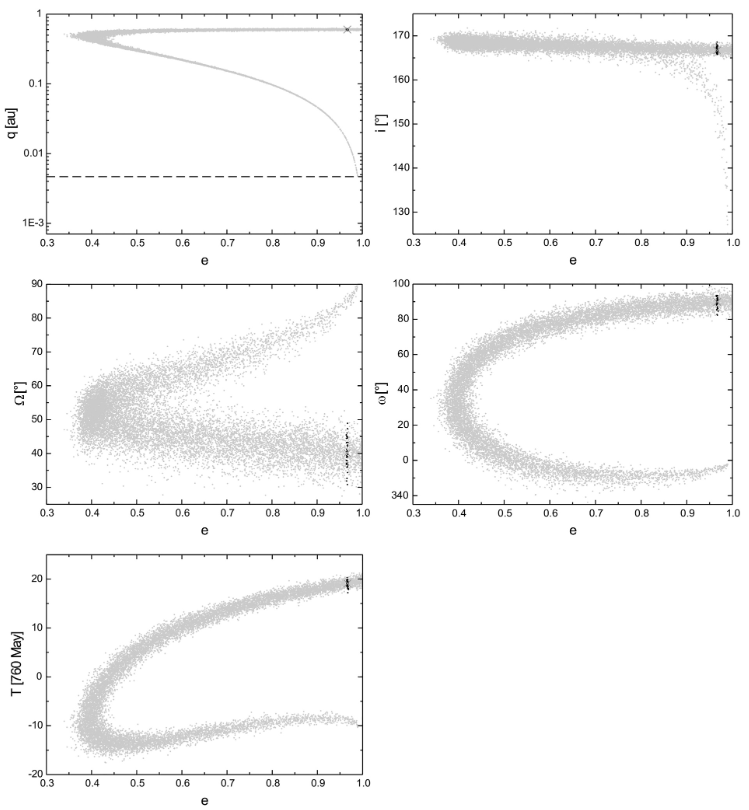
Keplerian elements for non-periodic solutions Fig. 9 - Neuhauser et al (2021)
Results from fitting the orbit Fig. 10 - Neuhauser et al (2021)
Results from fitting the orbit Fig. 11 - Neuhauser et al (2021)
Perihelion distance q versus inclination i. Fig. 12 - Neuhauser et al (2021)
Probability distribution of the Keplerian elements Fig. 13 - Neuhauser et al (2021)
Apparent brightness evolution for a usual comet Fig. 14 - Neuhauser et al (2021)
Transliteration of the Syriac text Fig. 15 - Neuhauser et al (2021)
Chinese Texts Fig. 16 - Neuhauser et al (2021)
Dated positions of the comet in AD 760
from historical observations
Table 1 - Neuhauser et al (2021)
Keplerian elements of our best fitting orbital solution Table 2 - Neuhauser et al (2021)
Residuals (O-C) of the best fitting orbital solution Table 3 - Neuhauser et al (2021)

Notes
Kepler Orbit (Wikipedia)