Faulting Event III in Trench 1

Faulting Event III is the youngest
Holocene
palaeoseismic event identified in Trench TR-1,
which was excavated across the southern segment
of the
Bet She'an Fault north of the archaeological site of
Tel Rehov. In this area, the fault zone is expressed as a
40–50 m-high fault-scarp
slope separating the
tufa
plateau in the west from a lower surface capped
by soil in the east. The fault exposed in the
trench forms part of the
western marginal fault
zone of the
Dead Sea
Transform.
Geophysical surveys indicate that the trench
fault is one branch of a broader fault belt that
splits westward from the main marginal fault of
the Jordan Valley. The trench exposed a
fault-generated scarp developed within Late
Pleistocene
tufa deposits and subsequently buried
by younger
alluvial-colluvial
sediments sediments.
Faulting Event III is represented
by fractures that cut Units 1–3 in the
alluvial-colluvial sequence above the
tufa
scarp exposed north of
Tel Rehov. Event III differs from Faulting Events I
and II because it is not represented by a
colluvial wedge
or by measurable vertical displacement. Instead,
it is represented by fractures that cross
Colluvial Units 1 and 2 and continue into the
lower part of Unit 3. Zilberman et al. (2004) therefore interpreted the event as fracturing of
the young sedimentary sequence rather than as a
new scarp-forming rupture.
The event may record renewed movement or
reactivation along the marginal fault zone, but
because no vertical offset was detected, it may
also reflect shaking from a more distant
earthquake rather than local surface rupture. In
this sense, Faulting Event III is weaker
palaeoseismic evidence than Events I and II: it
shows deformation of the trench sequence, but not
the formation of a new
fault scarp
or a datable colluvial package.
No vertical displacement estimate is available
for Faulting Event III.
Because no displacement was measured, it was not possible to derive a reliable
MW
estimate from the
Wells and
Coppersmith (1994)
displacement-magnitude relationships.
The age of Faulting Event III is poorly
constrained. It post-dates deposition of Units 1
and 2 and affects at least the lower part of Unit
3.
Radiocarbon ages
were obtained from two samples. A land snail
sample (TR 1.18), collected from the contact
between Units 2 and 3, produced an
uncalibrated age of 5282 ± 89
YBP
(3332 ± 89 BCE), whereas a
Melanopsis shell
sample (TR 1.1) from the upper part of Unit 3
yielded an age of 1005 ± 56 YBP
(945 ± 56 CE).
The older age is clearly an
outlier,
whereas the younger age, although still
uncalibrated, may be consistent with one of the
659/660 Jordan
Valley earthquake(s), one of the
749 CE Sabbatical
Year earthquakes, or one of the
1033/1034
earthquake(s). This suggests that Faulting
Event III may have occurred sometime between
approximately 600 and 1100 CE.



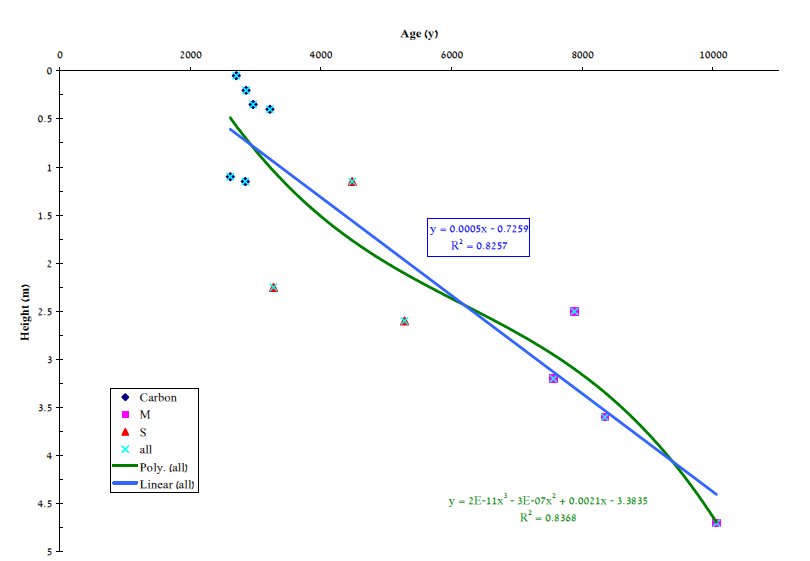
Figure 18
Figure 20