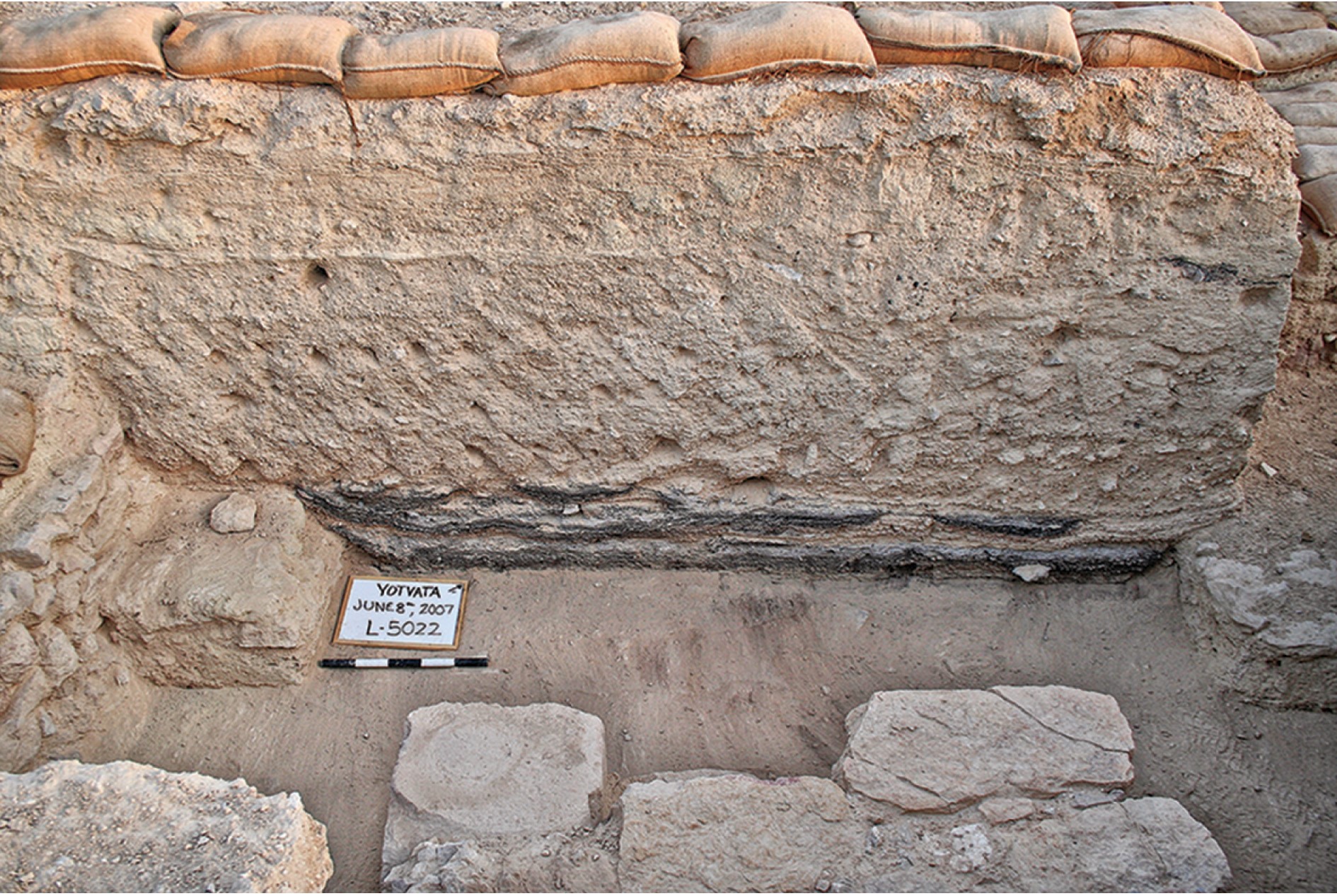
Post Roman Legion Abandonment Earthquake

Davies et al. (2015)
report results from excavations of the Late Roman fort
at Yotvata conducted between 2003 and 2007. A monumental
Latin inscription discovered earlier outside the east
gate indicates that the fort was constructed during the
reign of
Diocletian (r. 284-305 CE) when the
Legio X Fretensis
was transferred from Jerusalem to
Aila during the last
decade of the third century CE.
Two principal destruction horizons were identified in
the fort’s occupational sequence: an early burned layer
associated with the end of the initial Roman occupation,
and a later structural collapse layer that formed after
the site had already been abandoned.
The earliest destruction phase is associated with coins
dating to approximately 360 CE and is characterized by
extensive burning across the site. The excavators noted
"the first phase of Roman occupation at our fort, which
is associated with coins that go up to ca. 360, ended
with a violent destruction evidenced by intense burning
throughout." Despite the violence of this event, the
excavators found no evidence for earthquake-related
structural collapse in this layer. Instead, the burning
appears to reflect deliberate destruction. The excavated
contexts showed intense fire damage across multiple
areas of the fort, including the stone frame of the main
gate, which was described as fire-seared.
On this basis the excavators concluded that the earliest
destruction was caused by human agency rather than a
seismic event such as the
Cyril Quake of 363 CE.
They suggested that the destruction may be related to
the
Saracen revolt
led by
Queen Mavia in the
late fourth century. Because her forces included former
foederati, the authors
argued that they would have been capable of capturing
and destroying the Roman installation at Yotvata.
Personal communications (2020) from the excavation team further
support this interpretation. Gwyn Davies noted that the
fort was "destroyed in a violent attack" characterized
by widespread burning rather than structural collapse.
Similarly, Jodi Magness emphasized that the absence of
whole pottery vessels and other artifacts trapped in a
collapse layer argues strongly against earthquake
destruction at this stage, since sudden seismic collapse
typically entombs household objects in place.
Following the burning episode the fort was quickly rebuilt, as indicated by a sequence of new floor
surfaces throughout the complex. This second phase of
occupation continued until the site was abandoned in an
orderly manner toward the end of the fourth century.
Rooms were cleared before abandonment, suggesting a
planned withdrawal rather than a sudden disaster.
The final collapse horizon at the site formed only after
this abandonment. Soon afterward, an earthquake toppled
the standing walls of the deserted fort. Stratigraphic
evidence indicates only limited debris accumulation
between abandonment and this collapse event. On this
basis the excavators proposed that the destruction may
have resulted from the
419 CE Monaxius and
Plinta earthquake.
A brief
Byzantine occupation was later established on
top of the collapsed remains without attempts to level
the rubble. Significant sediment accumulated between
this Byzantine layer and the well-dated Early Islamic
occupation, indicating that the Byzantine phase and the
later Islamic settlement were separated by at least a
century or two. This stratigraphic gap effectively rules
out several later regional earthquakes as candidates for
the collapse event, including the late 6th century CE Inscription at Areopolis
Quake and the
634 CE Sword in the Sky
Quake. It does not, however, seem to rule out the
hypothesized ~500 CE Negev Quake.