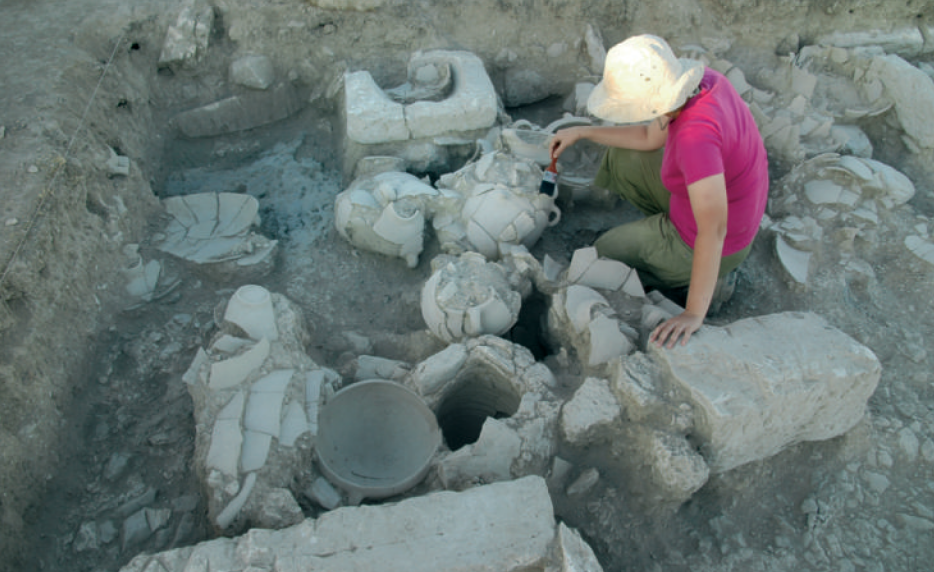
A4 and B3 Destruction - Iron IIB

Tel ‘Eton is described as containing the remains of a large, densely occupied
Iron Age II town in the southeastern
Shephelah,
which was violently destroyed in the
late eighth century BCE and did not recover.
Katz and Faust (2012:22) examined the dating of that destruction, noting that
the ceramic assemblage closely resembles nearby
Lachish Level III
which is widely thought to have been destroyed in
Sennacherib’s
military campaign in ~701 BCE. They “cautiously”
attribute the destruction at Tell 'Eton to the same event.
Some scholars, however, have proposed that the
Shephelah experienced two
Assyrian destruction
horizons: an earlier campaign in the mid- to
late-eighth century BCE, often associated with
Tiglath-pileser III (r. 745-727 BCE) or
Sargon II (r. 722-705 BCE), followed by the
701 BCE campaign of Sennacherib. In this model,
a first wave of devastation preceded 701, raising
the possibility that Tel ‘Eton could reflect an
earlier Assyrian campaign rather than the 701
horizon.
In the Bar-Ilan excavations, the destruction is
documented most clearly in the two excavation zones, Area A (at the high point of the tell) and Area B (a short distance
north of A). In Area A, a later massive square
structure (interpreted as a fortress) overlies a
destruction horizon. Above the destruction,
excavators report only limited resettlement,
with pottery resembling pottery in the
destruction stratum, implying a short interval between catastrophe
and brief re-use (
Katz and Faust, 2012:23-26).
Beneath the later remains in Area A, large parts
of well-preserved buildings are reported as
having suffered violent destruction: walls
standing up to ca. 1.5 m within debris of stones
and bricks, with dense
in situ
assemblages including dozens of pottery vessels, arrowheads,
loom weights, metal vessels, and
bullae/sealings.
The northern wing of the "central building", with four
small rooms, produced many storage vessels
smashed on floors, and in some cases preserved
contents (olives, grapes, lentils,
vetch, etc.).
A white layer interpreted as a second-storey
floor is reported in several places, while items
above it include a small assemblage of
bullae/sealings (
Katz and Faust, 2012:23-26).
Area B is said to preserve the late-eighth-century
destruction close to the present surface in many
of its squares. Although architectural preservation is
described as inferior to Area A, large assemblages
of complete vessels were recovered from the
destruction deposits, which the authors present
as evidence for violent destruction of the city.
Plastered floors are noted as surprisingly
well-preserved despite their shallow depth, and the
lower slope sector also yielded floor segments
with complete vessels (
Katz and Faust, 2012:23-26).
For dating, Katz and Faust argue that the destruction assemblage belongs in
the second half of the eighth century BCE. They divide the ceramic evidence
into three chronological groups—long-lived Iron IIA types continuing into the eighth century BCE;
types appearing not before the eighth century BCE and lasting to the end of the Iron Age; and
types characteristic only of the eighth century BCE—and emphasize that these categories co-occur within the same
destruction stratum, often within the same building, thereby constraining
the event to the eighth century BCE. They further stress the strong resemblance of the assemblage to
Lachish Level III,
whose destruction is historically attested
in both Assyrian and Biblical records and is widely dated to 701 BCE. Because of this,
they treat Lachish Level III as a chronological benchmark for nearby Shephelah sites (
Katz and Faust, 2012:39-42).
At the same time, they acknowledge ceramic
signals that could point to slightly earlier than 701 BCE. They highlight burnishing
patterns (
hand vs wheel burnish) as a possible
relative indicator, pottery vessels from Tel 'Eton that
are characteriztic of Lachish Phase IV or early Phase III, and they note
the absence of
lmlk
impressions in their complete
vessels and, more importantly, across the large
handle assemblage, which they treat as potentially
meaningful as
lmlk
stamping was present in
Lacshish level III before its destruction.
The absence of lmlk-stamped
handles may suggest that Tel ‘Eton’s
destruction preceded the widespread
circulation of these state-marked jars,
potentially placing the destruction event earlier within the eighth century BCE
(
Katz and Faust, 2012:45-48).
While
Katz and Faust (2012) ascribe the
destruction to a military campaign, a
seismic cause cannot be excluded. The
Lachish sequence offers the clearest
comparative framework where several scholars
associate the end of Lachish Level IV
with one of the mid-eighth-century BCE
Amos Quakes, whereas Lachish Level III
is conventionally linked to 701 BCE and
Sennacherib’s campaign. If the Tel ‘Eton
assemblage ultimately proves earlier than
a strict 701 linkage (as Katz and Faust
allow), its destruction horizon could
align more closely with Lachish IV and
thus potentially reflect a seismic event.
In their conclusion, Katz and Faust suggest that a late-eighth-century
catastrophe ended the town of Tel 'Eton and
was followed by limited
squatter-like reuse. They treat the ceramic-Lachish III fit as
strong, the “earlier than 701” indicators as
real but not decisive, and the most reasonable
working attribution as Sennacherib’s campaign,
pending further excavation and refinement of the
regional ceramic and stamped-handle chronologies (
Katz and Faust, 2012:48-50).