Open this page in a new tab

Kaysun

 Çakırhüyük (Kaysun) in Google Earth

Click on Image to explore in a new tab on Google Earth


Names
Transliterated Name Source Name
Kaysun
Kişum, Kaysum, Cesum, Kaeasun, Kesun, Keasun
K'esun Armenian
Kayşum, Keysun, Kaysun Syriac
Gison Gregory the Priest's Continuation of Matthew of Edessa's Chronicle
Kaysum Arabic
Kaesoun, Kessounion Greek
Çakırhüyük Modern Turkish
Keysun Kalesi Modern Turkish
Introduction
Introduction

Kaysun, which took the name Çakırhüyük, is a town in the Besni district of Adıyaman. The plain in which this town is located is the Keysun plain. It is 84 km away from Adıyaman and 30 km away from Besni. The people of the town are generally engaged in agriculture. Cotton and corn farming is mainly done in the Keysun plain. There is a high school, primary school, health center, agricultural credit cooperative, reading hall, Keysun irrigation union, and several cotton gin factories in our town.

There is a mound of approximately 20m. where the district center is located. The historical Keysun Castle was on this mound. The name of this castle, which played an active role in history, was formed by the change of the words BEYSUN and GEYSUN. It is not known when Keysun Castle, located in the middle of a wide plain in the south of Besni District, was built. The castle, which was the scene of frequent wars, was destroyed and rebuilt many times. The castle's mound and water sources are famous. The last construction phase of Keysun Castle dates back to the Middle Ages. However, it is not possible to see the ruins of the castle today (Source: Turgut H. Zeyrek Besni (Adiyaman) surface research-2006 Turkish Institute of Ancient Sciences Journal May 2007 Issue 24).

The name Çakırhüyük is the name Keysun, which was later changed during the republican period. But throughout history, this place has been called “Kişum”, “Kaysum”, ”Cesum”, “Kaeasun”, “Kesun”, “Keasun”. In Syriac Mihael and Mateos, it is “Keysun”, “Kaysun”, in Grigor’s Urfalı Mateos’s supplement it is “Gison” and it is explained that it means “Beautiful”. The name Keysun is often confused with Maraş-Göksun by historians. It is “Kayşum” in Syriac, “Kaysum” in Arabic, “Kaesoun” or “Kessounion” in Greek. This place is between Adıyaman and Besni.

In addition to our town having rich water resources, the fact that it also has fertile and arable lands allows us to make strong estimates that our region has a rich historical past. Today, due to the lack of a special study on the history of our town and the limited resources, we cannot clearly reveal the history of our town. However, the works proving the existence of the church on the eastern slope of our town and the existence of carved houses and rooms at the foot of the mountain on the northern slope of our town, the castle in the center of our town and the mounds in various parts of our town are important works in terms of shedding light on the historical past of our town. Many of these works have been designated as protected areas by the Ministry of Culture. In fact, sufficient research has not yet been done for these areas. The historical and cultural richness of our town and its surroundings is constantly being destroyed by treasure hunters through illegal means.

Aerial Views
Aerial Views

Aerial Views

  • Çakırhüyük (Kaysun) in Google Earth

Textual Chronology
1114 CE Marash Earthquake

Discussion

Discussion

Textual Seismic Effects
1114 CE Marash Earthquake

Effect                               Location Image Description
  • Severe concussion
  • Noise
  • Fractured Rocks
  • Split hills (fissures ?)
  • Shaken Trees
  • aftershocks
  • Collapsed Walls (collapsed churches)
Kaysun
  • "Now, while we were in a deep sleep, a horrible, crackling, and reverberating sound was heard, and all of creation resounded from the noise. A severe concussion was felt, and the plains and mountains shook with a frightful echoing sound, while tremendous rocks were cleft and hills were split open.

    Because of the intensity of this frightful calamity, the mountains and hills resounded, just like live animals who when they are terrified, shrilly cry out; this resounding noise hit the ears like the sound of a large throng in a camp. In this way, like a churned-up sea, all living creatures quaked and trembled from fear of the might of the Lord God; for all the plains and mountains resounded like the clanging of bronze, shaking and moving to and fro like trees struck by a high wind. The cries and groans of people issued forth like the plaintive moans of persons sick for a very long time, forcing them through fear to seek their own destruction. Like a fugitive, the whole land was reduced to despair and trembled with fear and like one condemned [to die], gave forth plaintive and tearful cries; moreover, these noises were heard even after the trembling ended, for about an hour during the night. Now, out of fear of the noises concomitant with this calamity, everyone despaired of their lives, saying: "The final day, the day of judgement, has arrived." Indeed the day of this calamity was a true mirror of that last day of judgment; for it happened to be Sunday and the day on which the heavy and somber tone of the Armenian chant was used, besides which the moon was in its last phase. Thus all the signs pointing to the last day were in evidence at this time.

    In consequence of all this, those who already were plunged into the depths of despair now became horror-struck and frozen with fear as if they had just died. Now during this night many towns and districts were destroyed. However, all the areas destroyed were those of the Franks, while no harm or destruction came to other regions or peoples.4 So on this night Samosata, Hisn-Mansur, Kesoun, and Raban were destroyed." - Matthew of Edessa

  • "In this earthquake, the church of Mar John of Kaishum and that of the Forty Martyrs collapsed, and they were rebuilt by the care of Mar Dionysius, bishop of Kaishum." - Michael the Syrian

  • "A great number of cities were ruined: Antioch collapsed, as well as Mecis, Hisn-Mansur, Kayˇsum, Ablastha, R’aban and Samosata." - Chronicle of Smbat Sparapet

  • "a terribly violent earthquake took place, and the whole city of Mar'ash sunk underground and became the tomb of the inhabitants thereof. And very many houses fell down in Samosata. Constantine, the lord of Gargar, was present in the town, and he, together with many others, was suffocated in the ruins. And there fell down thirteen towers of the wall of Edessa; and portions of the wall of Harran; and a hundred houses and one-half of the Citadel of Balash; and two churches of Khishum, viz. the church of Mar John, and the church of the Forty Martyrs. And through the care and solicitude of Dionysius, its bishop, they (i.e. the churches) were rebuilt." - Bar Hebraeus

Textual Intensity Estimates
1114 CE Marash Earthquake

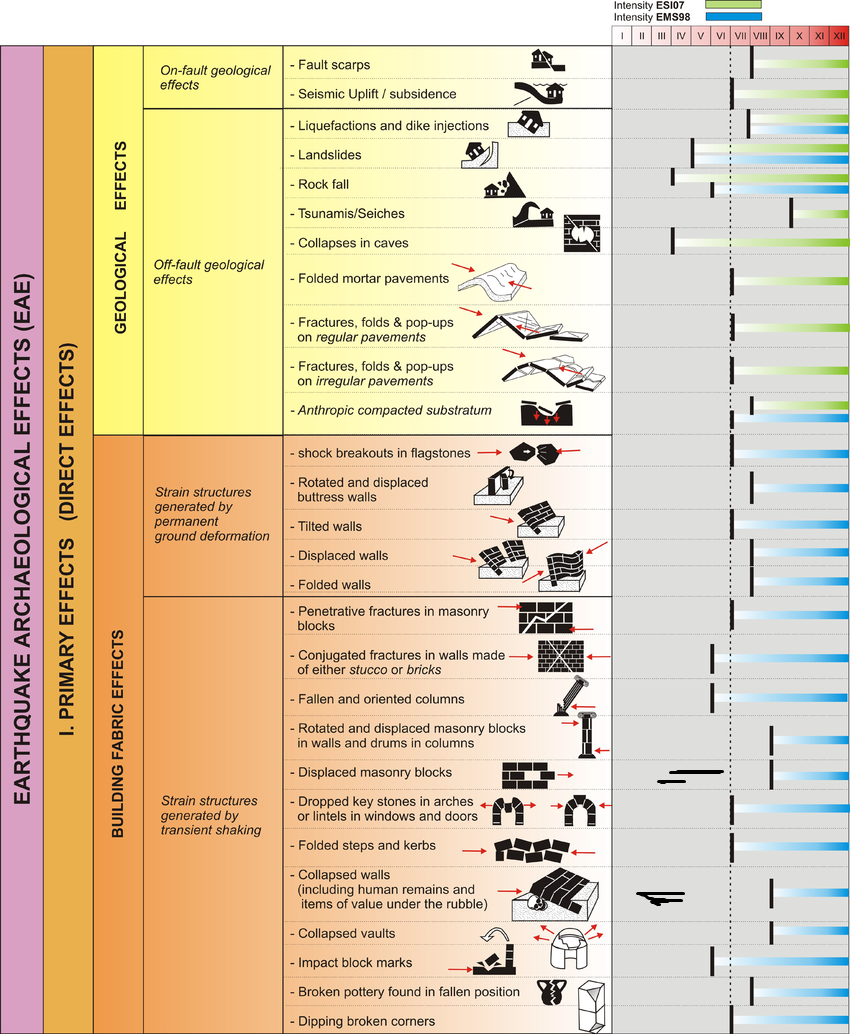
  • Earthquake Archeological Effects from Rodríguez-Pascua et al (2013: 221-224)
  • Environmental Effects (ESI 2007)
  • Synoptic Table of ESI 2007 Intensity Degrees from Michetti et al. (2007)
  • Environmental Effects vs. Intensity from Michetti et al. (2007)
Effect                               Location Image Description Intensity
  • Severe concussion
  • Noise
  • Fractured Rocks
  • Split hills (fissures ?)
  • Shaken Trees
  • aftershocks
  • Collapsed Walls (collapsed churches)
Kaysun
  • "Now, while we were in a deep sleep, a horrible, crackling, and reverberating sound was heard, and all of creation resounded from the noise. A severe concussion was felt, and the plains and mountains shook with a frightful echoing sound, while tremendous rocks were cleft and hills were split open.

    Because of the intensity of this frightful calamity, the mountains and hills resounded, just like live animals who when they are terrified, shrilly cry out; this resounding noise hit the ears like the sound of a large throng in a camp. In this way, like a churned-up sea, all living creatures quaked and trembled from fear of the might of the Lord God; for all the plains and mountains resounded like the clanging of bronze, shaking and moving to and fro like trees struck by a high wind. The cries and groans of people issued forth like the plaintive moans of persons sick for a very long time, forcing them through fear to seek their own destruction. Like a fugitive, the whole land was reduced to despair and trembled with fear and like one condemned [to die], gave forth plaintive and tearful cries; moreover, these noises were heard even after the trembling ended, for about an hour during the night. Now, out of fear of the noises concomitant with this calamity, everyone despaired of their lives, saying: "The final day, the day of judgement, has arrived." Indeed the day of this calamity was a true mirror of that last day of judgment; for it happened to be Sunday and the day on which the heavy and somber tone of the Armenian chant was used, besides which the moon was in its last phase. Thus all the signs pointing to the last day were in evidence at this time.

    In consequence of all this, those who already were plunged into the depths of despair now became horror-struck and frozen with fear as if they had just died. Now during this night many towns and districts were destroyed. However, all the areas destroyed were those of the Franks, while no harm or destruction came to other regions or peoples.4 So on this night Samosata, Hisn-Mansur, Kesoun, and Raban were destroyed." - Matthew of Edessa

  • "In this earthquake, the church of Mar John of Kaishum and that of the Forty Martyrs collapsed, and they were rebuilt by the care of Mar Dionysius, bishop of Kaishum." - Michael the Syrian

  • "A great number of cities were ruined: Antioch collapsed, as well as Mecis, Hisn-Mansur, Kayˇsum, Ablastha, R’aban and Samosata." - Chronicle of Smbat Sparapet

  • "a terribly violent earthquake took place, and the whole city of Mar'ash sunk underground and became the tomb of the inhabitants thereof. And very many houses fell down in Samosata. Constantine, the lord of Gargar, was present in the town, and he, together with many others, was suffocated in the ruins. And there fell down thirteen towers of the wall of Edessa; and portions of the wall of Harran; and a hundred houses and one-half of the Citadel of Balash; and two churches of Khishum, viz. the church of Mar John, and the church of the Forty Martyrs. And through the care and solicitude of Dionysius, its bishop, they (i.e. the churches) were rebuilt." - Bar Hebraeus
  • ?
  • ?
  • IX+?
  • IX+?
  • VIII+
  • ?
  • VIII+
Matthew of Edessa's descriptions suggest very high levels of intensity - perhaps IX (9).

Notes and Further Reading
References
Wikipedia pages

Fortress of Kaysun


Çakırhüyük, Besni (Kaysun)


Matthew of Edessa