
Jerusalem - Church of the Holy Sepulchre
 The church in 2010, from left to right: the bell tower (12th century), rotunda (big dome), catholicon (smaller dome), and ambulatory
Click on Image to open a high resolution magnifiable image in a new tab
Gerd Eichmann - Wikipedia -CC BY-SA 4.0
| Transliterated Name | Source | Name |
|---|---|---|
| Calvary | English | |
| Calvariae | Latin | |
| Calvariae locus | Latin | |
| Golgotha | Greek | Γολγοθᾶ |
- Map of the Old City and
its environs from Stern et al (1993 v. 2)
 Map of the Old City and its environs; numbers refer to excavation sites discussed in the text
Click on Image to open image in a new tab
Stern et al (2008)
- Map of the Old City and
its environs from Stern et al (1993 v. 2)
Map of the Old City and its environs; numbers refer to excavation sites discussed in the text
Click on Image to open image in a new tab
Stern et al (2008)
- Church of the Holy Sepulchre in Google Earth
 Church of the Holy Sepulchre
click on image to explore this site on a new tab in Google Earth - Church of the Holy Sepulchre on govmap.gov.il
 Church of the Holy Sepulchre
click on image to explore this site on a new tab in govmap.gov.il
- Plan of the Church of
the Holy Sepulchre in the Crusader Period from Stern et al (1993 v. 2)
 Plan of the Church of the Holy Sepulchre in the Crusader Period
Stern et al (1993 v. 2) - Table 1 Plan showing
phases from Tucci (2019)
 Table 1
Plan showing phases
plan revised by A. Angeloni from Tucci-Bonora Surveys 2012
Click on image to open in a new tab
Tucci (2019) - Fig. X Constantinian
phase at the end of the IV century (?) from Tucci (2019)
 Fig. X
Constantinian phase at the end of the IV century ?
Click on image to open in a new tab
Tucci (2019) - Fig. 1 Constantinian
phase at the end of the IV century from Tucci (2019)
 Fig. 1
Constantinian phase at the end of the IV century
Click on image to open in a new tab
Tucci (2019) - Fig. 17 Holy Sepulchre
at the end of the VIII century from Tucci (2019)
 Fig. 17
Status quo of the Holy Sepulchre at the end of the VIII century Highlights of the masonry of D and E type
Click on image to open in a new tab
Tucci (2019) - Fig. 3 High Medieval
phase 1 end of VIII century from Tucci (2019)
 Fig. 3
High Medieval phase 1 end of VIII century
from O. Garbarino, 2001
Click on image to open in a new tab
Tucci (2019) - Fig. 18 Holy Sepulchre
at the end of the X century from Tucci (2019)
 Fig. 18
Status quo of the Holy Sepulchre at the end of the X century Highlights of the masonry of E type
Click on image to open in a new tab
Tucci (2019) - Fig. 4 High Medieval
phase 2 end of X century from Tucci (2019)
 Fig. 4
High Medieval phase 2 end of X century
from O. Garbarino, 2001
Click on image to open in a new tab
Tucci (2019) - Fig. 21 Holy Sepulchre
rebuilt by the Byzantines after the Muslim devastation of 1009 from Tucci (2019)
 Fig. 21
Holy Sepulchre rebuilt by the Byzantines after the Muslim devastation of 1009 Highlights of the masonry of H type
Click on image to open in a new tab
Tucci (2019) - Fig. 5 Byzantine phase
end of XI century from Tucci (2019)
 Fig. 5
Byzantine phase, end of XI century
from O. Garbarino, 2001
Click on image to open in a new tab
Tucci (2019) - Fig. 25 Holy Sepulchre
after the Crusaders restoration in the second half of the XII century from Tucci (2019)
 Fig. 25
The Holy Sepulchre after the Crusaders restoration in the second half of the XII century Highlights of the masonry of I type
Click on image to open in a new tab
Tucci (2019) - Fig. 6 Crusaders
phase end of XII century from Tucci (2019)
 Fig. 6
Crusaders phase 1 end of XII century
from O. Garbarino, 2001
Click on image to open in a new tab
Tucci (2019) - Fig. 28 Current Status
Quo of the Building of the Holy Sepulchre overlaid onto an ideal reconstruction of the site at the time of Christ from Tucci (2019)
 Fig. 28
Current Status Quo of the Building of the Holy Sepulchre overlaid onto an ideal reconstruction of the site at the time of Christ
Click on image to open in a new tab
Tucci (2019) - Fig. 12 Longitudinal
cross section looking south from Tucci (2019)
 Fig. 12
Longitudinal cross section looking south
Click on image to open in a new tab
Tucci (2019) - Fig. 42 2D plan of the
ground floor of the Complex of the Holy Sepulchre from Tucci (2019)
 Fig. 42
2D plan of the ground floor of the Complex of the Holy Sepulchre, including the Chapels of St. Helena, the Invention of the Cross, and St. Vartan, extracted from the 3D point cloud
Tucci-Bonora surveys 2007-2009
Click on image to open in a new tab
Tucci (2019) - Fig. 43 Superimposition
of the 3D point cloud of the roof of the Complex of the Holy Sepulchre with the plan of the ground floor from Tucci (2019)
 Fig. 43
Superimposition of the 3D point cloud of the roof of the Complex of the Holy Sepulchre with the plan of the ground floor
Tucci-Bonora surveys 2007-2009
Click on image to open in a new tab
Tucci (2019)
- Plan of the Church of
the Holy Sepulchre in the Crusader Period from Stern et al (1993 v. 2)
Plan of the Church of the Holy Sepulchre in the Crusader Period
Stern et al (1993 v. 2) - Table 1 Plan showing
phases from Tucci (2019)
Table 1
Plan showing phases
plan revised by A. Angeloni from Tucci-Bonora Surveys 2012
Click on image to open in a new tab
Tucci (2019) - Fig. X Constantinian
phase at the end of the IV century (?) from Tucci (2019)
Fig. X
Constantinian phase at the end of the IV century ?
Click on image to open in a new tab
Tucci (2019) - Fig. 1 Constantinian
phase at the end of the IV century from Tucci (2019)
Fig. 1
Constantinian phase at the end of the IV century
Click on image to open in a new tab
Tucci (2019) - Fig. 17 Holy Sepulchre
at the end of the VIII century from Tucci (2019)
Fig. 17
Status quo of the Holy Sepulchre at the end of the VIII century Highlights of the masonry of D and E type
Click on image to open in a new tab
Tucci (2019) - Fig. 3 High Medieval
phase 1 end of VIII century from Tucci (2019)
Fig. 3
High Medieval phase 1 end of VIII century
from O. Garbarino, 2001
Click on image to open in a new tab
Tucci (2019) - Fig. 18 Holy Sepulchre
at the end of the X century from Tucci (2019)
Fig. 18
Status quo of the Holy Sepulchre at the end of the X century Highlights of the masonry of E type
Click on image to open in a new tab
Tucci (2019) - Fig. 4 High Medieval
phase 2 end of X century from Tucci (2019)
Fig. 4
High Medieval phase 2 end of X century
from O. Garbarino, 2001
Click on image to open in a new tab
Tucci (2019) - Fig. 21 Holy Sepulchre
rebuilt by the Byzantines after the Muslim devastation of 1009 from Tucci (2019)
Fig. 21
Holy Sepulchre rebuilt by the Byzantines after the Muslim devastation of 1009 Highlights of the masonry of H type
Click on image to open in a new tab
Tucci (2019) - Fig. 5 Byzantine phase
end of XI century from Tucci (2019)
Fig. 5
Byzantine phase, end of XI century
from O. Garbarino, 2001
Click on image to open in a new tab
Tucci (2019) - Fig. 25 Holy Sepulchre
after the Crusaders restoration in the second half of the XII century from Tucci (2019)
Fig. 25
The Holy Sepulchre after the Crusaders restoration in the second half of the XII century Highlights of the masonry of I type
Click on image to open in a new tab
Tucci (2019) - Fig. 6 Crusaders
phase end of XII century from Tucci (2019)
Fig. 6
Crusaders phase 1 end of XII century
from O. Garbarino, 2001
Click on image to open in a new tab
Tucci (2019) - Fig. 28 Current Status
Quo of the Building of the Holy Sepulchre overlaid onto an ideal reconstruction of the site at the time of Christ from Tucci (2019)
Fig. 28
Current Status Quo of the Building of the Holy Sepulchre overlaid onto an ideal reconstruction of the site at the time of Christ
Click on image to open in a new tab
Tucci (2019) - Fig. 12 Longitudinal
cross section looking south from Tucci (2019)
Fig. 12
Longitudinal cross section looking south
Click on image to open in a new tab
Tucci (2019) - Fig. 42 2D plan of the
ground floor of the Complex of the Holy Sepulchre from Tucci (2019)
Fig. 42
2D plan of the ground floor of the Complex of the Holy Sepulchre, including the Chapels of St. Helena, the Invention of the Cross, and St. Vartan, extracted from the 3D point cloud
Tucci-Bonora surveys 2007-2009
Click on image to open in a new tab
Tucci (2019) - Fig. 43 Superimposition
of the 3D point cloud of the roof of the Complex of the Holy Sepulchre with the plan of the ground floor from Tucci (2019)
Fig. 43
Superimposition of the 3D point cloud of the roof of the Complex of the Holy Sepulchre with the plan of the ground floor
Tucci-Bonora surveys 2007-2009
Click on image to open in a new tab
Tucci (2019)
- The Cracks of Calvary
from Wikipedia
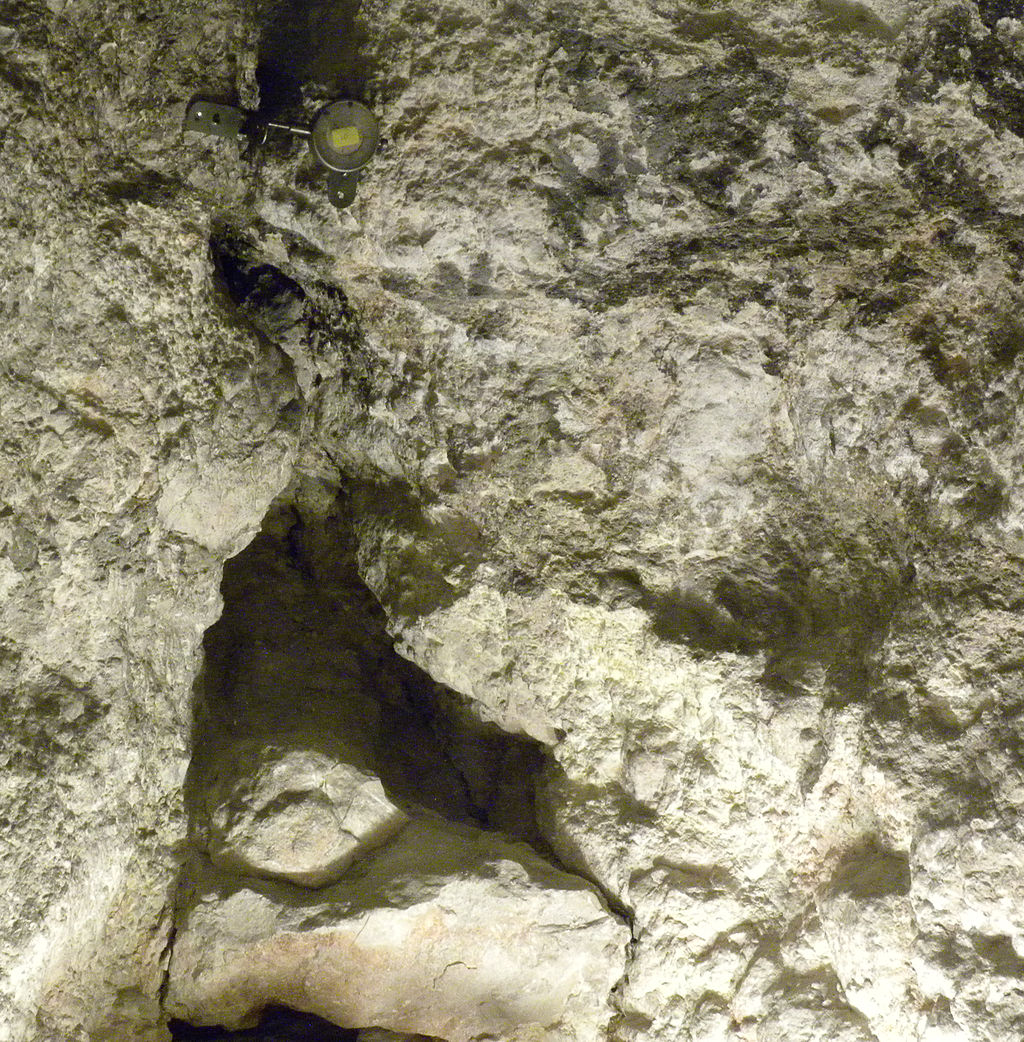 The Cracks of Calvary
Click on Image to open a high resolution magnifiable image in a new tab
Wilson44691 - Wikipedia - CCO 1.0

- The Cracks of Calvary
from Wikipedia
The Cracks of Calvary
Click on Image to open a high resolution magnifiable image in a new tab
Wilson44691 - Wikipedia - CCO 1.0
| Effect | Location | Image(s) | Description |
|---|---|---|---|
|
Church of the Holy Sepulchre
Map of the Old City and its environs; numbers refer to excavation sites discussed in the text
Click on Image to open image in a new tab Stern et al (2008)
The church in 2010, from left to right: the bell tower (12th century), rotunda (big dome), catholicon (smaller dome), and ambulatory
Click on Image to open a high resolution magnifiable image in a new tab Gerd Eichmann - Wikipedia -CC BY-SA 4.0
Plan of the Church of the Holy Sepulchre in the Crusader Period
Click on Image to open image in a new tab Stern et al (1993 v. 2) |
|
| Effect | Location | Image(s) | Description |
|---|---|---|---|
|
Church of the Holy Sepulchre
Map of the Old City and its environs; numbers refer to excavation sites discussed in the text
Click on Image to open image in a new tab Stern et al (2008)
The church in 2010, from left to right: the bell tower (12th century), rotunda (big dome), catholicon (smaller dome), and ambulatory
Click on Image to open a high resolution magnifiable image in a new tab Gerd Eichmann - Wikipedia -CC BY-SA 4.0
Plan of the Church of the Holy Sepulchre in the Crusader Period
Click on Image to open image in a new tab Stern et al (1993 v. 2) |
Before 1546 CE Quake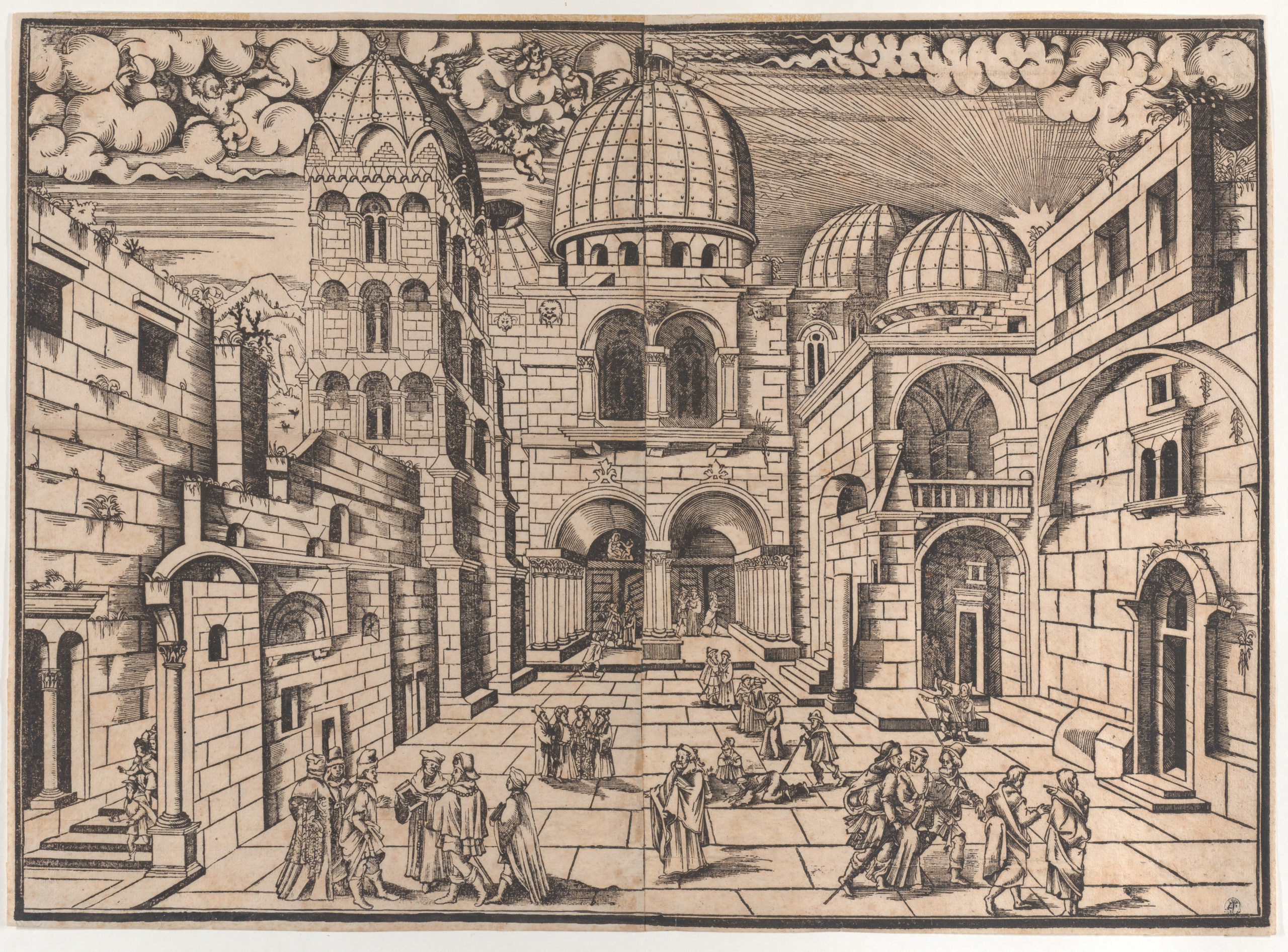 A drawing by Dominik de la Greche of the Church of the Holy Sepulchre apparently before the earthquake when the
Bell Tower Dome to the left was still intact
A drawing by Dominik de la Greche of the Church of the Holy Sepulchre apparently before the earthquake when the
Bell Tower Dome to the left was still intactfrom The Met - NYC After 1546 CE Quake 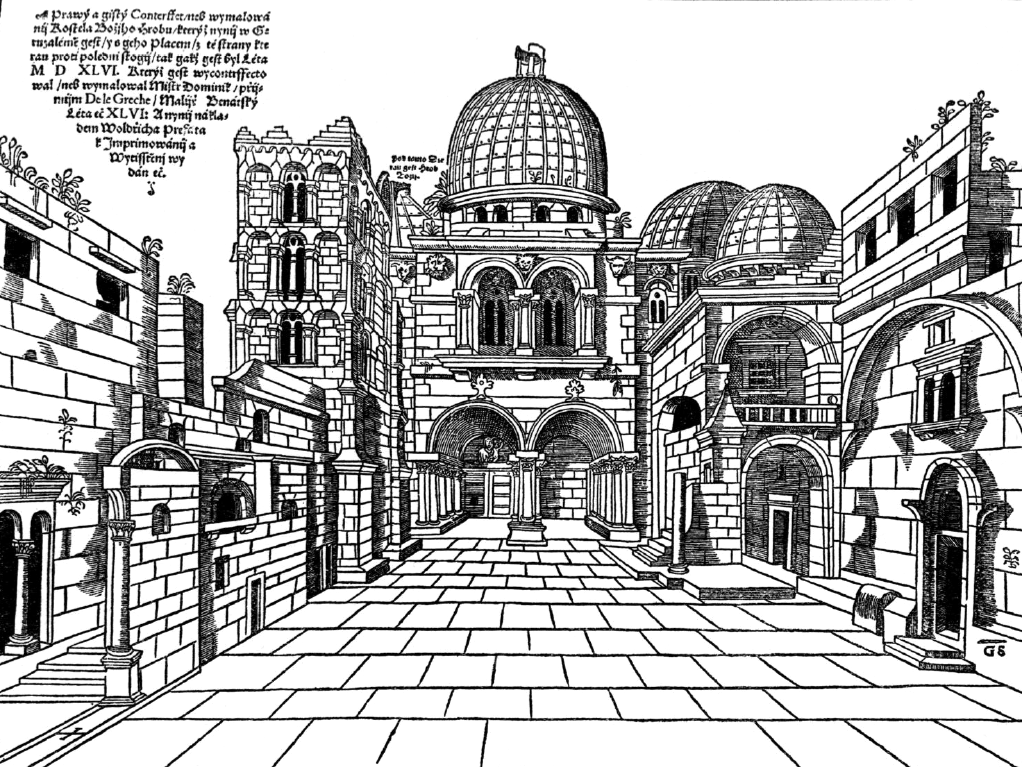 drawing of the Church of the Holy Sepulchre after the 1546 CE earthquake. Note that the dome of the bell tower to the left is missing
|
|

| Effect | Location | Image(s) | Description |
|---|---|---|---|
|
Church of the Holy Sepulchre
Map of the Old City and its environs; numbers refer to excavation sites discussed in the text
Click on Image to open image in a new tab Stern et al (2008)
The church in 2010, from left to right: the bell tower (12th century), rotunda (big dome), catholicon (smaller dome), and ambulatory
Click on Image to open a high resolution magnifiable image in a new tab Gerd Eichmann - Wikipedia -CC BY-SA 4.0
Plan of the Church of the Holy Sepulchre in the Crusader Period
Click on Image to open image in a new tab Stern et al (1993 v. 2) |
|
- Earthquake Archeological Effects chart
of Rodríguez-Pascua et al (2013: 221-224)
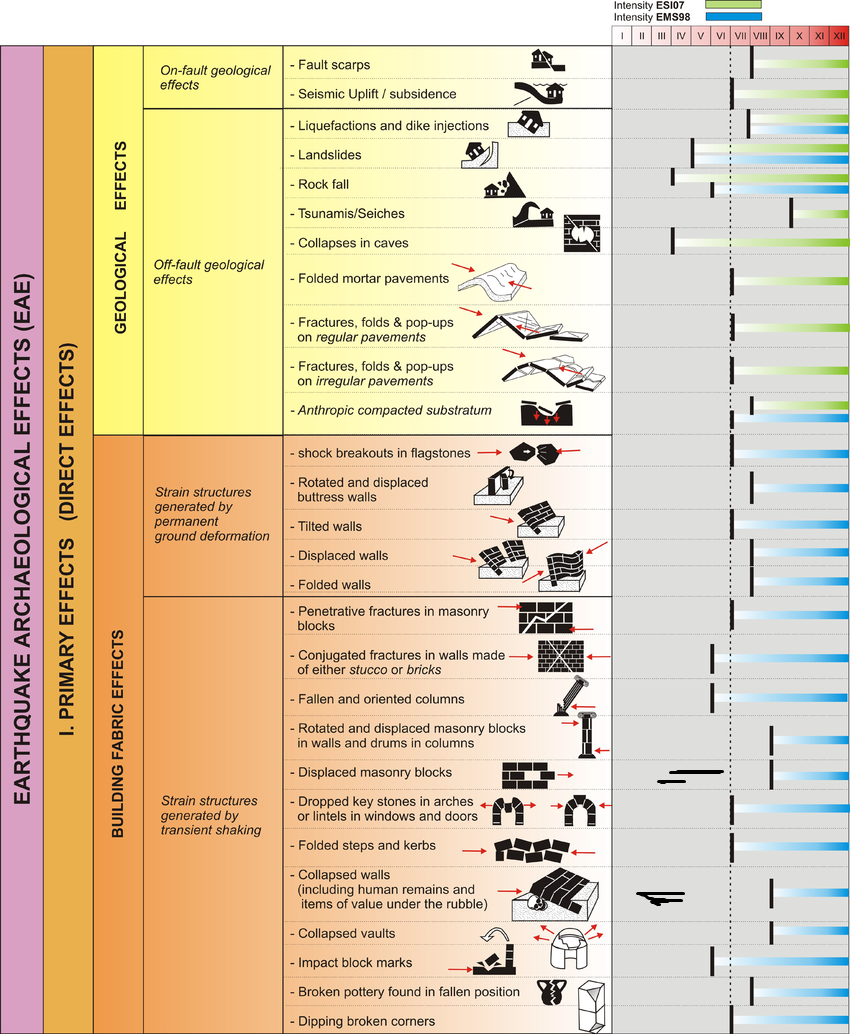 Earthquake Archeological Effects (EAE)
Rodríguez-Pascua et al (2013: 221-224)
| Effect | Location | Image(s) | Description | Intensity |
|---|---|---|---|---|
|
Church of the Holy Sepulchre
Map of the Old City and its environs; numbers refer to excavation sites discussed in the text
Click on Image to open image in a new tab Stern et al (2008)
The church in 2010, from left to right: the bell tower (12th century), rotunda (big dome), catholicon (smaller dome), and ambulatory
Click on Image to open a high resolution magnifiable image in a new tab Gerd Eichmann - Wikipedia -CC BY-SA 4.0
Plan of the Church of the Holy Sepulchre in the Crusader Period
Click on Image to open image in a new tab Stern et al (1993 v. 2) |
|
|
- Earthquake Archeological Effects chart
of Rodríguez-Pascua et al (2013: 221-224)
Earthquake Archeological Effects (EAE)
Rodríguez-Pascua et al (2013: 221-224)
| Effect | Location | Image(s) | Description | Intensity |
|---|---|---|---|---|
|
Church of the Holy Sepulchre
Map of the Old City and its environs; numbers refer to excavation sites discussed in the text
Click on Image to open image in a new tab Stern et al (2008)
The church in 2010, from left to right: the bell tower (12th century), rotunda (big dome), catholicon (smaller dome), and ambulatory
Click on Image to open a high resolution magnifiable image in a new tab Gerd Eichmann - Wikipedia -CC BY-SA 4.0
Plan of the Church of the Holy Sepulchre in the Crusader Period
Click on Image to open image in a new tab Stern et al (1993 v. 2) |
Before 1546 CE Quake
A drawing by Dominik de la Greche of the Church of the Holy Sepulchre apparently before the earthquake when the
Bell Tower Dome to the left was still intact from The Met - NYC After 1546 CE Quake
drawing of the Church of the Holy Sepulchre after the 1546 CE earthquake. Note that the dome of the bell tower to the left is missing
|
|
|
- Earthquake Archeological Effects chart
of Rodríguez-Pascua et al (2013: 221-224)
Earthquake Archeological Effects (EAE)
Rodríguez-Pascua et al (2013: 221-224)
| Effect | Location | Image(s) | Description | Intensity |
|---|---|---|---|---|
|
Church of the Holy Sepulchre
Map of the Old City and its environs; numbers refer to excavation sites discussed in the text
Click on Image to open image in a new tab Stern et al (2008)
The church in 2010, from left to right: the bell tower (12th century), rotunda (big dome), catholicon (smaller dome), and ambulatory
Click on Image to open a high resolution magnifiable image in a new tab Gerd Eichmann - Wikipedia -CC BY-SA 4.0
Plan of the Church of the Holy Sepulchre in the Crusader Period
Click on Image to open image in a new tab Stern et al (1993 v. 2) |
|
|