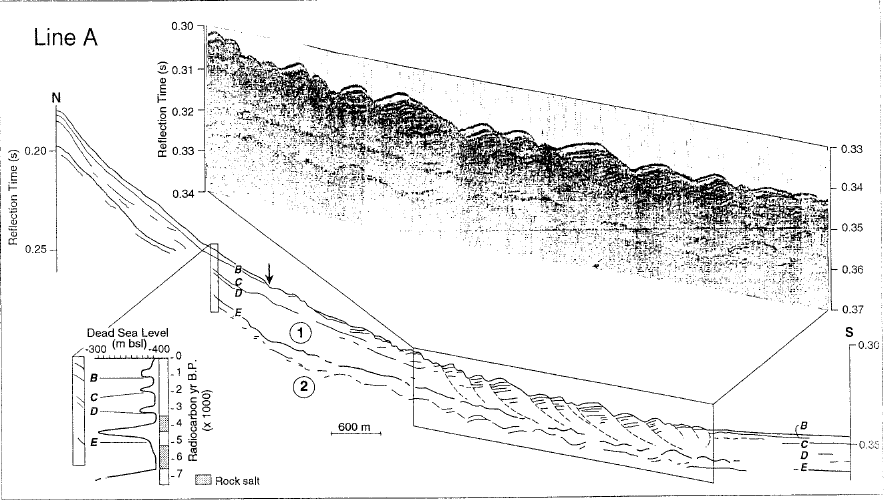
Event 2

Niemi and Ben-Avraham (1994) identified
evidence for earthquake-triggered slope failures in
seismic reflection profiles
from the deep-water basin of the Dead Sea. Their
data indicate at least two episodes of subaqueous
mass movement interpreted as
paleo-debris flows generated by seismic
shaking.
The seismic profiles show that a lower sequence of
reflectors exhibit deformation patterns distinct
from the younger reflectors associated
with Event 1 which is presumed to be due to the
1927 Jericho earthquake.
This lower unit appears to have slumped during an
earlier earthquake that occurred after deposition
of the lower sedimentary sequence but before
accumulation of the overlying reflectors
later destabilized in 1927. The
stratigraphy thus
preserves evidence for at least one earthquake
predating the historic event.
Four prominent seismic reflectors (B–E) in the
deep-water basin correspond to the tops of
rock-salt layers identified in sediment cores
from the Dead Sea. These reflectors are
interpreted as
halite horizons
deposited during major
lowstands of the lake.
Correlation of these horizons with
radiocarbon-dated Dead Sea lowstands over the
past ~5,000 years provides a chronological
framework for interpreting the deformation
structures observed in the seismic data.
Within this framework two distinct slump bodies
are recognized. The upper slump, associated with
the 1927 earthquake,
detaches along a basal glide plane within a thick
seismically transparent interval between reflectors D and E. Beneath
this unit a second slump structure records an
earlier mass-movement event.
Assuming sediment accumulation rates of
approximately 3–5 mm per year and correlating
the reflectors with radiocarbon-dated Dead Sea
lowstands, the lower slump sequence is estimated
to be younger than roughly 3,000–5,000
years BP (i.e. before ~1050–3050 BCE).