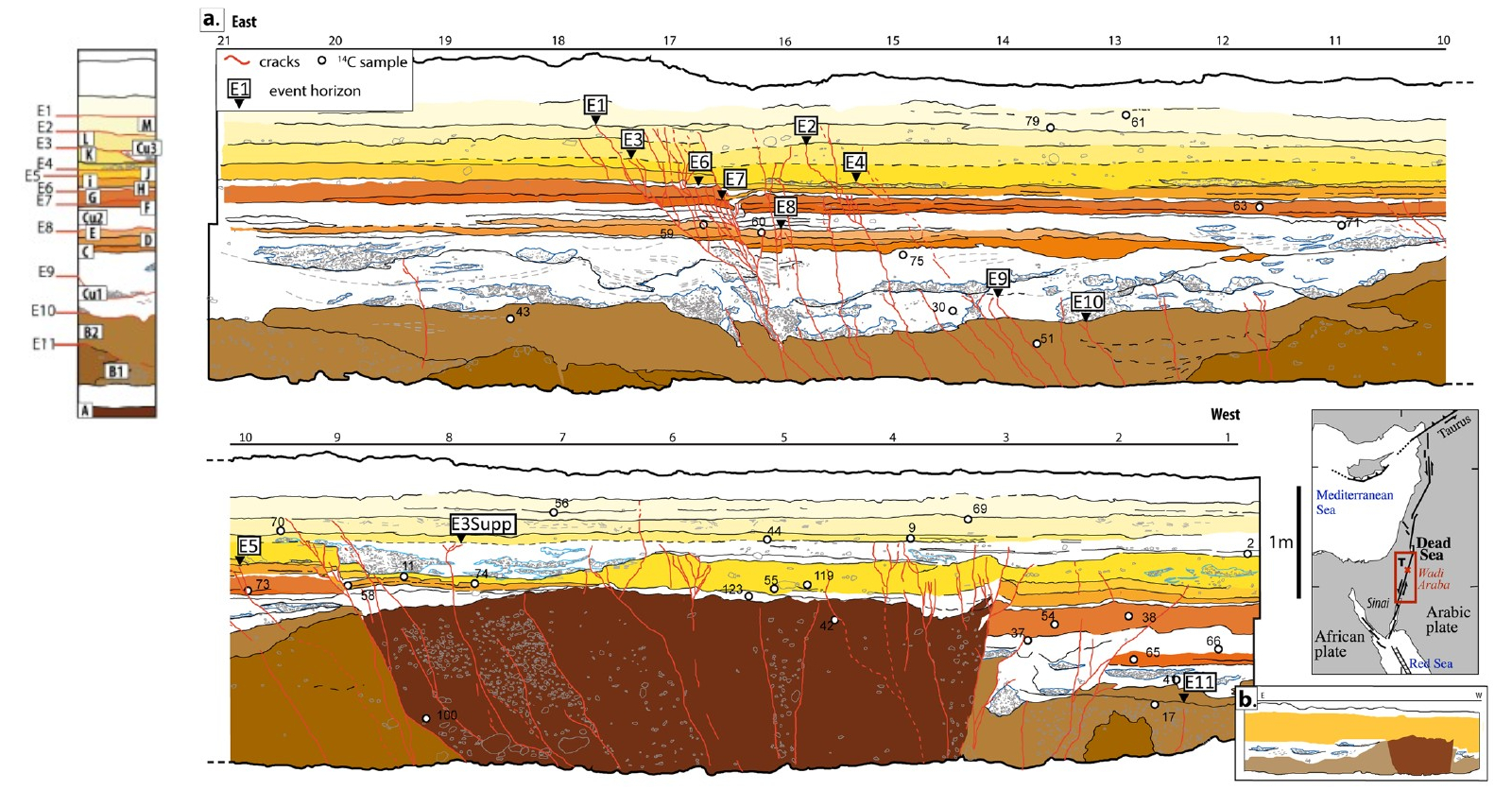
Event E7

In the Taybeh Trench, excavated across the
Arava Fault,
Lefevre et al. (2018)
identify Event E7 as a subtle rupture expressed
within the laminated sandy sequence overlying
layer E. The event is defined by a set of small
cracks observed near M17, which extend upward to
the top of layer F and are associated with a
minor vertical displacement.
Compared to E8, which shows clearer displacement
and deformation within multiple layers, E7 is
more weakly expressed. The cracks are confined
to a limited area and are relatively shallow,
terminating at the upper boundary of layer F.
However, the fine-grained and well-laminated
nature of layer F allows these fractures to be
identified with confidence, as the continuity of
lamination makes even small disruptions readily
visible.
The structural expression of E7 is therefore
characterized by small-scale brittle deformation
rather than significant offset. The limited
vertical displacement and restricted extent of
the cracks suggest either a lower-magnitude
surface rupture or deformation that was partly
accommodated through localized strain rather than
through large displacements. As in other
fault-perpendicular trench exposures, direct
evidence of lateral motion is not preserved, and
the observed deformation reflects the vertical
component of a dominantly strike-slip system.
As with Event E8, the interpretation
of E7 is less certain than for better-expressed
events. Some of the cracks attributed to this
event do not penetrate deeply and may display
geometries consistent with
pull-apart or accommodation structures. This raises the
possibility that the observed deformation could
represent secondary faulting associated with a
later rupture expressed higher up in the trench rather than an independent
surface-breaking earthquake. Nevertheless, the
consistent termination of cracks at the top of
layer F supports the interpretation of E7 as a
distinct event within the sequence.
From a depositional standpoint, E7 occurred
within a phase of relatively stable, fine-grained
sedimentation, where laminated sands were
accumulating across the trench. The preservation
of small cracks within this unit reflects minimal
post-depositional disturbance, while the lack
of significant displacement indicates that the
event did not substantially disrupt the
stratigraphic framework. This contrasts with
earlier events, where erosion and reworking
strongly affected preservation, and with later
events, where larger offsets are clearly visible.
Chronologically, E7 is moderately well-constrained.
Based on
Bayesian modeling of
radiocarbon dating of
detrital
charcoal samples
from bounding units,
Lefevre et al. (2018)
place the event between approximately 520 BCE and
280 BCE
(
2σ).
Although still relatively broad, this interval is
sufficient to distinguish E7 from adjacent events
in the sequence, while the limited structural
expression reflects both modest deformation and
uncertainty in event interpretation.