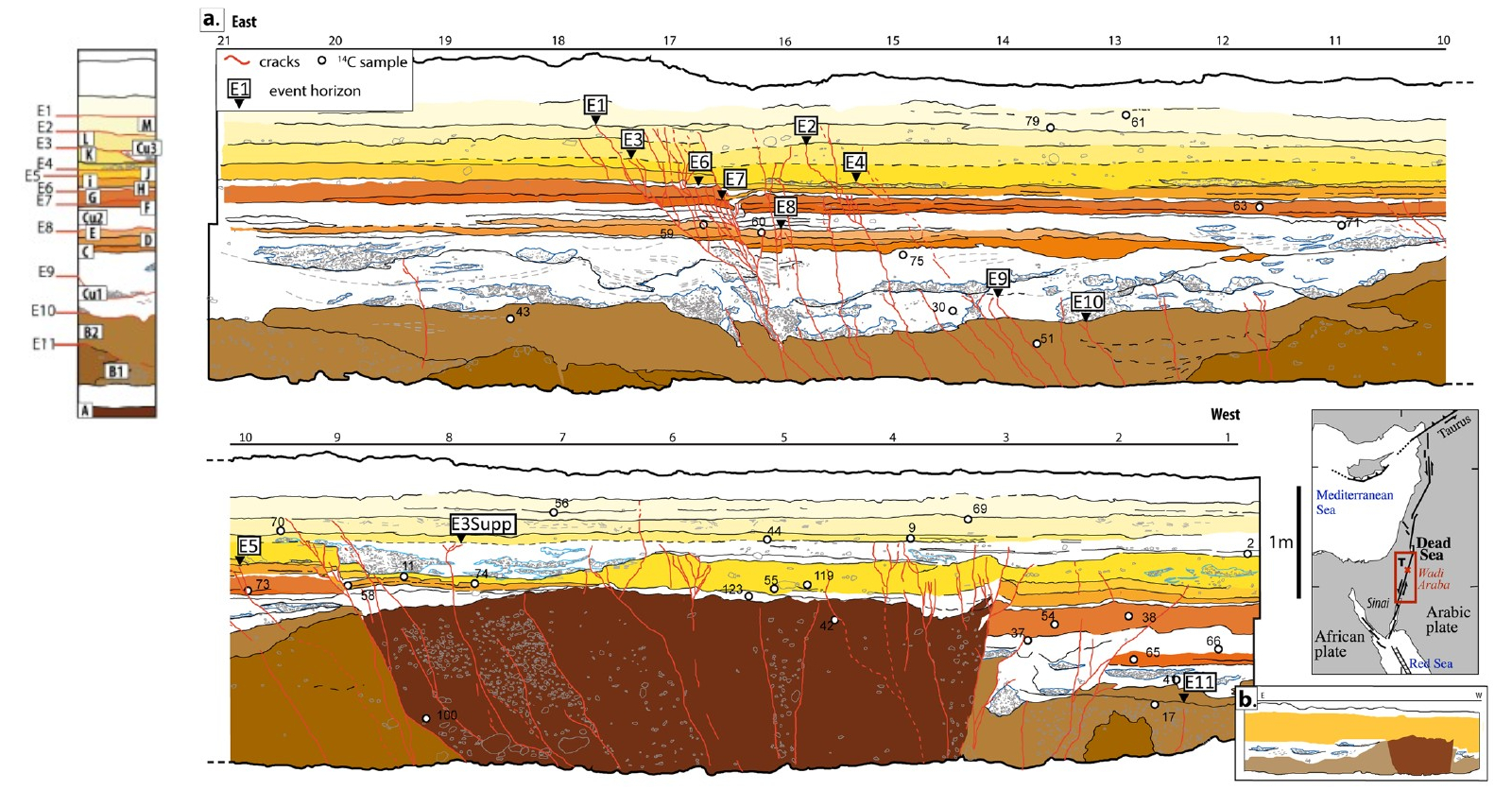
Event E6

In the Taybeh Trench, excavated across the
Arava Fault,
Lefevre et al. (2018)
identify Event E6 as a rupture expressed within
the laminated sandy succession overlying layer F
and extending upward toward layer H. The event
is defined by a set of faults that can be traced
through layers F and G, where deformation is
clearly visible despite the more ambiguous
expression at higher stratigraphic levels.
Unlike E7, which is characterized by small,
localized cracks, E6 is expressed by a more
coherent set of fractures that penetrate multiple
layers. These faults reach layer H, a thin,
coarse sandy unit, but their upper terminations
are difficult to identify because the base of
layer H is irregular and erosive. As a result,
direct measurement of vertical displacement is
not possible at the event horizon, even though
the continuity of fractures through underlying
laminated units provides clear evidence of a
surface-rupturing event.
The structural expression of E6 is therefore
intermediate between the weakly expressed E7 and
the more clearly defined younger events. The
faults cutting layers F and G indicate brittle
failure affecting relatively well-stratified
sediments, while the lack of a clear offset at
layer H reflects both the coarse nature of the
unit and the erosional character of its base.
As in other trench observations across
strike-slip systems, lateral displacement is not
directly observable, and deformation is instead
recorded through fracture networks and subtle
vertical components of motion.
From a tectonic perspective, E6 reflects
continued activity along a dominantly
strike-slip fault system, with deformation
expressed through a combination of fracturing
and minor vertical motion. The penetration of
faults through multiple laminated layers
suggests a rupture of sufficient magnitude to
affect the upper sedimentary sequence, even if
the precise displacement cannot be quantified.
The absence of clear offset at the event horizon
is likely a product of stratigraphic conditions
rather than an indication of negligible
deformation.
From a depositional standpoint, the occurrence
of E6 at the transition into layer H indicates
that seismic deformation took place during a
phase of changing sedimentary conditions, from
well-laminated sands to a thinner, coarser unit
with an irregular base. The erosional nature of
this contact has reduced the preservation of
the upper part of the deformation zone,
obscuring the exact termination of faults and
limiting the ability to reconstruct the full
extent of displacement. Nevertheless, the clear
fracturing within layers F and G provides a
reliable indicator of the event.
Chronologically, E6 is relatively well
constrained compared to earlier events. Based on
Bayesian modeling of
radiocarbon dating of
detrital
charcoal samples
from bounding units,
Lefevre et al. (2018)
place the event between approximately 160 BCE and
117 BCE
(
2σ).
This relatively narrow interval reflects improved
availability of datable material and clearer
stratigraphic relationships within the laminated
units, allowing E6 to be distinguished more
precisely within the Taybeh earthquake sequence.