Event E5

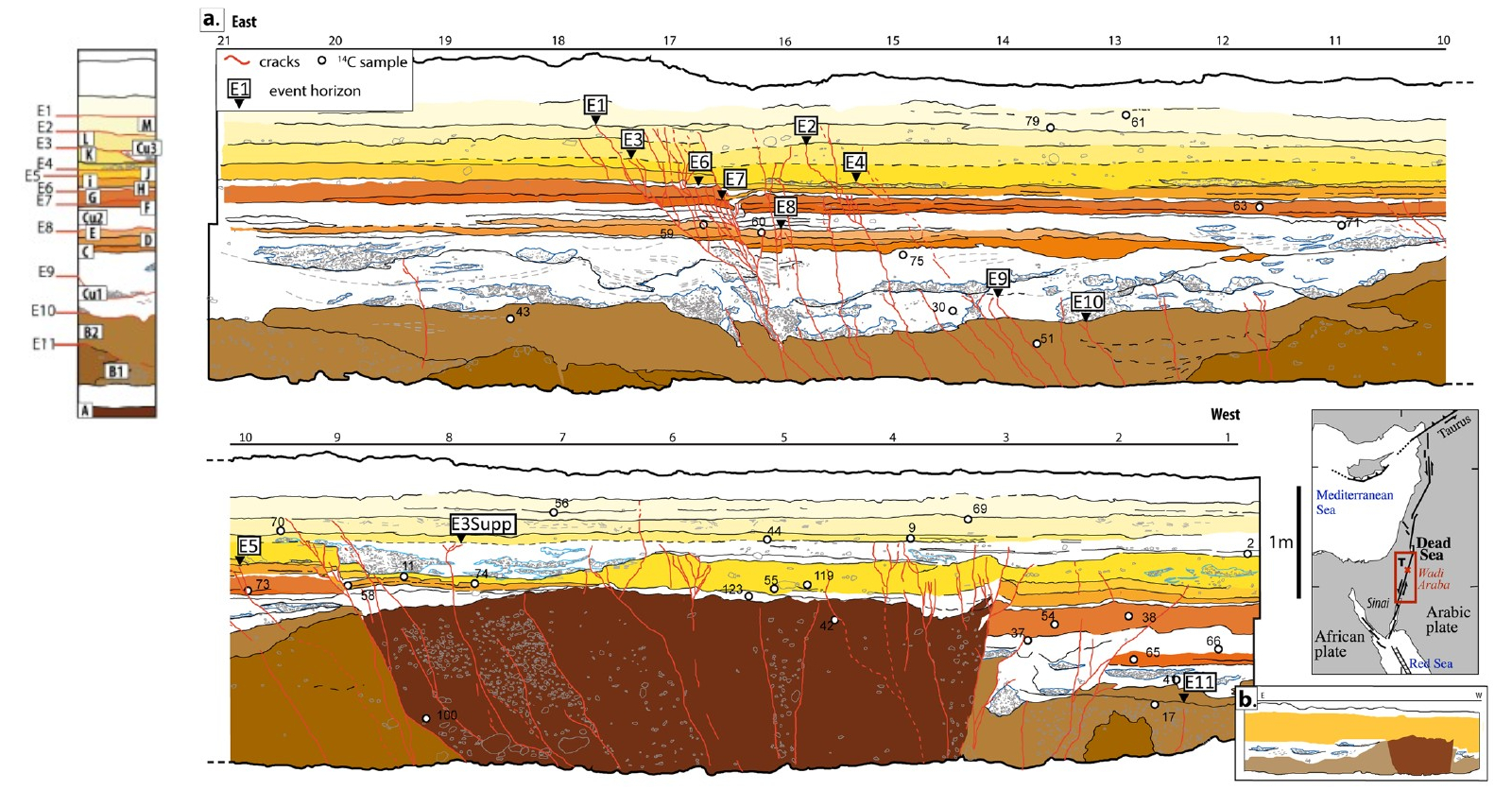
In the Taybeh Trench, excavated across the
Arava Fault,
Lefevre et al. (2018)
identify Event E5 as a weakly expressed rupture
within the laminated sandy succession, preserved
near the top of layer I. The event is defined by
a limited number of cracks concentrated between
M10 and M9, marking a discrete but localized
episode of deformation.
Unlike E6, which is characterized by faults that
penetrate multiple layers, E5 is associated with
only a small set of fractures, making its
identification less robust. These cracks extend
upward to the top of layer I, a brown sandy unit
containing an internal darker bed. Within this
intermediate bed, a small vertical displacement
is observed, providing the clearest structural
evidence for the event.
The structural expression of E5 is therefore
limited but still diagnostic. The small vertical
offset within layer I indicates localized brittle
failure, while the restricted number of cracks
suggests either a lower-magnitude rupture or
partial preservation of deformation. As with
other trench observations along strike-slip
faults, lateral displacement is not directly
observable, and deformation is instead recorded
through subtle vertical offsets and fracture
patterns.
From a tectonic perspective, E5 reflects
continued activity along a dominantly
strike-slip system, with deformation expressed
through minor vertical components superimposed
on lateral motion. The localized nature of the
fractures and the limited displacement suggest
that the rupture may not have produced
widespread surface deformation at the trench
scale. Alternatively, part of the deformation
may have been removed or obscured by subsequent
sedimentary processes.
Chronologically, E5 is moderately constrained. Based
on
Bayesian modeling of
radiocarbon dating of
detrital
charcoal samples
from surrounding units, Lefevre et al. (2018)
place the event between approximately 14 BCE and
206 CE (
2σ).