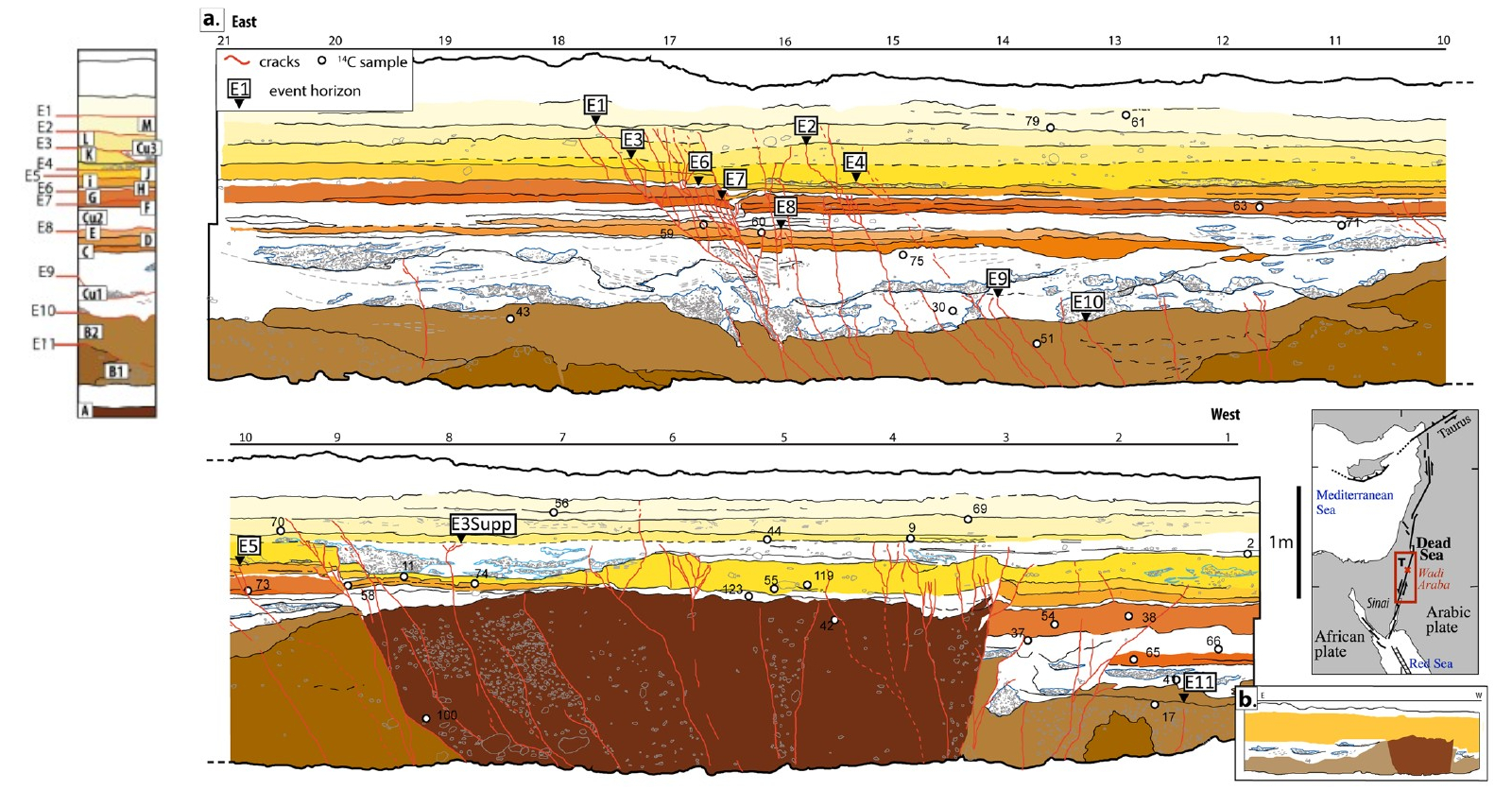
Event E4

In the Taybeh Trench, excavated across the
Arava Fault,
Lefevre et al. (2018)
identify Event E4 as a poorly expressed rupture
within the upper laminated sandy sequence,
preserved around layer J. The event is defined
by a series of cracks that cut through this
fine yellow sandy unit, although their exact
upper termination remains uncertain.
Unlike E5, which is associated with a localized
but identifiable vertical displacement, E4 is
characterized by ambiguous structural evidence.
The cracks observed within layer J may terminate
at its upper boundary, but this cannot be
confirmed because the overlying unit consists of
a thin, discontinuous gravel layer in which
deformation is difficult to recognize. As a
result, it is unclear whether the fractures
extend beyond layer J or are confined to it.
The structural expression of E4 is therefore
weak and equivocal. While the presence of cracks
indicates brittle deformation consistent with
surface rupture, the absence of clearly defined
offset layers or consistent fracture
terminations reduces confidence in the precise
definition of the event horizon. As in other
fault-perpendicular trench exposures, lateral
motion is not directly observable, and the
recorded deformation reflects only the vertical
component of a dominantly strike-slip system.
From a tectonic perspective, E4 represents a
phase of activity that is difficult to resolve
within the stratigraphic record. The limited
expression of deformation may indicate a
moderate-magnitude event or one whose surface
effects were only partially preserved.
Alternatively, the apparent weakness of the
signal may result from the coarse and
discontinuous nature of the overlying sediments,
which obscure or remove evidence of displacement.
From a depositional standpoint, E4 occurs at a
stratigraphic level where fine laminated sands
are overlain by discontinuous gravel layers.
This transition complicates the preservation of
paleoseismic features, as deformation within the
fine unit may not be transmitted clearly into
the coarser overlying deposits. The resulting
stratigraphic ambiguity makes it difficult to
distinguish whether observed cracks represent a
distinct event or are related to deformation
associated with adjacent ruptures.
Chronologically, E4 is fairly well-constrained. Based
on
Bayesian modeling of
radiocarbon dating of
detrital
charcoal samples
from surrounding units, Lefevre et al. (2018)
place the event between approximately 80 and 142 CE (
2σ)
which makes the
early 2nd century CE Incense Road Earthquake a plausible candidate.