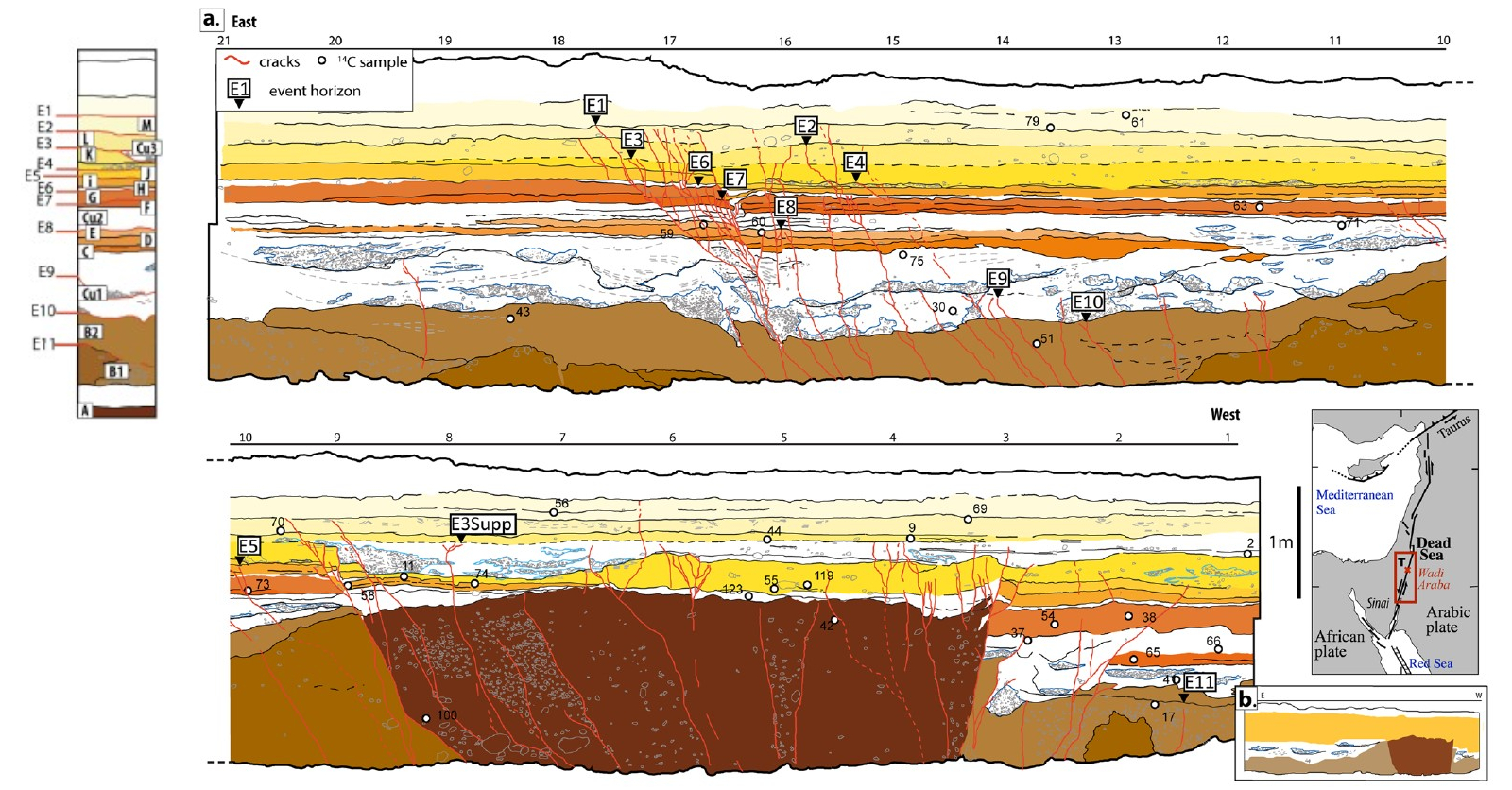
Event E3bis (aka E3supp)

In the Taybeh Trench, excavated across the
Arava Fault,
Lefevre et al. (2018)
identify Event E3
bis (also referred to as E3supp)
as a secondary rupture occurring shortly after
the major deformation associated with E3. The
event is preserved within an erosive channel
unit deposited on top of the scarp created by
E3, and is defined by a series of cracks that
terminate at the base of layer L.
Unlike E3, which is characterized by large and
laterally continuous displacement, E3bis is
expressed through a more limited set of
fractures. These cracks are observed near M8
and M4 within a channelized deposit that cuts
into the earlier E3 scarp. The stratigraphic
position of this unit clearly indicates that
E3bis postdates E3, as deformation is confined
to sediments that accumulated after the major
rupture event.
The structural expression of E3bis is therefore
moderate but distinct. The consistent upward
termination of cracks at the base of layer L
provides a clear event horizon, even though the
magnitude of displacement is smaller than that
observed for E3. As with other trench
observations across strike-slip systems,
lateral motion is not directly visible, and the
recorded deformation reflects a vertical
component of slip expressed through fracture
networks and localized offset.
From a tectonic perspective, E3bis likely
represents either a smaller independent
earthquake or an aftershock-related rupture
associated with the broader seismic episode
represented by E3. The occurrence of this event
within an erosive channel unit suggests that
fault activity continued during a period of
active sediment reworking, with deformation
superimposed on a dynamically evolving
landscape.
From a depositional standpoint, E3bis is closely
linked to the post-E3 landscape evolution. The
channel unit in which it is preserved erodes
into the earlier scarp, indicating a phase of
incision and sediment redistribution following
the major rupture. The preservation of cracks
within this unit suggests that deformation
occurred soon after deposition, before
subsequent sedimentation buried and stabilized
the surface.
Chronologically, E3bis is poorly constrained. Based on
Bayesian modeling of
radiocarbon dating of
detrital
charcoal samples
from bounding units,
Lefevre et al. (2018)
place the event between approximately 819 and 1395 CE (
2σ).