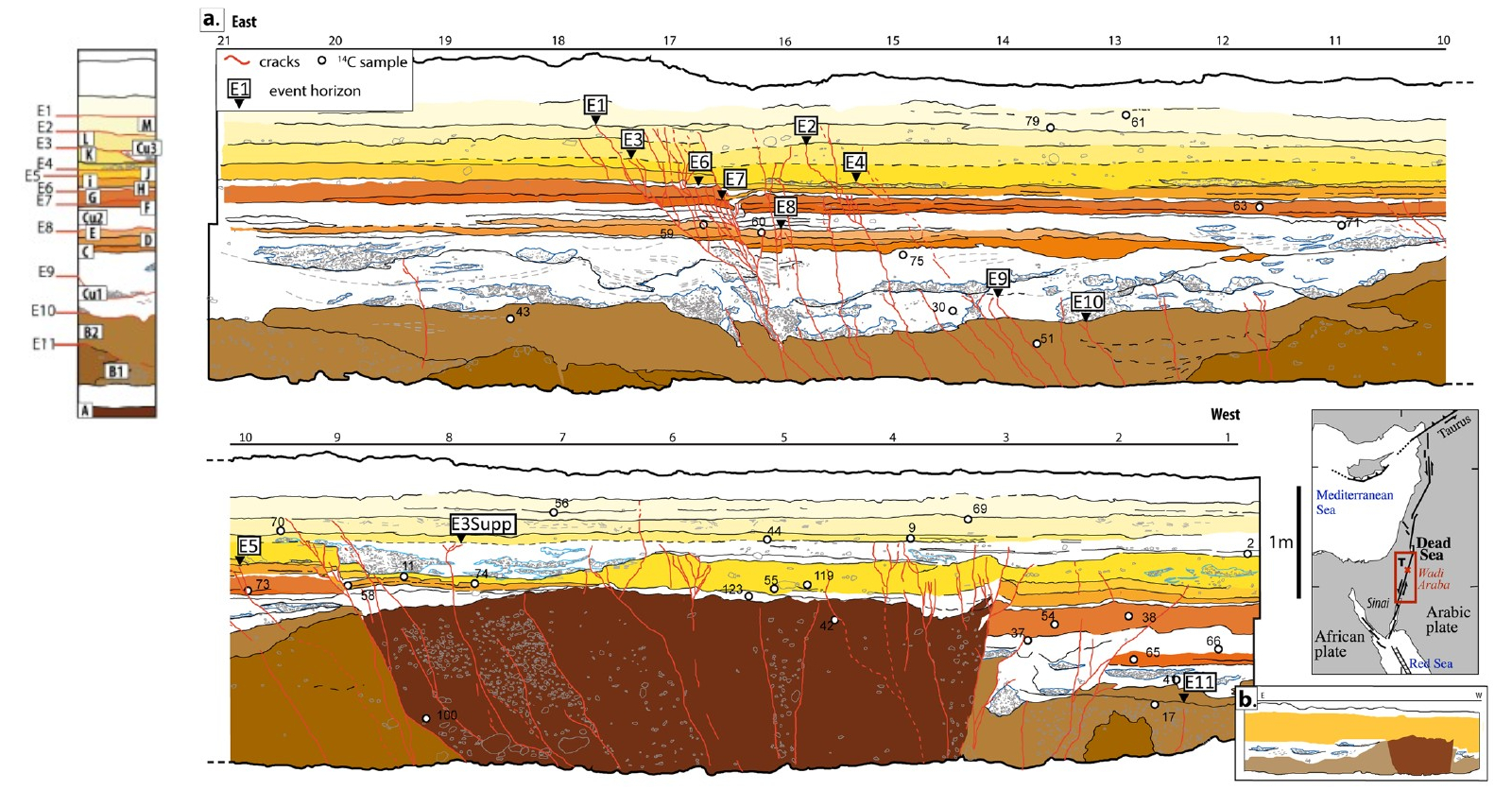
Event E3

In the Taybeh Trench, excavated across the
Arava Fault,
Lefevre et al. (2018)
identify Event E3 as one of the most prominent
ruptures preserved within the upper part of the
trench sequence. The event horizon is located at
the top of layer K, a fine, pinkish sandy unit, where deformation is expressed
through extensive fracturing and clear vertical
displacement across multiple stratigraphic
levels.
Unlike earlier events, which are often weakly
expressed or obscured by erosion, E3 is
characterized by well-defined and laterally
continuous deformation. Series of cracks are
observed both in the eastern sector near M17 and
in the central zone near M9, terminating at the
top of layer K. Event E3 may also show up between M3 and M7 as
cracks reaching the base of the overlying channel unit (Cu3).
At M9, layers I, J, and K are
clearly displaced downward by approximately
25 cm, providing a robust measure of vertical
offset and indicating significant rupture at the
surface.
The structural expression of E3 is therefore
strong and unambiguous. The magnitude of vertical
displacement, combined with the consistency of
fracture terminations, clearly distinguishes this
event from adjacent ruptures. As in other trench observations
across strike-slip systems, lateral displacement
is not directly observable, but the scale and
organization of vertical deformation indicate a
major surface-rupturing earthquake.
From a tectonic perspective, E3 reflects a
significant episode of slip along the
strike-slip system, accompanied by a pronounced
vertical component. The concentration of
deformation in two main zones, one near M17–M16
and another near M9, suggests localized
partitioning of strain within the fault zone.
The magnitude of offset and the extent of
fracturing imply a relatively large earthquake
compared to earlier events in the sequence.
Chronologically, E3 is poorly constrained. Based on
Bayesian modeling of
radiocarbon dating of
detrital
charcoal samples
from bounding units,
Lefevre et al. (2018)
place the event between approximately 287 and 815 CE (
2σ).
Although they suggest one of the
mid-8th century CE earthquakes
as a plausible candidate,
other earthquakes make a better fit, such as the
late 6th century CE Inscription at Areopolis Quake.