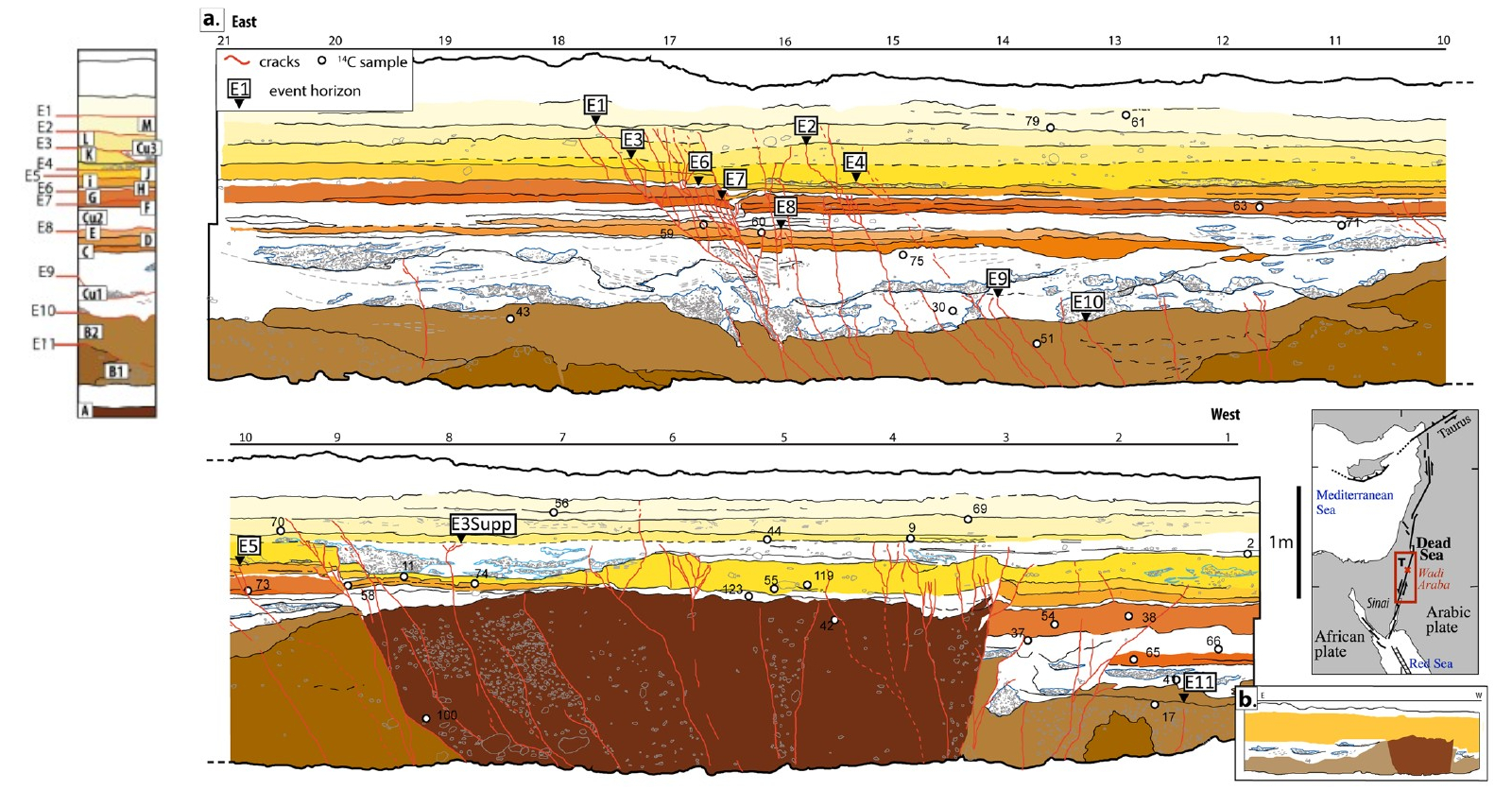
Event E11

In the Taybeh Trench, excavated across the
Arava Fault,
Lefevre et al. (2018)
identify Event E11 as the oldest and most weakly
expressed rupture in the trench sequence. This event occurs within
layer B1, a coarse
conglomerate,
where deformation is expressed not by clear offset
surfaces but by a set of cracks in the western part
of the trench that are "underlined" by vertically
oriented and rotated pebbles. These features mark
the passage of a surface-rupturing event, even
though the coarse grain size and limited internal
structure of the deposit obscure finer details of
displacement.
Unlike younger events in the Taybeh sequence, E11
does not exhibit measurable vertical displacement.
This absence is largely due to the presence of an
overlying
erosional surface,
which truncates the upper terminations of the cracks.
As a result, the original displacement associated
with E11 cannot be directly observed, and the
preserved deformation likely represents only the
lower portion of the rupture zone. The cracks
themselves, however, are well defined and consistent
with brittle failure.
The structural expression of E11 is therefore
limited but still diagnostic. The rotated pebbles
aligned along fracture planes indicate localized
shear and dilation during rupture, while the
absence of continuous offset layers reflects both
the coarse depositional environment and subsequent
reworking. In this context, deformation is recorded
primarily through
fabric reorganization rather than
through discrete displacement of
stratigraphy.
This makes E11 fundamentally different from younger
events such as E3 or E2, where laminated sandy units
allow precise identification of offsets and event
horizons. In the broader paleoseismic context, E11 belongs to
a group of early events (E11–E9) that are recorded
in coarse units and are therefore less clearly
expressed than younger earthquakes.
From a depositional perspective, the occurrence of
E11 within coarse alluvial material suggests that
the earthquake affected an environment dominated by
high-energy sedimentation, likely associated with
an active
alluvial fan.
Such environments tend to obscure subtle
paleoseismic signatures, and the preservation of
fractures within the conglomerate indicates that
E11 was sufficiently energetic to disrupt even
coarse, poorly stratified material. However, the
subsequent erosion and redeposition associated with
channel processes removed the upper part of the
deformation, limiting the observable record.
Chronologically, E11 remains poorly constrained. Based on Bayesian modeling of
radiocarbon dates
of
detrital
charcoal samples derived
from one sample stratigraphically below and two stratigraphically
above the event horizon, Lefevre et al. (2018)
place the event broadly between approximately 6100 and 5400 BCE
( 2σ).
This wide interval reflects both the limited availability of datable
material in the lower units and the presence of erosional contacts,
which introduce uncertainty.