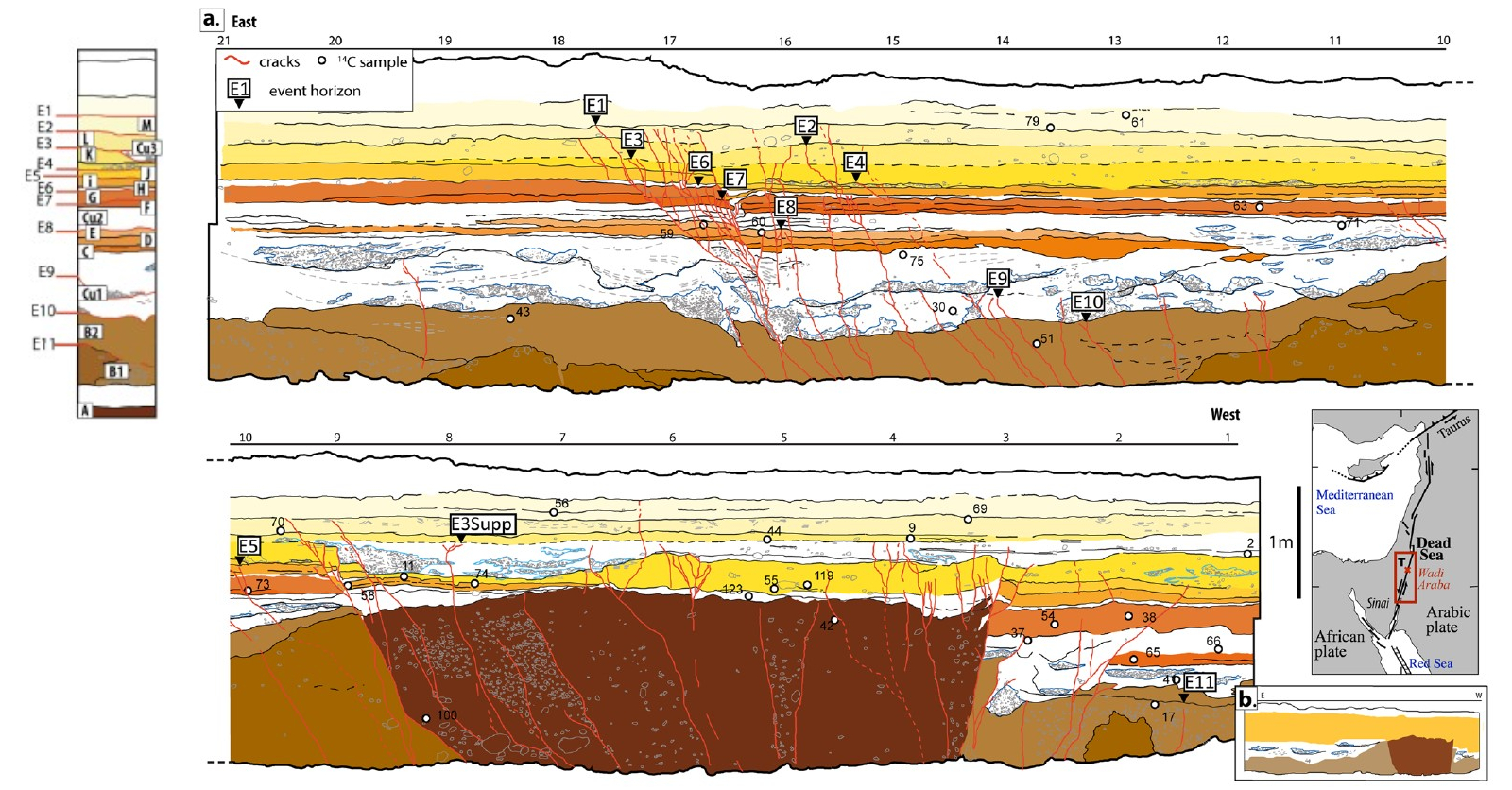
Event E10

In the Taybeh Trench, excavated across the
Arava Fault,
Lefevre et al. (2018)
identify Event E10 as one of the early ruptures
in the trench sequence, preserved near the
transition between basal coarse deposits and
overlying channelized units. The event horizon
is located at the top of layer B2, a unit of
indurated fine to medium sand with interbedded
gravels, where deformation is expressed through
a distributed set of cracks observed across both
the eastern and western portions of the trench.
Unlike E11, which is confined to a coarse
conglomerate,
E10 is recorded in a somewhat finer-grained unit,
allowing clearer identification of the event
horizon across the trench. At M2, a small but
distinct vertical displacement is observed and
attributed to this event, while elsewhere
deformation is primarily expressed as cracks
without visible offset. The lack of consistent
measurable displacement across the trench is
likely due to the presence of overlying
channelized deposits (unit Cu1), which are
erosive and have truncated or obscured the
upper terminations of many fractures.
The structural expression of E10 is therefore
more laterally extensive than E11 but still
relatively subtle. The presence of cracks across
both sides of the trench indicates that the
rupture affected a broad zone, consistent with
surface faulting along a strike-slip system.
However, as is typical in fault-perpendicular
trench exposures, direct evidence of lateral
displacement remains elusive, and deformation is
instead manifested through vertical offsets and
fracture networks. The observed small vertical
displacement at M2, combined with widespread
cracking, suggests a component of localized
vertical motion superimposed on dominant
strike-slip deformation. This pattern is
consistent with the broader tectonic setting of
the Taybeh site, where deformation reflects a
combination of strike-slip motion and variable
vertical components influenced by nearby
structural complexities.
From a depositional perspective, the occurrence
of E10 at the top of layer B2 marks a transition
from relatively continuous sedimentation to more
dynamic channelized deposition in the overlying
units. The erosive nature of these channel
deposits has significantly impacted the
preservation of the event, removing parts of the
deformation record and contributing to the
discontinuous expression of displacement. As a
result, E10 is better identified through the
spatial coherence of crack terminations than
through clear offset stratigraphy.
Chronologically, E10 is poorly constrained.
Based on
Bayesian modeling of
radiocarbon dating of
detrital
charcoal samples
from layers bracketing the event horizon,
Lefevre et al. (2018)
place E10 broadly between approximately 4600 and
4000 BCE
(
2σ).
This wide interval reflects the limited number of
datable samples associated with the bounding
units, as well as the influence of erosional
channel processes that complicate the
stratigraphic framework and reduce the precision
of chronological constraints.