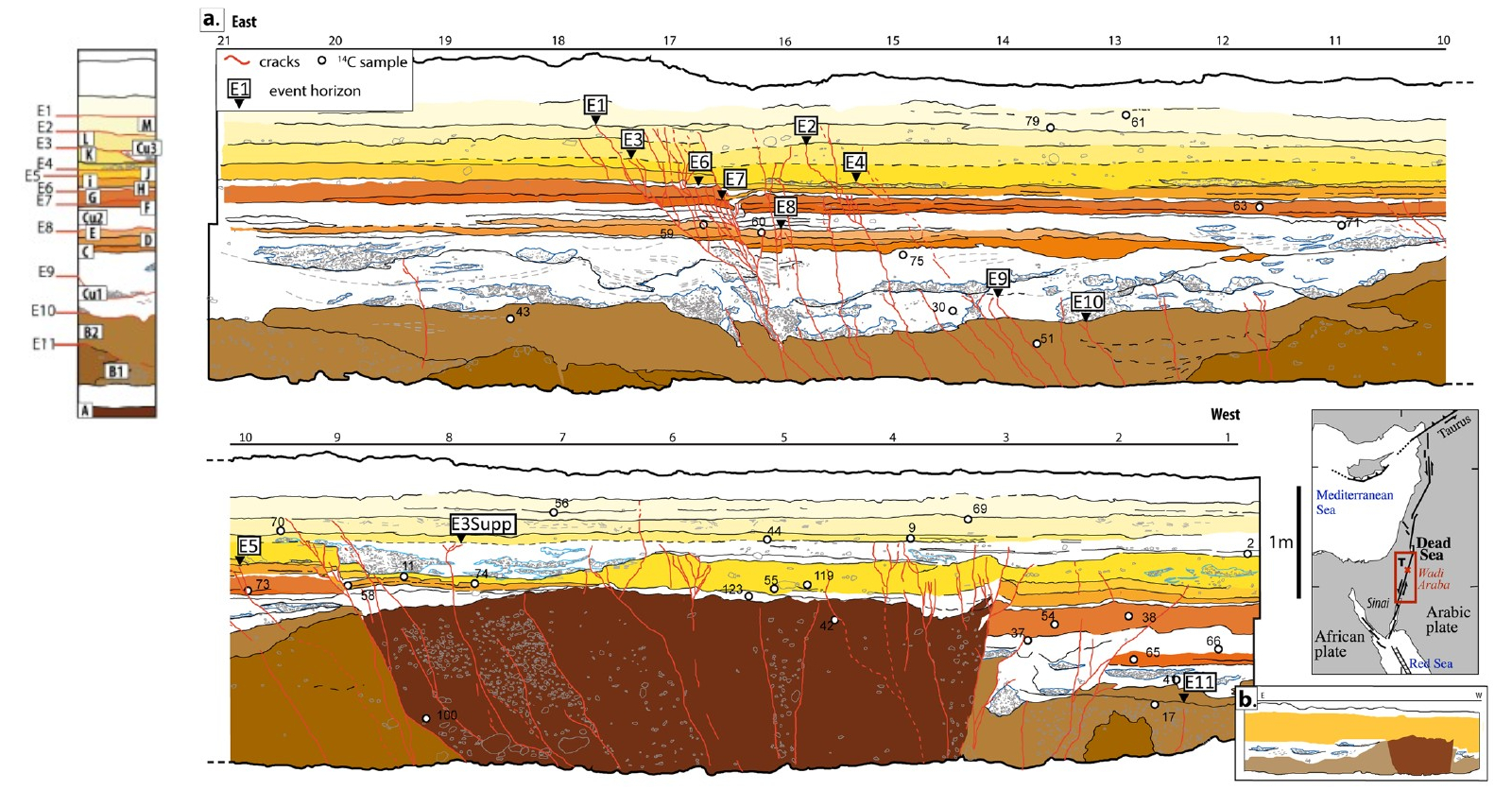
Event E1

In the Taybeh Trench, excavated across the
Arava Fault,
Lefevre et al. (2018)
identify Event E1 as the most recent rupture
preserved in the trench sequence, recorded at
the top of the stratigraphic succession. The
event horizon corresponds to the upper surface
of layer M, a light pink laminated sandy unit,
where deformation is expressed through two sets
of fractures located in the principal zones of
strain concentration.
Unlike earlier events such as E2 and E3, which
exhibit measurable vertical displacement and
well-developed fracture networks, E1 is
characterized by relatively minor deformation.
Cracks are observed near M18 and M9, extending
to the top of layer M, but are associated with
only limited displacement. The subtle nature of
these features suggests that the event produced
only modest surface deformation at the trench
scale.
The structural expression of E1 is therefore
weak but clearly identifiable.
Lefevre et al. (2018)
also identified additional cracks confined to unit A, the underlying push-up structure,
which they may attribute to Event E1.
Because the upper portion of unit A has been eroded,
no measurable offset could be determined.
From a tectonic perspective, E1 represents a
recent episode of activity along the dominantly
strike-slip fault system, with deformation
expressed through minor vertical components
superimposed on lateral motion. The limited
extent of deformation suggests either a
moderate-magnitude event or a rupture whose
surface expression was not strongly preserved
within the trench.
Chronologically, E2 is fairly well constrained. Based on
Bayesian modeling of
radiocarbon dating of
detrital
charcoal samples
from bounding units,
Lefevre et al. (2018)
place the event between approximately 1688 and 1800 CE (
2σ).
The absence of corresponding historical reports
for a major earthquake in the region during this
period may suggest that E1 represents a smaller-magnitude event, consistent with its limited
structural expression in the trench. Alternatively, it is possible that Event E1
corresponds to the
1834 CE Fellahin Revolt Quake.