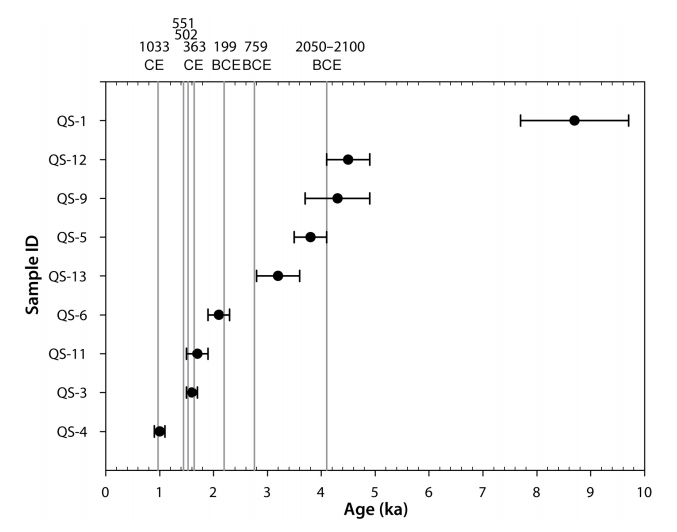
Events QS-3 and QS-11

QS-3 and QS-11 are
OSL-dated rockfall boulders from the
slopes west of
Qiryat Shemona, below the
Ramim escarpment. The rockfall source was
the 40 m high subvertical cliff of the Ein El
Assad Formation, located about 350 m above the
town.
Kanari et al. (2019) dated these rockfalls by
sampling soil or
colluvium from directly beneath the
boulders, constraining the time when the sediment
was last exposed to sunlight prior to burial by
the fallen blocks. QS-3 produced an age of
1.6 ± 0.1
ka, and QS-11 produced an age of
1.7 ± 0.2 ka, corresponding collectively to a
range of 100–500 CE (1.5-1.9 ka).
Kanari et al. (2019) note that these ages fall
within or close to the range of several large historical
earthquakes, notably the
363 CE Cyril Quakes,
the 502 CE Fire in the Sky earthquake,
and the 551 CE Beirut earthquake.
The 419 CE Monaxius and Plinta Quake
is another possibility. Although the possibility of two separate events
cannot be excluded, Kanari et al. (2019) suggested one of the
363 CE Cyril Quakes as
the most plausible candidate for both rockfalls.