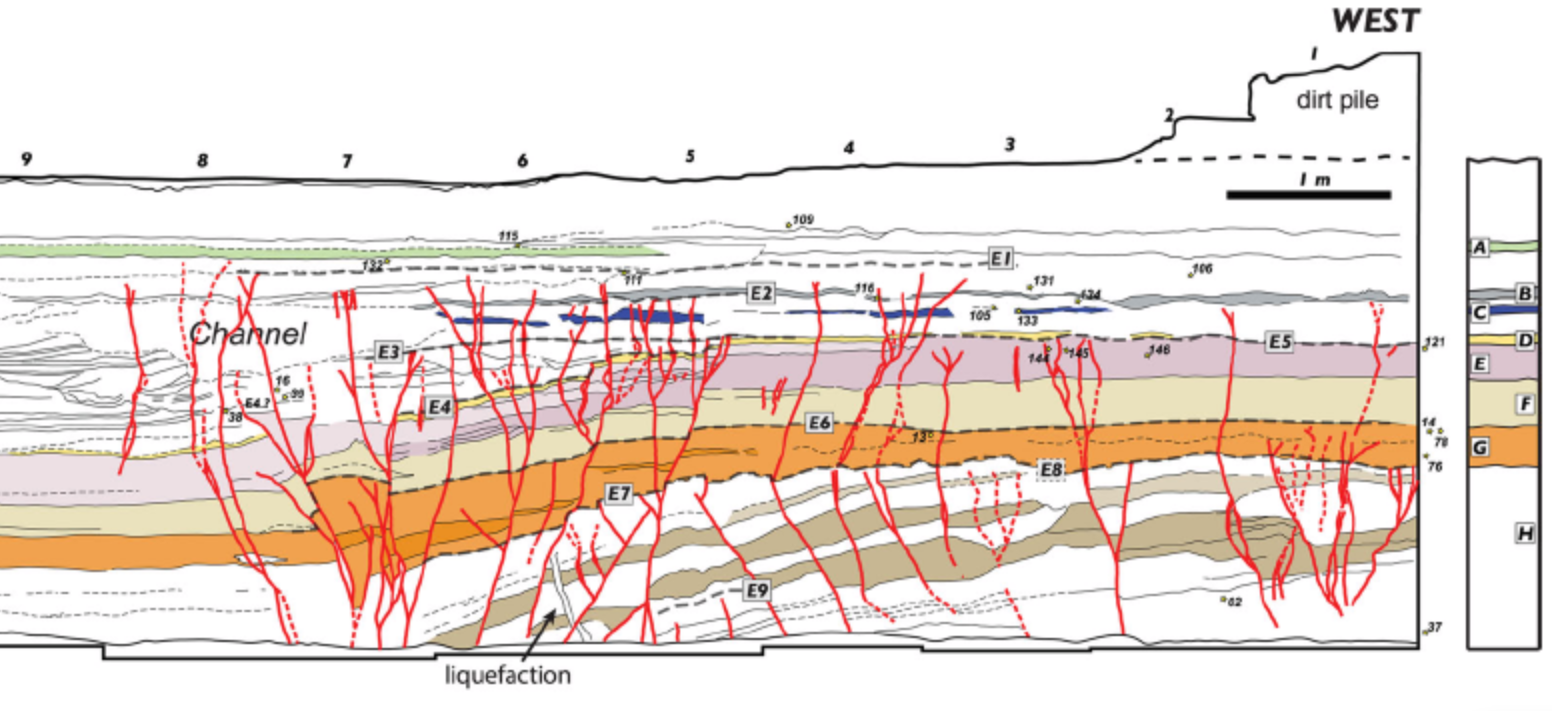
Event Esupp2

In the Qatar Trench, oriented perpendicular to the
Arava Fault
within the Yotvata Playa and just south of the
Yotvata extensional step,
Klinger et al. (2015)
identify Event Esupp2 as occurring between Events
E9 and E8. Evidence is restricted to the western fault zone of the trench and rests mainly on
a tilted
liquefaction conduit between
MM5 and
MM6,
together with faint cracks at
MM3 and
between MM5 and
MM6.
Because the conduit is tilted in the same manner
as unit H, it must predate E8, yet it rises higher
than the two cracks assigned to E9, which indicates
that it postdates E9. On this basis, Klinger et al.
infer a possible additional rupture horizon between
those two better defined events, but they stress that
the evidence remains difficult to document. Esupp2 is
interpreted as one of the fault
ruptures that likely terminated at the Yotvata
extensional step.
Chronologically, Esupp2 falls within the broad early
prehistoric interval assigned to the lower part of the
trench, sometime between E8 and E9, within the wider
2797-1245 BCE bracket for the E8-E9
sequence. This bracket was determined from a
Bayesian model of
radiocarbon dates derived from
detrital charcoal.