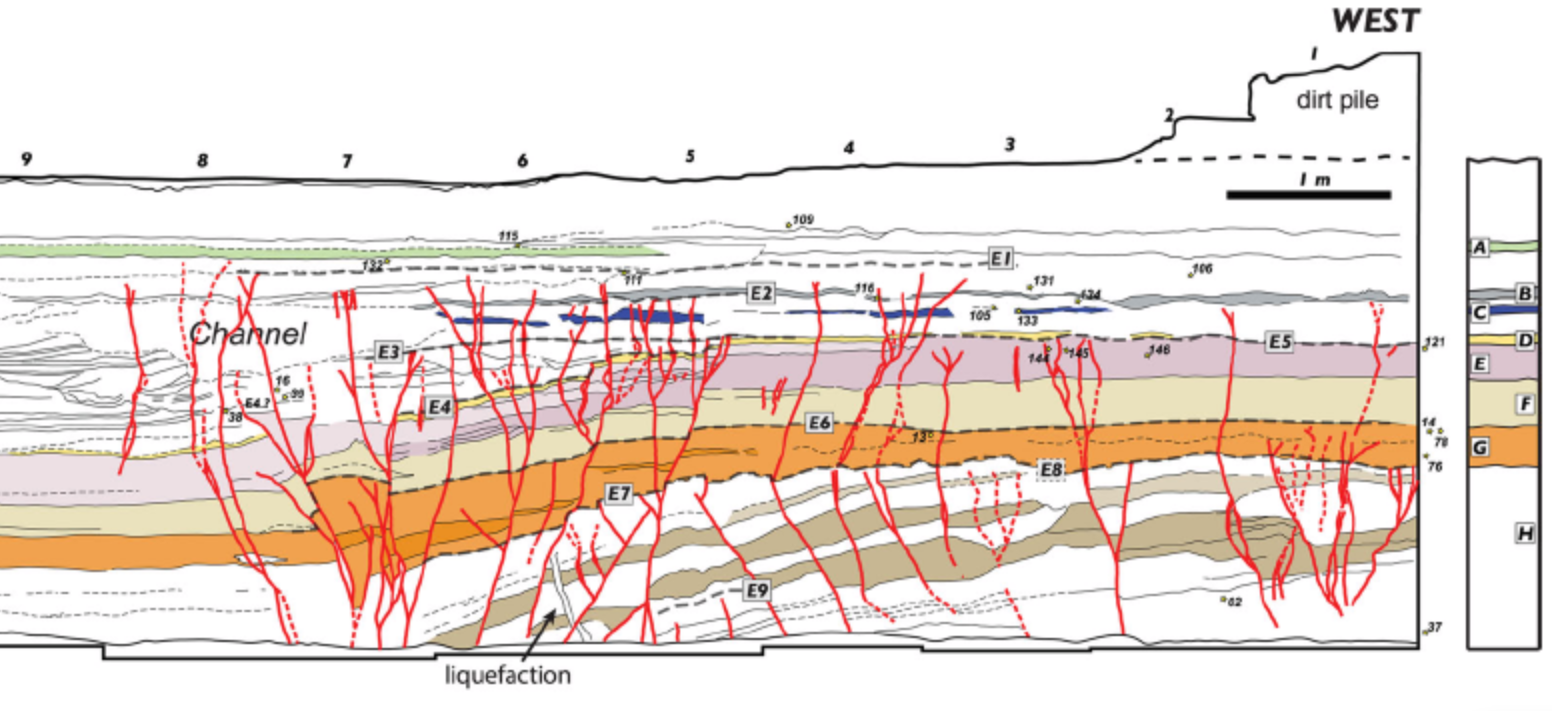
Event E9

In the Qatar Trench, oriented perpendicular to the
Arava Fault
within the Yotvata Playa and just south of the
Yotvata extensional step,
Klinger et al. (2015)
identify Event E9 as the oldest unambiguous rupture
recognized in the trench. The evidence is confined
to the western part of the main fault zone, where a
set of two faults at
MM5
offsets the lower part of unit H. These faults can
be followed upward only indistinctly, and their
upper terminations are not sharply defined. However,
the sandier beds higher in unit H, which alternate
with finer material, are not offset. This indicates
that the rupture horizon for E9 lies below those
overlying sands and therefore in the lower part of
unit H.
The interpretation of E9 rests mainly on this pair
of faults and on its stratigraphic relationship to
younger deformation. A tilted
liquefaction conduit
between
MM5
and
MM6
rises appreciably higher than the two E9 cracks, so
it must postdate E9. Yet that conduit was itself
tilted together with unit H during the later Event
E8, which shows that E9 predates both the conduit-
forming disturbance and the stronger deformation of
E8. In this way, E9 marks the earliest recognized
surface-breaking event in the lower trench sequence,
before the Esupp2 and
before the more substantial tilting assigned to E8.
Chronologically, E9 belongs to the broad prehistoric
interval represented by the E8, Esupp2, and E9, which
Klinger et al. (2015)
place within a 2797-1245 BCE bracket. This age range
was derived from a
Bayesian model
built from
radiocarbon dates
obtained on
detrital charcoal. Because the lower part
of the trench contains fewer chronological markers
and because the contact between units H and G is
erosional, E9 cannot yet be dated more narrowly.
Klinger et al. treat E9 as part of an
early seismic cluster, possibly paired with E8, in
which two closely spaced prehistoric ruptures may
record a broader episode of regional earthquake
activity along the southern Dead Sea fault. However,
because E9 is interpreted as one of the fault
ruptures that likely terminated at the Yotvata
extensional step, its proposed pairing with E8,
which is inferred to have propagated through this
step, is
internally inconsistent.