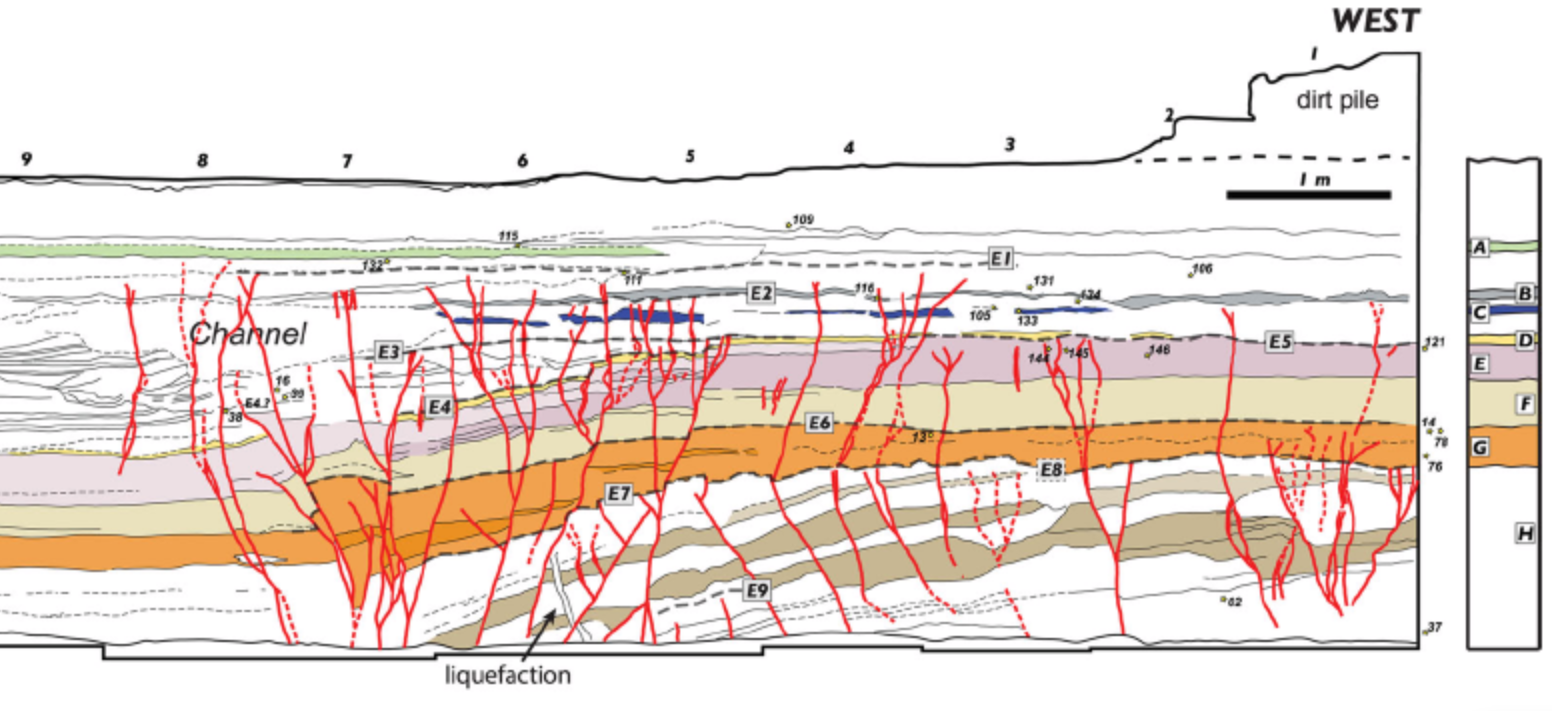
Event E8

In the Qatar Trench, oriented perpendicular to the
Arava Fault
within the Yotvata Playa and just south of the
Yotvata extensional step,
Klinger et al. (2015)
identify Event E8 as a major prehistoric rupture in
the lower part of the trench sequence, younger than
E9 and Esupp2 and older than E7. Evidence is restricted to the western fault zone of the trench and is expressed by a
distinctive set of faults, most of them dipping
westward, between
MM1
and
MM5,
which tilted the layers of unit H. This deformation
was not limited to simple cracking. Klinger et al.
infer that the event also produced a substantial
down-drop of the eastern compartment, creating
accommodation space later filled by
subhorizontal sediments preserved east of
MM8
beneath unit G. In this respect, E8 stands out as
one of the larger deformation events in the trench,
involving both faulting and
block rotation rather
than only narrow cracks.
The faults associated with E8 terminate upward near
the contact between units H and G, but that contact
itself is not offset even though the lower layers
are. Klinger et al. therefore conclude that the H-G
contact is an
erosional contact that postdates E8 rather
than the true event horizon. Some E8 cracks were
later reactivated by younger earthquakes and can be
traced upward through higher levels, but their upper
geometry differs from the original structure because
later motion produced eastward-dipping fault traces.
This overprinting complicates the reconstruction,
yet the older westward-dipping geometry and the
tilting of unit H remain the key indicators that
E8 was a separate, substantial event.
Event E8 is also bracketed stratigraphically by a
tilted
liquefaction conduit
between
MM5
and
MM6.
Because that conduit was tilted together with all of
unit H, it must predate E8. At the same time, the
conduit rises higher than the cracks attributed to
E9, demonstrating that it postdates E9. This helps
place E8 above E9 and above the possible Esupp2
liquefaction conduit
disturbance, while still below the better-defined
E7 rupture at the H-G boundary. The result is a
sequence in which E8 records a major episode of
subsidence and tilting in the western fault zone,
later followed by renewed rupture on overlapping
fault traces.
Chronologically, E8 falls within the same broad
prehistoric interval as E9 and Esupp2.
Klinger et al. (2015)
assign the E8–E9 sequence to a 2797–1245 BCE
time window derived from a
Bayesian model
based on
radiocarbon dates
derived from
detrital charcoal.
They propose that E8 and E9 may represent a paired
sequence, although the temporal spacing between
the two events cannot be resolved with precision
because of limited chronological control in the
lower trench and the presence of an
erosional hiatus at the H–G contact, which
may have removed as much as ~700 years of the
sedimentary archive. In their interpretation, E8
is emphasized, together with E4, as one of the two
events marked by comparatively large vertical
displacement, a pattern they attribute to rupture
propagation through the
Yotvata extensional step and potentially along a much longer
segment of the Wadi Araba fault compared to the
more localized, crack-dominated events. However,
because E9 is interpreted as one of the fault
ruptures that likely terminated at the Yotvata
extensional step, its proposed pairing with E8,
which is inferred to have propagated through this
step, is
internally inconsistent.