Event E6 Open this page in a new tab

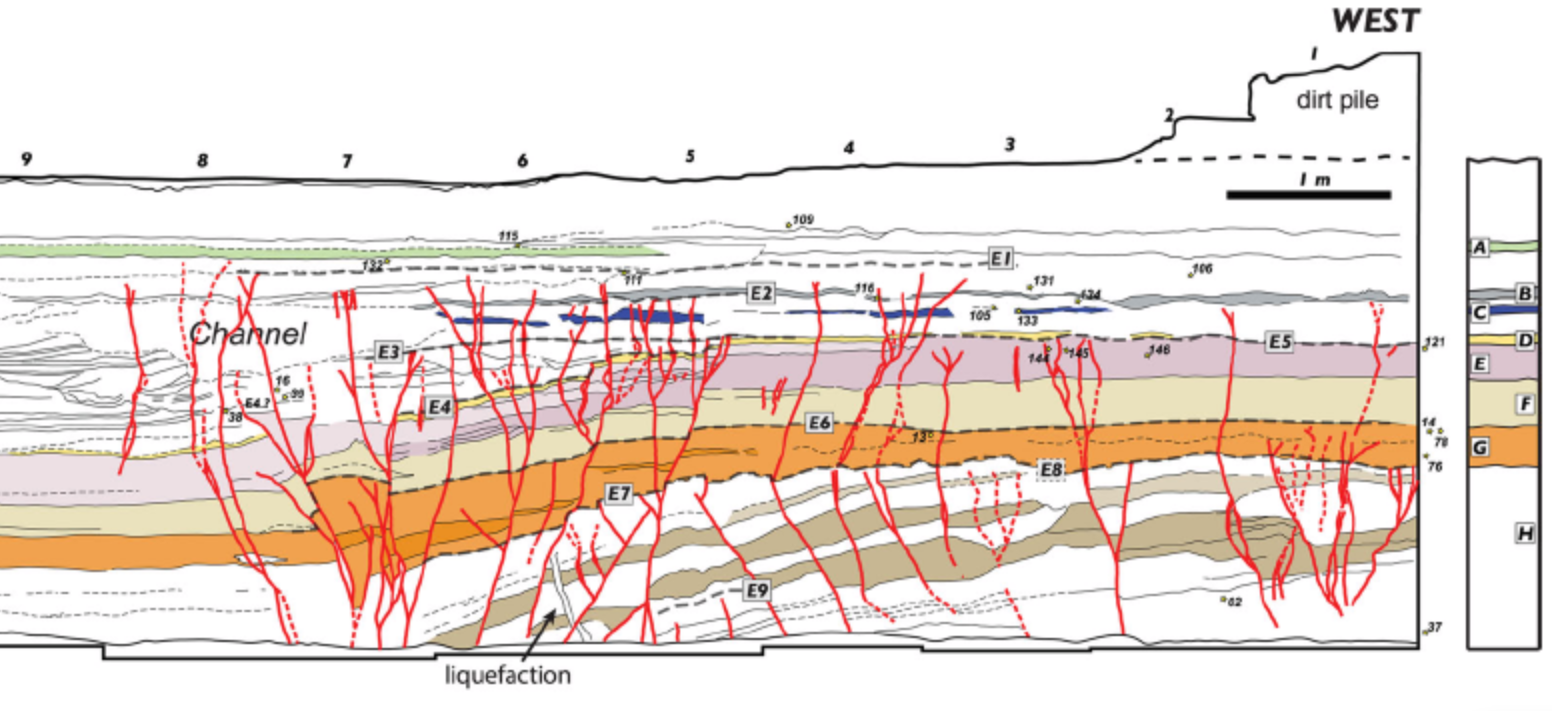
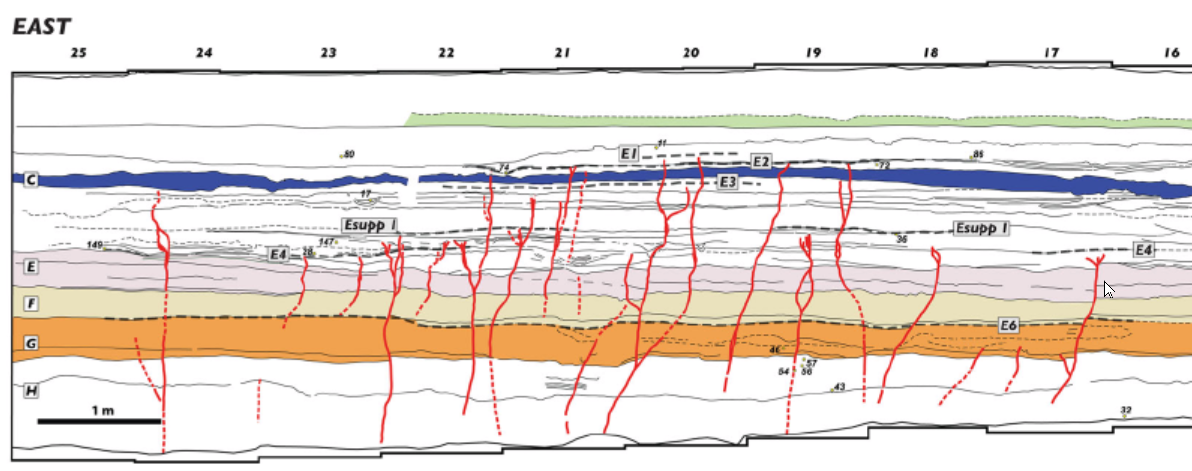
In the Qatar Trench, oriented perpendicular to the Arava Fault within the Yotvata Playa and just south of the Yotvata extensional step, Klinger et al. (2015) identify Event E6 as a clearly expressed rupture in the middle part of the trench sequence, younger than E7 and older than E5. Evidence is present in both the west and east fault zones and is defined by a group of faults that terminate within unit G. These faults are especially well exposed at MM1, MM6– MM7, and MM17. The upward terminations of E6 faults do not all end at exactly the same level, especially near MM7 in the main fault zone. Klinger et al. interpret this variation as the combined result of lateral change in the thickness of unit G, prior subsidence of the eastern compartment during E7, and the effects of horizontal slip during E6 itself. Because of this complexity, they place the E6 event horizon at the contact between G and F, while noting that the true horizon might locally lie slightly lower in the section. Structurally, E6 appears as a crack- and fault- dominated event rather than one accompanied by the large tilting and probable accommodation space creation seen in E8 or the major vertical deformation documented for E4. According to Klinger et al. (2015), this indicates that it is likely that E7 was created by a fault rupture that terminated at the Yotvata extensional step. Still, because E6 is visible in both fault zones, it likely represents a substantial rupture at the trench site.

Chronologically, E6 is less tightly constrained than E7 because unit F contained no preserved organic material suitable for dating. Klinger et al. (2015) place the event between 9 BCE and 492 CE on the basis of a Bayesian model of radiocarbon dates derived from detrital charcoal from adjacent units.


Figure 5 - Trench log of the southern wall. The full resolution photomosaic of the wall is available in Fig. S1. The different stratigraphic units are indicated by letters A to H located in the synthetic stratigraphic section. Conservative position of event horizons are indicated with a dashed line, including for event Esuppl unambiguously visible in the eastern fault zone only. E8 is indicated for reference, although the dashed line corresponds to E7 event horizon (see discussion in text). Esupp2, between E8 and E9 is not indicated. Meter Marks (MM) are indicated above the trench. Dated 14C samples are indicated by star. To the west, a few samples have been collected up to 2 m outside the gridded wall, where the layers could be traced horizontally. Samples are indicated at the corresponding depth and stratigraphic position. - Click on Image to open in a new tab - Klinger et al (2015)


Figure 5 - Trench log of the southern wall. The full resolution photomosaic of the wall is available in Fig. S1. The different stratigraphic units are indicated by letters A to H located in the synthetic stratigraphic section. Conservative position of event horizons are indicated with a dashed line, including for event Esuppl unambiguously visible in the eastern fault zone only. E8 is indicated for reference, although the dashed line corresponds to E7 event horizon (see discussion in text). Esupp2, between E8 and E9 is not indicated. Meter Marks (MM) are indicated above the trench. Dated 14C samples are indicated by star. To the west, a few samples have been collected up to 2 m outside the gridded wall, where the layers could be traced horizontally. Samples are indicated at the corresponding depth and stratigraphic position. - Click on Image to open in a new tab - Klinger et al (2015)


By Jefferson Williams