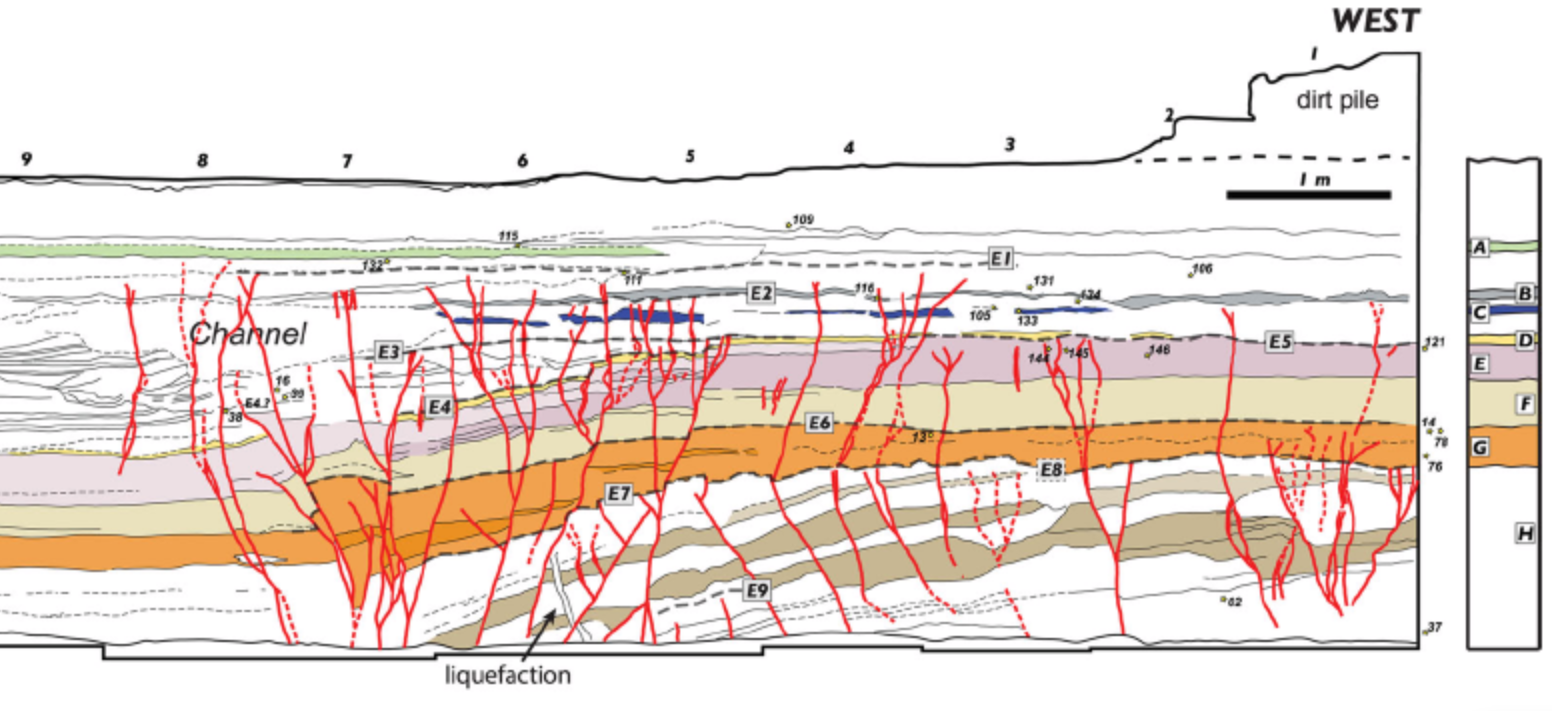
Event E5

In the Qatar Trench, oriented perpendicular to the
Arava Fault
within the Yotvata Playa and just south of the
Yotvata extensional step,
Klinger et al. (2015)
identify Event E5 as a relatively modest rupture in
the middle part of the trench sequence, younger than
E6 and older than E4. Evidence is restricted to the
western fault zone of the trench and is most clearly
expressed at
MM3,
where faults terminate at the top of unit E and are
sealed by unit D. Because unit D is a yellowish,
compact, fine sand layer with sharp boundaries, it
provides a particularly clear marker for separating
successive ruptures. On this basis, E5 is defined as
a distinct event that deformed unit E but did not
break unit D. In contrast to larger events in the
sequence, E5 is characterized by limited deformation
rather than major warping or broad vertical offset.
The distinction between E5 and E4 depends heavily on
the stratigraphic role of unit D. At
MM5,
faults that cut unit D and stop just above it cannot
belong to E5 and are instead assigned to the younger
event E4. This makes unit D an important separator
between the two ruptures and removes ambiguity about
whether the observed deformation represents one event
or two. Klinger et al. emphasize that the presence of
this distinct marker layer demonstrates that E5 and
E4 are separate earthquakes, even though their cracks
terminate within only a short vertical distance of one
another in the trench wall.
Structurally, E5 appears as a crack- and fault-
dominated event with relatively minor expression. Unit
E can be traced across the trench, but no cracks
related to E5 are visible east of
MM8,
which indicates that the event was either limited to
the western part of the main fault zone or else too
weakly expressed farther east to be recognized. Unlike
E4, which produced major
subsidence of the eastern compartment and
substantial deformation, E5 left only a modest set of
fault terminations. In the broader discussion of the
trench sequence, Klinger et al. therefore regard E5
as an event of smaller magnitude at the site, or
alternatively as a more distant earthquake that
triggered only limited cracking in the trench exposure.
Chronologically, E5 forms a closely spaced pair with
E4.
Klinger et al. (2015)
place the E4-E5 sequence within a 671-845 CE time
window derived from a
Bayesian model
of
radiocarbon dates
derived from
detrital charcoal.
Within that interval, they discuss correlation with the
8th-century CE seismic crisis.