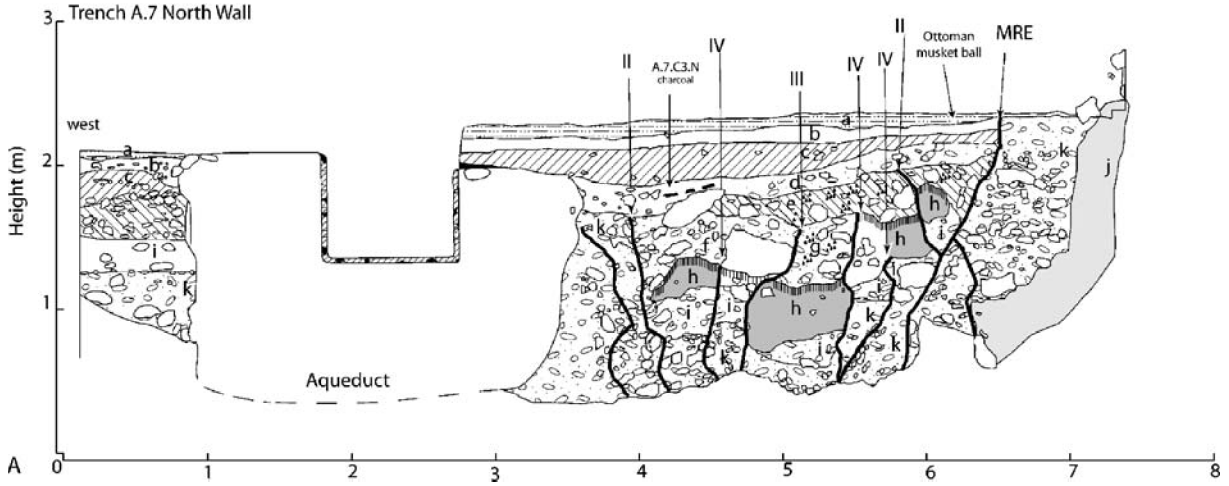
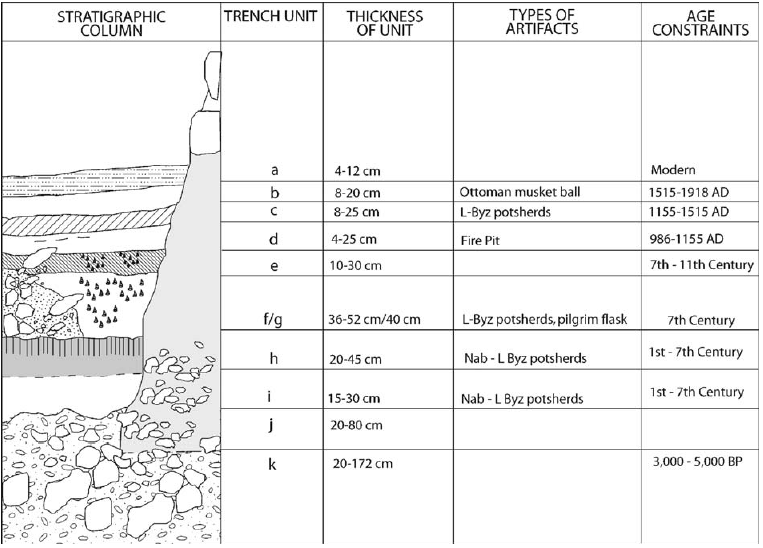
Event IV

Haynes et al. (2006)
identify an earlier seismic event, Event IV, at Qasr Tilah
that they date to the 7th century CE. They
suggest that the causative earthquake was
either the Sword in the Sky Quake (633/634 CE)
or the Jordan Valley Quake of 659/660 CE,
favoring the latter.
Archaeological evidence indicates that the site
was occupied at the time of this 7th century
destruction. Structural repairs were carried
out after the event, showing continued use of
the site following the earthquake. Because of
these repairs, it is unclear how much
lateral slip was produced, or even whether the observed
damage was caused by lateral displacement or by
generalized destructive shaking.
At some point after this repair phase, the site
was abandoned. Archaeological evidence indicates
that occupation did not continue beyond the
Early
Umayyad
period (661–700 CE). As noted by Haynes et al.
(2006), "MacDonald (1992) collected some
Byzantine and Umayyad surface
potsherds at the
site and documented ruins of Byzantine houses
(village) along the fan surface of Wadi Tilah."
If the observed repairs addressed damage caused
by lateral slip rather than generalized shaking,
this would imply that part of the
Wadi Araba fault ruptured during the 7th century event.