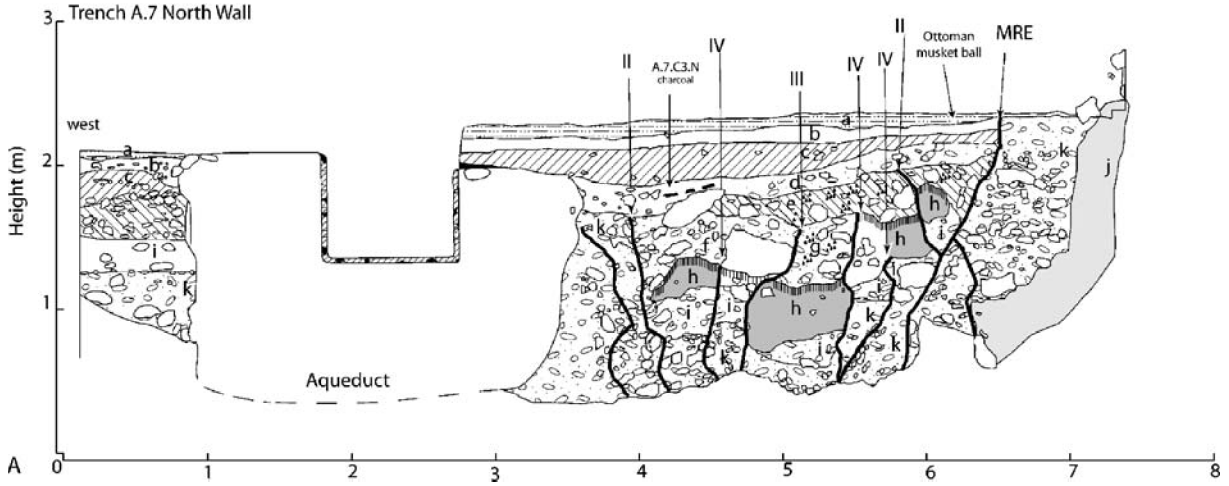
Event III

Haynes et al. (2006)
identify a ground-rupturing earthquake,
labeled Event III, in the trench stratigraphy.
This event displaced units f, g, h, and k, and
its rupture trace is buried by unit e, showing
that the earthquake occurred before the
deposition of that layer (e).
The tops of units f and g appear to have formed
the ground surface at the time of the rupture,
indicating that Event III took place after Event IV which ruptured units f and g in the
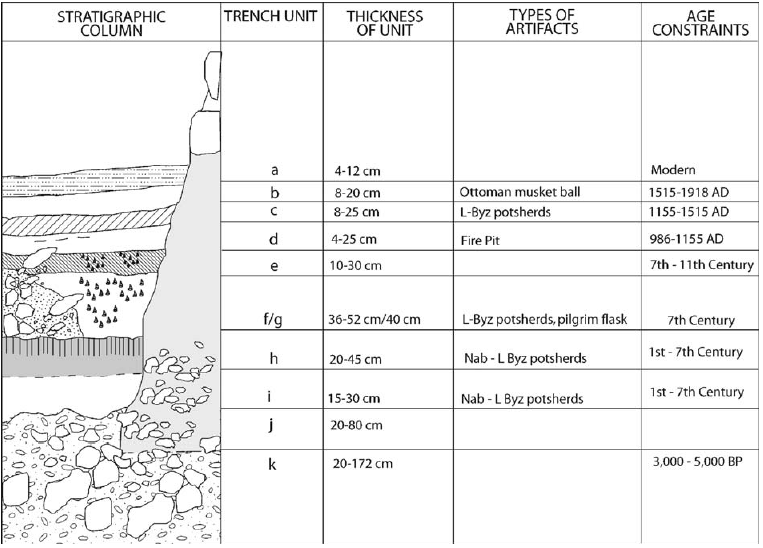
7th century. These underlying units (f and g) contain
aqueduct rubble and potsherds dating to the
7th century, providing a
terminus post quem
for the earthquake.
Unit e, which seals the rupture, lies beneath
unit d, a layer with a radiocarbon-constrained
age between the 10th and 12th centuries. This
provides a
terminus ante quem
for the event. Taken together, these
relationships indicate that Event III occurred
sometime between the 7th and 12th centuries CE.