Haynes et al. (2006) identify the penultimate ground-rupturing earthquake, labeled Event II, in the trench stratigraphy. This event offsets unit e along with units f and g and the underlying layers, showing that these deposits were in place at the time of rupture. The fault trace terminates at the top of unit e, indicating that unit e formed the ground surface when the earthquake occurred. This layer is sealed by the undeformed unit d, which has a radiocarbon age between 986 and 1155 CE. This provides a terminus ante quem in the 10th to 12th centuries for the event. The underlying layers reflect occupation that ended after the 7th century, providing a terminus post quem for the earthquake. Taken together, these constraints indicate that Event II most likely occurred sometime between the 7th and 12th centuries CE.
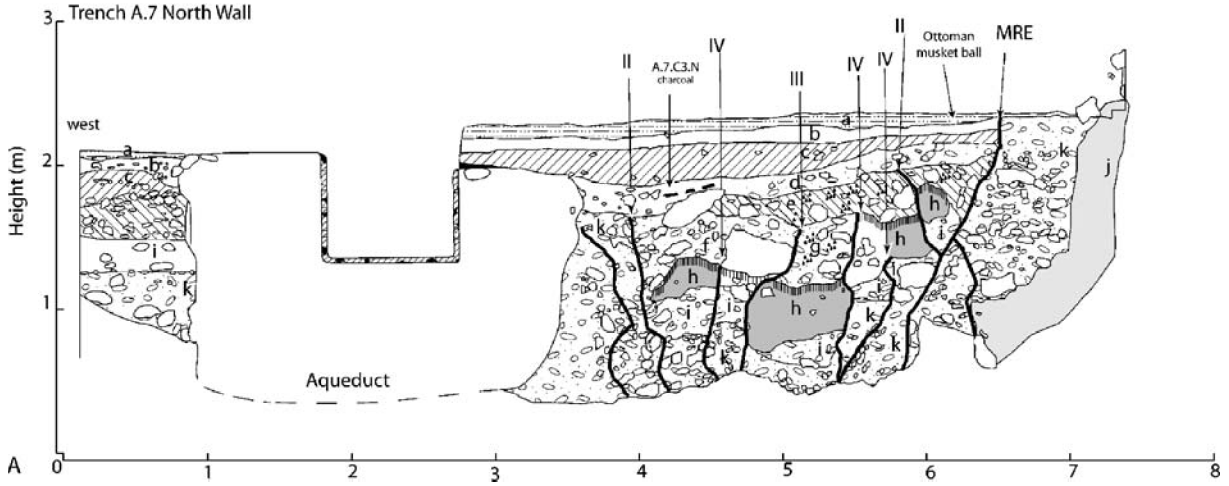
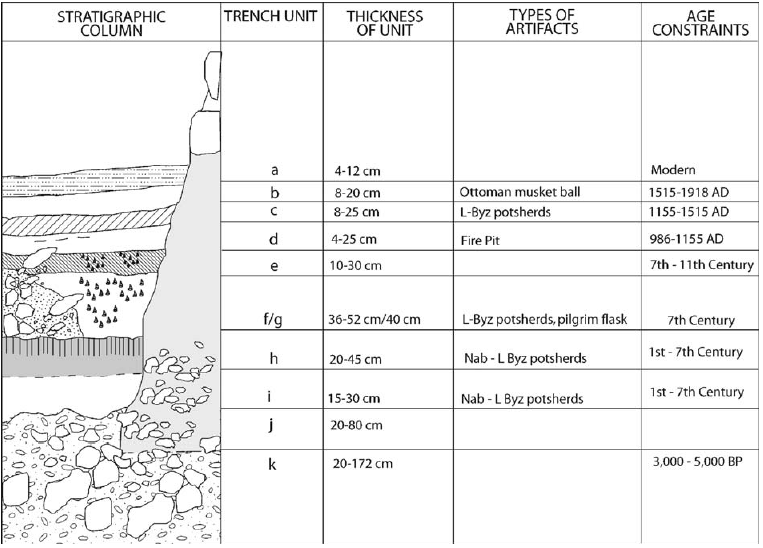
Left - Figure 5 - Schematic diagram of Trench A.7 north wall. Stratigraphic units are identified by lowercase letters. Faults are emphasized by heavy lines. Earthquakes are identified by Roman numerals, with IV as the oldest. Dashed lines indicate unexcavated portion of aqueduct floor - Right - Figure 4 - Schematic stratigraphic column of Trench A.7. Thicknesses of units are generalized from measurements of unit throughout the trench. Listed artifacts provide age control for constraining deposition and earthquake history in units where they were discovered. Age constraints come from radiocarbon data and typological dating of sherds. - Click on either image to open in a new tab - Both figures from Haynes et al. (2006)