Event I Open this page in a new tab

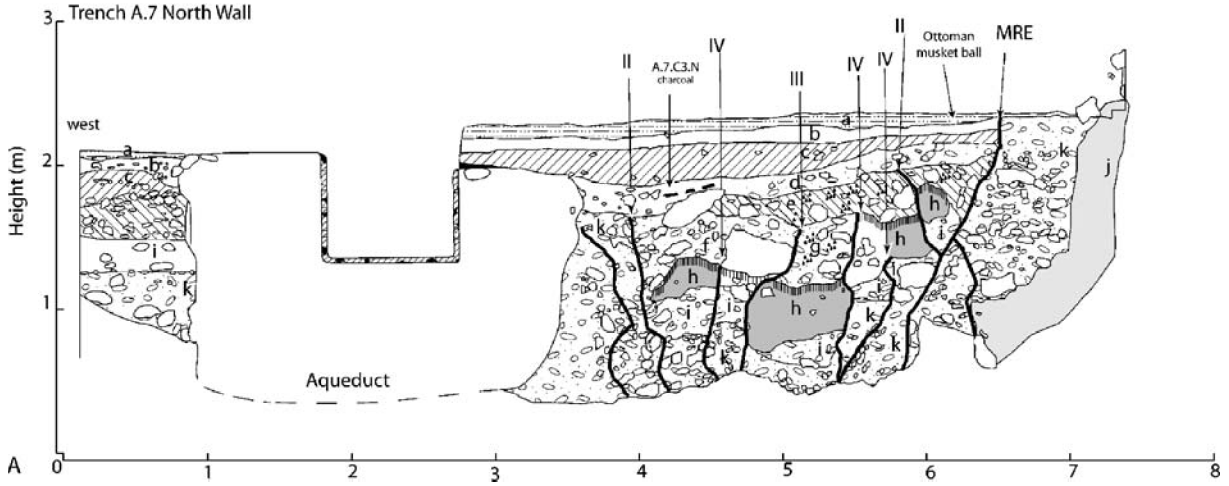
Haynes et al. (2006) report that at the archaeological site of Qasr Tilah, trenching in Trench A.7 across a fault strand exposed evidence for a ground-rupturing earthquake, labeled in the trench log as the MRE (Most Recent Event), which displaced late stratigraphic units all the way through unit b. The fault trace terminates only a few centimeters below the present surface, where it is sealed by unit a, the modern ground surface, indicating that the rupture predates the formation of the present surface.

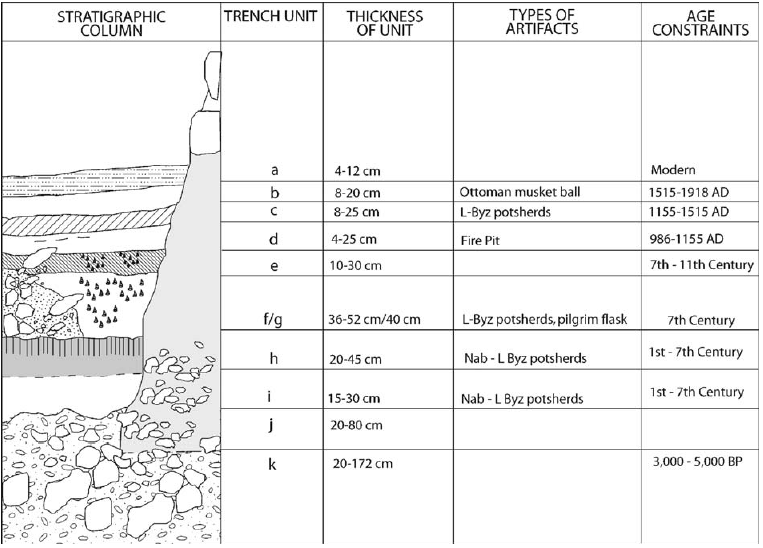
An Ottoman musket ball recovered near the base of unit a provides a chronological constraint. This artifact indicates that the earthquake occurred before the end of Ottoman control in 1918 CE and after the onset of Ottoman rule in 1516 CE.



Left - Figure 5 - Schematic diagram of Trench A.7 north wall. Stratigraphic units are identified by lowercase letters. Faults are emphasized by heavy lines. Earthquakes are identified by Roman numerals, with IV as the oldest. Dashed lines indicate unexcavated portion of aqueduct floor.

Right - Figure 4 - Schematic stratigraphic column of Trench A.7. Thicknesses of units are generalized from measurements of unit throughout the trench. Listed artifacts provide age control for constraining deposition and earthquake history in units where they were discovered. Age constraints come from radiocarbon data and typological dating of sherds.

Click on either image to open in a new tab - Both figures from Haynes et al. (2006)


By Jefferson Williams