Nemer and Meghraoui (2006) report that the oldest identified event (Event V) in the Jarmaq trench, which intersects the Roum fault, cuts unit g and occurred before the deposition of unit f. No reliable lower bound could be established for this event. Because unit f is not well dated, Event V is instead constrained using the nearest dated layer (unit e), indicating that it occurred before 8555–7603 BCE. Unit e was radiocarbon dated by one bulk soil sample (JAR-13-B). The Jarmaq trench as a whole indicates combined left-lateral strike-slip and normal motion.
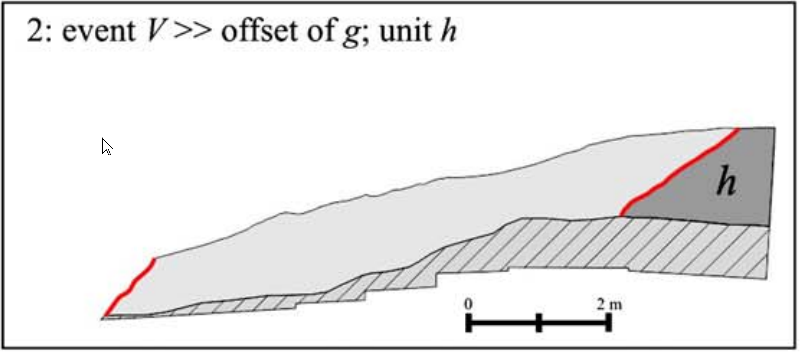
Fig. 8 - Schematic reconstruction of palaeoseismic event V - clcik on link to open in a new tab - Nemer and Meghraoui (2006)
Fig. 6 - (a) Photo mosaic of the southern wall of the excavation across the Roum fault showing the rupture strands (white lines) and associated stratigraphic units (labelled in yellow). (b) Illustration of a. The 5 palaeoseismic events determined from the capping horizons are labelled V to Z in black boxes (see text for details and Fig. 7 for the palaeo-earthquake distribution). Black squares are the 6 measured and reliable unit radiocarbon ages. - clcik on link to open in a new tab - Nemer and Meghraoui (2006)