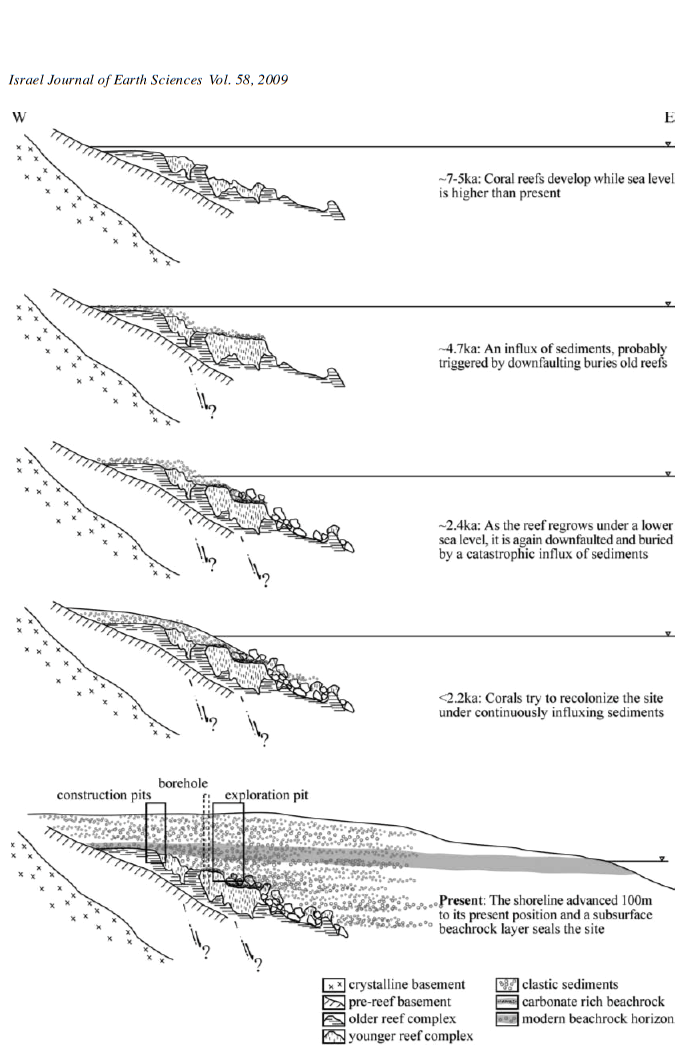
Event B

Shaked et al. (2011) report that Event B is an inferred down-faulting event
which occurred around 2.4
ka
BP (~450 BCE) recognized in the buried reef at
the IUI site
on the northwestern shore of the Gulf of Aqaba.
Shaked et al. interpret this episode as a sudden
tectonic
subsidence event,
probably earthquake-related, because the buried
reef flat is measurably lower than the
modern
reef flats under essentially similar sea-level
conditions, implying vertical displacement of
the coastal margin. Downward displacement of this reef is
estimated at a minimum of 0.6 m since 2.4
ka
BP (~450 BCE).
The principal evidence for Event B is a renewed
influx of
clastic sediment that interrupted reef growth and
formed the
indurated Unit #3 horizon. This unit
buries the older reef surface and is overlain by
small “juvenile” corals that briefly resettled
before being buried again. The limited size of
these corals and absence of a developed reef
framework indicate unstable conditions with
continued sediment influx. As in Event A, rapid
burial rather than gradual accumulation is
inferred, consistent with tectonically induced
changes to local topography.
Shaked et al. suggest that
down-faulting created new
accommodation space that was rapidly filled by
sediments transported alongshore, most likely
during high-energy storm events. Event B appears
to represent a later phase in the same pattern
of repeated tectonic disturbance, ultimately
leading to complete burial of the reef and
subsequent
progradation of the shoreline by
approximately 100 m. In this interpretation,
Event B records a probable paleoearthquake
expressed through coastal subsidence, abrupt
sediment influx, and suppression of sustained
reef development.
Dating was derived from
radiocarbon samples of the buried
corals using the
marine calibration curve of Stuiver et al. (1998)
that incorporates a
ocean residence time of 402 years.
Radiocarbon dates were cross-checked against
U-Th dates also derived from samples
of the buried corals.