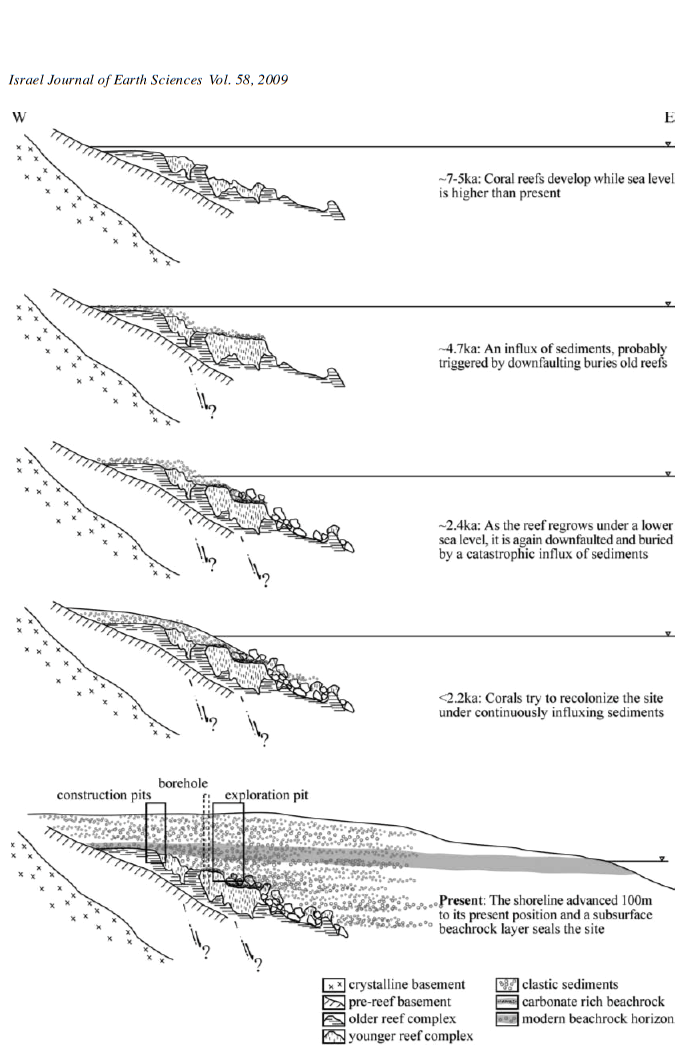
Event A

Shaked et al. (2011) report that Event A is an inferred down-faulting event
which ocurred around 4.7 ka
BP (~2750 BCE) recognized in the buried reef at
the IUI site
on the northwestern shore of the Gulf
of Aqaba. Shaked et al. interpret this
episode as a sudden tectonic
subsidence event,
probably earthquake-related, because the reef
flat is lower than
coeval
reef flats elsewhere
around the gulf and because the buried corals
were sealed in unusually pristine condition.
The main evidence for Event A is a sudden influx
of
clastic sediment that covered the reef while
the corals were still alive. The corals are not
bioeroded, overgrown, or significantly altered,
and some contain
crystalline rock fragments in
their voids, indicating rapid burial rather than
slow, gradual sedimentation. Shaked et al.
suggest that
down-faulting created
accommodation space that was then quickly filled by sediment
derived mainly from the adjacent shore and beach.
Although the exact amount of displacement for
Event A is not tightly constrained, the event
appears to mark an early episode in a repeated
pattern of vertical tectonic instability at the
site that hindered development of a mature reef.
In this interpretation, Event A records a
probable paleoearthquake expressed not by a
discrete surface rupture in trench walls, but by
abrupt coastal subsidence, coral mortality, and
rapid sedimentary burial.
Dating was derived from
radiocarbon samples of the buried
corals using the
marine calibration curve of Stuiver et al. (1998)
that incorporates a
ocean residence time of 402 years.
Radiocarbon dates were cross-checked against
U-Th dates also derived from samples
of the buried corals.