Penultimate Event

In
Akyuz et al. (2006), the
"penultimate event" is clearly identified in the Ziyaret trench, where a
set of
fault strands
cut Units I and II but do not affect Unit III. This
relationship indicates that the event post-dates
deposition of Unit II and is sealed by Unit III.
The event also appears to be expressed in other trenches. In
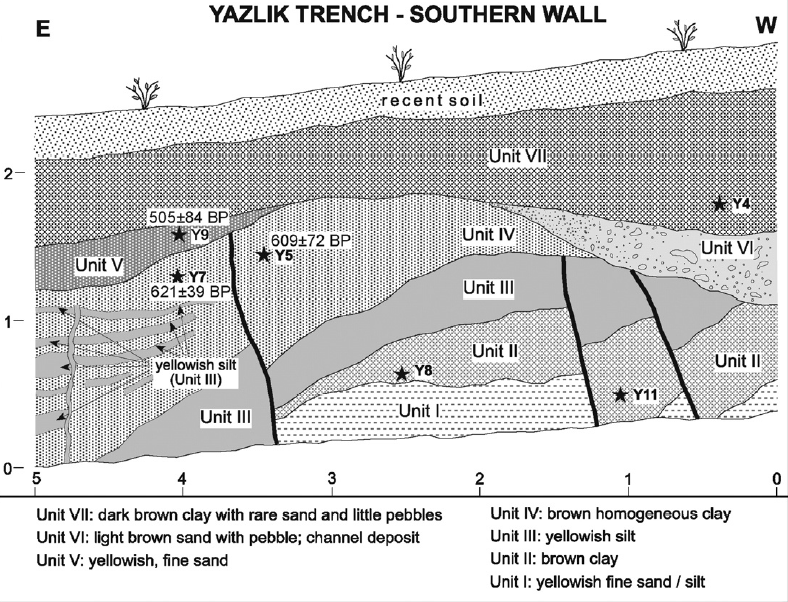
the Yazlik trench it is expressed by a
single fault that cuts Units I–IV and is overlain by
undeformed Units V and VII while in the Harabe trench, it is represented a fault
strand(s) that penetrates Unit III but not Unit IV.
Akyuz et al. (2006:290-292) estimate that the
"penultimate event" struck between
"sometime between 1350 ± 40 A.D. and 1423 A.D.,
and before 1442 A.D.," based on
charcoal
radiocarbon samples from the Ziyaret and Yazlık trenches.
They propose an earthquake in
1408 CE as a plausible candidate.
Ambraseys (2009:385-385) locates this earthquake
in the vicinity of the Hacipasa Trenches, as do
Guidoboni and Comastri (2005:558). As with the
other earthquakes, the dominant motion appears to
have been
strike-slip.