Vadum Jacob Earthquake

Ellenblum et al. (1998:304),
drawing on
William of Tyre,
Abu Shama,
Ibn al-Athir, and
ʿImad al-Din al-Isfahani,
state that “the foundation stone of the
castle [of Vadum Jacob] was laid in October
1178 CE.” The fortress “was besieged and
destroyed 11 months later, on 30 August
1179 CE,” establishing a
terminus post quem
of 1179 CE for later seismic damage.
Up to ~2.1 m of
lateral slip
was measured in the southern and northern
defense walls
with as much as 10 cm of
vertical offset.
About 0.5 m of displacement was attributed
to a
later event that damaged an Ottoman
mosque, leaving ~1.6 m of slip between 1179
CE and the
Ottoman-period
rupture.
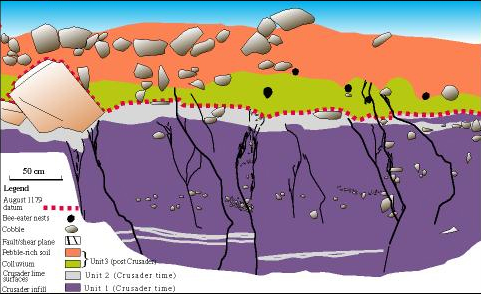
To constrain a
terminus ante quem
for the initial rupture, a
trench
was excavated parallel to the southern face of the castle. Four
units were identified. Units 1 and 2
predate or coincide with 30 August 1179 CE.
A fallen
ashlar block
atop Unit 2 likely fell soon after the
Muslim conquest.
Colluvial
Unit 3 accumulated from 1179 CE to the
present; Unit 4 is a
modern bioturbated soil horizon.
Faults rise through the
colluvial wedge,
indicating at least two post-1179
earthquakes. The first likely occurred
soon after 1179 CE; the second much later.
The stratigraphy suggests an early
post-1179 rupture, making one of the
1202 CE earthquakes
the most likely candidate.