Open this page in a new tab

Historical Syria

Syria

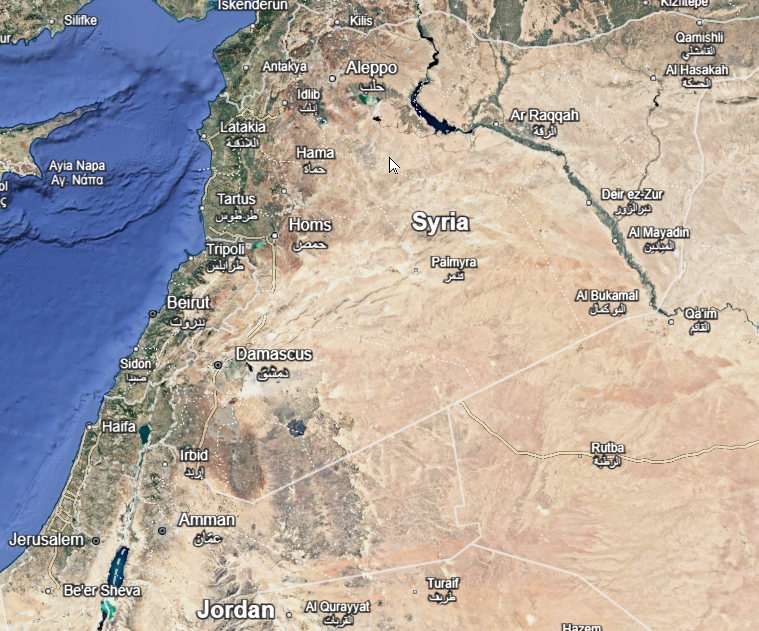
click on image to explore in a new tab in Google Earth


Names
Transliterated Name Source Name
Syria Modern English
Sūriyā Modern Arabic سوريا
Sūriyya Modern Standard Arabic سورية
Sūryā Syriac ܣܘܪܝܐ
Syría Ancient Greek Συρία
Syria Latin Syria
al-Shām Classical Arabic الشام
Bilād al-Shām Classical Arabic / Islamic Geography بلاد الشام
Syrian Arab Republic Modern English / Official Name
al-Jumhūriyya al-ʿArabiyya as-Sūriyya Modern Arabic / Official Name الجمهورية العربية السورية
Introduction
Introduction

Syria is a historical region of the eastern Mediterranean whose geographical and political meaning has changed considerably through time. The name predates the modern Syrian Arab Republic and was historically applied to territories extending beyond the borders of the modern state. In its broader geographical sense, Syria formed part of the Levant, encompassing areas along the eastern Mediterranean coast and extending inland toward the Euphrates and northern Arabian steppe.

During the Hellenistic and Roman periods, "Syria" was used both as a broad geographical designation and as the name of political and administrative territories. The Roman province of Syria was established following the Roman annexation of the Seleucid kingdom in 64 BCE. Subsequent administrative reorganizations divided the region into several provinces, including Syria Coele, Syria Phoenice, Syria Prima, and Syria Secunda. As a result, the geographical concept of Syria frequently extended beyond the boundaries of any particular province bearing that name.

Following the Muslim conquest in the seventh century CE, much of the region became known in Arabic as Bilād al-Shām, a broader geographical designation encompassing approximately modern Syria, Lebanon, Jordan, Israel, Palestine, and portions of southern Turkey. Syria was particularly important under the Umayyad Caliphate (661–750 CE), whose capital at Damascus made the region the political center of the Caliphate. After the Abbasids came to power in 750 CE, the political center shifted eastward to Iraq and authority in Syria was increasingly exercised by regional dynasties and competing states.

During the medieval period, different parts of Syria were controlled at various times by Abbasid, Tulunid, Ikhshidid, Fatimid, Seljuk, Crusader, Zengid, Ayyubid, and Mamluk rulers. The region was incorporated into the Ottoman Empire in 1516 CE and remained under Ottoman rule until the end of World War I. Ottoman Syria was not a single administrative province but was divided and repeatedly reorganized into several provinces and districts.

Following the collapse of the Ottoman Empire, the modern territorial meaning of Syria gradually emerged. Much of the present country became part of the French Mandate for Syria and Lebanon after World War I. The modern Syrian state subsequently developed within these boundaries and achieved full independence in 1946. Consequently, references to "Syria" in ancient, medieval, and early modern sources should be interpreted according to their historical context rather than assumed to refer to the boundaries of the modern Syrian Arab Republic.

Aerial Views
Aerial Views

Aerial Views

  • Syria in Google Earth

Textual Chronology
January 749 CE Sabbatical Year Earthquakes - Talking Mule Quake

Discussion

Discussion

March 756 CE By No Means Mild Earthquake

Discussion

Discussion

Textual Seismic Effects
16 January 749 CE Sabbatical Year Earthquakes - Holy Desert Quake South

  • These entries are included for reference. Williams (2024) argues that references to damage in Syria attributed to the Holy Desert Earthquake were actually transposed from the Talking Mule Quake during the textual transmission of the ultimate source or sources underlying the Byzantine accounts.
Effect                                                      Location Image(s) Description
  • Collapsed Walls
  • Fatalities (Collapsed Walls)
Syria
  • "In the 6th year of Constantine, there was a great earthquake in Palestine, by the Jordan, and in all of Syria; in the month of January at the 4th hour. An innumerable multitude perished - many tens of thousands. Churches and Monasteries collapsed. The worst was in the wilderness of the Holy City (Jerusalem)." – Paul the Deacon

  • "Anno Mundi 6238, divine incarnation year 738. In the 6th year of Constantine there was a powerful earthquake in Palestine, by the Jordan, and in all of Syria in January, at the 4th hour. Thousands died, an innumerable multitude perished, churches and monasteries collapsed, and it was worst in the desert of the Holy City." – Anastasius Bibliothecarius

  • "[A.M. 6238, AD 745/6] II In this year there was a great earthquake in Palestine, by the Jordan and in all of Syria on 18 January, in the 4th hour. Numberless multitudes perished, churches and monasteries collapsed, especially those in the desert of the Holy City. IIa

    II In the same year a pestilence that had started in Sicily and Calabria travelled like a spreading fire all through the 14th indiction1 to Monobasia2, Hellas, and the adjoining islands, thus scourging in advance the impious Constantine and restraining his fury against the Church and the holy icons, even though he remained unrepentant like Pharaoh of old. This disease of the bubonic plague spread to the Imperial City in the 15th3 indiction. All of a sudden, without visible cause, there appeared many oily crosslets upon men's garments, on the altar cloths of churches, and on hangings. The mysteriousness of this presage inspired great sorrow and despondency among the people. Then God's wrath started destroying not only the inhabitants of the City, but also those of all its outskirts. Many men had hallucinations and, being in ecstasy, imagined to be in the company of certain strangers of terrible aspect who, as it were, addressed in friendly fashion those they met and conversed with them. Taking note of their conversation, they later reported it. They also saw the same men entering houses, killing some of the inmates, and wounding others with the sword. Most of what they said came to pass just as they had seen it.

    In the spring of the 1st indiction4 the plague intensified and in the summer it flared up all at once so that entire households were completely shut up and there was no one to bury the dead. Because of extreme necessity a way was devised of placing planks upon animals saddled with four paniers each5 and so removing the dead or piling them likewise one upon the other in carts. When all the urban and suburban cemeteries had been filled as well as empty cisterns and ditches, and many vineyards had been dug up and even the orchards within the old walls6 to make room for the burial of human bodies, only then was the need satisfied7. When every household had been destroyed by this calamity on account of the impious removal of the holy icons by the rulers, straight away the fleet of the Hagarenes sailed from Alexandria to Cyprus, where the Roman fleet happened to be. The strategos of the Kibyraiots fell upon them suddenly in the harbour of Keramaia8 and seized the mouth of the harbour. Out of 1,000 dromones9 it is said that only three escaped. IIb
    Footnotes

    a Cf. Agapios, 261 (Jan.): earthquake in Palestine, esp. at Tiberias, where more than 100,000 were killed.

    Mich. Syr. ii. 509-10; Chr. 1234, 254. 33 ff. (without date): damage at Damascus, Tiberias, Mabbug, and elsewhere.

    Ps.-Dion. Chron. 42-3, AG 1059: Chalcedonian bishop of Mabbug crushed with his flock.

    b Cf. Nik. 67. 4-43,- 68. 3-11. Kleinchronik, 1. 17 (Schreiner, i. 45) abbreviates Theoph. as regards the plague.


    1 AD 745/6.

    2 Monemvasia on the east coast of the Peloponnese.

    3 dB mistakenly prints '5th'.

    4 AD 747/8. This is the date given for the plague in Kleinchronik, 2. 4 (Schreiner, i. 47).

    5 Reading Sia £AIA V aayp novp.4vu v vno TETpaKavdr/Xov. For the meaning of this expression see I. Rochow, Klio, 69 (1987), 571-2.

    6 The Constantinian walls.

    7 On the plague see also Theodore Studites, Laud. Platonis, PG 99: 805D. Nik. Antirrh. Ill, PG 100: 496B-D, adds that the emperor betook himself during the plague to the suburbs of Nicomedia. So also Geo. Mon. 754 and Epist. ad Theophilum, PG 95: 364B.

    8 Situation unknown. See Sir George Hill, A History of Cyprus, i (Cambridge, 1940); 262 n. 5; L. Philippou, KvnpiaKai Sirovhal, 6 (1942), 1-5, who believes the battle did not take place in Cyprus. According to Nik. the conflict was initiated by Constantine, who sent a fleet against the Arabs.

    9 Thirty in Anast., probably correctly.

    " – Theophanes

  • "1. In the reign of Copronymus, an earthquake occurred in Palestine and the Jordan and all the Syrian land. And many tens of thousands, innumerable people indeed, are dead, and churches and monasteries are fallen.

    And at the same time a pestilential disease, starting from Sicily and Calabria and spreading like a fire, crossed to Greece and the islands. ...12.

    Footnotes

    12 Earthquake in Levant and plague at Cpl. in 747; cf. Nic. 62. 24-64. 9; Theoph. 422. 25-424. 3; Cedr. ii. 7. 17-9. 1.

    GC is closer to Theophanes than to Nicephorus in that it records an earthquake in the Levant before turning to the plague, but both the other two have more information than is preserved in GC (including an exact date for the earthquake in Theophanes). The earthquake is not mentioned by Nicephorus, but he regularly omitted information that was available in the chronicle source which he shared with Theophanes. This common source did record some major events in the near east, including the earthquake of 750 (Nic. 64. 22-65. 7, Theoph. 426. 16-26; see below on GC 13), so that it could have contained a reference to the earthquake of 747. Theophanes also had an independent eastern chronicle source, which has parallels with Syriac chronicles down to 746, and contained further information probably added by a writer in Palestine c.780 (see E. W. Brooks, 'The Sources of Theophanes and the Syriac Chroniders', BZ xv, 1906, 578-87), but the example of the 750 earthquake shows that not all eastern information in Byzantine chronicles should be traced to it.

    GC 12, as it stands, cannot have been the common source of Theophanes and Nicephorus because of their fuller treatment (cf. Whitby, 'Chronographer' 11-12). However, GC's account of the plague is disordered when compared with the other versions, in that it mentions the burial arrangements for the victims before the apparition of oily crosses on the garments of the afflicted, and it does not contain any of the anti-iconoclast interpretations of the plague included by the orthodox authors. One must assume, therefore, either (i) that it is an inaccurate derivation from Theophanes by an excerptor who deliberately eliminated Theophanes' anti-iconoclast interpretation of the plague, although this would run counter to the excerptor's use of the epithet Copronymus for Constantine; or (ii) that it is an inaccurate and abbreviated version of the common source used by Theophanes and Nicephorus, the distortions being caused by the excerptor's belief that he was running out of space on folio 242r (cf. p.192 above). We find the latter assumption easier, but for the alternative, see Mango, Nicephorus' 546-7.

    Note by Williams: Copronymus or Copronym is a play on words with the name of Constantine combining the greek words κόπρος (kopros) which means feces and ὄνομα (onoma) which means name. The hostility of the authors who use this epithet against "Emperor Poop-onymous" derives from bitter doctrinal disputes within Christendom such as disputes over iconoclasm.

    " – Megas Chronographos

  • "Year 6 - There was a great earthquake in Palestine, by the Jordan and in all of Syria on 18 January at the 4th hour. An innumerable multitude perished - thousands. Churches and Monasteries collapsed. The worst was in the wilderness by the Holy City (Jerusalem)." – George Cedrenus

  • "In the year 132 A.H. [20 August 749 CE to 8 August 750 CE] there was an earthquake at Al-Sham. " – Ibn al‑Nazif

January 749 CE Sabbatical Year Earthquakes - Talking Mule Quake

  • Seismic Effects follow Williams (2024) in partitioning effects between the Holy Desert North, Holy Desert South, and Talking Mule Earthquakes.
Effect                                                      Location Image(s) Description
  • Collapsed Walls
  • Fatalities (Collapsed Walls)
  • Landslide
Syria
  • "9th year of Constantine ...

    [Porrò] On the 8th of February [eiusdem] 3rd indiction, the son Leo was born to emperor Constantine from the daughter of Chagan of Chazaria. That same year there was an earthquake in Syria, an enormous and terrible [calamity]. Many died. A spring [moved ?]. In another place in the mountains, a village moved for about six miles with its walls and homes intact and without any small thing dying. Finally, In Mesopotamia, the earth split two thousand [feet?] and out of the chasm came a different soil which was white and sandy. Out of this chasm emerged a spotless mule speaking in a human voice which predicted an invasion by a foreign army into the land of the Arabs. This came true." – Paul the Deacon

  • "Emperor Constantines 9th year

    ... That year there was an earthquake in Syria, a terrible calamity. Many died. A spring [moved?]. In another place in the mountains, a village moved with its walls and homes intact for 6 Roman miles. Finally in Mesopotamia, the earth split two thousand feet and out of the chasm came a white sandy soil and a spotless mule which spoke in a human voice and prophesied that the Arab lands would be invaded by a foreign army. And this prophecy came true." – Anastasius Bibliothecarius

  • "[A.M. 6241, AD 748/9] In this year Marouam was pursued by the Maurophoroi, who captured him and killed him after waging a very heavy war. They were commanded by Salim, son of Alim, one of the aforementioned fugitives who had sent Aboumouslim on his mission. The rest of them gathered in Samaria and Trachonitis and awarded their leadership by lot to Aboulabas, and next to him to his brother Abdela, and next to the latter to Ise Ibinmouse. II They appointed Abdela, son of Alim and brother of Salim, to be commander in Syria; Salim himself to be commander in Egypt; while Abdela, brother of Aboulabas (from whom he received the nomination to the command) they appointed over Mesopotamia. II Aboulabas himself, who was in supreme authority, established his seat in Persia, the government and all the seized treasure (which Marouam had carried away) having been transferred to him and his Persian allies from Damascus. Marouam's surviving sons and relatives went from Egypt to Africa, whence they crossed the narrow sea that separates Libya from Europe next to the Ocean at a place called Septai and settled until this day in Spain of Europe, where some kinsmen and correligionists of theirs had come to dwell at an earlier time — the latter being descendants of Mauias who had suffered shipwreck there. The devastation in the days of Marouam lasted six years and in the course of it all the prominent cities of Syria lost their walls except Antioch, which he planned to use as a refuge. Innumerable Arabs were also killed by him for he was very cunning in civil matters. He belonged to the heresy of the Epicureans, that is Automatists, an impiety he had imbued from the pagans who dwell at Harran.

    II On 25 January of the same 3rd indiction a son was born to the emperor Constantine by the daughter of the Chagan of Chazaria and he called him Leo. In the same year there was an earthquake and terrible destruction in Syria, as a result of which some cities were entirely destroyed, others partially so, while others slid down entire, with their walls and houses, from positions on mountains to low-lying plains, a distance of six miles or thereabout. Eyewitnesses affirmed that the ground in Mesopotamia was split along two miles and that out of the chasm was thrown up a different soil, very white and sandy, in the midst of which, they said, there came up an animal like a mule, quite spotless, that spoke in a human voice and announced the incursion of a certain nation from the desert against the Arabs, which indeed came to pass.

    The next year, on the feast of holy Pentecost the impious emperor Constantine conferred the imperial crown on his son Leo by the hand of the false patriarch Anastasios who shared his views. II" – Theophanes

  • "69. Thereafter a son was born to the emperor, whom he named Leo. At the same time a severe earthquake occurred in Syria, causing enormous damage. For some cities that were there (were completely destroyed and) the ground round about opened up to a great extent, while others suffered this fate but partially. Others were shifted from their high positions and slipped down entire, with their walls and houses, to the plains below, moving a distance of as much as six miles, more or less, from their original situation. Some affirmed they had seen the ground in Mesopotamia (which is near Syria) crack deeply along (a distance) of two miles, and another ground, sandy and very white, thrown up from below; and that along with the latter was cast up a female mule, which proclaimed in a human voice the destruction of the Arabs. A short time thereafter a tribe appeared from the desert beyond and slew many multitudes (of Arabs) without resistance." – Nikephoros I of Constantinople

  • "1. In the reign of Copronymus, an earthquake occurred in Palestine and the Jordan and all the Syrian land. And many tens of thousands, innumerable people indeed, are dead, and churches and monasteries are fallen.

    And at the same time a pestilential disease, starting from Sicily and Calabria and spreading like a fire, crossed to Greece and the islands. ...12.

    Footnotes

    12 Earthquake in Levant and plague at Cpl. in 747; cf. Nic. 62. 24-64. 9; Theoph. 422. 25-424. 3; Cedr. ii. 7. 17-9. 1.

    GC is closer to Theophanes than to Nicephorus in that it records an earthquake in the Levant before turning to the plague, but both the other two have more information than is preserved in GC (including an exact date for the earthquake in Theophanes). The earthquake is not mentioned by Nicephorus, but he regularly omitted information that was available in the chronicle source which he shared with Theophanes. This common source did record some major events in the near east, including the earthquake of 750 (Nic. 64. 22-65. 7, Theoph. 426. 16-26; see below on GC 13), so that it could have contained a reference to the earthquake of 747. Theophanes also had an independent eastern chronicle source, which has parallels with Syriac chronicles down to 746, and contained further information probably added by a writer in Palestine c.780 (see E. W. Brooks, 'The Sources of Theophanes and the Syriac Chroniders', BZ xv, 1906, 578-87), but the example of the 750 earthquake shows that not all eastern information in Byzantine chronicles should be traced to it.

    GC 12, as it stands, cannot have been the common source of Theophanes and Nicephorus because of their fuller treatment (cf. Whitby, 'Chronographer' 11-12). However, GC's account of the plague is disordered when compared with the other versions, in that it mentions the burial arrangements for the victims before the apparition of oily crosses on the garments of the afflicted, and it does not contain any of the anti-iconoclast interpretations of the plague included by the orthodox authors. One must assume, therefore, either (i) that it is an inaccurate derivation from Theophanes by an excerptor who deliberately eliminated Theophanes' anti-iconoclast interpretation of the plague, although this would run counter to the excerptor's use of the epithet Copronymus for Constantine; or (ii) that it is an inaccurate and abbreviated version of the common source used by Theophanes and Nicephorus, the distortions being caused by the excerptor's belief that he was running out of space on folio 242r (cf. p.192 above). We find the latter assumption easier, but for the alternative, see Mango, Nicephorus' 546-7.

    Note by Williams: Copronymus or Copronym is a play on words with the name of Constantine combining the greek words κόπρος (kopros) which means feces and ὄνομα (onoma) which means name. The hostility of the authors who use this epithet against "Emperor Poop-onymous" derives from bitter doctrinal disputes within Christendom such as disputes over iconoclasm.

    " – Megas Chronographos

  • "That year there was a powerful earthquake in Syria. Some cities were destroyed - others only partly so. In one place, a village moved with its walls and buildings intact. In Mesopotamia, the earth split three thousand feet and a white sandy soil came out of the chasm. Then an incredible thing - an onager emerged speaking of human affairs and predicted a foreign invasion - which happened a short time later." – Georgius Monachus (George the Monk), also known as Georgius Hamartolos (George the Sinner)

  • "In the ninth year of Constanine, Marnamus was killed in the war with the Abbasids. On 25 January, a son Leo was born to Constantine [from his wife] Irena, the daughter of Chazara.

    At the same time, there was a serious earthquake and terrible destruction in Syria. Some cities were destroyed [and] others partly destroyed. In some place[s?], in the mountains, a village[s?] slid down the mountain for a distance of 6 miles with their houses and buildings intact. Further, in Mesopotamia the earth was split for two thousand steps [~feet] and out of that chasm came a different type of white soil from which a emerged a mule who spoke a prophecy in a human voice - that a nation from the desert would invade the Arab lands. The prophecy came true." – George Cedrenus
  • "In the year 132 A.H. [20 August 749 CE to 8 August 750 CE] there was an earthquake at Al-Sham." – Ibn al‑Nazif

March 756 CE By No Means Mild Earthquake

Effect                                                      Location Image(s) Description
  • Considerable Earthquake
Syria
  • "755-756 The year one thousand and sixty-seven: In the month of Adar (March), on the third day — a Tuesday — a powerful, terrible and dreadful earthquake took place in the middle of the night in the land of the Jazira. Three villages on the Khabur collapsed, and many people perished inside them, like grapes in a wine press. Many other places were also destroyed by this earthquake, brought on by the great number of our sins:

    The earth shall totter exceedingly,
    the earth shall shake violently,
    and it shall sway like a hut.


    This is what our sins are able to do: to shake the ground beneath us!" – Pseudo-Dionysius of Tell-Mahre

  • "[A.M. 6248, AD 755/6] II In this year, on 9 March, there occurred a considerable earthquake in Palestine and Syria.IIa Theodore [I], patriarch of Antioch, was exiled because of the malice of the Arabs, having been accused of frequently communicating Arab affairs by letter to the emperor Constantine. And so, Salim1 himself banished him to the land of Moab which was his native country. The same Salim decreed that no new churches should be built, that crosses should not be displayed and that Christians should not discourse with Arabs on matters of religion. II He invaded the Roman country2 with a force of 80,000 and, when he had come to Cappadocia, he heard that Constantine was taking up arms against him. Taking fright, he returned empty-handed without causing any damage, except that he took a few Armenians who had joined him. IIb.
    Footnotes

    a Ps.-Dion. Chron. 63 records an earthquake in Mesopotamia on 3 Mar. AG 1067.
    b Cf. Agapios, 278, with different details.

    1 Salih b. 'Ali. He was governor of Egypt down to AH 140 (757/8). In AH 141 (758/9) he was appointed over Qinnasrin (Chalkis), Emesa, and Damascus: Tabari, Williams, i. 28, 31, 36, 44. His measures against the Christians, including the patriarch of Antioch, would thus appear to date from 758/9.

    2 Salih led two expeditions to rebuild Melitene, the first in AH 138 (755/6), the second the following year (which is probably the one meant here). On the latter occasion he entered Byzantine territory by the pass of Adata: Tabari, Williams, i. 29, 32. Cf. Brooks, 'Abbasids', 733.

    ” - Theophanes

Textual Intensity Estimates
January 749 CE Sabbatical Year Earthquakes - Talking Mule Quake

  • Seismic Effects follow Williams (2024) in partitioning effects between the Holy Desert N, Holy Desert S, and Talking Mule Earthquake.
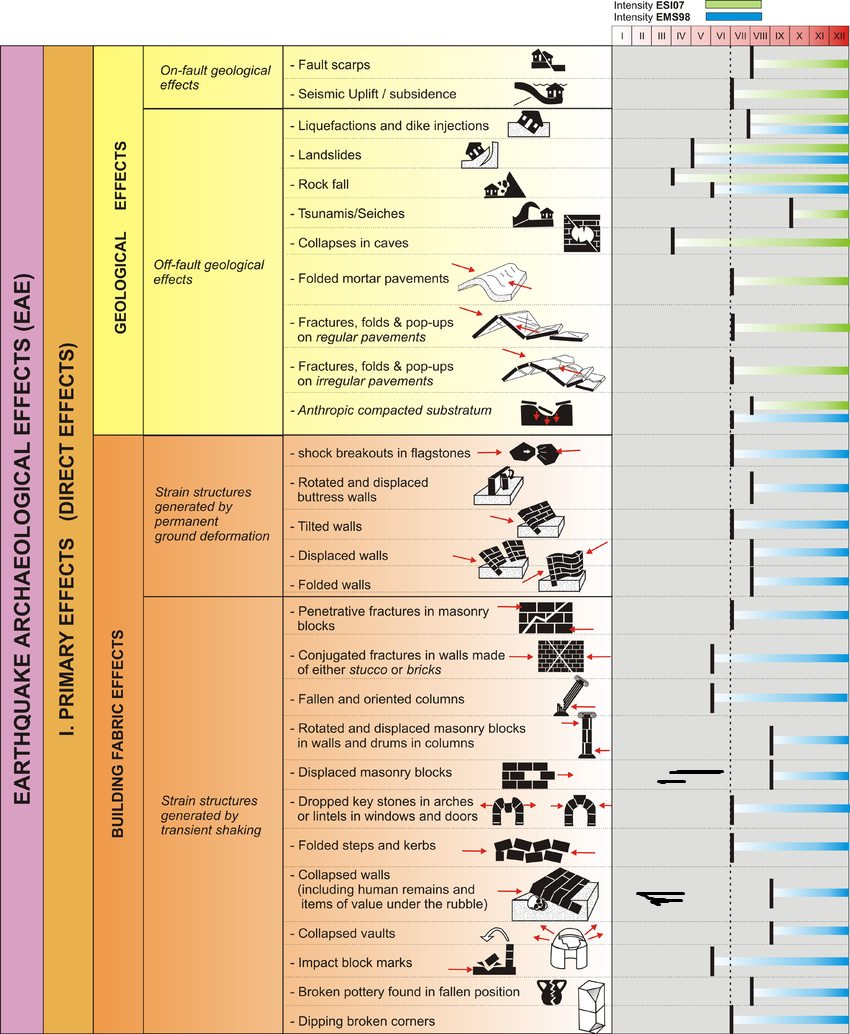
  • Earthquake Archeological Effects chart of Rodríguez-Pascua et al (2013: 221-224)
Effect                                                      Location Image(s) Description Intensity
  • Collapsed Walls
  • Fatalities (Collapsed Walls)
  • Landslide
Syria
  • "9th year of Constantine ...

    [Porrò] On the 8th of February [eiusdem] 3rd indiction, the son Leo was born to emperor Constantine from the daughter of Chagan of Chazaria. That same year there was an earthquake in Syria, an enormous and terrible [calamity]. Many died. A spring [moved ?]. In another place in the mountains, a village moved for about six miles with its walls and homes intact and without any small thing dying. Finally, In Mesopotamia, the earth split two thousand [feet?] and out of the chasm came a different soil which was white and sandy. Out of this chasm emerged a spotless mule speaking in a human voice which predicted an invasion by a foreign army into the land of the Arabs. This came true." – Paul the Deacon

  • "Emperor Constantines 9th year

    ... That year there was an earthquake in Syria, a terrible calamity. Many died. A spring [moved?]. In another place in the mountains, a village moved with its walls and homes intact for 6 Roman miles. Finally in Mesopotamia, the earth split two thousand feet and out of the chasm came a white sandy soil and a spotless mule which spoke in a human voice and prophesied that the Arab lands would be invaded by a foreign army. And this prophecy came true." – Anastasius Bibliothecarius

  • "[A.M. 6241, AD 748/9] In this year Marouam was pursued by the Maurophoroi, who captured him and killed him after waging a very heavy war. They were commanded by Salim, son of Alim, one of the aforementioned fugitives who had sent Aboumouslim on his mission. The rest of them gathered in Samaria and Trachonitis and awarded their leadership by lot to Aboulabas, and next to him to his brother Abdela, and next to the latter to Ise Ibinmouse. II They appointed Abdela, son of Alim and brother of Salim, to be commander in Syria; Salim himself to be commander in Egypt; while Abdela, brother of Aboulabas (from whom he received the nomination to the command) they appointed over Mesopotamia. II Aboulabas himself, who was in supreme authority, established his seat in Persia, the government and all the seized treasure (which Marouam had carried away) having been transferred to him and his Persian allies from Damascus. Marouam's surviving sons and relatives went from Egypt to Africa, whence they crossed the narrow sea that separates Libya from Europe next to the Ocean at a place called Septai and settled until this day in Spain of Europe, where some kinsmen and correligionists of theirs had come to dwell at an earlier time — the latter being descendants of Mauias who had suffered shipwreck there. The devastation in the days of Marouam lasted six years and in the course of it all the prominent cities of Syria lost their walls except Antioch, which he planned to use as a refuge. Innumerable Arabs were also killed by him for he was very cunning in civil matters. He belonged to the heresy of the Epicureans, that is Automatists, an impiety he had imbued from the pagans who dwell at Harran.

    II On 25 January of the same 3rd indiction a son was born to the emperor Constantine by the daughter of the Chagan of Chazaria and he called him Leo. In the same year there was an earthquake and terrible destruction in Syria, as a result of which some cities were entirely destroyed, others partially so, while others slid down entire, with their walls and houses, from positions on mountains to low-lying plains, a distance of six miles or thereabout. Eyewitnesses affirmed that the ground in Mesopotamia was split along two miles and that out of the chasm was thrown up a different soil, very white and sandy, in the midst of which, they said, there came up an animal like a mule, quite spotless, that spoke in a human voice and announced the incursion of a certain nation from the desert against the Arabs, which indeed came to pass.

    The next year, on the feast of holy Pentecost the impious emperor Constantine conferred the imperial crown on his son Leo by the hand of the false patriarch Anastasios who shared his views. II" – Theophanes

  • "69. Thereafter a son was born to the emperor, whom he named Leo. At the same time a severe earthquake occurred in Syria, causing enormous damage. For some cities that were there (were completely destroyed and) the ground round about opened up to a great extent, while others suffered this fate but partially. Others were shifted from their high positions and slipped down entire, with their walls and houses, to the plains below, moving a distance of as much as six miles, more or less, from their original situation. Some affirmed they had seen the ground in Mesopotamia (which is near Syria) crack deeply along (a distance) of two miles, and another ground, sandy and very white, thrown up from below; and that along with the latter was cast up a female mule, which proclaimed in a human voice the destruction of the Arabs. A short time thereafter a tribe appeared from the desert beyond and slew many multitudes (of Arabs) without resistance." – Nikephoros I of Constantinople

  • "1. In the reign of Copronymus, an earthquake occurred in Palestine and the Jordan and all the Syrian land. And many tens of thousands, innumerable people indeed, are dead, and churches and monasteries are fallen.

    And at the same time a pestilential disease, starting from Sicily and Calabria and spreading like a fire, crossed to Greece and the islands. ...12.

    Footnotes

    12 Earthquake in Levant and plague at Cpl. in 747; cf. Nic. 62. 24-64. 9; Theoph. 422. 25-424. 3; Cedr. ii. 7. 17-9. 1.

    GC is closer to Theophanes than to Nicephorus in that it records an earthquake in the Levant before turning to the plague, but both the other two have more information than is preserved in GC (including an exact date for the earthquake in Theophanes). The earthquake is not mentioned by Nicephorus, but he regularly omitted information that was available in the chronicle source which he shared with Theophanes. This common source did record some major events in the near east, including the earthquake of 750 (Nic. 64. 22-65. 7, Theoph. 426. 16-26; see below on GC 13), so that it could have contained a reference to the earthquake of 747. Theophanes also had an independent eastern chronicle source, which has parallels with Syriac chronicles down to 746, and contained further information probably added by a writer in Palestine c.780 (see E. W. Brooks, 'The Sources of Theophanes and the Syriac Chroniders', BZ xv, 1906, 578-87), but the example of the 750 earthquake shows that not all eastern information in Byzantine chronicles should be traced to it.

    GC 12, as it stands, cannot have been the common source of Theophanes and Nicephorus because of their fuller treatment (cf. Whitby, 'Chronographer' 11-12). However, GC's account of the plague is disordered when compared with the other versions, in that it mentions the burial arrangements for the victims before the apparition of oily crosses on the garments of the afflicted, and it does not contain any of the anti-iconoclast interpretations of the plague included by the orthodox authors. One must assume, therefore, either (i) that it is an inaccurate derivation from Theophanes by an excerptor who deliberately eliminated Theophanes' anti-iconoclast interpretation of the plague, although this would run counter to the excerptor's use of the epithet Copronymus for Constantine; or (ii) that it is an inaccurate and abbreviated version of the common source used by Theophanes and Nicephorus, the distortions being caused by the excerptor's belief that he was running out of space on folio 242r (cf. p.192 above). We find the latter assumption easier, but for the alternative, see Mango, Nicephorus' 546-7.

    Note by Williams: Copronymus or Copronym is a play on words with the name of Constantine combining the greek words κόπρος (kopros) which means feces and ὄνομα (onoma) which means name. The hostility of the authors who use this epithet against "Emperor Poop-onymous" derives from bitter doctrinal disputes within Christendom such as disputes over iconoclasm.

    " – Megas Chronographos

  • "That year there was a powerful earthquake in Syria. Some cities were destroyed - others only partly so. In one place, a village moved with its walls and buildings intact. In Mesopotamia, the earth split three thousand feet and a white sandy soil came out of the chasm. Then an incredible thing - an onager emerged speaking of human affairs and predicted a foreign invasion - which happened a short time later." – Georgius Monachus (George the Monk), also known as Georgius Hamartolos (George the Sinner)

  • "In the ninth year of Constanine, Marnamus was killed in the war with the Abbasids. On 25 January, a son Leo was born to Constantine [from his wife] Irena, the daughter of Chazara.

    At the same time, there was a serious earthquake and terrible destruction in Syria. Some cities were destroyed [and] others partly destroyed. In some place[s?], in the mountains, a village[s?] slid down the mountain for a distance of 6 miles with their houses and buildings intact. Further, in Mesopotamia the earth was split for two thousand steps [~feet] and out of that chasm came a different type of white soil from which a emerged a mule who spoke a prophecy in a human voice - that a nation from the desert would invade the Arab lands. The prophecy came true." – George Cedrenus
  • VIII+
  • VIII+
  • IV+
This evidence requires a minimum Intensity of VIII (8) when using the Earthquake Archeological Effects chart of Rodríguez-Pascua et al (2013: 221-224).

March 756 CE By No Means Mild Earthquake

  • Earthquake Archeological Effects chart of Rodríguez-Pascua et al (2013: 221-224)
Effect                                                      Location Image(s) Description Intensity
  • Considerable Earthquake
Syria
  • "755-756 The year one thousand and sixty-seven: In the month of Adar (March), on the third day — a Tuesday — a powerful, terrible and dreadful earthquake took place in the middle of the night in the land of the Jazira. Three villages on the Khabur collapsed, and many people perished inside them, like grapes in a wine press. Many other places were also destroyed by this earthquake, brought on by the great number of our sins:

    The earth shall totter exceedingly,
    the earth shall shake violently,
    and it shall sway like a hut.


    This is what our sins are able to do: to shake the ground beneath us!" – Pseudo-Dionysius of Tell-Mahre

  • "[A.M. 6248, AD 755/6] II In this year, on 9 March, there occurred a considerable earthquake in Palestine and Syria.IIa Theodore [I], patriarch of Antioch, was exiled because of the malice of the Arabs, having been accused of frequently communicating Arab affairs by letter to the emperor Constantine. And so, Salim1 himself banished him to the land of Moab which was his native country. The same Salim decreed that no new churches should be built, that crosses should not be displayed and that Christians should not discourse with Arabs on matters of religion. II He invaded the Roman country2 with a force of 80,000 and, when he had come to Cappadocia, he heard that Constantine was taking up arms against him. Taking fright, he returned empty-handed without causing any damage, except that he took a few Armenians who had joined him. IIb.
    Footnotes

    a Ps.-Dion. Chron. 63 records an earthquake in Mesopotamia on 3 Mar. AG 1067.
    b Cf. Agapios, 278, with different details.

    1 Salih b. 'Ali. He was governor of Egypt down to AH 140 (757/8). In AH 141 (758/9) he was appointed over Qinnasrin (Chalkis), Emesa, and Damascus: Tabari, Williams, i. 28, 31, 36, 44. His measures against the Christians, including the patriarch of Antioch, would thus appear to date from 758/9.

    2 Salih led two expeditions to rebuild Melitene, the first in AH 138 (755/6), the second the following year (which is probably the one meant here). On the latter occasion he entered Byzantine territory by the pass of Adata: Tabari, Williams, i. 29, 32. Cf. Brooks, 'Abbasids', 733.

    ” - Theophanes
  • VII+
Specific Seismic Effects in Syria are not mentioned by either author. Theophane's description of the earthquake as "considerable" or "by no means mild," depending on the translation, suggests a minimum intensity of VII (7).

Notes and Further Reading
References
Wikipedia pages

Syria (region)


Coele-Syria


Roman Syria


Bilad al-Sham


Syria