
Open this page in a new tab

Saint Catherine's Monastery In Sinai
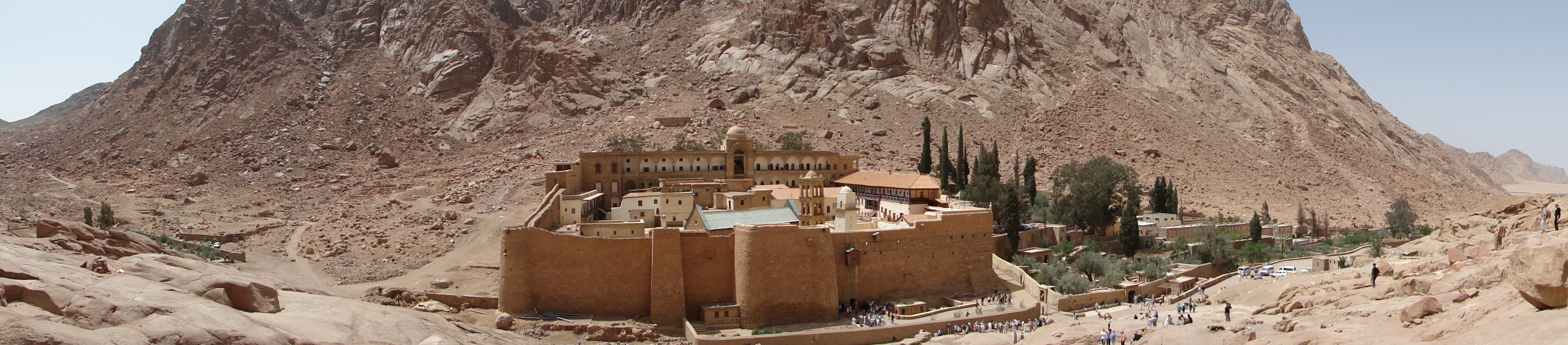
A panorama of St Catherine's Monastery

Wikipedia - Egghead06 - CC0 (public domain)


Names
Transliterated Name Language Name
Saint Catherine's Monastery English
Moní tís Agías Aikaterínis (Monastery of Saint Catherine) Greek Μονὴ τῆς Ἁγίας Αἰκατερίνης
Dayr al-Qiddīsa Katrīn Arabic دير القدّيسة كاترين
Sacred Autonomous Royal Monastery of Saint Catherine of the Holy and God-Trodden Mount Sinai Official Title
Introduction
Introduction

Located at the foot of Mount Sinai, Saint Catherine's Monastery In Sinai was built between 548 and 565 CE, and is the world's oldest continuously inhabited Christian monastery (wikipedia citing El Din (1998), Leroy and P. Collin (2004), and a defunct website). The site also hold's the world's oldest continually operating library (wikipedia citing the Sinai Palimpsests Project).

Aerial Views and Illustrations

Aerial Views

  • Saint Catherine's Monastery in Google Earth

Illustrations

  • Saint Catherine's Monastery as illustrated by David Roberts in 1839
  • Saint Catherine's Monastery as illustrated by Carsten Niebuhr in 1762

Textual Chronology
1091 CE Sinai Quake

Discussion

Discussion

1212 CE Quake

Discussion

Discussion

1839 CE Saint Catherine's Monastery Quake

Discussion

Discussion

Textual Seismic Effects
1091 CE Sinai Quake

Effect                             Location Image(s) Description
  • 7 shocks
St. Catherine's Monastery and vicinity
  • "at that evening seven great and terrible earthquakes happened, and the Barbarians got in fear and left, and after that they asked nothing more" - Patriarch Nektarios of Jerusalem

1212 CE Quake

Effect                             Location Image(s) Description
  • Rockfalls
  • Collapsed Walls
  • Roof Collapse
  • Inhabitants frightened
St. Catherine's Monastery and vicinity
  • "On Monday [AD] 30 April of 1312 at sunset a small earthquake happened, and another one at midnight; at dawn of Tuesday 1 May another great and terrible earthquake occurred; and because of the rumble and the shaking of the Mountains and of the rocks throwing down from the Mountains, it looked like that the entire World would submerge. The northern and eastern walls as well as two towers of the Monastery pulled down; and some of the cells collapsed completely but in others only the roofs collapsed. The earthquakes did not finish, on the contrary they were coming one after the other. Then, the Monks got in fear and with cries and lamentations left to the wine-arbor, where the Cemetery is situated, for they were afraid of the complete ruination of the Monastery, since the walls were so much damaged as it was possible for a loaded animal to pass through." - Patriarch Nektarios of Jerusalem

1839 CE Saint Catherine's Monastery Quake

Effect                             Location Image(s) Description
  • Displaced Wall
St. Catherine's Monastery
  • Ambraseys (2009) reports that a near-contemporary source described damage to a fortification wall of St Catherine’s monastery in Sinai due to an earthquake in 1839 CE.

Textual Intensity Estimates
1091 CE Sinai Quake

  • Simple MMI Intensity Scale
Effect                                                          Location Image(s) Description Intensity
  • 7 shocks (Frightens many ?)
St. Catherine's Monastery and vicinity
  • "at that evening seven great and terrible earthquakes happened, and the Barbarians got in fear and left, and after that they asked nothing more" - Patriarch Nektarios of Jerusalem
  • VI+
The archeoseismic evidence requires a minimum Intensity of VI (6).

1212 CE Quake

  • Earthquake Archeological    Effects from Rodríguez-Pascua et al (2013: 221-224)
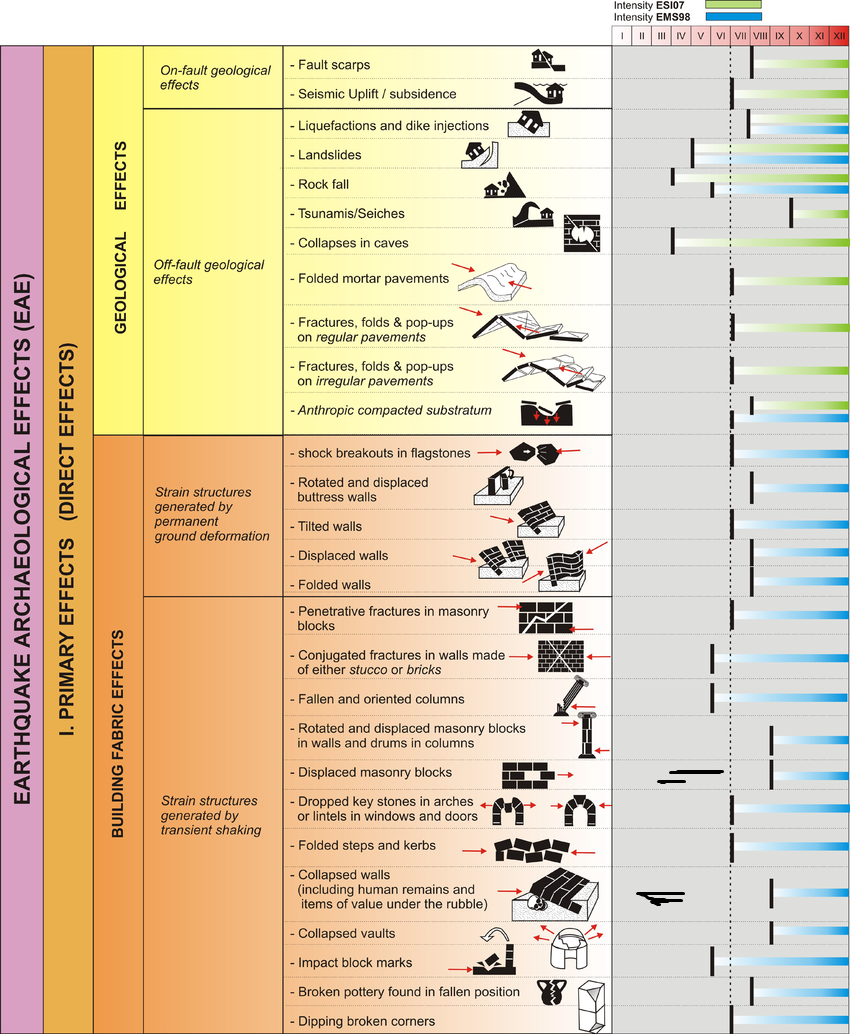
  • Synoptic Table of ESI 2007    Intensity Degrees from Michetti et al. (2007)
  • Simple MMI Intensity Scale
Effect                             Location Image(s) Description Intensity
  • Rockfalls
  • Collapsed Walls
  • Roof Collapse (due to displaced walls)
  • Inhabitants frightened
St. Catherine's Monastery and vicinity
  • "On Monday [AD] 30 April of 1312 at sunset a small earthquake happened, and another one at midnight; at dawn of Tuesday 1 May another great and terrible earthquake occurred; and because of the rumble and the shaking of the Mountains and of the rocks throwing down from the Mountains, it looked like that the entire World would submerge. The northern and eastern walls as well as two towers of the Monastery pulled down; and some of the cells collapsed completely but in others only the roofs collapsed. The earthquakes did not finish, on the contrary they were coming one after the other. Then, the Monks got in fear and with cries and lamentations left to the wine-arbor, where the Cemetery is situated, for they were afraid of the complete ruination of the Monastery, since the walls were so much damaged as it was possible for a loaded animal to pass through." - Patriarch Nektarios of Jerusalem
  • VI+
  • VIII+
  • VII+
  • VII+
The archeoseismic evidence requires a minimum Intensity of VIII (8).

1839 CE Saint Catherine's Monastery Quake

Effect                             Location Image(s) Description Intensity
  • Displaced Wall
St. Catherine's Monastery
  • Ambraseys (2009) reports that a near-contemporary source described damage to a fortification wall of St Catherine’s monastery in Sinai due to an earthquake in 1839 CE.
  • VII+
The archeoseismic evidence requires a minimum Intensity of VII (7) when using the Earthquake Archeological Effects chart of Rodríguez-Pascua et al (2013: 221-224).

Notes and Further Reading
References
Wikipedia pages

Saint Catherine's Monastery


Mount Sinai


Palimpsest