
Open this page in a new tab

Ras al-Ayn

Ras al-Ayn

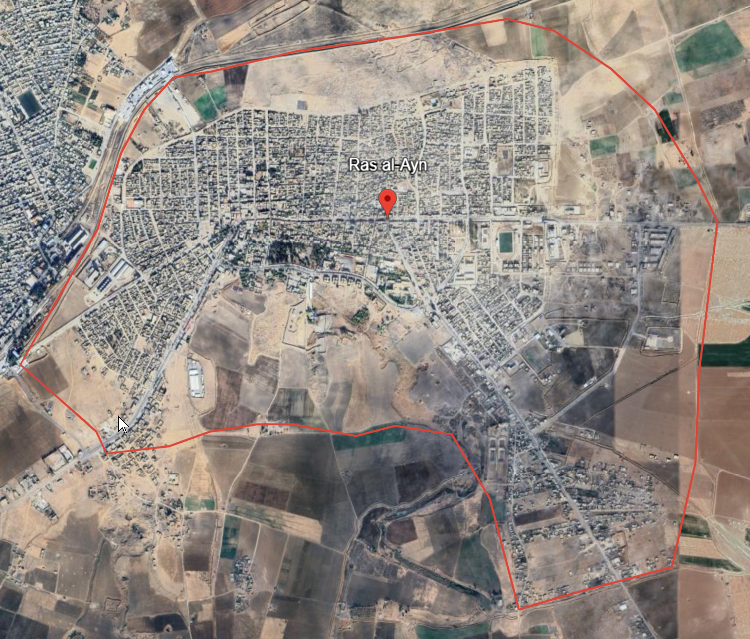
click on image to explore this site on a new tab in Google Earth


Names
Transliterated Name Language Name
Ras al-Ayn Arabic رأس العين
Ras al-Ain Arabic (variant)
Raʾs al-ʿAyn Arabic (scholarly) رأس العين
Ain Werda Arabic (medieval) عين وردة
Serê Kaniyê Kurdish
Reshʿayna Syriac ܪܝܫ ܥܝܢܐ
Resh Ayna Syriac (translit.)
Rish ʿAyna Syriac (variant)
Rēš ina Akkadian
Sikkan Aramaic
Rhesaina / Ressaina Greek / Latin
Raisena Greek (Ptolemy)
Theodosiopolis Greek / Byzantine Θεοδοσιούπολις
Ceylanpınar Modern Turkish
Introduction
Introduction

Ras al-Ayn, known in Syriac as Reshʿayna, is a historically significant settlement located in the upper Khabur basin in northeastern Syria, near the modern Turkish border. Its name, meaning “head of the spring,” reflects the remarkable hydrological setting of the site, where abundant karstic springs form the principal source of the Khabur River, one of the major tributaries of the Euphrates.

Because of this unique concentration of perennial water sources in an otherwise semi-arid landscape, Ras al-Ayn has been a focal point of settlement since antiquity. The site lay along important routes connecting northern Mesopotamia with Syria and Anatolia, and its control was tied not only to regional communication but also to access to water and agricultural productivity. In Late Antiquity and the early medieval period, it functioned as a notable urban and ecclesiastical center within the Syriac-speaking world.

Syriac sources preserve the name Reshʿayna (ܪܝܫ ܥܝܢܐ), emphasizing its identity as a place defined by springs. Later Arabic sources refer to it as Ras al-Ayn, maintaining the same meaning. Across these traditions, the continuity of the toponym reflects the enduring importance of the site’s hydrology, which remained the defining feature of its geography and settlement history.

Aerial Views
Aerial Views

Aerial Views

Normal Size

  • Ras al-Ayn in Google Earth

Magnified

  • Ras al-Ayn in Google Earth

Notes and Further Reading
References

Articles and Books

Barsoum, Ignatius Afram (1991) ܒܪ̈ܘܠܐ ܒܕܝܪ̈ܐ ܕܥܠ ܡܪܕܘܬ ܝܘܠܦܢ̈ܐ ܣܘܪ̈ܝܝܐ ܗܕܝܪ̈ܐ, 2nd ed., Holland: Bar Hebraeus Verlag, p. 555

Barsoum, Ignatius Afram (1987) كتاب اللؤلؤ المنثور في تاريخ العلوم والأداب السريانية, 4th ed., Holland: Bar Hebraeus Verlag, p. 516

Barsoum, Ignatius Aphram (2003) The Scattered Pearls: A History of Syriac Literature and Sciences, 2nd revised ed., Piscataway, New Jersey: Gorgias Press, p. 557

Brock, S. P. et al. (2011) Gorgias Encyclopedic Dictionary of the Syriac Heritage, Piscataway, New Jersey: Gorgias Press, pp. 26, 46, 110, 111, 190, 220, 276, 279, 302, 313, 344, 351, 357, 366, 367, 370, 419, Maps I B1, II B1, III

Brooks, E. W. (1935–1936) Iohannis Ephesini historiae ecclesiasticae pars tertia, CSCO Syr. III.3, Louvain: L. Durbecq, pp. 308, 313, 328, chs. 3.6.13, 3.6.17, 3.6.26

Mladjov, I. (2018) Diachronic Maps of Syriac Cultures and Their Geographic Contexts, in King, D. and Michelson, D. A. (eds.), The Syriac World, London-New York: Routledge, maps 1, 2, 7

Potter, W. L. and Michelson, D. A. (2018) Index of Maps, in King, D. (ed.), The Syriac World, London-New York: Routledge, p. 832

Takahashi, H. and Van Rompay, L. (2011) Reshʿayna, in Brock, S. P. et al. (eds.), The Gorgias Encyclopedic Dictionary of the Syriac Heritage, Piscataway, NJ: Gorgias Press, p. 351

Yāqūt al-Ḥamawī (1990) معجم البلدان, Beirut: Dār al-kutub al-ʿilmiyya, vol. III, p. 15

Wikipedia pages

Ras al-Ayn