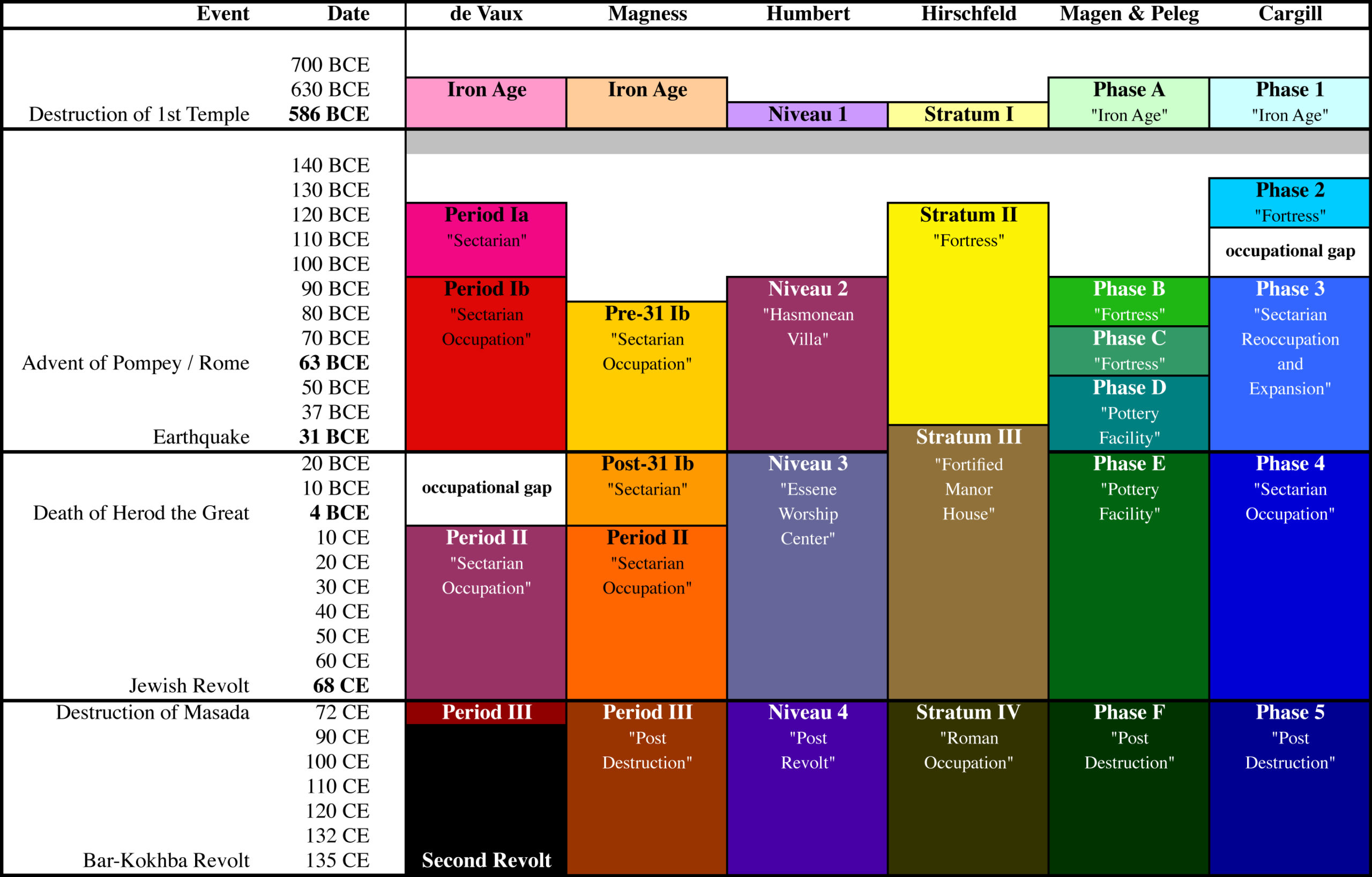
Phase Ib Earthquake

Roland de Vaux, the original excavator of
Qumran, interpreted a destruction layer between Periods Ib and 2 which he attributed to an
earthquake (in 31 BCE) and a fire that caused the settlement to be abandoned for several decades.
This interpretation has been challenged, particularly the idea of a decades-long abandonment.
Magness (2002), for example, proposed a revised chronology that subdivided Phase Ib
into two sub-phases, before and after a 31 BCE earthquake.
The fire and subsequent abandonment were placed nearly 30 years after the earthquake.
Magness (2002) suggested that the fire was caused by human agency, possibly linked
to military activity or unrest in the area. For archaeoseismic purposes, most chronologies
of Qumran agree that the site was impacted by the
31 BCE Josephus Quake, with Hirschfeld, who excavated nearby
En Feshka, as a notable exception.