
Open this page in a new tab

Qasr al-Yahud

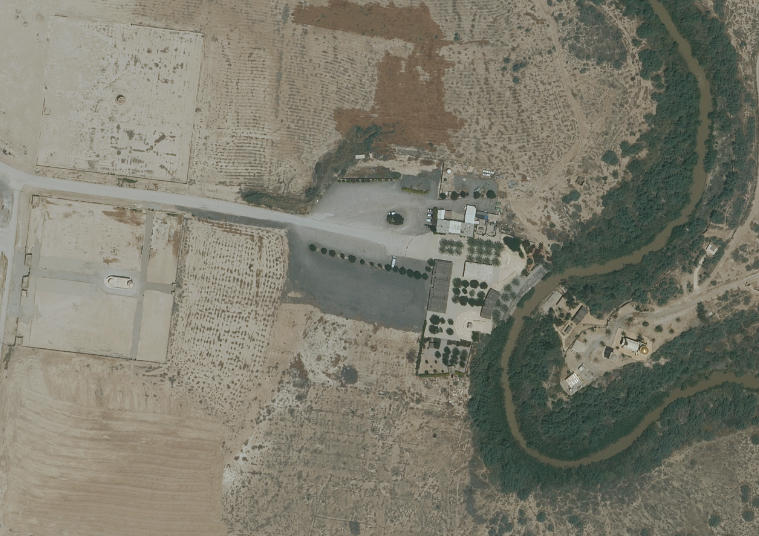
Aerial View of Qasr al-Yahud Qasr al-Yahud on govmap.gov.il

click on image to explore this site on a new tab in govmap.gov.il


Names
Transliterated Name Language Name
Qasr al-Yahud Arabic قصر اليهود
Qasr al-Yahud Hebrew קאסר אל יהוד
Monastery of John The Baptist English
Mār John Syriac
Introduction
Introduction

  • from Chat GPT 5.2, 18 January 2026
  • sources: Joshua 3
Qasr al-Yahud (Qasr el-Yehud), the Byzantine ruins of the Church of John the Baptist, are located on the west bank of the Jordan River at one of the most important pilgrimage landscapes in the southern Levant. The church stood immediately adjacent to the traditional baptism site of Jesus by John the Baptist and formed part of a densely ritualised riverine complex that attracted pilgrims from Late Antiquity through the early Islamic period.

The site is also traditionally identified as the place where the ancient Israelites first crossed the Jordan into the “Promised Land”, as described in Joshua 3. This biblical association explains the Arabic toponym al-Yahud, “of the Jews”, and underscores the long-lived sacred geography that framed the construction, use, and repeated rebuilding of the Byzantine church complex.

Maps and Aerial Views

  • Location Map from Serbian Orthodox Church
  • Qasr al-Yahud in Google Earth
  • Qasr al-Yahud on govmap.gov.il

Textual Chronology
Jordan Valley Quakes - 659-661 CE

Discussion

Discussion

Textual Seismic Effects
Jordan Valley Quakes - 659-661 CE

Effect                                         Location Image(s) Description
  • Collapsed Walls
  • Foundation Damage
Monastery of John the Baptist
  • "In those days, when the Arabs were assembled there with Mu'awiya, there was an earthquake and a violent tremor and the greater part of Jericho fell, including all its churches, and of the House of Lord John at the site of our Saviour’s baptism in the Jordan every stone above the ground was overthrown, together with the entire monastery." - The Maronite Chronicle

  • "On the banks of the Jordan are built three monasteries, namely, that of the Forerunner, of Chrysostom . . . the monastery of the Forerunner having been levelled with the ground by an earthquake, now by the munificent hand of our Emperor, Manuel Comnenus Porphyrogenitus, crowned by God,* has been entirely rebuilt, the prior being entrusted with the superintendence of the restoration." - The Concise Description of the Holy Places by John Phokas
  • Textual Intensity Estimates
    Jordan Valley Quakes - 659-661 CE

    • Earthquake Archeological    Effects from Rodríguez-Pascua et al (2013: 221-224)
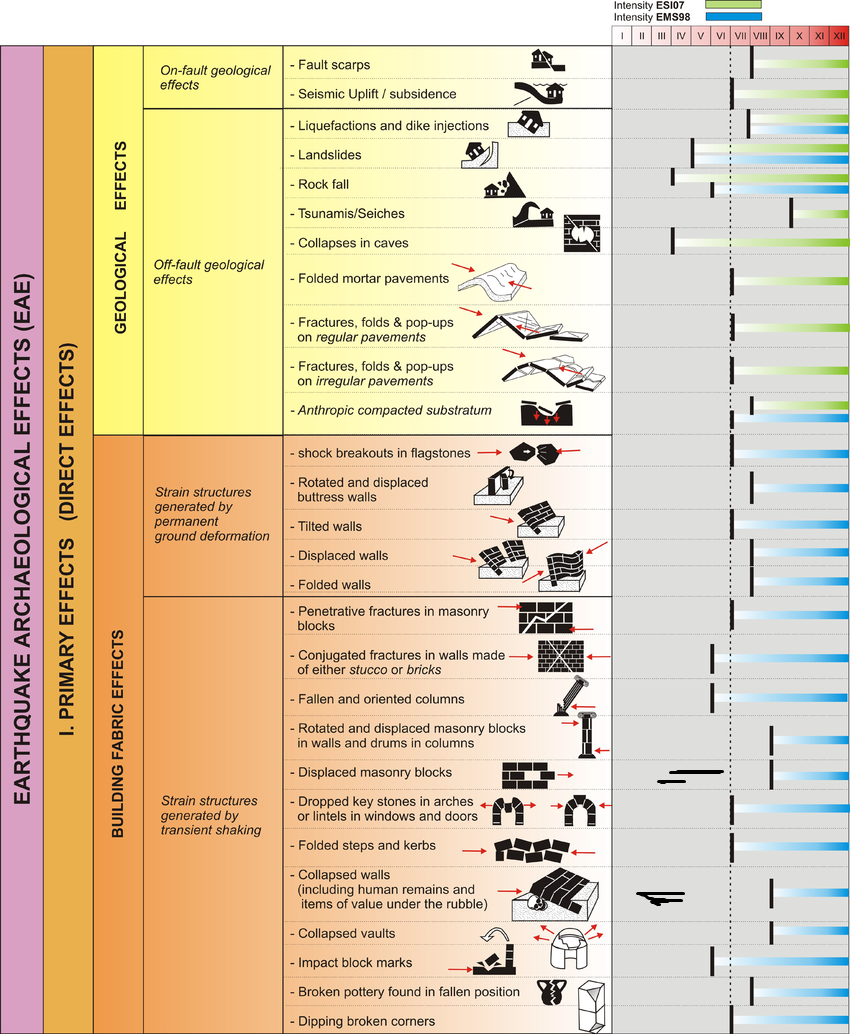
    • Synoptic Table of ESI 2007    Intensity Degrees from Michetti et al. (2007)
    • Simple MMI Intensity Scale
    Effect                                         Location Image(s) Description Intensity
    • Collapsed Walls
    • Foundation Damage
    Monastery of John the Baptist
  • "In those days, when the Arabs were assembled there with Mu'awiya, there was an earthquake and a violent tremor and the greater part of Jericho fell, including all its churches, and of the House of Lord John at the site of our Saviour’s baptism in the Jordan every stone above the ground was overthrown, together with the entire monastery." - The Maronite Chronicle

  • "On the banks of the Jordan are built three monasteries, namely, that of the Forerunner, of Chrysostom . . . the monastery of the Forerunner having been levelled with the ground by an earthquake, now by the munificent hand of our Emperor, Manuel Comnenus Porphyrogenitus, crowned by God,* has been entirely rebuilt, the prior being entrusted with the superintendence of the restoration." - The Concise Description of the Holy Places by John Phokas
    • VIII+
    • IX+
    The archeoseismic evidence requires a minimum Intensity of IX (9) when using the Earthquake Archeological Effects chart of Rodríguez-Pascua et al (2013: 221-224).

    Notes and Further Reading
    References
    Wikipedia pages

    Qasr al-Yahud