Open this page in a new tab

Mount Tabor

Mount Tabor

click on image to explore in a new tab in Google Earth


Names
Transliterated Name Source Name
Mount Tabor Modern English
Har Tavor Hebrew הר תבור
Tavor Hebrew תבור
Jabal Tabor Arabic جبل طابور
Jabal al-Tur Arabic جبل الطور
Itabyrion Greek / Classical Ἰταβύριον
Itabyrium Latin / Classical
Mount of Transfiguration Christian tradition
Introduction
Introduction

Mount Tabor is a prominent isolated mountain in Lower Galilee in northern Israel. Its summit reaches approximately 562 m above sea level and rises about 400 m above the surrounding valleys and plains. Its distinctive rounded profile and relative isolation make it visible from considerable distances across Lower Galilee.

Geographically, Mount Tabor stands near the eastern margin of the Jezreel Valley and overlooks the surrounding lowlands of Lower Galilee. Its slopes support Mediterranean woodland, including Palestine oak and Mount Tabor oak, while the summit and upper slopes contain numerous archaeological, historical, and religious remains.

Mount Tabor appears in ancient Jewish and Christian traditions and was an important landmark throughout antiquity. The mountain is mentioned in the Hebrew Bible and later Jewish literature. In Christian tradition, Mount Tabor became identified with the Transfiguration of Jesus, although the New Testament does not explicitly name the mountain where the event occurred. Churches, monasteries, fortifications, and pilgrimage facilities were subsequently constructed on and around the summit.

The mountain also occupied a strategic position overlooking routes through Lower Galilee and the Jezreel Valley. Its archaeological record reflects repeated occupation and use during the Classical, Byzantine, Islamic, Crusader, and later periods. Today, the summit contains major Christian religious complexes as well as remains of earlier fortifications and settlement.

Aerial Views
Aerial Views

Aerial Views

  • Mount Tabor in Google Earth

Textual Chronology
January 749 CE Sabbatical Year Earthquakes

Discussion

Discussion

Textual Seismic Effects
January 749 CE Sabbatical Year Earthquakes

  • Seismic Effects follow Williams (2024) in partitioning effects between the Holy Desert North, Holy Desert South, and Talking Mule Earthquakes.
Effect                                                      Location Image(s) Description
  • Landlside
Mount Tabor
  • "9th year of Constantine ...

    [Porrò] On the 8th of February [eiusdem] 3rd indiction, the son Leo was born to emperor Constantine from the daughter of Chagan of Chazaria. That same year there was an earthquake in Syria, an enormous and terrible [calamity]. Many died. A spring [moved ?]. In another place in the mountains, a village moved for about six miles with its walls and homes intact and without any small thing dying. Finally, In Mesopotamia, the earth split two thousand [feet?] and out of the chasm came a different soil which was white and sandy. Out of this chasm emerged a spotless mule speaking in a human voice which predicted an invasion by a foreign army into the land of the Arabs. This came true." – Paul the Deacon

  • "Emperor Constantines 9th year

    ... That year there was an earthquake in Syria, a terrible calamity. Many died. A spring [moved?]. In another place in the mountains, a village moved with its walls and homes intact for 6 Roman miles. Finally in Mesopotamia, the earth split two thousand feet and out of the chasm came a white sandy soil and a spotless mule which spoke in a human voice and prophesied that the Arab lands would be invaded by a foreign army. And this prophecy came true." – Anastasius Bibliothecarius

  • "[A.M. 6241, AD 748/9] In this year Marouam was pursued by the Maurophoroi, who captured him and killed him after waging a very heavy war. They were commanded by Salim, son of Alim, one of the aforementioned fugitives who had sent Aboumouslim on his mission. The rest of them gathered in Samaria and Trachonitis and awarded their leadership by lot to Aboulabas, and next to him to his brother Abdela, and next to the latter to Ise Ibinmouse. II They appointed Abdela, son of Alim and brother of Salim, to be commander in Syria; Salim himself to be commander in Egypt; while Abdela, brother of Aboulabas (from whom he received the nomination to the command) they appointed over Mesopotamia. II Aboulabas himself, who was in supreme authority, established his seat in Persia, the government and all the seized treasure (which Marouam had carried away) having been transferred to him and his Persian allies from Damascus. Marouam's surviving sons and relatives went from Egypt to Africa, whence they crossed the narrow sea that separates Libya from Europe next to the Ocean at a place called Septai and settled until this day in Spain of Europe, where some kinsmen and correligionists of theirs had come to dwell at an earlier time — the latter being descendants of Mauias who had suffered shipwreck there. The devastation in the days of Marouam lasted six years and in the course of it all the prominent cities of Syria lost their walls except Antioch, which he planned to use as a refuge. Innumerable Arabs were also killed by him for he was very cunning in civil matters. He belonged to the heresy of the Epicureans, that is Automatists, an impiety he had imbued from the pagans who dwell at Harran.

    II On 25 January of the same 3rd indiction a son was born to the emperor Constantine by the daughter of the Chagan of Chazaria and he called him Leo. In the same year there was an earthquake and terrible destruction in Syria, as a result of which some cities were entirely destroyed, others partially so, while others slid down entire, with their walls and houses, from positions on mountains to low-lying plains, a distance of six miles or thereabout. Eyewitnesses affirmed that the ground in Mesopotamia was split along two miles and that out of the chasm was thrown up a different soil, very white and sandy, in the midst of which, they said, there came up an animal like a mule, quite spotless, that spoke in a human voice and announced the incursion of a certain nation from the desert against the Arabs, which indeed came to pass.

    The next year, on the feast of holy Pentecost the impious emperor Constantine conferred the imperial crown on his son Leo by the hand of the false patriarch Anastasios who shared his views. II" – Theophanes

  • "69. Thereafter a son was born to the emperor, whom he named Leo. At the same time a severe earthquake occurred in Syria, causing enormous damage. For some cities that were there (were completely destroyed and) the ground round about opened up to a great extent, while others suffered this fate but partially. Others were shifted from their high positions and slipped down entire, with their walls and houses, to the plains below, moving a distance of as much as six miles, more or less, from their original situation. Some affirmed they had seen the ground in Mesopotamia (which is near Syria) crack deeply along (a distance) of two miles, and another ground, sandy and very white, thrown up from below; and that along with the latter was cast up a female mule, which proclaimed in a human voice the destruction of the Arabs. A short time thereafter a tribe appeared from the desert beyond and slew many multitudes (of Arabs) without resistance." – Nikephoros I of Constantinople

  • "That year there was a powerful earthquake in Syria. Some cities were destroyed - others only partly so. In one place, a village moved with its walls and buildings intact. In Mesopotamia, the earth split three thousand feet and a white sandy soil came out of the chasm. Then an incredible thing - an onager emerged speaking of human affairs and predicted a foreign invasion - which happened a short time later." – Georgius Monachus (George the Monk), also known as Georgius Hamartolos (George the Sinner)

  • "In the ninth year of Constanine, Marnamus was killed in the war with the Abbasids. On 25 January, a son Leo was born to Constantine [from his wife] Irena, the daughter of Chazara.

    At the same time, there was a serious earthquake and terrible destruction in Syria. Some cities were destroyed [and] others partly destroyed. In some place[s?], in the mountains, a village[s?] slid down the mountain for a distance of 6 miles with their houses and buildings intact. Further, in Mesopotamia the earth was split for two thousand steps [~feet] and out of that chasm came a different type of white soil from which a emerged a mule who spoke a prophecy in a human voice - that a nation from the desert would invade the Arab lands. The prophecy came true." – George Cedrenus

  • "Year 131 [A.H.]

    Begins on Friday 30 Ab of the year 1059 of the Greeks [30 August 748 AD]

    A year in which there were many earthquakes; many places ruined; a valley [located] near Mount Tabor was transported from its place to 4 miles with its houses and properties, without a single grain of dust falling from its houses, and without either a man nor an animal dying , or even a hen [sic]. In which the Church of the Jacobites, at Mabug, collapsed on a Sunday at the time of the Mass and many people perished there (Kuwarazmi'. - Daniel the Jacobite)." – Elias of Nisibis

  • "Meanwhile there was an earthquake at Damascus 'which lasted for days and shook her like leaves on trees'. In Beit Qoubayê (?), there was a fortress that had been built at great expense by Al-Hajjaj ibn Yusuf. It was overthrown from top to bottom and more than 80 people suffocated inside. Many in the city itself perished. Myriads of people died in Ghautah and Dareya. Bosrah, Nawa, Der'at, and Ba'albek were swallowed up completely. The water in the springs of Baalbek turned to blood. It returned to normal after much prayer and repentance by the townsfolk.

    There was an extraordinary storm in the Sea. Its waves rose to the sky. The waves surged with a terrifying and horrid noise like a cauldron boiling from the flames of a fire. The sea overflowed and breached its banks destroying many towns and villages on its shores.

    In the land of Balqa, that is to say Moab, there was a fortress on the shore of the sea, where the Yemenite Taiyayê tribe lived. It was struck by the sea's waves, the foundations were torn out, and it was deposited three miles away.

    This earthquake destroyed the city of Tiberius except for house of a man named 'Isa. It overthrew thirty synagogues and wonderful natural things. The thermal baths - that wonderful building - built by Solomon the son of David, collapsed and was destroyed. There was a spring with purgative water and amazing constructions above it, surrounded by hotels (inns) for the sick who sought to be healed. There were clay pots artistically made and arranged. On each pot was written how many times it purged the bowels of those who drank from it. Each person chose a pot according to how much they wanted to drink. All these buildings are gone.

    A village near Mount Tabor moved four miles from its place with all its homes and buildings intact. Neither a stone nor a small mud brick fell. Nor did [467] any person or animal die - not even a chicken!

    The spring next to Jericho moved six miles from its original location.

    In Mabboug, the quake struck during mass. People and animals died because the great churches and walls collapsed.

    In Constantinople, the statues of the emperors fell as well as most of the buildings. The same thing happened in Nicaea and in the other cities.

    Around this time, Const[antinus] drove out Germanus, their patriarch, from the church, and installed Anasta[si]us. " – Michael the Syrian

  • "On the insurrections and ruin which happened at this time in the West, and the fall of the city of Mabbug. For in the year 1060 of the Greeks, 134 of the Arabs, great upheaval afflicted the world . . .

    And there was an earthquake at Damascus and in the whole surrounding area, which lasted for days, and in which the area trembled and was shaken. It also [affected] Beth Cubaye, a citadel which had been built by Hagag the son of Joseph with much effort and at great expense. This was overturned and was destroyed down to its foundations, and more than eighty people were killed and buried in the middle of it. And in the same city many people died. Likewise in Gutah [a suburb] of Dareya, countless people died in this earthquake. Bosra and Neve (sic.) were razed to their foundations. And a great part of Baalbek collapsed, and the springs of water there became like blood.

    There was an unusual and unexpected storm in the sea. The waves were seen to be lifted up to the sky: like a pot boiling over a blazing fire, the waves boiled with a terrible sound which made those who heard them tremble. And [the sea] rushed up and overflowed its bounds, destroying many coastal villages. Many other things are also told which, if they were recorded, would be a great burden for the writer and his readers.

    They say also that in the region of Belca or the Moabitide, a certain citadel located on the shore of the sea, inhabited by Yemenite Arabs, was razed down to its foundations when waves poured into it from the depths; and it was hurled three miles. This earthquake completely overthrew the city of Tiberias, except for the house of a monk called ‘Isa. Also thirty synagogues of the Jews were overturned there and some natural wonders which were in that city. The baths built by King Solomon, a wonderful edifice, were completely overthrown and collapsed. There was also in that city a purgative spring of water given by God for the health of man. And above it had been erected fine buildings . . . These buildings were all razed and destroyed. And another village, near Mt Tabor, was moved and shifted four miles from its site, with its houses and goods, and not a single stone or piece of adobe fell; and not a man or animal died, not even a chicken.

    And a spring of water situated close to Jericho, near which there were citadels, gardens and mills founded by Solomon the son of Abdamalich, itself stayed where it was, but the river which has its source there moved six miles back from the place in which it flowed, so that all that Solomon had built by this river perished.

    And Mabbug [became] no insignificant ruin, and many people died there; for at the time of the Sunday sacrifice, as the priest stood raising his hands over the oblation, the church collapsed, killing those on whom it fell, and all who were inside were crushed and perished, the priests together with the people; and instead of canticles and spiritual psalms, crashes and lamentation were heard in the entire city. The foundations of the walls were also shattered. (Chron. 1234, 325–327/254–255)." – Chronicon Ad Annum 1234

Textual Intensity Estimates
January 749 CE Sabbatical Year Earthquakes

  • Seismic Effects follow Williams (2024) in partitioning effects between the Holy Desert North, Holy Desert South, and Talking Mule Earthquakes.
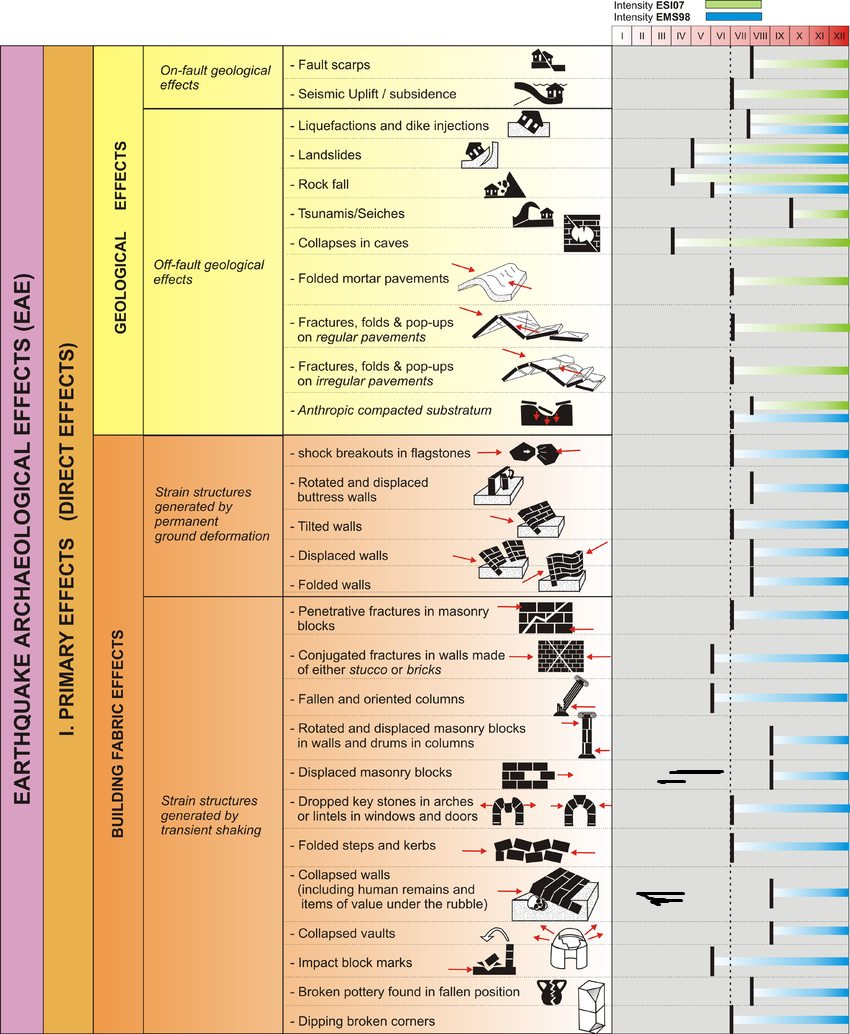
  • Earthquake Archeological Effects chart of Rodríguez-Pascua et al (2013: 221-224)
Effect                                                      Location Image(s) Description Intensity
  • Landlside
Mount Tabor
  • "9th year of Constantine ...

    [Porrò] On the 8th of February [eiusdem] 3rd indiction, the son Leo was born to emperor Constantine from the daughter of Chagan of Chazaria. That same year there was an earthquake in Syria, an enormous and terrible [calamity]. Many died. A spring [moved ?]. In another place in the mountains, a village moved for about six miles with its walls and homes intact and without any small thing dying. Finally, In Mesopotamia, the earth split two thousand [feet?] and out of the chasm came a different soil which was white and sandy. Out of this chasm emerged a spotless mule speaking in a human voice which predicted an invasion by a foreign army into the land of the Arabs. This came true." – Paul the Deacon

  • "Emperor Constantines 9th year

    ... That year there was an earthquake in Syria, a terrible calamity. Many died. A spring [moved?]. In another place in the mountains, a village moved with its walls and homes intact for 6 Roman miles. Finally in Mesopotamia, the earth split two thousand feet and out of the chasm came a white sandy soil and a spotless mule which spoke in a human voice and prophesied that the Arab lands would be invaded by a foreign army. And this prophecy came true." – Anastasius Bibliothecarius

  • "[A.M. 6241, AD 748/9] In this year Marouam was pursued by the Maurophoroi, who captured him and killed him after waging a very heavy war. They were commanded by Salim, son of Alim, one of the aforementioned fugitives who had sent Aboumouslim on his mission. The rest of them gathered in Samaria and Trachonitis and awarded their leadership by lot to Aboulabas, and next to him to his brother Abdela, and next to the latter to Ise Ibinmouse. II They appointed Abdela, son of Alim and brother of Salim, to be commander in Syria; Salim himself to be commander in Egypt; while Abdela, brother of Aboulabas (from whom he received the nomination to the command) they appointed over Mesopotamia. II Aboulabas himself, who was in supreme authority, established his seat in Persia, the government and all the seized treasure (which Marouam had carried away) having been transferred to him and his Persian allies from Damascus. Marouam's surviving sons and relatives went from Egypt to Africa, whence they crossed the narrow sea that separates Libya from Europe next to the Ocean at a place called Septai and settled until this day in Spain of Europe, where some kinsmen and correligionists of theirs had come to dwell at an earlier time — the latter being descendants of Mauias who had suffered shipwreck there. The devastation in the days of Marouam lasted six years and in the course of it all the prominent cities of Syria lost their walls except Antioch, which he planned to use as a refuge. Innumerable Arabs were also killed by him for he was very cunning in civil matters. He belonged to the heresy of the Epicureans, that is Automatists, an impiety he had imbued from the pagans who dwell at Harran.

    II On 25 January of the same 3rd indiction a son was born to the emperor Constantine by the daughter of the Chagan of Chazaria and he called him Leo. In the same year there was an earthquake and terrible destruction in Syria, as a result of which some cities were entirely destroyed, others partially so, while others slid down entire, with their walls and houses, from positions on mountains to low-lying plains, a distance of six miles or thereabout. Eyewitnesses affirmed that the ground in Mesopotamia was split along two miles and that out of the chasm was thrown up a different soil, very white and sandy, in the midst of which, they said, there came up an animal like a mule, quite spotless, that spoke in a human voice and announced the incursion of a certain nation from the desert against the Arabs, which indeed came to pass.

    The next year, on the feast of holy Pentecost the impious emperor Constantine conferred the imperial crown on his son Leo by the hand of the false patriarch Anastasios who shared his views. II" – Theophanes

  • "69. Thereafter a son was born to the emperor, whom he named Leo. At the same time a severe earthquake occurred in Syria, causing enormous damage. For some cities that were there (were completely destroyed and) the ground round about opened up to a great extent, while others suffered this fate but partially. Others were shifted from their high positions and slipped down entire, with their walls and houses, to the plains below, moving a distance of as much as six miles, more or less, from their original situation. Some affirmed they had seen the ground in Mesopotamia (which is near Syria) crack deeply along (a distance) of two miles, and another ground, sandy and very white, thrown up from below; and that along with the latter was cast up a female mule, which proclaimed in a human voice the destruction of the Arabs. A short time thereafter a tribe appeared from the desert beyond and slew many multitudes (of Arabs) without resistance." – Nikephoros I of Constantinople

  • "That year there was a powerful earthquake in Syria. Some cities were destroyed - others only partly so. In one place, a village moved with its walls and buildings intact. In Mesopotamia, the earth split three thousand feet and a white sandy soil came out of the chasm. Then an incredible thing - an onager emerged speaking of human affairs and predicted a foreign invasion - which happened a short time later." – Georgius Monachus (George the Monk), also known as Georgius Hamartolos (George the Sinner)

  • "In the ninth year of Constanine, Marnamus was killed in the war with the Abbasids. On 25 January, a son Leo was born to Constantine [from his wife] Irena, the daughter of Chazara.

    At the same time, there was a serious earthquake and terrible destruction in Syria. Some cities were destroyed [and] others partly destroyed. In some place[s?], in the mountains, a village[s?] slid down the mountain for a distance of 6 miles with their houses and buildings intact. Further, in Mesopotamia the earth was split for two thousand steps [~feet] and out of that chasm came a different type of white soil from which a emerged a mule who spoke a prophecy in a human voice - that a nation from the desert would invade the Arab lands. The prophecy came true." – George Cedrenus

  • "Year 131 [A.H.]

    Begins on Friday 30 Ab of the year 1059 of the Greeks [30 August 748 AD]

    A year in which there were many earthquakes; many places ruined; a valley [located] near Mount Tabor was transported from its place to 4 miles with its houses and properties, without a single grain of dust falling from its houses, and without either a man nor an animal dying , or even a hen [sic]. In which the Church of the Jacobites, at Mabug, collapsed on a Sunday at the time of the Mass and many people perished there (Kuwarazmi'. - Daniel the Jacobite)." – Elias of Nisibis

  • "Meanwhile there was an earthquake at Damascus 'which lasted for days and shook her like leaves on trees'. In Beit Qoubayê (?), there was a fortress that had been built at great expense by Al-Hajjaj ibn Yusuf. It was overthrown from top to bottom and more than 80 people suffocated inside. Many in the city itself perished. Myriads of people died in Ghautah and Dareya. Bosrah, Nawa, Der'at, and Ba'albek were swallowed up completely. The water in the springs of Baalbek turned to blood. It returned to normal after much prayer and repentance by the townsfolk.

    There was an extraordinary storm in the Sea. Its waves rose to the sky. The waves surged with a terrifying and horrid noise like a cauldron boiling from the flames of a fire. The sea overflowed and breached its banks destroying many towns and villages on its shores.

    In the land of Balqa, that is to say Moab, there was a fortress on the shore of the sea, where the Yemenite Taiyayê tribe lived. It was struck by the sea's waves, the foundations were torn out, and it was deposited three miles away.

    This earthquake destroyed the city of Tiberius except for house of a man named 'Isa. It overthrew thirty synagogues and wonderful natural things. The thermal baths - that wonderful building - built by Solomon the son of David, collapsed and was destroyed. There was a spring with purgative water and amazing constructions above it, surrounded by hotels (inns) for the sick who sought to be healed. There were clay pots artistically made and arranged. On each pot was written how many times it purged the bowels of those who drank from it. Each person chose a pot according to how much they wanted to drink. All these buildings are gone.

    A village near Mount Tabor moved four miles from its place with all its homes and buildings intact. Neither a stone nor a small mud brick fell. Nor did [467] any person or animal die - not even a chicken!

    The spring next to Jericho moved six miles from its original location.

    In Mabboug, the quake struck during mass. People and animals died because the great churches and walls collapsed.

    In Constantinople, the statues of the emperors fell as well as most of the buildings. The same thing happened in Nicaea and in the other cities.

    Around this time, Const[antinus] drove out Germanus, their patriarch, from the church, and installed Anasta[si]us. " – Michael the Syrian

  • "On the insurrections and ruin which happened at this time in the West, and the fall of the city of Mabbug. For in the year 1060 of the Greeks, 134 of the Arabs, great upheaval afflicted the world . . .

    And there was an earthquake at Damascus and in the whole surrounding area, which lasted for days, and in which the area trembled and was shaken. It also [affected] Beth Cubaye, a citadel which had been built by Hagag the son of Joseph with much effort and at great expense. This was overturned and was destroyed down to its foundations, and more than eighty people were killed and buried in the middle of it. And in the same city many people died. Likewise in Gutah [a suburb] of Dareya, countless people died in this earthquake. Bosra and Neve (sic.) were razed to their foundations. And a great part of Baalbek collapsed, and the springs of water there became like blood.

    There was an unusual and unexpected storm in the sea. The waves were seen to be lifted up to the sky: like a pot boiling over a blazing fire, the waves boiled with a terrible sound which made those who heard them tremble. And [the sea] rushed up and overflowed its bounds, destroying many coastal villages. Many other things are also told which, if they were recorded, would be a great burden for the writer and his readers.

    They say also that in the region of Belca or the Moabitide, a certain citadel located on the shore of the sea, inhabited by Yemenite Arabs, was razed down to its foundations when waves poured into it from the depths; and it was hurled three miles. This earthquake completely overthrew the city of Tiberias, except for the house of a monk called ‘Isa. Also thirty synagogues of the Jews were overturned there and some natural wonders which were in that city. The baths built by King Solomon, a wonderful edifice, were completely overthrown and collapsed. There was also in that city a purgative spring of water given by God for the health of man. And above it had been erected fine buildings . . . These buildings were all razed and destroyed. And another village, near Mt Tabor, was moved and shifted four miles from its site, with its houses and goods, and not a single stone or piece of adobe fell; and not a man or animal died, not even a chicken.

    And a spring of water situated close to Jericho, near which there were citadels, gardens and mills founded by Solomon the son of Abdamalich, itself stayed where it was, but the river which has its source there moved six miles back from the place in which it flowed, so that all that Solomon had built by this river perished.

    And Mabbug [became] no insignificant ruin, and many people died there; for at the time of the Sunday sacrifice, as the priest stood raising his hands over the oblation, the church collapsed, killing those on whom it fell, and all who were inside were crushed and perished, the priests together with the people; and instead of canticles and spiritual psalms, crashes and lamentation were heard in the entire city. The foundations of the walls were also shattered. (Chron. 1234, 325–327/254–255)." – Chronicon Ad Annum 1234
  • IV+
This evidence requires a minimum Intensity of IV (4) when using the Earthquake Archeological Effects chart of Rodríguez-Pascua et al (2013: 221-224).

Notes and Further Reading
References
Wikipedia pages

Mount Tabor


Mount of Transfiguration


Church of the Transfiguration


Lower Galilee


Jezreel Valley