Antila Well Earthquake

Taxel (2013:176) suggested that Mazliah,
also known as Ramla (South), pre-existed the
foundation of Ramla around 716 CE and
suffered damage during one of the mid-8th century CE
Sabbatical Year Earthquakes. This
interpretation is based on clear
archaeoseismic evidence documented by
Gorzalczany (2009b) in Areas J2 and K1 at
Ramla (South), which he attributed to a
major earthquake in the eighth century CE. The damage
included cracks running along installation walls, large
collapse deposits composed of unrobbed
ashlar masonry, floors
that had subsided, and walls that curved in
anomalous directions. In several cases, collapsed walls
were intentionally buried beneath soil and
hamra, indicating an immediate post-event response focused on
restoring settlement activity rather than abandonment.
Particularly diagnostic evidence was recovered from a
storage room in Area J, where dozens of jars were found
smashed in situ, some inverted, and all broken
simultaneously. These vessels are dated to the first
half of the eighth century CE and were sealed beneath
collapse debris, indicating destruction in a single
event rather than gradual structural failure. The room
was subsequently leveled and rebuilt, after which jars
dating to the second half of the eighth century CE were
found intact, creating a narrow chronological window
that tightly brackets the earthquake event
(
Gorzalczany, 2009b).
Additional, unequivocal evidence for seismic activity
was documented in the
baulks of Area K1, where a fissure
cut vertically through superimposed sand and hamra
layers. One side of the stratigraphic sequence had
dropped relative to the other, and the rupture extended
across several excavation squares. A plaster floor and
a column base positioned above the fissure subsided by
approximately 1.5 m
(
Gorzalczany, 2009b).
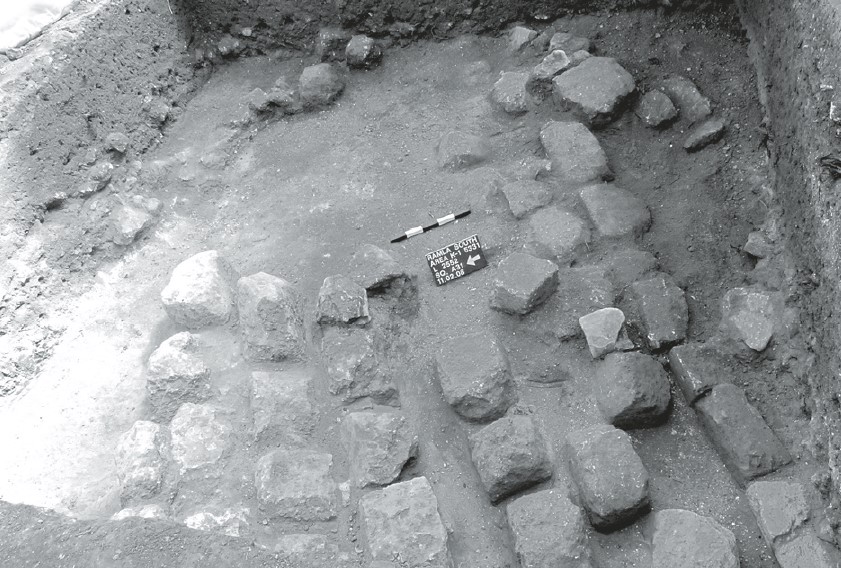
Further deformation was observed elsewhere on the site,
where stratigraphic layers exhibited both vertical and
horizontal displacement, producing stepped and
overlapping sand and hamra sequences. This deformation
affected an
antilia-type
water-well installation, including its pit, lifting superstructure, associated
fill, and adjacent occupation layer, all of which
collapsed and sank together. The configuration of
alternating permeable and less-permeable layers, a
shallow water table, and uncompacted artificial fill
indicates
liquefaction as a primary failure mechanism
during seismic shaking. The orderly in-situ collapse of
dressed stone wall courses in Area K1 further supports
earthquake-induced failure rather than human demolition
or gradual decay
(
Gorzalczany, 2009b).
At the White Mosque in Ramla, seismic damage
from a mid-eighth-century CE earthquake has
been proposed as a trigger for renovations
undertaken during the second construction
phase. While
Rosen-Ayalon (2006) emphasized that the
stratigraphic evidence recovered during
excavations was disturbed and therefore
inconclusive, it was nevertheless noted
that even limited earthquake damage could
have justified substantial rebuilding.
Comparative analysis of architectural
features—particularly
pointed arches in
subterranean cisterns beneath the
mosque and in
“the pools of Saint Helena” to
its north—suggests that Phase 2 construction
occurred around 788/789 CE. The northern
cistern is securely dated by a
dedicatory inscription to 788/789 CE, and the shared
use of pointed arches together with close
architectural similarity suggests that
both cistern systems were constructed at
the same time, providing a plausible date
for major repairs to the mosque.
- Illustration of an antilia-type
water well


Left – Fig. 2

Left – Fig. 4