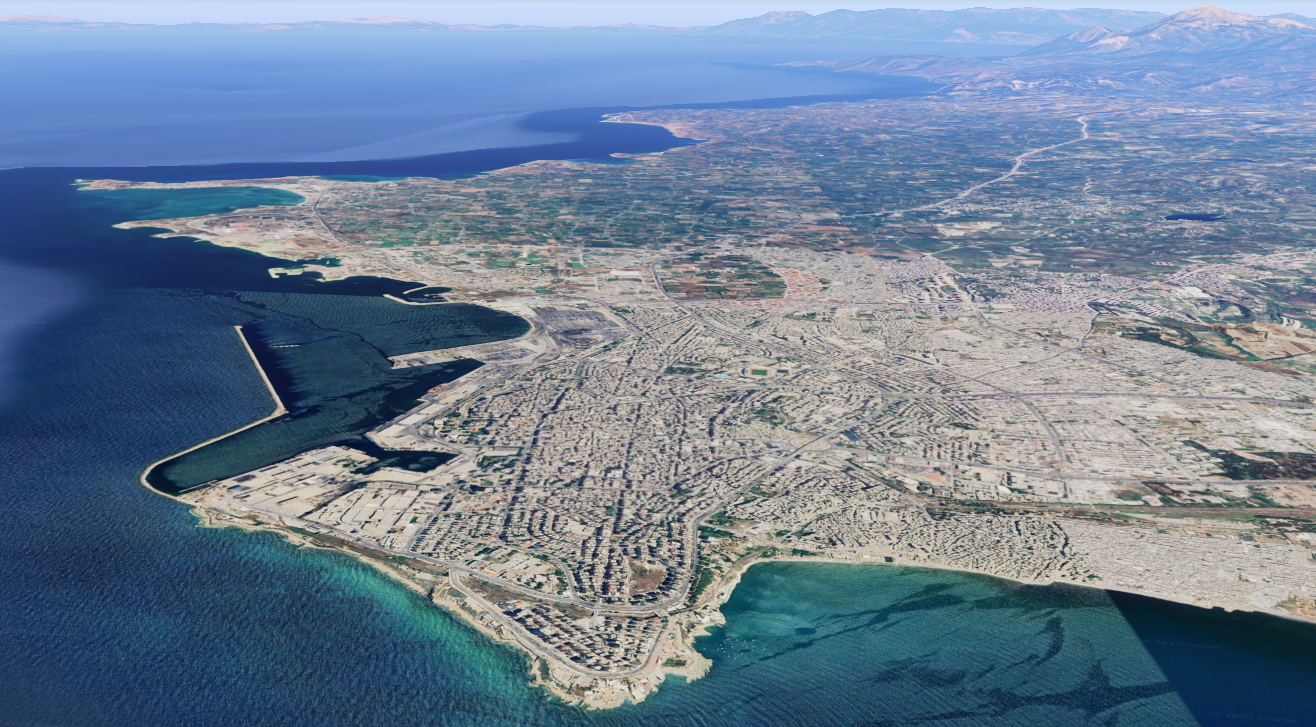
| Transliterated Name | Source | Name |
|---|---|---|
| Latakia | English | |
| Lattaquié | French | |
| al-Lādhqiyya | Arabic | ٱللَّاذْقِيَّة |
| Laodikeia i Paralos | Greek | Λαοδίκεια ἡ Πάραλος |
| Laodicea | Greek | Λαοδίκεια |
| Laodicea in Syria | ||
| Laodicea ad Mare | ||
| Leukê Aktê | Greek | Λευκὴ ἀκτή |
| Ramitha | Greek | Ῥάμιθα |
| Ramitha | Greek | Ῥάμιθα |
| Ramitha | Phoenician | |
| La Liche | Crusader French | |
| Lazkiye | Ottoman Turkish |
AD 1114 Aug 10 Alexandretta
The large earthquake of 29 November 1114 (see below)
was preceded by two strong shocks. The first, which
occurred on the Feast of St Laurence on 10 August 1114 (Fulch. Gest. Franc. 431) was probably felt in Antioch,
and allegedly ‘caused damage to maritime cities and fortified towns with loss of life’, which, since these cities are
not named, may be pure rhetoric (Estoire, 645; Walt. Chan. i. 442; Rob. Tor. i. 146).
It is possible that this was an earthquake with an
epicentre offshore in the Bay of Iskenderun (Alexandretta). Aftershocks continued for two months (Fulch. Hist. Hier., 573, dates in 1113)
Ambraseys, N. N. (2009:282). Earthquakes in the Mediterranean and Middle East: a multidisciplinary study of seismicity up to 1900.
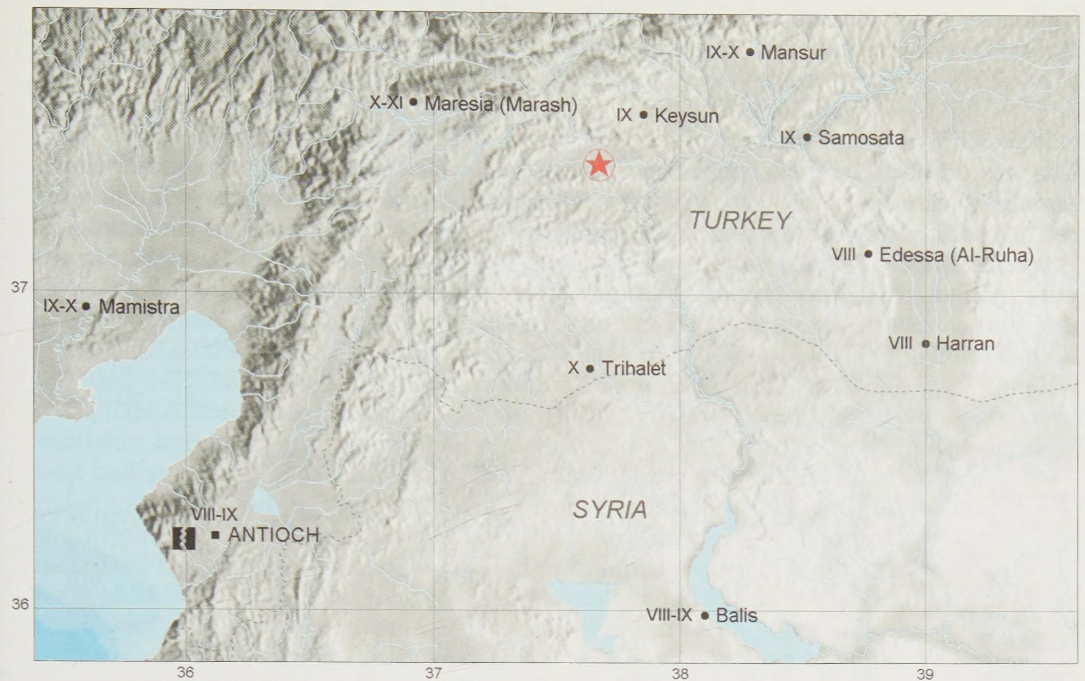
AD 1114 Nov 13 Misis
The second shock for which there is information occurred
on the southeastern part of the plain of Adana, in the
Principality of Antioch.
The earthquake destroyed a part of Misis (Mamistra) and allegedly all the towns in the surrounding area,
causing great loss of life. The neighbourhood of Antioch
and the city itself suffered less, but in the suburbs of Antioch the ground opened up and a number of towers and
houses nearby settled into the ground. Many other towns
in Caelo-Syria, Isauria and Cilicia, the names of which are
not given, were also affected.
The large earthquake that followed a few weeks
later overshadowed this event, rendering it impossible to
extract more details about this earthquake.
The date of the earthquake is given in the annals
Genetic Braves, in Andrea Dandul. Chron. 265 (Dan
dolo, 265; see also Alexander 1990, 146) it occurred on
St Bricious’ day on the Ides of November (13 November
1114).
Of the sources that mention the event, Flor. Hist.
ii. 43, Rob. Tor. 14, Will. Tyr. xi. 23/i. 529–530 and Rom.
Sal. 207 add the effects of the earthquake of 29 November. Other sources are Fulch. Gest. Franc. liv. 7/214, Walt.
Chanc. I. i–II. i/83–85, Sigeb. (cont.) 241/376, Estoire,6 45
and Fulch. Hist. Hier., ii.571–572.
Ambraseys, N. N. (2009:282-283). Earthquakes in the Mediterranean and Middle East: a multidisciplinary study of seismicity up to 1900.
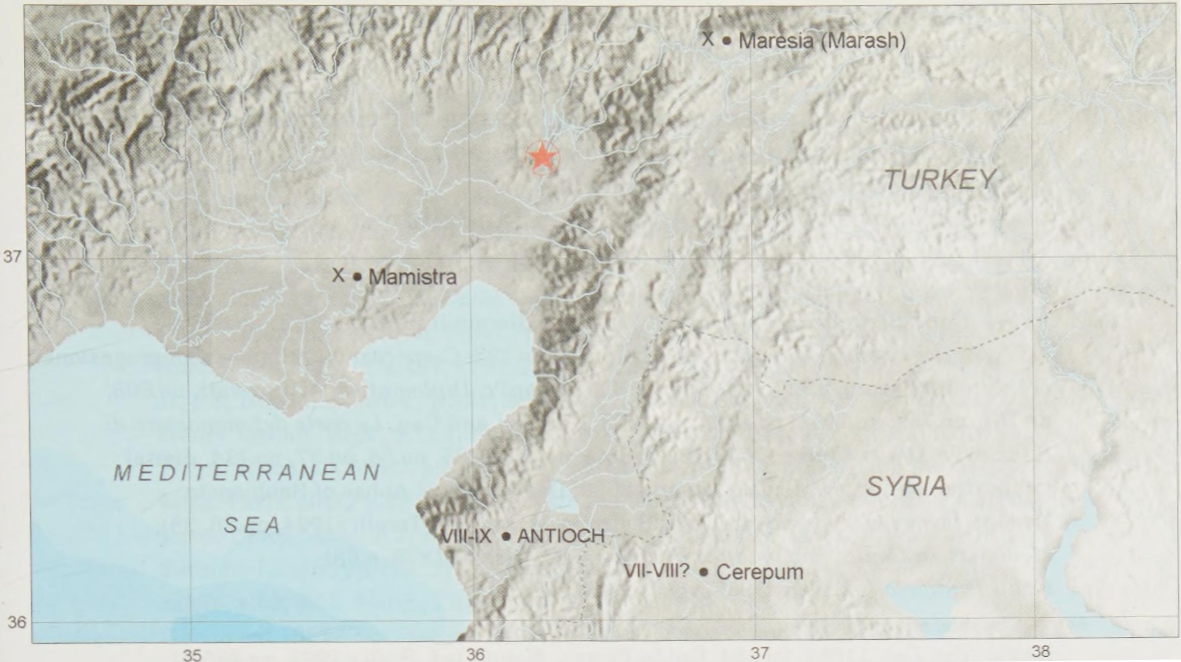
AD 1114 Nov 29 Antioch, Maras
The earthquake of 29 November 1114 occurred at night
and affected the Christian County of Edessa and Principality of Antioch, which lie around the present borders of
southern Turkey and northern Syria. The shock occurred
at a time of almost continuous conflict between Christian and Muslim states. It was strongly felt to the east and
southeast in neighbouring Muslim territory, as well as to
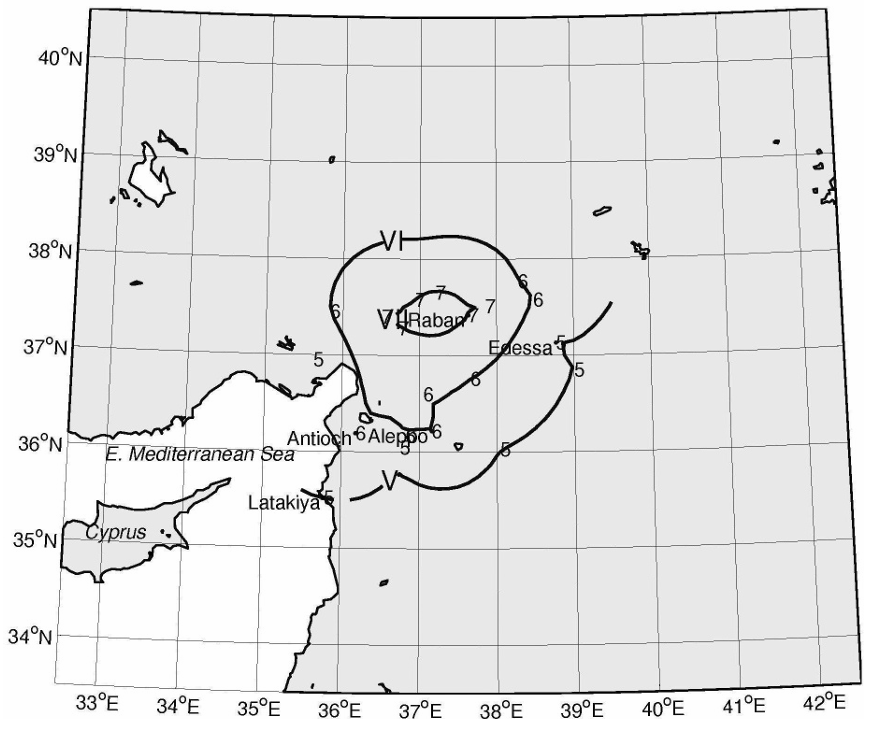
the north in Armenian and Turkish states. An isoseismal
map is given in Figure 3.10.
The earthquake occurred at night on the Sunday
of the vigil of St Andrew’s day (29 November 1114).
Although there are not many contradictions among the
sources, they vary about the date of the event. Of 25
authors who mention the event, 3 give the year as 1113,
16 agree on 1114, and 5 put it in 1115, all of them providing details that are clearly those of the earthquake
of 29 November 1114. A few of the wrong dates must
be copyists’ errors adopted by later writers; and some
must be due to the amalgamation of the main shock with
its foreshocks and aftershocks, a habit typical of later
sources, particularly Syriac writers who drew heavily on
earlier material. This would also account for the few references to an earthquake in 1115. In fact, there is strong
agreement about the date of the main shock between
contemporary and near-contemporary occidental sources
that all give the night of 29 November.
The earthquake affected almost all of the territory
occupied by the Franks. It was felt also in Mesopotamia,
Syria and other regions. In those areas occupied by Muslims nothing unfortunate occurred.
Maras, a fortified town in the Principality of Antioch, and its suburbs were almost totally destroyed, resulting in great loss of life. The city walls, which were not
in good condition, the fort, its ramparts and some houses
were all completely demolished. The Church of Mar John
of Kaysun collapsed, as did the Church of the Forty Martyrs. Among those killed in the town were the Constable,
the Bishop, members of the clergy and many important
people. Large parts of the villages belonging to Maras,
which are not named, were also destroyed.
It is said that Maras was a very populous city and
that between 24000 and 40000 individuals lost their lives,
besides strangers, and that more than 100 priests and
deacons died. The casualty figures are naturally suspect
because they are comparable to, if not larger than, the
population of Maras. They sound like a biblical formula
for a multitude.
The monastery of Mashchgavor (Mashkur), which
must be sought near the northern part of the Amanus
Mountain (Giaur Dag), also fell, killing, amongst others,
the Armenian doctor Gregory.
The same happened to Shoughr, the monastery
of the Basilians on the Black Mountains (Ler-sar), which
is located between Maras and Sis (Missis, Kozan), about
50 km from the former, which was also ruined, its church
collapsing and killing thirty monks and two officiating
priests.
A similar incident is reported from the monastery
of Hiesuvank near Maras. It fell, crushing all the religious
under its ruins.
Raban was almost totally destroyed and the same
happened to Kaysun. It seems that damage at Mansur
(Hisn Mansur) was serious, but not excessive.
Samosata (Sumaisat), built on the left bank of
the Euphrates, was badly damaged. Houses collapsed in
some parts of the town and elsewhere sank into their
foundations. According to a chronicler, they disappeared
under the ground, taking with them a number of people, among them Constantine, the lord of Gargar, but
not his jailers or other Franks. It is possible that much
of the destruction was due to ground failures worsened
by the Euphrates overflowing and flooding the town,
which happened shortly before, or after, the earthquake
in Samosata.
Little is known about Elbistan (Ablastha, Zeitun)
where damage could not have been very serious. It is also
stated that Tell Khalid (Trialeth), a fortified site at the
head of Sadjour Suyu, a tributary of the Euphrates River,
was also destroyed.
The earthquake was strongly felt in the district of
Aleppo. In the city itself there was no damage to speak
of, but nearby Azaz, a fort already in ruins, was badly
damaged, and its governor fled to Aleppo.
Damage in Aleppo was minimal, but the fortified
site of Athareb about 25km southwest of the city was
almost completely ruined, which is not surprising because
two years earlier the siege engines of the Franks had
pounded its walls to pieces, leaving little standing to be
shaken down by the earthquake. Zerdana, 10km south
of al Athareb, shared the same fate.
The earthquake caused great concern in the Principality of Antioch, but otherwise only sporadic damage. In the city itself people fled their homes in panic,
but, since the walls remained intact, no one managed to
escape and many fled to the church of the Apostle Peter,
seeking his protection. It seems that damage was confined
to the collapse of the tower of the north gate and damage
to a few houses in the city centre and some in the new,
upper district (al akaba) of the city, where a few people
lost their lives.
In the suburbs of Antioch, the earth opened up,
presumably as a result of incipient sliding or liquefaction
of the ground, causing some damage.
The patriarch proclaimed three days of fasting,
but the authorities did not appear to worry about swift
repairs or the condition of the city. They organised
repairs by asking inhabitants to contribute according to
their means and toured chief fortresses in the district
to assess the need for repairs. Contrary to what many
near-contemporary sources imply, there is no mention
of extensive damage or that the city collapsed; for one
thing, churches in which people took refuge were left
standing.
Repairs carried out after the earthquake suggest
that it was rather strong in Latakia.
The site of Balis (Balas) a former town in Syria
and a port on the western bank of the Euphrates, 5 km
from modern Meskene, suffered some damage. Almost
all writers say that the earthquake ruined 100 houses,
burying many people in the debris, and caused the collapse of half of the citadel while the rest of the town
stayed secure. They also state that soon before or after
the earthquake, which must have been felt at Balis, the
Euphrates overflowed, ruining 100 houses and sweeping
away half of the citadel. It is hard to decide whether the
earthquake or the flood caused the loss of 100 houses and
part of the citadel.
In Edessa (Ruha, Urfa) the earthquake occurred
almost immediately after the Muslims, who had been
besieging the city for two months, had withdrawn. The
shock was felt in the Edessan countryside, where the
mountains and hills were shaken. Muslim sources say that
13 towers of the city wall collapsed, with some loss of life.
Oddly, Frankish sources, which mention a flood shortly
after the earthquake that demolished the nearby dam,
do not mention any damage caused by the earthquake in
Odessa (sic.).
The old walls of Harran were breached in places
and houses were ruined, killing a number of people.
Little is known about Sis, except that the town was
again damaged and many villages and monasteries in the
plains were destroyed, with casualties.
The earthquake was not felt in Damascus, where
news of it arrived some days after the event. It is probable
that the shock was perceptible in Jerusalem, but claims of
damage extending that far should be dismissed as gross
exaggeration. There is some evidence, however, that this
or another earthquake at about the same time caused
some concern.
It has not been possible to substantiate the statement that the sea was stirred up as a result of the earthquake. This should be regarded as spurious information,
perhaps belonging to the earthquake of 10 August 1114.
Apparently only the Frankish-occupied provinces
were badly damaged. Records of the repairs to damaged
buildings in Muslim territory are mainly concerned with
the mosques which were damaged by the earthquakes or
by other causes. The silver which remained from the treasure of the waqf was allotted to the repairs.
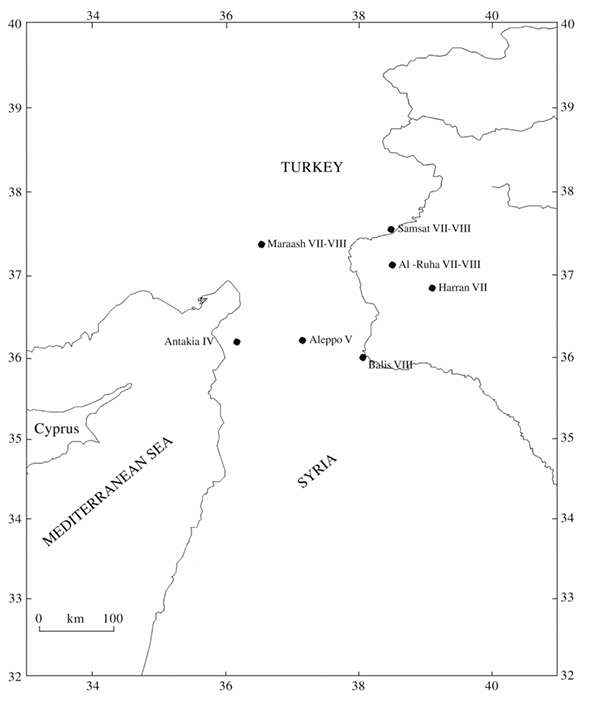
The sources for this earthquake can be divided,
broadly, between East and West, which is reflected in
the very different geographical areas given for the event.
The eleventh–twelfth-century occidental sources almost
all mention the destruction of ‘Mamistria’ (Mopsuestia)
and Marash and the damage to Antioch, but they mention nothing east of Marash and ‘Trihalet’ (Tell Halid).
Fulcher of Chartres, who was probably resident
in Jerusalem when this event happened, gives details of
three earthquakes. The first occurred in 1114 on the feast
of St Lawrence (10 August), but he gives no location. A
second, on the Ides of November (13 November 1114),
destroyed part of Mamistra. A third, undated, but listed
under events in 1114, shook ‘the area of Antioch [Antiochia?] and destroyed a great many towns in whole or
in part, including houses as well as walls...They say that
this quake destroyed the city of Marash,...about sixty
miles north of Antioch. The houses and walls were completely demolished...Another town called Trialeth, near
the Euphrates River, was also destroyed’. Fulcher notes
that there were many deaths in Antioch and Marash.
He also locates a further earthquake at Mamistra (Mopsuestia) in 1115, which seems to have been just as serious, demolishing Mamistra, and ‘other places in the area
of Antioch suffered no less’. Fink and Ryan claim that
no other writer mentions this earthquake (Fulch. Gest.
Franc. 214 n. 7), but in fact a second earthquake in Mopsuestia is given in the Chronicle of Robert of Torigny;
thus it may indicate a destructive aftershock rather than a repeat (cf. Walter the Chancellor’s record of an ‘earthquake of five months’).
The Flores Historiarum, an anonymous chronicle
used by William of Malmesbury, lists a single earthquake
in 1113, ‘a little while’ after a comet in May, which flattened ‘part of Mamistra, not far from Antioch, together
with two fortified towns, Triphalech and Mariscum. Note
that no damage is recorded for Antioch itself.
Li Estoire de Jerusalemet d’Antioche has an earthquake in 1114 on St Lawrence’s day (10 August)– ‘all
the maritime cities collapsed, and people died. The cities
of Mareis [Marash] and Trichalet [Trihaleth] collapsed’.
Once again Antioch is not mentioned. The reference to
‘all the maritime cities’ may be pure rhetoric, but, since
the Dead Sea fault runs through Jerusalem as far as
Antioch, it is possible that damage extended for some
distance.
William of Tyre was born in Frankish Syria in
1130, spent his youth abroad, and returned in 1160. He
must thus have worked from earlier accounts, which
probably explains the wider geographical extent which he
accords to the earthquake. He places it in 1114 and says
that it ‘struck the whole of Syria’, destroying ‘many cities
and countless towns, most of all around Cilicia, Isauria
and Caelo-Syria’, noting that the Cilician city of Mopsuestia was ‘completely prostrated’. William describes the
collapse of buildings and the ensuing human suffering in
graphic detail, although most of this is in standard disaster language, so it adds nothing new. He does, however,
say that this was ‘not just a great peril in one region, but a
plague which spread widely, to the furthest bounds of the
East’.
Benedict of Accolti records two earthquakes, but
gives no details of either. The first he places in 1114 – ‘the
Syrians suffered such great calamity and ruin as had never
previously been recorded in history’. Benedict lists what
was apparently another earthquake, which was destructive throughout Syria, in ‘the same year as they handed
over the dead bodies of Boamond, the prince of Antioch, and Tancred’. Boamond (Bohemond I) died in 1111
and Tancred on 12 December 1112 according to Runciman (1952 ii, 51 n. 2, 125 n. 2), who, however, says nothing about the handing over of their bodies at a later
date.
The Chronicle of Robert of Torigny reports the
collapse of Mopsuestia, Marash and Triphalech (Tell
Halid) brought about by an earthquake in 1114, and adds
in a separate entry that in 1115 ‘Mamistria was ruined by
quite a great (or a greater) earthquake’. This may refer to a
destructive aftershock, and is possibly the same as Benedict of Accolti’s second earthquake.
The Continuation of Sigbert of Gembloux
(Anselm of Gembloux; ending in 1148) records that in
1115 ‘the earth opened in the suburbs of Antioch on the
day of the Ides of November [13 November], during the
night, and it swallowed up a number of towers and houses
nearby together with their inhabitants’. Anselm notes that
people fled Antioch when the earthquake happened, but
returned to find that their homes had been swallowed
up. Note, however, that there is no evidence that Anselm
(N.B. Sigbert died in 1112) ever visited Outremer, so this
story may come from returning crusaders. Alexandre
remarks that ‘Anselme a place l’´evenement en 1115 et l’a
confondu, semble-t-il, avec le seisme de Cilicie survenu deux semaines plus tot, le 13/11/1114.’ (Alexandre 1990,
147).
Walter the Chancellor, who was probably chancellor to Prince Roger of Antioch, gives an apocalyptic
account of this earthquake’s effects in Antioch, where he
was probably an eyewitness. Apparently it struck ‘Antioch and the surrounding area’ in 1115 ‘on the vigil of the
feast of the blessed Apostle Andrew [29 November]’ during the night. Part of the walls seems to have been damaged and some houses collapsed, with deaths inevitably
ensuing, but some people were killed by jumping, in
panic, from high structures. The people cried out to God,
and were convinced that the earthquake was a result of
their sins. In the morning they all went to the church of
St Peter to attend the Office and hear an admonitory sermon. In all this there is no mention of extensive damage
for one thing, the church was still standing. Then, Walter
says, fresh concern was raised by refugees fleeing from
the destruction of Marash, then by a report from Mopsuestia, which had apparently been partly destroyed on
the feast of St Bricius (13 November). To add to the terror, aftershocks ensued and continued for five months.
Walter also notes Prince Roger’s work to rebuild the
defences.
Strangely, Walter places this event in 1115, after
the plague of locusts (presumably of 1114), but before
the alliance between il-Ghazi and Tughtigin, which was
made in 1114 (Grousset 1991, 484). This is not sufficient
to throw his entire account in doubt, however, because he
clearly refrains from exaggerating the structural damage
in Antioch.
Romuald of Salerno records an earthquake in
Syria in 1115, during the eighth indiction, in December
and before Christmas. It razed Mamistra and Marash to
the ground, and part of Antioch, ‘the damage extending
to Jerusalem’. This might be dismissed as gross exaggeration, perhaps to implicate all the crusader states in the
sins that brought on the earthquake. It is unlikely that the
earthquake extended this far, however, since Fulcher was
probably living in Jerusalem when the earthquake happened, but does not even say that it was felt there.
The first oriental author is Matthew of Edessa,
who died in 1136. Runciman (1951 I, 334f.) describes
him as ‘naive’, and remarks that ‘much of his information about the Crusade must have been derived from some
ignorant Frankish soldier; but about events in his native
city and its neighbourhood he was very fully informed’.
Indeed, he was an eyewitness of this earthquake, and
describes its effects in historical southwestern Armenia
in detail. Matthew places it in a.Arm. 563, on the 12th
of the month of Mareri (29 November 1114), a Sunday,
and also places it on the feast of the Finding of the Cross.
This is erroneous, since this movable feast did not fall on
a Sunday in 1114 (Dulaurier 1861; Matth. Edess. 455 n.1).
Matthew says that the earthquake happened at night, and
was followed by a loud aftershock about an hour later.
Apparently only the Frankish-occupied provinces were
harmed. Samosata, Hisn-Mansur, Kayˇsum and Raban
were ‘ravaged’; at Marash it was ‘terrible’, causing the
deaths of 40000 people, with similarly great destruction
and casualties at Sis and in the surrounding villages and
monasteries. He relates, in addition, the collapse of the
Basilian monastery on the Black Mountain (Shughr) during the blessing of the church, which claimed 32 lives,
and the Jesuian monastery at Esouanc’ near Marash,
in which all the inhabitants died. Matthew also relates
that ‘the illustrious Armenian doctor Gregory, surnamed
Mashgevor, died in the same place’. This is ambiguous.
It could be that this is a separate entry for a.Arm. 563,
recording only Gregory’s death at Mashgevor, or does
Matthew mean that Gregory died when Mashgevor was
struck by this earthquake? In fact, since Mashgevor is
between Marash and Antioch, about 40km south of the
former, this earthquake must have affected it.
Michael the Syrian (1126–99) must have worked
from earlier sources. He places this earthquake in A.S.
1426 on the 29th latter Tesrin (29 November 1114) at
dawn. His account covers only Marash, Kayˇsum and
Samosata, but he adds interesting details, notably the collapse of the church of Mar John at Kaysum and the death
of Constantine of Gargar at Samosata.
Ibn al-Qalanisi (fl. 1140–60) says only that in A.H.
508 (AD 1114) there was ‘a great earthquake’ in Syria,
which apparently made the people anxious – he does not
mention any damage. This is probably because his work
is a history of Damascus, and thus is not primarily concerned with other areas. His record may indicate that the
earthquake was strongly felt in Syria, however.
Ibn al-Jauzi (1126–1200) has two separate records
of this earthquake. The first, in al-Muntazam, cites
al-Masaaf on Abu Bakr’s record of a letter, which was
apparently received in Baghdad on Thursday 17 Rajab
A.H. 508 (17 December 1114). According to the letter,
on Sunday the 18th prior Jumada (actually Thursday 19
November) an earthquake struck Mesopotamia, causing
13 towers in the walls of Ruha (Edessa) to fall, together
with the walls of Harran and many houses there, killing
their inhabitants. ‘Sumaisat [Samosata] sank and its position was swallowed up. About 100 houses crashed down
in Balis, where half the citadel was thrown down and half
stayed secure.’
The Mirat al-Zeman by the same author (JW: Mirat is by Ibn al-Jauzi's grandson Sibt Ibn al-Jauzi) gives a
rather briefer account, but includes the interesting detail
that the Euphrates overflowed at Balis, swept away 100
houses and half of the citadel, and flooded Samosata.
The thirteenth-century sources are all oriental.
The anonymous Chronicon ad annum Christi 1234 pertinens places this event in A.S. 1422 (AD 1110) on
29 November, ‘the night of Sunday’. The chronology at
this point in the text is very confused, however, insofar
as the author places this earthquake immediately after
Roger of Antioch took Azaz, which was in 1118 (Tritton 1933, 85) and in the same year as Joscelin of Courtenay was banished and Baldwin was made governor of
Tiberias, which may have been either 1104 (Will. Tyr. xi.
22/493) or 1109 (Albert of Aix, xi. 12/668). It is not known
how Runciman derived his date of 1113 (Runciman 1952,
vol. 2, 96 and n.3). There is no doubt to which earthquake
the Chronicle is referring, however, since it notes the total
destruction of ‘Germanicia, which is Mar’as’, with the collapse of houses and ramparts’ and the deaths of ‘more
than 100 priests and shammas [deacons]’, in addition to
the ruin of Hisn Mansur and the total destruction of ‘several other places’ (Cosmas, 226). This is a typical description of the earthquake – note that no mention is made of
Antioch or even Mopsuestia.
Ibn al-Athir (1160–1233) dates this event to A.H.
508, 28th of latter Jumada (27 November 1114), describing it as affecting al-Jazirah (not ‘Mesopotamia, Syria’ as
in RHC) and other regions. Clearly Ibn al-Athir saw it as
extending much further north, insofar as he notes in particular the collapse of ‘great parts’ of al-Ruha (Edessa),
‘Harran, Samosata, Balis and other cities’, with many
deaths ensuing. Once again, no mention is made of the
more western cities. Runciman (1952, vol. 2, 481) notes
Ibn al-Athir’s chronological deficiencies and his tendency
to transform his sources’ accounts after his own prejudices; but he praises him as ‘a real historian who tried
to understand the broad significance of the event that he
described’.
Kemal ad-Din (writing in the middle of the thirteenth century) records this event in his Chronicle of
Aleppo, which was his hometown. He gives the same date
as Ibn al-Athir, and in particular notes the severe damage in ‘the districts of Aleppo, Harran, Antioch, Mar’ash
and the Syrian borders’. Apparently the tower of the
north gate of Antioch and ‘a few houses in the high
quarter (Akabah) collapsed and there were numerous victims’, which suggests that Antioch was not badly damaged overall. A’zaz, between Antioch and Tell Halid, was
ruined, and al-Atharib and Zardanah, between Antioch
and Aleppo, were reportedly destroyed, but Kemal notes
that damage in Aleppo was ‘not very serious’. Kemal’s
record is unusual among ‘eastern’ sources for its geographical spread, but by virtue of living in Aleppo he was
much further west than most.
Gregory Abu’l Faraj (or Bar Hebraeus), a late
thirteenth-century Syriac writer who drew heavily on
Michael the Syrian, copies Michael the Syrian’s date
of A.S. 1426, 29th latter Tesrin (29 November 1114).
Budge (1928) incorrectly interprets this as 1115 and he
records Samosata’s collapse and Constantine of Garagar’s death there, but adds numerous other details about
the damage. Marash apparently ‘sank underground’,
13 towers fell at Edessa, part of the wall of Harran,
100 houses and half of the citadel at Balash, and the
churches of Mar John and the Forty Martyrs at Khishum
(Hisn-Mansur).
The account in the Chronicle of Sembat (c. 1275)
is based in part on Matthew of Edessa’s record, from
which it takes the date of the Finding of the Cross, a.Arm.
563. Sembat fails to mention the damage to Sis, however, but remarks on how ‘the sea got up’, and Antioch collapsed, together with ‘Mecis’ (Mopsuestia?) and
Ablastha (Elbistan), as well as the locations mentioned
by Matthew. Sembat says nothing about the death of Gregory of Mashgevor, in an earthquake or otherwise. Over
half of the area affected by this earthquake is covered
by Sembat’s account: he mentions most of the locations
north of a line running between Antioch and Samosata.
Al-Suyuti (1445–1505) mentions this earthquake under
the year A.H. 508 (AD 1114–15) in his Kashf al-salsala
‘an wasf al-zalzala. Al-Suyuti’s perspective on the earthquake is characteristically ‘eastern’, being based mostly,
it seems, on the account of Ibn al-Athir. He places the
earthquake in the Jazirah, and notes the damage to
Edessa, Harran, Balis and Samosata.
The Historia Hierosolomitana, one of the histories
of the Crusades in the compilation of Jacques de Bongars (1554–1612) gives two, possibly three, earthquakes
for this event. The first, which is questionable, is placed
in 1113 – ‘the sea was rougher than usual, such that it was
impossible to fish in the sea; and the earth was struck twice
by a terrible earthquake’, but he does not give a location.
Christians were apparently terrified and ‘were afflicted in
this way for two months’. More earthquakes are given for
1114. The first occurred in Jerusalem in April or May,
before the plague of locusts from Arabia. Then, in either
the same or a separate earthquake, the Historia does not
make it clear, part of Mopsuestia, ‘part of the city centre as
well as part of the new district’ of Antioch (cf. Anselm of
Gembloux’s account of the damage in Antioch), Marash
and ‘Thihalet’ (Tell Halid) were destroyed. A further
earthquake is given for 1115, ‘which overthrew Mamistria
[Mopsuestia], once a quite illustrious city, also striking in
the same terror many other places in the territory of Antiochia’ – this may be based on Fulcher’s 1115 earthquake
(liv. 7/214/428). The Historia seems to give a muddled picture, but does provide the interesting details about the
rough sea (note Sembat’s remark that ‘the sea got up’)
and the damage to the centre of Antioch.
These chronological problems are not too difficult to resolve, however. Firstly, it must be remembered
that this earthquake was followed by five months of after
shocks, and may have been preceded by foreshocks. A
destructive foreshock might have done most of the earthquake’s damage in a given city, and, since this would be
the most perceptible effect, a local source would naturally
tend to use this to date the earthquake. This would also
account for the few references to an earthquake in 1115
(Fulcher, Rob. Tor, Bongars), which was probably a damaging aftershock.
In fact, there is strong agreement between the
two eyewitnesses, Walter the Chancellor and Matthew
of Edessa, about the date of the main shock. Both give
the night of 29 November. Walter’s year of 1115 was
shown above to be an anomaly, and was probably due
to a scribal error. It should be 1114, thus agreeing with
Matthew’s a.Arm. 563. The problem of the latter’s incorrectly placing the earthquake on the day of the Finding
of the Cross may be due to a scribe’s misunderstanding
his source. Dulaurier observes that the dominical letter of
a.Arm. 563, which was D, was sent out on 29 November
1114, the very day of the earthquake (Dulaurier 1861,
n. 65).
Walter also gives an earlier earthquake in Mopsuestia, on 13 November 1114, the same date as given by
Fulcher (lii/210) and the Continuation of Sigbert (241). It
is thus likely that a strong foreshock destroyed Mopsuestia and parts of Cilicia, the destruction extending over a
much wider area on 29 November, which must therefore
have been the main shocks.
The slight variation of dates among the ‘eastern’
sources, all of whom place the earthquake in November 1114, is probably explained by the occurrence of
variably destructive foreshocks and aftershocks. Ibn al
Jauzi’s record of the letter to Baghdad gives 19 November, as has been seen. At Aleppo the earthquake may
well have done the most damage on 27 November, hence
Kemal’s date. Other later writers, such as Abu’l Faraj,
seem to have chosen one date from their sources. It is
thus likely that the earthquake, with its foreshocks and
aftershocks, had damaging effects from November 1114
until some time in the first quarter of 1115.
It is hard to justify Runciman’s date of 1117, which
is given by none of the sources, and indeed would require
systematic errors in all the early sources (Runciman 1952,
vol. 2, 130).
A final factual difficulty is the number of deaths at
Mopsuestia given by Matthew of Edessa and the Chronicon ad annum 1234. The former gives 40000 and the latter 24000. The former sounds like a biblical formula for
a multitude, but the violence of this earthquake, and the
fact that it happened at night when people were indoors,
does not rule out such a number. Also it is not impossible that the Chronicon ad annum 1234 is referring to the
destructive aftershock in Mopsuestia in 1115.
Guidoboni and Comastri (2005, 74) split this
earthquake into two events, one on 13 November 1114
and another on 29 November 1115; the reasons for this
do not seem clear.
For more details, see also
The earthquake that was felt in many places...In the year 1114 an infinite multitude of locusts swarmed out of a part of Arabia...Later, on the Feast of St Lawrence, there was an earthquake. Still later, on the Ides of November, an earthquake at Mamistra destroyed a part of the city...Likewise a great quake, the worst ever heard of, shook the area of Antioch and destroyed a great many towns in whole or in part, including houses as well as walls. Some of the common people perished of suffocation in the ruins...They say that this quake destroyed the city of Marash, which I think is about sixty miles north of Antioch. The houses and walls were completely demolished and the people living there were killed...Another town called Trialeth, near the Euphrates River, was also destroyed.(Fulch. Gest. Franc. lii/210)
In that year [1115] the city of Mamistra was demolished by an earthquake. Other places in the area of Antioch suffered no less.’(Fulch. Gest. Franc. liv. 7/214/428)
1113: in the month of May a huge comet appeared and after a little while an earthquake flattened part of the city of Mamistra, not far from Antioch, together with two fortified towns, Triphalech and Mariscum.’(Flor. Hist. ii. 43)
(1114) On the Feast of St Lawrence we were visited by an earthquake: all the maritime cities and fortified towns collapsed, and people died. The cities of Mareis [Marash] and Trichalet [Trihaleth] collapsed. The Turks passed the Euphrates, and came between the Euphrates and Antioch.(Estoire, 645C)
A huge earthquake struck part of Antiochia ... In the year from the Incarnation of the Lord 1114 an earthquake struck the whole of Syria which was so great that it destroyed many cities and countless towns, most of all around Cilicia, Isauria and Caelo-Syria. For in Cilicia it completely prostrated Mamistra and many other towns; it also threw down Maresia together with its suburbs, so that scarcely any traces remained. Towers shook and the larger buildings fell down causing countless deaths, and cities, like stone ramparts, formed great mounds, and crushing their penitent citizens entombed them. In consternation people fled their homes in the cities, fearing the ruin of their houses, and while they hoped to find rest under the open sky, they were struck with a fear which interrupted their sleep, suffering, as the watch men had feared, violent seizures in their sleep. For this was not just a great peril in one region, but a plague which spread widely, to the furthest bounds of the East.’(Will. Tyr. xi. 23/i. 529–530))
‘In the year 1114 there was an earthquake in which the Syrians suffered such great calamity and ruin as had never previously been recorded in history ... In the same year as they handed over the dead bodies of Boamond, the prince of Antioch, and Tancred, there was a massive earthquake, the force of which caused destruction throughout the towns of Syria.(Ben. Accolt. xvii/617/914)
(1114) Part of the city of Mamistria collapsed in an earthquake, and two forts not far from Antioch, Mariscum and Triphalech.(Rob. Tor. 145–147)
‘(1115) Mamistria was ruined by quite a great (or a greater) (majori) earthquake.(Rob. Tor. 146))
1115. The earth opened in the suburbs of Antioch on the day of the Ides of November [13 November], during the night, and it swallowed up a number of towers and houses nearby together with their inhabitants. Certain men, as is human wont, left the place with their wives and children; but when they returned to the places where their homes had been, the earthquake had swallowed them up.(Sigeb. (cont.) 241)
Thus in the 1115th year after the Incarnation of Our Lord Jesus Christ, on the vigil of the Feast of the blessed Apostle Andrew, in the silence of an untimely night...there was a massive and terrible earthquake in Antioch and the surrounding area. Men were agitated by this unexpected phenomenon, feeling, seeing and hearing the walls collapsing and other things leaning over acutely. Some thought to flee, some fell from the walls and some others hurled themselves headlong from high houses. Still others were torn limb from limb in their sleep by the [collapsing] ruins; and since part of the wall remained intact, no one [in that part] could escape. Some were struck by terror, and abandoning their homes and possessions, and leaving everything, they rushed through the open spaces and neighbouring towns like madmen. Stretching out their hands to heaven on account of diverse fears and needs, they did not cease to cry out in various tongues and piteous lamentation, “Spare, O Lord, spare Thy people”.(Walt. Chan. I. i–II. i/83–85/106)
When morning came, since so vast a mass of wretchedly slaughtered men and beasts lay under the ruins, all the Latins, Greeks, Syrians, Armenians, foreigners and pilgrims unanimously declared that this had happened because of their atrocious sins. And they did not delay: in obedience to saving counsel, they fled to the very church of the blessed Apostle Peter, seeking his advocacy in perpetual protection...
When the Divine Office had been celebrated and a sermon preached, and orders enjoined as to how they should behave and what they should do, they thought that nothing more serious had happened [than the events of the night], but were suddenly greeted with terrifying news. For certain men, who by God’s will had escaped the destruction of Miragium [Marash], claimed that their city, together with its seigneur and bishop, the clergy and all the people, had been razed to its foundations. Not long after, report came from the city of Mamistra, that the citizenry and the greater part of the city had previously been destroyed on the feast of St Bricius [13 November 1114], which only increased their fears: what about Cyprus? What about the rest of Antiochia? Other things equally tormented the people. Fear and terror made that wretched people groan, for in short they did not know where to stay or whither to flee. Each day and hour the earthquake oppressed them dreadfully. As God permitted them to know neither when to flee nor whither, they thought it easier to live with the beasts in the open, than inside in constant fear of the buildings’ collapse. And thus in the suburbs, on the plains, in gardens, thickets and deserts as well as other places, they dwelt in tents rather than houses. More of them, having left their cities and moving their huts from one place to another, remained on the plains. [The people do penance.] Corrected by the fruit of their penance, and adorned with good works, they were freed from the danger of the earthquake of five months and more, not by their own merits, but by the grace of God...Having visited the forts and other places, the prince [Roger] obtained what was needed as quickly as possible, then, noting the things which would be useful for the defence of his land and were closer to the enemy, he did not rush to do everything, but made whatever repairs and works were necessary for immediate safety. And thus, having dismissed his army, and returned to Antioch with a few of his men, he summoned the mayor (dux) of Antioch, Radulf of Acre, a man of sound judgment and discussed with him first what was to be done about repairs to and the condition of the whole city . . .
In the same year [1115, indiction 8] in the month of December, before Christmas, there was an earthquake in Syria, so great that Mamistra and Marais [Mar’ash] were razed to the ground, and several other cities and fort-towns fell, their men crushed, as was part of the city of Antioch, the damage extending as far as Jerusalem.’(Rom.Sal.207)
In that same year [563 in the Armenian calendar = 21 February 1114 to 20 February 1115], when the Persian sultan Daph’ar took Edessa and marched to the Euphrates], God visited his wrath on his creatures. On the 12th of the month of Mareri, a Sunday, the day of the Finding of the Cross, there was a terrible upheaval ... While we were deep in sleep, suddenly an awful noise was heard, echoed by the entire universe. An earthquake was felt; the plains and the mountains were cast up with a roar; the hardest rocks shattered and the hills broke open. The mountains and hills were shaken violently, echoed and, like living creatures, grew agitated and emitted a blast of air. To our ears this was like the sound made by a multitude of men ...Like a raging sea, creatures rushed from all sides, overcome with terror which the wrath of the Lord had inspired in them ... The earth was like a fugitive, at bay and trembling, in consternation like a condemned man who cries out in lamentations and tearful groans. Its sound was heard again after the earthquake for about an hour, on the same night. Faced with this disaster, everyone thought that he had reached the end of his life...That night saw the ruin of many towns and provinces, but this was only in the part occupied by the Franks; in the other parts and in those of the infidels nothing unfortunate occurred. Samosata, Hisn-Mansur, Kaysum and Raban were ravaged by this plague. At Marash it was terrible and 40000 persons lost their lives: it was a very populous city, and no one escaped. The same happened in the town of Sis where an innumerable multitude of the inhabitants perished; many villages and monasteries were destroyed and a multitude of men and women wiped out. On the famous Black Mountain, the holy monks and the Armenian doctors of the Basilian monastery were assembled for the blessing of the church. While they were celebrating the Divine Office, the building fell on them, and thirty monks as well as two doctors were swallowed up in the ruins: their bodies are still buried there. A similar incident occurred near Marash: the great monastery of the Jesuians [Icouanc] crushed all the religious under its ruins. When the shocks ceased, snow began to fall, and the country was buried under a thick blanket. The illustrious Armenian doctor Gregory, surnamed Mashgevor, died in the same place.(Matth. Edess. 217/287–290)
In the year 1426, on 29th tesrin II [November], at the dawn of Sunday, He Who looketh on the earth and it trembleth (Ps. 96.4) looked and there was a very violent earthquake in which the town of Mar’as was completely swallowed up. It was overturned, that is to say that its foundations were tossed up high and the buildings thrown down. It became the tomb of its inhabitants and a source of terror to all who saw it. In this earthquake the church of Mar John of Kaysum collapsed, along with that of the Forty Martyrs; they were rebuilt under the care of Mar Dionysius, bishop of Kayˇsum. Samosata also collapsed in this earthquake, and in that town Constantine, seigneur of the fortress of Gargar, was suffocated along with many other people. Large parts of all these towns and of villages collapsed.(Mich. Syr. xv. 11/iii. 200f.)
In this year also a great earthquake occurred in Syria. The earth shook with it and the people were anxious.(Ibn al-Qalanisi 191/133; C 149)
Al-Masaaf said: I saw in the handwriting of our Shaykh Abu Bakr ibn ‘Abd al-Baqi al-Bazaz the following: on Thursday 17th Rajab 508 [17 December 1114] there arrived in Baghdad a document which described how, in the night of Sunday 18th Jumada I akhira [19 November, a Thursday (!)] of this year an earthquake had occurred in which thirteen towers in the walls of Ruha [Edessa] fell down. Some of the walls of Harran fell down and many houses came down on top of people, who perished. Sumaisat sank and its position was swallowed up. About 100 houses crashed down in Balis, where half the citadel was thrown down and half stayed secure(Ibn al-Jauzi, Munt. 9/180, 181; Seth 139b))
Terrible earthquake in Mesopotamia– the greater part of the ramparts of Edessa and Haran were overturned, with a great number of houses. The Euphrates overflowed and ruined 100 houses at Bales and swept away half of the citadel, flooding Samosata as well as other places.’(Sibt ibn al-Jauzi, Mirat. 551-554))
(After Roger had taken Azaz)In the year 1422 of the Greeks, on the 29th November, the night of Sunday, there was a strong earthquake, and Germanicia, which is Mar’aˇs, was destroyed and completely lost; its houses collapsed and its ram parts fell. 24000 people died there, besides strangers, and more than 100 priests and shammas [deacons]. Hisn Mansur was also ruined; several other places were totally destroyed.(That year Baldwin, seigneur of Edessa, took ill against Joscelyn, governor of Tell Basir.) (Chron. 1234, 274/ii.58)
(a.H. 508) In the same year, in the month of latter Jumada [November 1114], a violent earthquake was felt in Mesopotamia, Syria [al-Jazirah] and other regions. Great parts of Edessa, Harran, Samosata, Balis and other cities collapsed on their foundations; many people were buried in the debris.(Ibn al-Athir RHC,295)
During the night of Sunday 28th of latter Jumada of 508 [27 November 1114], a terrible earthquake laid waste the districts of Aleppo, Harran, Antioch, Mar’ash and the Syrian borders. The tower of the north gate of Antioch and a few houses in the high quarter [Akabah] collapsed and there were numerous victims. As the fort of A’zaz was no more than a ruin, the governor went to seek asylum at Aleppo, but when he arrived he was put to death by order of Lulu, with whom he was at logger heads; Lulu charged another governor to re-populate and repair the fort. The damage was not very serious in Aleppo, but other places, like el-Athareb and Zerdanah, were almost completely destroyed.(Kemal al-Din C Chron. Ale, ad ann. 508/RHC 607)
In the year which is 1426 of the Greeks [AD1114] on the 29th day of the month of the Later Teshrin [November], which is the 29th day of the 6th month of the Arabs, a terribly violent earthquake took place, and the whole city of Marash sank under ground and became the tomb of the inhabitants thereof. And very many houses fell down in Samosata. Constantine the lord of Gargar together with many others was suffocated in the ruins. And there fell down thirteen towers of the wall of Edessa; and a portion of the wall of Harran; and a hundred houses and one-half of the Citadel of Balash; and two churches of Khishum, viz. the church of Mar-John and the church of the Forty Martyrs.(Abu’l-Faraj 247/280)
a.Arm. 563 [21 February 1114 to 20 February 1115]. The earth trembled, because God was wrathful. This was in the month of Mareri, for the Feast of the Finding of the Cross. In the middle of the night, the shocks were felt. A rumble and terrible roars came from the depths of the earth. The sea got up, and the mountains and hills made terrifying sounds. A great number of cities were ruined: Antioch collapsed, as well as Mecis, Hisn-Mansur, Kayˇsum, Ablastha, R’aban and Samosata. Marash was completely overturned, and 40000 people were found dead.(Sembat, ad ann. 563/RHC 614)
On the Black Mountain, at the monastery of the Basilians, some doctors (vartabeds) and monks had assembled to celebrate the blessing of the church; this building collapsed around them, and thirty monks and two doctors were killed. In that year the doctor Geoge Megh’rig, author of the rule established at Trazarg, died in Jesus Christ; he was buried in that monastery.
An extremely violent earthquake took place in the territory of al-Jazirah: it caused thirteen towers of Ruha to collapse, part of the girdle-wall of Harran and numerous houses. At Balis, 100 houses were destroyed, and whereas half of the citadel was overturned, the other half remained intact. The town of Sumaysat disappeared under the ground: a great number of victims were mourned.(al-Suyuti Kashf xxxvi/22)
(1113) The sea was rougher than usual, such that it was impossible to fish in the sea; and the earth was struck twice by a terrible earthquake, and the parched (?) peoples were threatened with the terror of collapsing buildings. All Christian places were besieged with deep silence: a certain image of death touched the Christians, leaving them stupefied, and, in their terror, as white as sheets. For they all understood something which they knew to be true, that this was the vindication of God’s anger at them. They were afflicted in this way for two months, and then at last God had mercy and turned His anger into grace, and the Christians revived . . .(Bongars ii. 571–573)
In the year 1114, before the infinite swarm of locusts came from parts of Arabia, the territory of Jerusalem was laid waste for some days; in the month of April or May and following it Jerusalem was shaken terribly by an earthquake. A part of the city of Mamistria was overturned, and in the region of the great city of Antioch too, part of the city centre as well as part of the new district was overthrown together with some of the population. Likewise in a city called Mariscum – alas, what a tragedy! the people, sitting at their hearths, were wiped out, in a terrible and pitiful way, under the ruins of the buildings. In Euphratesia too the town which they call Thihalet was razed to its foundations.(Bongars ii. 572)
. . . in the same year [1115] [God] overthrew Mamistria, once a quite illustrious city, also striking in the same terror many other places in the territory of Antiochia.(Bongars ii. 573))
Al-Wahrani was a comrade of Nur ad-Din. He made full use of his talent for satire and another judge took his place. The matter was that of the qadi Mahmud ibn Yahla ibn Aflah al-Lakhami: It is because of his bad character that God sent the eclipse and terrorised us with the earthquake which obliged us to flee our homes.(Rasa’il, MS Dar al-Kutub, at Cairo, f. 11)
According to Abu Shama, Nur ad-Din repaired the damage to the mosques which was caused by the earthquakes or by other causes. He delegated his powers to the qadi Kamal ad Din ash-Shahrzawri (the successor of ‘Asrun) for the business of the waqfs, with the mandate of applying the law, doing good and combating evil, and the authorisations to allot to the repairs the silver which remained from the treasure of the waqfs, with the agreement of the . . .(Abu Shama, Rawdat 1/229)
Fig. 7
Intensity Data Points
(051) 1114 November 13 Maresia [southern Turkey] > fissures
sources 1
1114. [...] Immediately afterwards, that is to say on the Ides of November [13 November], an earthquake at Mamistra razed part of the town to the ground. The earthquake was even more violent in the region of Antioch, to the extent that walls and houses were totally or partially destroyed in many towns; and some of the inhabitants were also crushed in the ruins. It is said that the earthquake shock was so severe at the town of Mariscum, which stands, I think, about sixty miles to the north of Antioch, that houses and town walls were completely destroyed, and all the inhabitants were killed. What a tragedy!
Another town, called Trihalet, which is situated by the river Euphrates, was also completely destroyed".
Anno millesimo centesimo decimo quarto 1...). Tempore autem sequenti, quod accidit idus Novembris, apud urbem Mamistriam terrae motus partem subruit oppidi. Item major et inauditus regionem Antiochenam adeo per loca concussit, ut oppida plurima sive tota, sive dimidia, tam domos quam muralia solo tenus subrueret, in qua etiam ruina pars plebis suffocatae interiret. Mariscum dicunt civitatem ab Antiochia sexaginta, ut aestimo, distantem milliariis, in parte septentrionali, subvertit in tantum cornmotio ilia, ut domos et muralia penitus corruerent, et populum inhabitantem, proh dolor!William of Tyre, a reliable Latin historian who was born in Syria around 1130, provides a very detailed account of the earthquake, but fails to indicate the exact date of its occurrence, simply giving the year:
cunctum exstingueret. Aliud quoque oppidum, quod Trialeth nuncupant, prope fluvium Eufraten nihilominus subruit.
"In the year of the Incarnation of the Lord one thousand one hundred and fourteen, so great an earthquake shook the whole of Syria, that many towns and fortified settle ments were razed to the ground, and major damage occurred in Cilicia, Isauria and Coelesyria.
For in Cilicia the town of Mamistra was razed to the ground, together with many fortified settlements. Maresia and all its territory were also struck, to the extent that it was scarcely possible to see anything left: towers and walls were violently shaken by the shocks, and as the bigger buildings crashed to the ground, they killed a great many inhabitants. Great cities were reduced to piles of debris, which became tombs for those inhabitants who were crushed beneath them.
People fled in dismay from the towns, fearing that their homes would collapse; and while they hoped to find safety by remaining in the open, they woke from their sleep in terror, tormented in their dreams by visions of the dangers which they tried to avoid when they were awake. Nor was the disaster confined to one region, for it had spread to the most distant parts of the Orient".
Anna ab incarnatione Domini millesimo centesimo decimo quarto, tantus universam Syriam terrae motus concussit, ut multas urbes et oppida infinita dirueret funditus; maxime autem circa Ciliciam, Isauriam et Coelesyriam.The contemporary chronicler Walter the Chancellor records that after the strong earth quake of 29 November 1115 (see the next entry), survivors at Antioch were panic. stricken at the thought of the destruction caused by the previous earthquake of 13 November 1114:
Nam in Cilicia Mamistram cum multis oppidis solo tenus prostravit; Maresiam quoque dejecit cum suburbanis suis, ita ut quorundam vix etiam exstarent vestigia: quatiebantur turres et moenia, majoribusque aedificiis periculosis ruentibus, fiebat populorum strages infinita; et civitates amplissimae quasi agger lapidum constitutae, tumulus erant oppressorum, at contritis habitatoribus vicem praestabant sepulchri.
Fugiebat plebs mente costernata habitationem urbium, domiciliorum ruinam formidantes: et dum sub dio requiem invenire sperant, timore concussi, somnis interrumpunt, oppressiones quas vigilantes timuerant, in somnis perpessi. Nec erat hoc, tam ingens, in una tantum regione, periculum: sed usque ad extremos Orientis fines, haec pestis late se diffuderat.
"Not long afterwards, terror [at Antioch] was much increased by the memory that the town of Mamistra had been largely destroyed and its inhabitants killed on the previ ous feast of St.Brice [13 November 1114]".
Nec multo post recordatio oppidi Mamistrae, cum oppidan s et maiore parte civitatis in festo sancti Bricii antea pessumdati, metum multiplicat.Another contemporary, Abbot Anselm of Gembloux (Belgium), who continued the authoritative Chronica Monasterii Gemblacensis, records the effects of the earthquake of 13 November 1114 at Antioch, but places the information under the year 1115:
"1115. On the Ides of November, during the night, the earth opened in the suburbs of Antioch, swallowing up many towers and the houses next to them together with their inhabitants. Some, as is the custom with those people, had gone away from those places with their wives and children; but on the way back the earthquake swallowed them up where they were".
1115. Idibus novembris in suburbio Antiochiae terra noctu dehiscens, turres multas et adiacentes domos, cum habitatoribus absorbuit. Quidam autem, ut est illud hominum genus, cum uxore et filiis de locis illis migraverat; sed in redeundo positum idem terraemotus absorbuit in loco quo erat.The anonymous author of the chronicle Estoire de Jerusalem et d'Antioche attributed the effects of this earthquake, of which he had learned from Fulk of Chartres, to the previous earthquake of 10 August 1114 (see the preceding entry):
"1114. Then we had a plague of locusts from the region of Arabia which destroyed all our corn and gardens. On the feast of St.Lawrence there was an earthquake, and all the towns and settlements along the coast collapsed, thereby killing the inhabitants. The towns of Maras and Trihalet collapsed in ruins"
MCXIII. Puis nos vint tant grant plante d'aosteroles des contrees d'Airabe, qui tot nos gasterent blez et gardins. A feste saint Loraint, nos vint terre mote, et fundirent tote la marine citez et chastiaus, et deunc la gent morut; la cite de Mareis et Trichalet fundirent.Although the chronicler Lisiard of Tours derives his information from Fulk of Chartres, he fails to take account of the exact chronological sequence of events in 1114 provided by Fulk (a plague of locusts in April and May, an earthquake without damage on 10 August in the Jerusalem area, and a destructive earthquake on 13 November in the Antioch region), and conflates the two separate earthquakes of 10 August and 13 November 1114, recording a single earthquake which supposedly began in the April-May period:
"1114. After the arrival from Arabia of an infinite multitude of locusts, the territory of Jerusalem suffered violent devastation for a number of days, for in April and May and subsequently it was dreadfully shaken in an earthquake. A large part of the town of Mamistra was destroyed; in the region of Antioch, many fortified settlements were completely or partially razed to the ground and some of their inhabitants killed; and similarly, in the town called Mariscum, all the inhabitants were buried in the sudden collapse of buildings, and, alas, they all suffered a terrible and wretched death. And in the region of the Euphrates, the fortress of Trihalet was also razed to the ground".
Anno .M.C.XIV, et prius locustarum multitudine infinita ex Arabiae partibus convolante, terrirorium Jerosolimitanum per dies aliquot vehmenter vastatum; mense Aprili vel Maio et sequenti terrae motu horribiliter concussum; Mamistriae urbis pars nonnulla subversa; in regione quoque Antiochena plurima oppida, quaedam media, quaedam ex integro, solo tenus cum parte plebis subruta; itemque in urbe quam Mariscum noncupant, populus universus repentinis aedificiorum ruinis praefocatus, heu pro dolor! Terribiliter et miserabiliter exstinctus; in Eufratesia etiam oppidum quod Trihalet noncupant funditus eversum.The Venetian writer Marin Sanudo the Elder (1270-c.1343), uses William of Tyre as his source when he provides a factual if brief account of the earthquake:
"1114. The East, and Cilicia in particular, were struck by such an earthquake that the town of Mamistra and all the fortresses in the surrounding area were razed to the ground; and elsewhere, other towns were so seriously damaged that no building was left standing. And as men wandered through the fields in flight, they were afraid of being swallowed up by the earth".In the Latin chronicles compiled in Italy in later centuries, the information provided by the earliest sources became increasingly corrupted.
MCXIV. Tantus terraemotus Orientem permovit, maxime in Cilicia, ut Malmistram, et in circuitu fortilitia cuncta deiceret: et alibi, civitates aliquae ita deletae sunt, ut aedium nullum remanserit vestigium. Homines quoque, per campos errantes, a terra absorberi metuentur.
"Then the East was shaken by so tremendous an earthquake that it completely destroyed buildings especially in Cilicia, at Malmistra, and all the fortresses in the sur rounding area, and in some places nothing was left standing. Men wandered through the fields fearing that they would be swallowed up by the earth. During the night of the Ides of November [13 November], in the suburbs of Antioch, the earth swallowed up many towers and the houses beside them, together with their inhabitants".The report of the earthquake provided by Accolti (1415-1464), a historian and jurist from Arezzo, is also confused. He mentions the earthquake briefly in his Historia Gotefridi, together with other historical and natural events which occurred in various different years. Thus he firstly records a passing comet and what may have been aurora borealis (in May 1114, a comet with a long tail was indeed visible in Europe for a number of nights); then he mentions the capture of Tripoli (1109), Beirut (1110) and Sidon (1111) by king Baldwin of Jerusalem (1110-1118), and finally the death of princes Bohemond (1111) and Tancred (1112):
Tunc tantus teremotus Orientem concusit, ut Cilicia maxime, ut Malmistra et cuncta fortilicia in circuitu deiceret et alicubi etiam edium nullum remansit vestigium; homines quoque per agros errantes terra assorbi timebant. In suburbano Antiochie, ydibus novembris, terra nocte turres plures et adiacentes domos, cum habitatoribus absorbuit.
At that time, a comet with a great fiery mane appeared in the sky, and from the first to the third hour two suns could be seen in the sky with a rainbow in between. In this same year, in which we are told that Bohemond, prince_of Antioch, and Tancred died, a terrible earthquake reduced many towns throughout Syria to ruins".The contemporary historian Michael the Syrian provides factual information about earthquake effects at Maras and Keysun:
His temporibus, cometes in coelo visa est, crines igneos magnosque habens, necnon ab hora prima usque ad tertiam duo soles, et iris in medio cernebantur. [...] Eodem anno, Boamundum, Antiochiae principem, et Tancredum mortuos tradunt, maximumque terraemotum fuisse, cuius vi multa oppida per Syriam totam corruerunt.
"In the year fourteen hundred and twenty-six (of the Greeks, 1114), on 29 Tishrin II [November], He who has only to look at the earth for it to shake, did look; and there was a very violent earthquake in which the city of Mar`ash was entirely swallowed up and overturned, that is to say its foundations rose up and its buildings collapsed, so that it became a grave for its inhabitants and a terror to those who saw it. In this earthquake, the church of Mar John of Kaishum and that of the Forty Martyrs collapsed, and they were rebuilt by the care of Mar Dionysius, bishop of Kaishum. Samosata also fell in that earthquake, and Constantine, lord of the fortress of Gargar, was suffocated there [at Samosata, not Gargar] with many people. In every city and village numerous places collapsed".There is also a useful reference to the earthquake in the Syrian Chronicle to the year 1234, for although it contains a dating error, mention of the collapse of the castle at Mansur is also included:
Michael the Syrian
1114 November 13
Guidoboni and Comastri (2005)
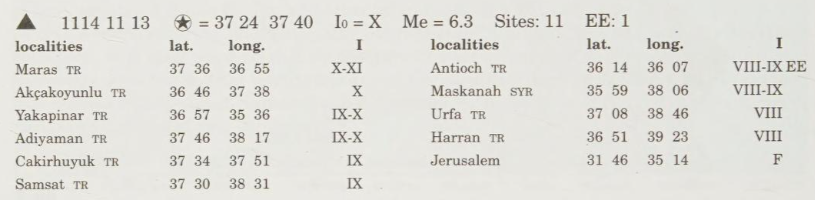
"In the year fourteen hundred and twenty-two of the Greeks (1111), on the night of Sunday, 29 Tishrin II [November], there was a severe earthquake and Germanicia, which is Mar`ash, was destroyed and entirely perished. Its houses were destroyed, its whole wall collapsed. Twenty-four thousand died besides strangers, and more than a hundred priests and deacons. The castle of Mansur and many other places were wiped out".
That this report does indeed refer to the earthquake of 1114, is made clear by the fact that the same chronicle gives the right date for the earthquake in a later passage:Chron. Ad Annum 1234
1114 November 13
Guidoboni and Comastri (2005)
"In the year fourteen hundred and twenty-five (of the Greeks, 1114) ... at this time the country of Gargar was ruled by an Armenian, whose name was Michael. He was the son of Constantine, who was buried under the prison of Samosata during the earth quake, which destroyed Mar`ash".Matthew of Edessa wrongly dates the death of the Armenian nobleman Constantine, lord of Gargar, who was imprisoned in the fortress at Samosata, to the year 566 [20 February 1117 — 19 February 1118], evidently attributing the collapse of the fortress at Samosata to the Marmet earthquake in 1117-1118 (see the entry concerned); but it actually happened on 13 November 1114. Arabic sources complete the picture of the earthquake's effects, by providing precise details concerning not only the territory of Edessa, but also — unlike the Latin and Syriac sources — the emirate of Aleppo.
"I have seen a text by our master Ibn Abi Bakr ibn Abd al-Baqi al-Bazzaz, which stat ed: "On Thursday 17 Rajab in the year 508, a letter reached Baghdad in which it was written that on the night of Sunday 18 Jumada II in the same year [20 November 1114], there had been an earthquake at Al-Ruha, and 13 towers in the city walls had collapsed. Part of the walls at Harran had also collapsed, and many houses had col lapsed on top of their inhabitants. There had been collapses at Sumaysat; at Balis, about a hundred houses have been destroyed, and half of the citadel has collapsed, but the other half has survived".
There is a brief reference to the earthquake in Ibn al-Qalanisi (12th century):Ibn al-Jawzi
1114 November 13
Guidoboni and Comastri (2005)
"In that year [508 H.], there was a strong earthquake in Syria which caused both the earth and the hearts of its inhabitants to tremble".
Ibn al-Athir (1160-1233), repeats the same information as that provided by Ibn al Jawzi:Ibn al-Qalanisi
1114 November 13
Guidoboni and Comastri (2005)
"In the month of Jumada II [508 H. = November 1114], there was a violent earthquake in the regions of Gazira and Syria as well as other regions. Ruha, Harran, Sumaysat, Balis and other towns were largely destroyed, and many people died in the ruins".
There is a later record of the earthquake in Ibn Kathir (1300-1373), who writes that:Ibn al-Athir
1114 November 13
Guidoboni and Comastri (2005)
"In the Khurasan, a few houses were destroyed, and a good many dwellings were destroyed in many other villages. About 100,000 people died, and half the citadel at Harran collapsed, but the other half remained standing. The town of Sumaysat [pres ent-day Samsat] also collapsed. Many people died in the ruins".
Ibn Kathir
1114 November 13
Guidoboni and Comastri (2005)
Fig. 8
Intensity Data Points
(052) 1115 November 29 Mamistra [southern Turkey]
sources 1
In the one thousand one hundred and fifteenth year since the birth of Our Lord Jesus Christ, on the eve of the feast of St.Andrew the Apostle [29 November], deep in the silence of the night, when human frailty can most sweetly enjoy the calm of sleep, an immense and terrible earthquake struck the city of Antioch and its territory. Men are taken by surprise. They feel, see and hear that they and others are in danger from collapsing walls, towers and other buildings; and so they leap down from the fortifications and even throw themselves from tall houses. Many, however, are taken by surprise in their sleep, and are crushed in their collapsing homes, so that although some walls of their houses remained standing, they were never found. Others abandoned their homes and all their possessions and belongings in terror, and wandered through the streets and squares of the city in a daze. And as all were torn between fear and a sense of impotence, they raised their hands to heaven, and each in his own tongue cried out incessantly with tearful voice: '0 Lord, have mercy on your people!' When morning came, and it was clear what slaughter of men and animals was concealed beneath the ruins, everyone together, whether Greeks, Latins, Syrians, Armenians, strangers or pilgrims, agreed that what had happened was a result of their sins. [...] When church services had been held, the sermon delivered and men had decided where to go and what to do [the Antiochenes] who thought that nothing worse could happen to them, were suddenly horrified by a terrible piece of news. For some people, who by the grace of God had escaped the destruction of the town of Maresia, told how that town had been razed to the ground [by the earthquake] and its lord and bishop with all his clergy and the whole population had met their deaths. And shortly afterwards, their terror was increased by the memory of what had happened at the town of Mamistra, where, on the feast of St.Brice in the previous year [13 November 1114], the townspeople and most of the town itself had been swept away in the disaster. And what could have happened to the town of Cerepum? And what to the rest of the Antioch region? Everyone felt a torment of this kind. This mixture of fear and apprehension so increased in the wretched population [of the town] that no-one knew whether to stay or flee. Fear of an earthquake so weighed upon these wretches every day and at any time that they all said to one another: 'Oh cursed fate to be born, unhappy fate to die, and intolerable fate to be alive!'. Although they had all seen that there is no place or way to avoid the power of God, yet they preferred to live in the open with the animals rather than suffer the continual fear that the buildings in which they found themselves would collapse. And so they abandoned their homes and went to live in the streets, squares, gardens and thickets, using tents as homes. Yet others left the towns and travelled from place to place with their makeshift camps.Fulk of Chartres has a very brief report of the earthquake:
But the patriarch, who was a man capable of dealing with the situation and all eventualities, by calling upon all the resources of his wisdom, managed to soothe the hearts of the stricken and of those who had no further hope in life, succouring them with the sweetness of holy preaching [...]. Those who had fled were called back, sinners were led back to the path of righteousness, comfort was given to orphans and widows, by pro viding what was necessary in their indigence. Efforts were made, with suitable help and joyous countenance, to restore the bodily health of the poor, the sick and the indigent, and to cheer those who had already recovered. What more needs to be said? Men were reformed through penitence, ennobled by good works, and freed from the fear of the earthquake, though it continued to threaten them for more than five months, not by their own merits but by the will of God; and so they joyfully gave thanks to the Omnipotent in His church".
I - Anno igitur millesimo centesimo quinto decimo ab Incarnatione Domini nostri Iesu Christi, in vigilia festivitatis beati Andreae apostoli, sub intempestate noctis silentio, qua humana fragilitas habilius atque dulcius quiescere consuevit, factus est terraemotus in Antiochiam et eius partes immensus et orribilis. Ipso etenim ex insperato homines terribiliter pulsi, sentiunt, vident, audiunt murorum, turrium, aedificiorumque diversorum ruinam sibi ac caeteris penitus imminere; quam nonnulli fugtendo putantes evadere, quidam elapsi a moenibus, quidam ab altis domibus in praecipitium se dedere. Plures equidem in somno cum ruina membratim ita sunt rapti, quod, manente etiam parte parietis integra, nusquam comparuere. Alii vero terrore percussi, dimissis domibus, spretis opibus, relictis omnibus, per plateas et oleos civitatis velut amentes se agebant. Expansis tamen ad coelum manibus, pro diversitate metus et impotentiae, pro diverso linguarum genere, voce lacrimabili: 'Three, Domine, puree populo tuo!' clamare non cessabant.
II — Mane autem facto, cum sub ruina tam hominum quam et aliorum animalium miserae cladis pateret immanitas, omnes unanimiter Latini, Graeci, Syri, Armeni, advenae et peregrini, suis peccatibus exigentibus id accidisse profitentur
III— Celebrato vero divino officio, facto sermone, iniuntisque mandatis quo modo se habeant, vel quid agere debeant, nihil gravius accidisse putantes, repente horribili terrentur nuntio. Quidam namque, a periculo ruinae oppidi Miragii divino nutu elapsi, ipsam civitatem cum eiusdem domino et episcopo, clero etiam et omni populo, funditus eversam fuisse protestantur. Nec multo post recordatio oppidi Mamistrae, cum oppidanis et maiore parte civitatis in festo sancti Bricii antea pessumdati, metum multiplicat. Quid de Cerepo? Quid de ceteris Antiochenis finibus? Par tormentum predicatur de disparibus. Metus ergo timori permixtus ita miserae plebi ingeminatur, quod ubi maneant aut quo fugiant prorsus ignorant. Quaque enim die, horis, desperatis instabat terraemotus; unde ad invicem haec pronuntiant: '0 necessitas abiecta nascendi, misera moriendi, dura vivendi nostra necessitas!' Hi, licet noverint Dei potentia nusquam et numquam posse aufugi, eligunt tamen facilius esse cohabitare cum bestiis extra, quam intus incessanter aedificia timere ruitura. Quocirca in vicis, in plateis, in hortis, in virgultis, desertis habitationibus aliis, tentoribus pro domibus potiebantur. Plures etiam, relictis civitatibus, de loco ad locum translatis mapalibus, in campis morabantur.
IV — Atqui patriarcha, loci, temporis, omnium peritissimus, per necessaria disciplinarum philosophiae membra discurrens, desolatorum et iam fere de vita desperantium corda, sanctae predicationis dulcedine fota, mitigavit. 1...] Dispersos revocant, devios corrigunt, orphanis, visuis ferre solatium, et eorum indigentium supplere satagunt. Sufficienti etiam hospitalitate, pauperum, inpoum et indigentium corpora vultu hilari nituntur recreare, ac recreates datis muneribus exhilarare. Quid ultra? Fructu poenitentiae correcti, bonis operibus adornati, a periculo terrae motus per quinque menses et ultra imminentis, non suis meritis, sed Dei gratia liberati, Cunctipotenti referunt gratiarum actiones in ecclesia sua laeti.
"1115. [...] In that same year, the town of Mamistra was again reduced to ruins by an earthquake. Nor was it felt less strongly in other towns in the region of Antioch".Lisiard of Tours also mentions it briefly:
Anno millesimo centesimo decimo quinto. 1...] Ipso anno iterum subversa est urbs Mamistria terrae motu. Alias autem in regione Antiochena non minus accidit.
"1115. [...] Indeed, just as [God] in his love protected men, so he also called them unto himself with implacable justice, [as he showed] that same year by destroying with an earthquake the formerly quite illustrious town of Mamistra, and also by striking many other places in the region of Antioch with a similar disaster".Secondary Latin sources tend to give wrong dates for this earthquake and, in particular, to confuse it with the previous destructive earthquake of 13 November 1114, whose damage zone becomes partly superimposed on that of the earthquake of 29 November 1115. Archbishop Romuald of Salerno (1120/1130-1181), for example, confuses information about the 1114 earthquakes (see the preceding entries) and that of 29 November 1115, making the following entry for December 1115:
Anno .M.C.XV. [...] Verum quos ita Deus per se protegebat pius, per se quoque ipse corripiebat justus, eodem anno et Mamistriam terrae motu subvertens, urbem olim satis illustrem, et pleraque alia in territorio Antiocheno loca horrore simili concutiens.
"In the month of December in that same year, before Christmas, there was so great an earthquake in Syria that Mamistra and Maras and many other towns and villages were razed to the ground, crushing men in the ruins; and part of Antioch and even of Jerusalem collapsed to the ground".The Liber Pontificalis similarly attributes some of the damage caused by the earthquake of 13 November 1114 to that of 1115. For while the complete collapse of Mamistra did indeed occur on 29 November 1115, the surface faulting at Antioch was in fact caused by the previous earthquake:
Eodem anno mense Decembris in Siria ante Natalem Domini terre motus ita fuit magnus, quod Mamistra et Marais ad solum usque et alie quam plures civitates et castella, attritis hominibus, set et pars civitatis Antiochiae ac usque Jerusalem prostrate ceciderunt.
"Here are the prodigies which occurred at that time: an earthquake destroyed all the town walls and houses at Mamistra; and most of the inhabitants were caught up in the disaster. One knight, for example, who was trying to flee to Antioch, was swallowed up by the earth together with his horse when a fissure suddenly appeared, so that he was buried alive.
And on that same occasion, an ox was caught in another crack in the earth, and while its body disappeared into the abyss, its horns remained attached to the surface".
Huius temporibus prodigia. Apud Mamistram terremotus muros omnes domosque subvertit; maiorem hominum partem ruina involvit, quam dum miles quidam fugere nititur ad Antiochiam properans, subito hiatu terrae cum equo absorptus, prius est sepultus quam mortuus.
Ibidem, alio hiatu terrae bos interceptus, dum corpore inferius fluxit cornibus superius hesit.

Fig. 8 Map of intensity distribution for November 1114 earthquake - Sbeinati et al. (2005)
Ibn Al-Jawzi: In the year 508 A.H., the night of 18 Jamada II Sunday (1114 November 19), an earthquake occurred, causing collapse of 13 towers of Al-Ruha Wall, a part of Harran Wall fell down and many houses collapsed on their inhabitants, Samasat was swallowed up, 100 houses and half of the citadel collapsed at Balis.
Ibn Al-Athir: In this year (508 A.H.) in Jamada II (November 2-30), there was a strong earthquake in Al-Jazira area, Al-Sham and others, causing a wide destruction at Al-Ruha, Harran, Samsat, Balis and others, and many people killed under debris.
Al-Dawadari: In this year (508 A.H.), there was an earthquake at Aleppo. Samsat and Marash were swallowed up and many people killed.
Ibn Kathir: In this year (508 A.H.) (1114 January 7-1115 May 26), there was a great earthquake in Al-Jazira, causing destruction of 13 towers and many houses in Al-Ruha and some houses in Khurasan (?) and many houses in many countries where many of its inhabitants were killed about 100000 victims, and half of Harran castle was collapsed, Samsat was swallowed up and many people were killed under debris.Parametric Catalogues
| Effect | Location | Image(s) | Description |
|---|---|---|---|
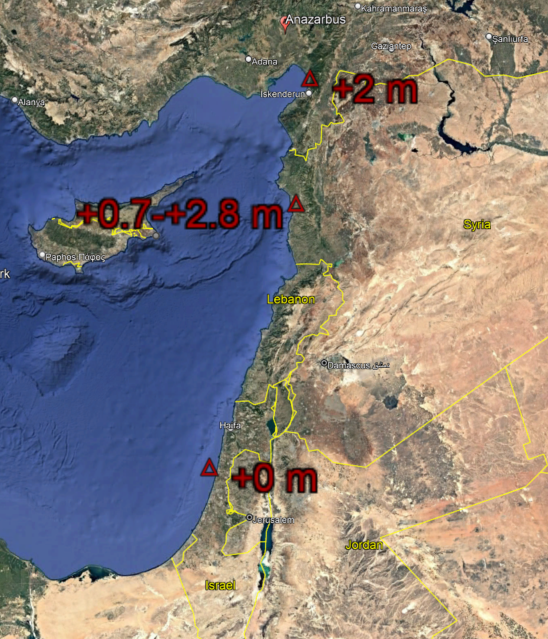
| Coastal Uplift | Levantine Coast from Turkey to Lebanon |
|
| Effect | Location | Image(s) | Description | Intensity |
|---|---|---|---|---|
| Coastal Uplift | Levantine Coast from Turkey to Lebanon |
|
IX |
de Vogüé, M. (1865-77) Syrie centrale, Architecture civile et religieuse I - open access at Archive.org
Renan, E. (1864-74) Mission de Phénicie 1 - open access at BnF Gallica
Renan, E. (1864-74) Mission de Phénicie Plates 3 - open access at BnF Gallica
Renan, E. (1864-74) Mission de Phénicie Plates 4 - open access at BnF Gallica
Renan, E. (1864-74) Mission de Phénicie Plates - open access at Archive.org
Wikipedia Page on Mission de Phénicie
Sauvaget, J., Mouterde, R. P. R., & Mouterde, R. P. B. (1934). Le Plan De Laodicée-Sur-Mer
. Bulletin d’études Orientales, 4, 81–116. - at JSTOR
Seyrig, H. (1952). Antiquités syriennes: 52. Le phare de Laodicée. Syria, 29(1/2), 54–59. - at JSTOR