Open this page in a new tab

Kition

Aerial shot of Kition after excavation Aerial shot of Kition after excavation

unsure which site or levels

Photo by Jefferson Williams in March 2023 from inside Larnaca Museum - original provenance unknown


Names
Transliterated Name Source Name
Kition Ancient Greek Κιτιον
Citium Latin
k-t Egyptian
k-t or k-t-y Phoenician
Introduction
Introduction

Kition (aka Citium) was a Ancient Greek city-kingdom on the southern coast of Cyprus (in present-day Larnaca). According to the text on the plaque closest to the excavation pit of the Kathari site (as of 2013), it was established in the 13th century BC by Greek (Achaean) settlers, after the Trojan War.

Citium (aka Kition) from The Princeton Encyclopedia of Classical Sites
Aerial Views and Plans

Aerial Views

  • Aerial shot of Kition after excavation
  • Kition in Google Earth

Plans

Normal Size

  • Plan of Kition Area II
  • Plan of Kition Area II Floors I to IV

Magnified

  • Plan of Kition Area II
  • Plan of Kition Area II Floors I to IV

Textual Chronology
17-15 BCE Cyprus Earthquake

Discussion

Discussion

References
Ambraseys (2009)

17–15 BC Cyprus

A destructive earthquake in Cyprus. It occurred in 15 BC (Diodorus) or, according to others (Eusebius), in Ol.190.3 (17 BC), that is sometime between 17 and 15 BC, during which period one or more earthquakes partly destroyed many places in Cyprus, including Paphos. The city was rebuilt with the assistance of Augustus and was renamed Augusta.

Inscriptions found at Palaepaphos (IGR iii. 939, 941–944) confirm the reconstruction activity in the city immediately or soon after 15 BC. An inscription (Dussaud 1896) from Byblus recording the gratitude of a survivor from an earthquake, dated vaguely to the first centuries BC or AD, may perhaps refer to this earthquake, which, in this case, should have occurred between Cyprus and the coast of Syria. A later writer (Georg. Mon. PG. i. 294) confuses Paphos with Salamina and Cyprus with Syria in this connection (see above, 44–32 BC)

Notes

. . . he...gave money to the Paphians who had suffered from an earthquake, besides allowing them, by a decree, to call their city Augusta.’ (D.C.=Dio Cass. LIV. 23/LCL.vi.342).
. . . he (Augustus) relieved others (cities) which had been destroyed by earthquakes .. .’(Suet.Aug.47/LCL.i.200).
The senate and the people of Paphos Sebaste (Augusta) [commend] Tiberius Caesar, son of the divine Augustus, Emperor Augustus and greatest pontifex, to Paphian Aphrodite.’ (IGR.iii.941–942).
An earthquake destroyed many districts of Cyprus.’ (Eus. Gk., 142).
A large part of the island of Cyprus was reduced to a ruin [by an earthquake].’ (Eus. Arm., 142).
In Cyprus many parts of the towns fell in an earthquake.’ (Hieron., 166).
Apollodorus son of Nicon, saved from the earthquake, erected this to Zeus, his saviour.’ (Dussaud 1896).
Let us add that every sea-shore is prone to earthquakes: thus Paphos was not shaken just once . . .’ (Sen. QN. VI. xxvi. 4).

References

Ambraseys, N. N. (2009). Earthquakes in the Mediterranean and Middle East: a multidisciplinary study of seismicity up to 1900.

Guidoboni et al. (1994)

(074) 17 B.C. Paphos, Cyprus sources 1

  • Dio Cass. 54.23.7
  • Eus. Hieron. Chron. 166c
sources 2
  • Georg. Sync. 593
catalogues
  • Manetti [1457]
  • Bonito (1691)
  • von Hoff (1840)
  • Mallet (1853)
  • Schmidt (1881)
  • Ben-Menahem (1979)
  • Guidoboni (1989)
Dio Cassius mentions rebuilding work carried out at Paphos on the island of Cyprus in 15 B.C. at the behest of Augustus:
[Augustus] also set aside money for the inhabitants of Paphos, who had suffered in an earthquake, and issued a decree that the city should be named Augusta
Dio Cassius is a late (3rd century A.D.) but well-informed writer who relies on good sources; and in this case he has thought it worthwhile to record the prompt assistance given by Augustus towards the reconstruction of cities struck by earthquakes. These are by no means disinterested details; for it is well known that in his idealisation of the emperor Augustus, Dio Cassius was trying to describe the contemporary situation and, by implication, draw attention to the problem of public buildings. He wanted to persuade the emperors of his day not to devote too much attention to grandiose public works, leaving municipalities with the all too frequent burden of work such as the rebuilding of a city struck by an earthquake. For a general reference to rebuilding work carried out by Augustus, see the passage from Suetonius (Aug. 47) quoted in entry ( 072 ).

That the earthquake was also felt throughout Cyprus, is clear from a reference in the Chronicon of Eusebius for the third year of the 190th Olympiad [17 B.c.]:
Large parts of towns in Cyprus were destroyed in an earthquake.

In Cypro plurimae civitatum partes terrae motu conciderunt.
Syncellus reports the earthquake in the same terms as Eusebius.

References

Guidoboni, E., et al. (1994). Catalogue of Ancient Earthquakes in the Mediterranean Area up to the 10th Century. Rome, Istituto nazionale di geofisica.

Sibyl Quake - 76 – 81 CE – probably between June 78 CE and June 79 CE

Discussion

Discussion

Textual Seismic Effects
17-15 BCE Cyprus Earthquake

Effect                                   Location Image(s) Description
  • Ruined (collapsed walls)
Cyprus in general
  • "23.7 However, he [Emperor Augustus] did this later. At the time we are considering he colonized numerous cities in Gaul and in Spain, restored to the people of Cyzicus their freedom, and gave money to the Paphians, who had suffered from an earthquake, besides allowing them, by a decree, to call their city Augusta." - Dio Cassius

  • "In Cyprus, many parts of the cities were ruined in an earthquake." - Chronicon by Eusebius

Sibyl Quake - 76 – 81 CE – probably between June 78 CE and June 79 CE

Effect                                   Location Image(s) Description
  • City Destroyed (collapsed walls)
  • Tsunami ?
Kition, Cyprus
  • "Three cities in Cyprus were destroyed all together in an earthquake." - Chronicon by Eusebius

  • "an earthquake destroyed three cities of Cyprus" - Orosius

  • "In Cyprus, three cities collapsed in an earthquake" - George Syncellus

  • "There was an earthquake in Cyprus. For three days there were collapses (Chronicon by Eusebius)" - Elias of Nisibis

  • "... An earthquake affected 3 cities in Cyprus. Among them was Salamis. Eusebius" - Sethus Calvisius

  • "an earthquake will destroy at once Salamis and Paphos when the dark water overwhelms Cyprus, which is washed by many waves." - Sibylline Oracles

  • Since several sources refer to the destruction of three cities on Cyprus, Ambraseys (2009) speculated that the third city was likely Kition (Citium)

Textual Intensity Estimates
17-15 BCE Cyprus Earthquake

Effect                                   Location Image(s) Description Intensity
  • Ruined (collapsed walls)
Cyprus in general
  • "23.7 However, he [Emperor Augustus] did this later. At the time we are considering he colonized numerous cities in Gaul and in Spain, restored to the people of Cyzicus their freedom, and gave money to the Paphians, who had suffered from an earthquake, besides allowing them, by a decree, to call their city Augusta." - Dio Cassius

  • "In Cyprus, many parts of the cities were ruined in an earthquake." - Chronicon by Eusebius

  • VIII+
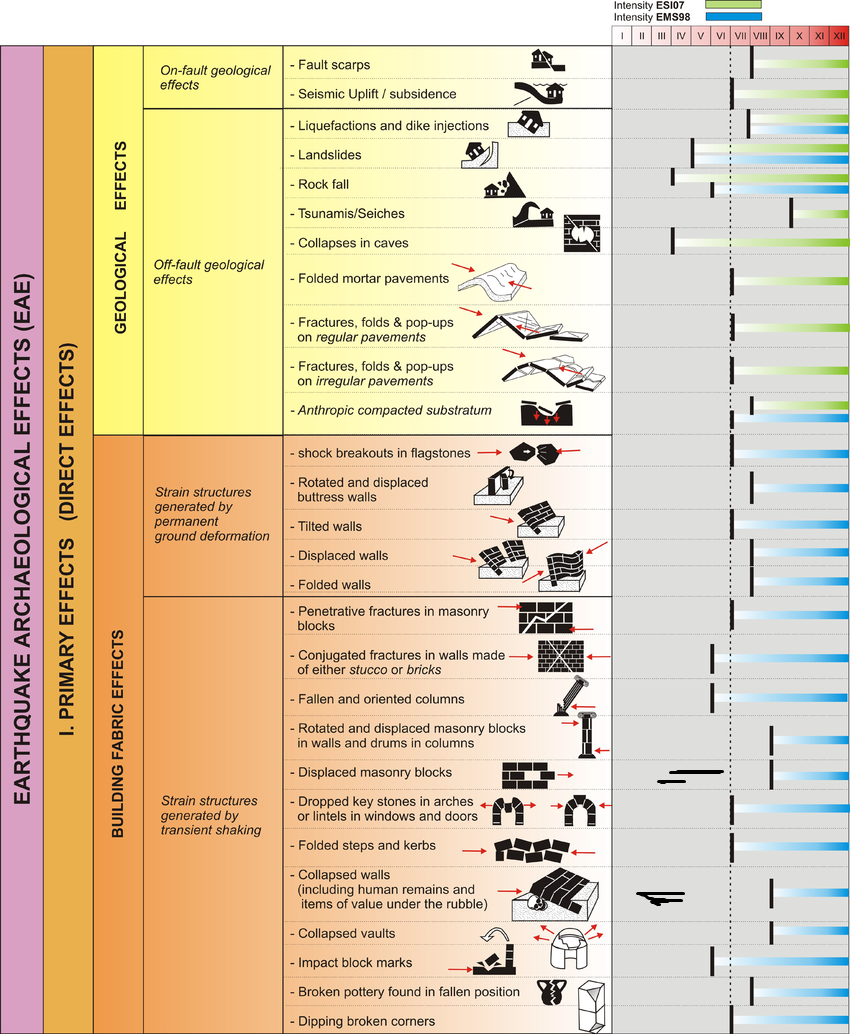
This evidence requires a minimum Intensity of VIII (8) when using the Earthquake Archeological Effects chart of Rodríguez-Pascua et al (2013: 221-224).

Sibyl Quake - 76 – 81 CE – probably between June 78 CE and June 79 CE

Effect                                   Location Image(s) Description Intensity
  • City Destroyed (collapsed walls)
  • Tsunami ?
Kition, Cyprus
  • "Three cities in Cyprus were destroyed all together in an earthquake." - Chronicon by Eusebius

  • "an earthquake destroyed three cities of Cyprus" - Orosius

  • "In Cyprus, three cities collapsed in an earthquake" - George Syncellus

  • "There was an earthquake in Cyprus. For three days there were collapses (Chronicon by Eusebius)" - Elias of Nisibis

  • "... An earthquake affected 3 cities in Cyprus. Among them was Salamis. Eusebius" - Sethus Calvisius

  • "an earthquake will destroy at once Salamis and Paphos when the dark water overwhelms Cyprus, which is washed by many waves." - Sibylline Oracles

  • Since several sources refer to the destruction of three cities on Cyprus, Ambraseys (2009) speculated that the third city was likely Kition (Citium)
  • VIII+
  • IX+?
This evidence requires a minimum Intensity of VIII (8) when using the Earthquake Archeological Effects chart of Rodríguez-Pascua et al (2013: 221-224). Intensity may have been higher (IX+) as suggested by the tsunami but, it is not entirely clear whether the Syballine Oracles refered to a tsunami or a storm.

Notes and Further Reading
References

Bibliography from The Princeton Encyclopedia of Classical Sites

Luigi Palma di Cesnola, Cyprus, its Ancient Cities, Tombs and Temples (1877)

A. Sakellarios, Τὰ Κυπριακά I (1890)

John L. Myres, “Excavations in Cyprus 1894: Larnaca,”JHS 17 (1897), 152-73I

id., “Excavations in Cyprus 1913: The Bamboula Hill at Larnaca,”BSA 41 (1940-45) 85-69PI

I. K. Peristianes, Γεϝικὴ Ἱστορία τῆς νήσου Κύπρου (1910)

V. Karageorghis, “Fouilles de Kition 1959: Etudes sur les origines de la ville,”BCH 84 (1960), 504-88MPI

id., “Chronique des fouilles et découvertes archéologiques à Chypre,”BCH 84 (1960), 283-86I; 90 (1966), 362-65PI; 91 (1967) 315-24I; 92 (1968) 302-11PI; 93 (1969) 517-27PI; 94 (1970) 251-58PI; 95 (1971) 377-90PI; 96 (1972) 1058-64PI; 97 (1973) 648-53I

id., “New Light on the History of Ancient Kition,” Mélanges K. Michalowski (1966) 495-504I

K. Nicolaou, Κίτιον Ἑλληνίς * Kypriakai Spoudai 15 (1961) 19-39MI

id., “Archaeological News from Cyprus 1966,” AJA 71 (1967) 401; 72 (1968) 374-75; 74 (1970) 73, 393-94; 76 (1972) 313-14; 77 (1973) 53-54,427.

Wikipedia pages

Kition

  • from Wikipedia - click link to open new tab


Larnaca

  • from Wikipedia - click link to open new tab