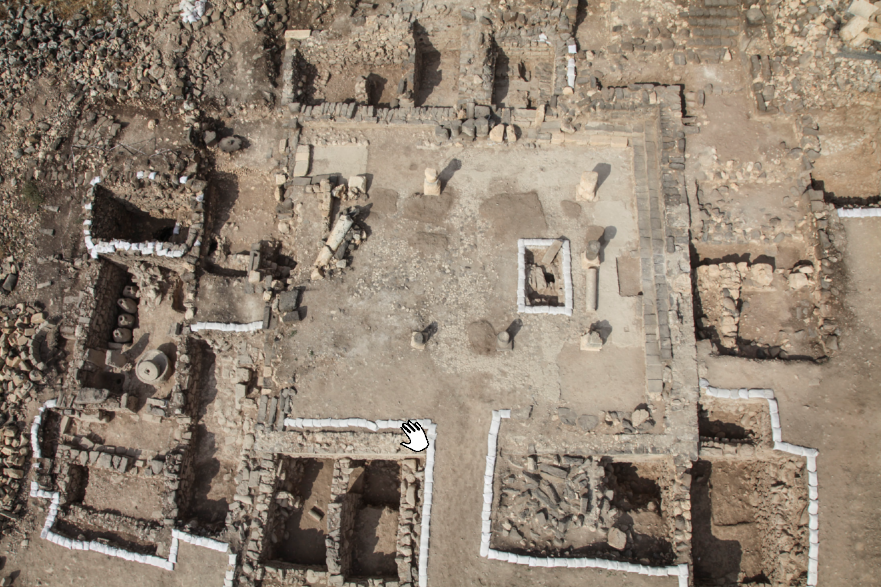
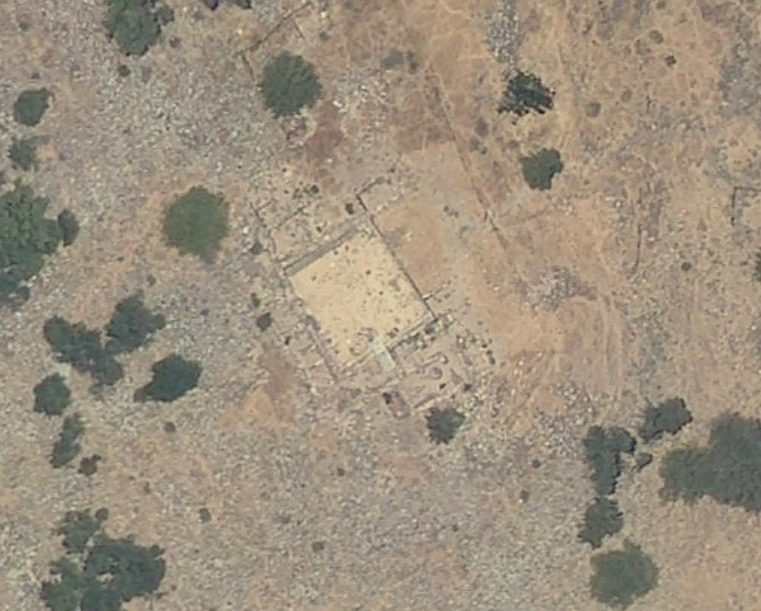
Aerial View of Khirbet Wadi Hamam on govmap.gov.il| Transliterated Name | Source | Name |
|---|---|---|
| Khirbet Wadi Hamam | | |
| Hamaam | Hebrew | חַמָּם |
| Horvat Veredim | Hebrew | |
| Hamaam | Arabic | حمام |
| Mazraʿat Mugr al Hamam | Arabic | |
| Khirbet el-Wereidat | Arabic | |
| Wadi Hamam | Arabic | |
| Migdal Zabaʿayya ? | Aramaic | |
Khirbet Wadi Hamam near Hamaam
was first settled in the Hasmonean period around the early first century BCE
reaching
a peak in terms of size and prosperity in the Early Roman period, when large-scale infrastructural
and building projects were carried out.
(Uzi Leibner)
Archaeological evidence for a severe decline in the settlement surfaces in the mid-fourth century,
when most of the village was abandoned. The latest stratified remains at the site date to the last
decades of the fourth century, and village life seems to have ceased entirely at the end of that
century or in the early fifth.
(Uzi Leibner)
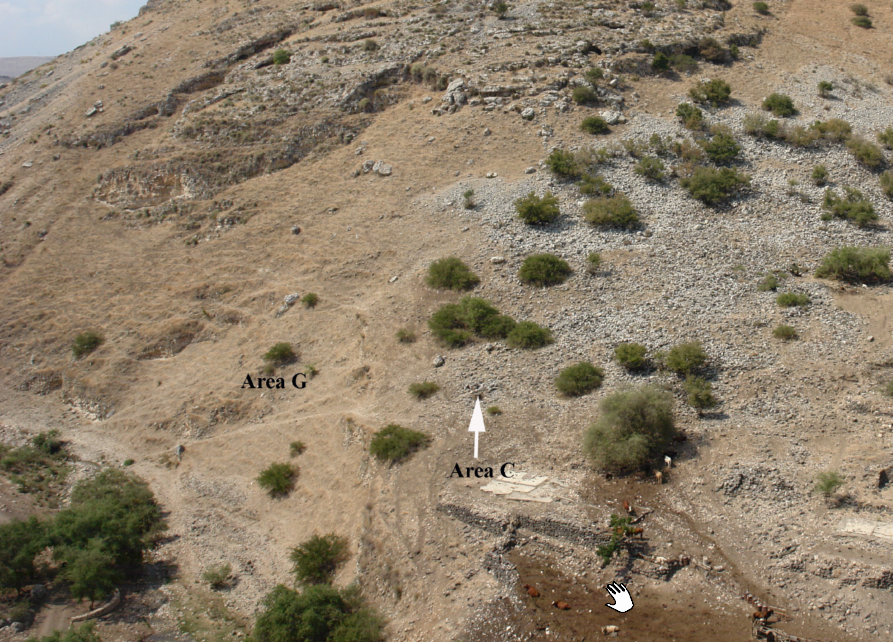
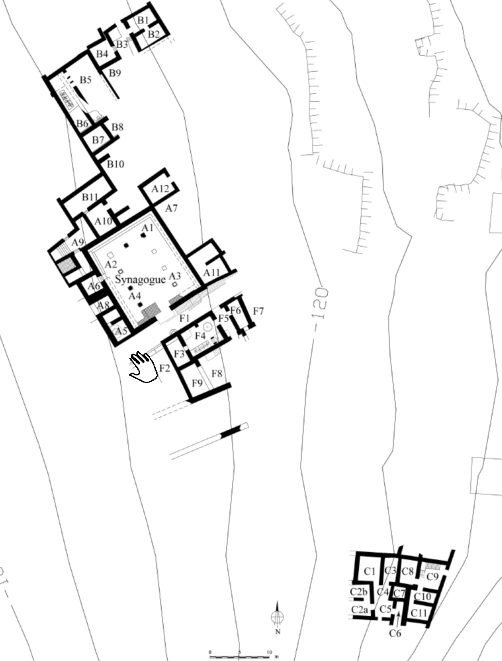
Fig. 1.5
Fig. 1.5
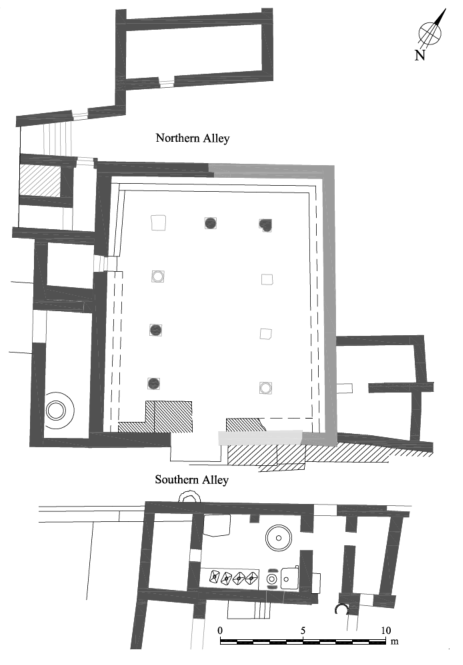
Fig. 2.4
Fig. 2.5
Fig. 2.4
Fig. 2.5
| Stratum | Period | Date | Description |
|---|---|---|---|
| 4 | Late Chalcolithic / Early Bronze Age IA | ca. 4500–3300 BCE | “The earliest remains, dated to the Late Chalcolithic period and Early Bronze Age IA, were entitled Stratum 4. Most of the finds from these periods were retrieved near bedrock and in fills beneath structures of Stratum 3 in Areas A and F. They comprise hundreds of pottery sherds and flints, a few groundstone implements and a zoomorphic clay figurine. No architectural remains could be assigned with certainty to this stratum, although the abundant small finds attest to extensive activities at the site during this era.” |
| 3 | Late Hellenistic / Early Roman | ca. 100 BCE–135 CE | “After a gap of some three millennia, the site was resettled during the Late Hellenistic (Hasmonean) period. Only a few architectural remains, found in Area A, could be assigned to this early stage. However, the considerable quantity of Late Hellenistic pottery recovered in fills beneath Early Roman structures, along with a dozen Seleucid and autonomous Phoenician coins from late second-century BCE Akko-Ptolemais and Tyre and some 90 Hasmonean coins, indicate that the occupation of Kh. Wadi Hamam began around the early first century BCE… The settlement expanded and developed during the Early Roman period, reaching its peak in terms of size and prosperity… Of special importance are the remains of a lavish ‘public building’, probably a Second-Temple period synagogue constructed in the center of the village around the mid-first century CE… The affluent occupation of Stratum 3 came to an abrupt end in a massive destruction documented in all excavation areas… to the reign of Hadrian, ca. 125–135 CE.” |
| 2 | Roman / Late Roman | ca. 200–400 CE |
"Following the second-century destruction, the site was
apparently abandoned for several decades, or at least
suffered a serious decline, as is evident from the
decrease in the quantities of coins dating to the latter
part of that century. A wide range of evidence for
habitation alongside the massive construction of new
structures appears around the end of the second or
early third century CE, designated Stratum 2. Remains
of this stratum were uncovered in all four excavation
areas in the village, indicating that Kh. Wadi Hamam
flourished again in the third and early fourth centuries
CE (Figs. 1.10–1.11). Reconstruction of the village was
based mostly along the lines of the early terraces,
although the plans of the domestic structures and the
general layout of the village differed from that of the
previous period. A ‘Galilean’-type synagogue was built
in the center of the village, where the earlier ‘public
building’ and dense domestic structures once stood. Evidence of a gradual decline of the settlement began to appear in the early fourth century, with the abandonment of a few structures. Many other structures were abandoned around the mid-fourth century, most likely as a result of the 363 CE earthquake. Activity in the second half of the fourth century was documented only in a restricted area in the center of the site, and village life seems to have ceased entirely by the end of the fourth or early years of the fifth century CE.” |
| 1 | Byzantine–Modern (ephemeral) | ca. 400–1950 CE | “Isolated small finds from the Byzantine, Umayyad, Crusader, Mamluk and Ottoman periods, up to the present day, were all grouped as Stratum 1. They were recovered in the topsoil with no relation to architectural remains and attest to ephemeral activities at the site, most likely pasturing and stone-robbery, or squatters making use of the ruins.” |
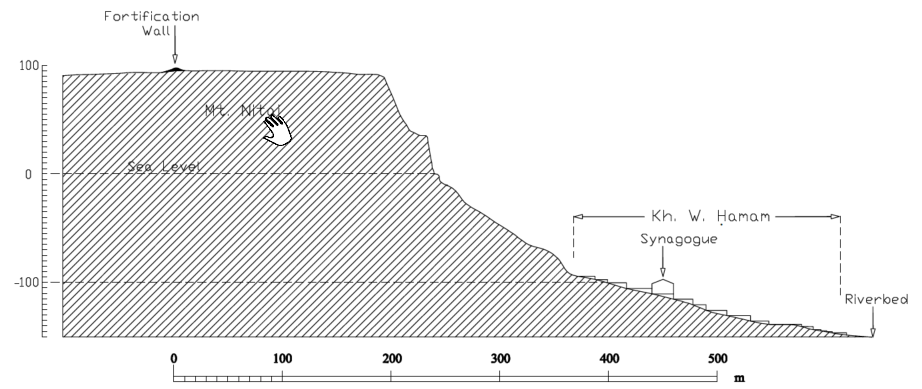
Despite its size, central location, and proximity to long-settled sites such as Magdala (2 km) and Tiberias (6 km), the ancient name of the site has long disappeared. The Arabic name Hamam (pigeon) derives from the flocks of pigeons nesting in the nearby cliffs, and was already recorded as the name of an agricultural plot in the Ottoman census of the sixteenth century— Mazraʿat Mugr al Hamam (Arabic “the sown land of the caves of Hamam”).7 In the British Survey of Western Palestine in the late nineteenth century, the site name was recorded as Kh. el-Wereidat (Arabic “the ruin of the small roses”).8 This peculiar name, alongside the better-known name Kh. Wadi el-Hamam, is also recorded in the first half of the twentieth century by the British Mandate Department of Antiquities and is the source of the current Hebrew name Horvat Veradim (Hebrew “ruin of the roses”).9 However, today the local Bedouin use the name el-Wereidat for a nearby burial site located 0.8 km to the north, also known as Waʿara el-Soda (see Chapter 20). Bedouin families who had settled in huts in the lower part of the site in the mid-twentieth century have since moved to the modern village of Wadi Hamam, to the east of the site (Fig. 1.5).
...He then departed to spend the Sabbath at home. Passing that Migdal Zaba` ayya14 he heard the voice of Nakai the Scribe saying: "have you not said that ben Yobai has purified Tiberias? Yet it is said that a corpse has been found there!" He (R. Shimon) said: "I swear that I know of innumerable (lit. as the hair on my head) laws attesting to the purity of Tiberias, except for certain places. (Besides) did you not vote (with those who declared Tiberias clean)? You have breached the fence of sages, `He who breaches a fence will be bitten by a snake' (Eccles. 10:8). Immediately one (a snake) emerged, and thus it had happened to him. He (R. Shimon) then passed through the valley of Beth Tofa.15 He saw a man standing and gathering the after-growth of the Sabbatical year. He said: "Is this not the after-growth of the Sabbatical year (and thus forbidden)?" He (the man) said: "Are you not the one who permitted it?" He (R. Shimon) said: "But do my colleagues not disagree with me?" Immediately he raised his eyebrows and looked at him, and (the man) became a heap of bones.16The most reasonable route of the (legendary?) journey of R. Shimon bar Yobai leads from Tiberias northward and then turns westward in Nabal Arbel, passing immediately below Kh. Wadi Hamam, and ascending directly to the Beth Netofa Valley. Migdal Zabaʿayya should be located somewhere along this route. The only substantial Roman-period sites along this course are el-Mejdel, Kh. Wadi Hamam and Kh. Umm el-`Amed (`Ammudim). As the first is clearly identified with Migdal Nunayya/Magdala/Tarichea, Migdal Zabaʿayya should probably be identified with one of the remaining two, whose ancient names are not preserved.
R. Hinena said: "All matters are a matter of custom". There were acacia trees in Migdal Zaba'ayya. They came and asked R. Hanina, associate of the rabbis, whether they might work with them (i.e., make use of them). He said to them: "since your forefathers have been accustomed to treat them as forbidden, do not change the custom of your forefathers, may they rest in peace".17In a similar story appearing in Song of Songs Rabbah (1.12 [55] Dunesky ed., p. 44), the reasoning for this refrainment is a tradition according to which the Children of Israel took from these trees when they went down to Egypt, and later built the holy ark from them. In any case, the only kind of acacia in northern Israel is the Acacia albida, which grows in small clusters in low, hot localities between the vicinity of Beth Shean and the Sea of Galilee basin.18 These conditions suit el-Mejdel and Kh. Wadi Hamam, but not Kh. Umm el-`Amed that is located ca. 300 m higher in elevation. Another hint as to the area in which the story takes place is the appeal of the locals of Migdal Zaba'ayya to `Rabbi Hanina associate of the rabbis', a relatively unknown sage who was active in Tiberias in the late third century CE.19
The kitmos20 of three villages would be brought up to Jerusalem in a wagon (i.e., due to its abundance): Kabul, Shikhin and Migdal Zaba'ayya, and all three were destroyed. Kabul because of contention; Shikhin because of witchcraft; and Migdal Zaba'ayya because of fornication... R. Yohanan said: there were eighty stores of palgas21 weavers in Migdal Zaba'ayya ...22Kabul and Shikhin (Asochis) are well known from both Josephus and rabbinic sources and their identification is clear: the first is located in the western Lower Galilee, near `Akko, and the second in the central Lower Galilee, near Sepphoris.23 Nearly a century ago, Press identified Migdal Zaba'ayya with el-Mejdel and suggested that this tradition is organized geographically from west to east, hence covering the entire Lower Galilee.24 This suggestion seems convincing, although as noted, el-Mejdel should clearly be identified with Migdal Nunayya/Magdala, hence Migdal Zaba'ayya is to be sought elsewhere in the eastern Lower Galilee. It would be helpful, of course, if we knew to what destruction the tradition alludes. The report by Josephus on the burning of Kabul by the Romans during the First Jewish Revolt,25 led Klein to attribute these destructions to that revolt.26 However, it is unclear if the rabbinic tradition is referring to a single event that brought about the devastation of all three villages. Furthermore, the literary context of the tradition seems actually to point to events connected to the Bar Kokhba Revolt rather than the First Jewish Revolt. It appears in a section that begins with a quo-tation from the Mishnah "Betar was captured", immediately after the dreadful legends about the siege and fall of Betar, and it is integrated in a series of stories about the wealth of various settlements, such as Tur Shim'on and Har ha-Melekh, which in all likelihood were destroyed during the Bar Kokhba Revolt.27
[a messenger came to Job and said...] the Sabeans made a raid and took them (the cattle) [and have slain the servants]' (Job 1.15). R. Abba bar Kahana said: They went from Kefar Kernos, and through all the Aulon and reached Migdal Zaba'ayya and died there. `And only I escaped to tell you' (ibid.): R. Yudan said: Wherever (in scripture) it is said `only', it implies a restriction. He (the messenger) too, was broken and stricken. R. Yudan said... and he too, as soon as he told his message, immediately died... `While he was still speaking, another messenger came and said: The Chaldeans formed three raiding parties [and swept down on your camels and made off with them] (Job 1.17). R. Samuel b. Nahman said: As soon as Job heard this he began marshalling his warriors... (but) when he was told `A fire of God is fallen from heaven' (Job 1.16) he said: What can I do. A voice has fallen from heaven! Who can do anything? ...32What is the meaning of this ambiguous midrash? And why does it elaborate on a journey of Jobs' servants through sites that are not mentioned either in the story or in the Bible in general? It seems that the rabbis are alluding to events in these places that were known to their contemporaneous audience but whose meaning is hidden from us today.33 In any case, two of the places mentioned here can be clearly identified: Kefar Kernos is mentioned in the Talmud Yerushalmi and in the halachic inscription from the Rebov synagogue, both pointing to a village adjacent to Beth Shean.34 Aulon is mentioned in the Septuagint (Deut. 1.1, Hebrew Hazeroth) and is identified in the Onomasticon of Eusebius as follows:
The great long plain is still called the Aulon (Aviv). It is bordered on both sides by mountains extending from Lebanon to the desert of Pharan. In the Aulon is the famous city [Tiberias] and nearby the lake, Scythopolis, Jericho and the Dead Sea and their surrounding regions. The Jordan flows through the midst of the whole region....35Thus, the Aulon is what is called today the Jordan Valley. According to the story, Job's servants began their journey near Beth Shean, passed through the Jordan Valley and all but one died at Migdal Zaba'ayya, again indicating that this village is located somewhere in the vicinity of the Sea of Galilee. In this context, it should be noted that a tradition appearing in the Babylonian Talmud, and in some manuscripts of Genesis Rabbah, states that Job lived in Tiberias.36 This may be the reason for the development of our story focusing on sites in this region. It is not clear why Migdal Zaba'ayya was chosen as the servants' death-place. The tradition, brought by R. Abba bar Kahana who lived in the Galilee in the late third—early fourth centuries CE, may allude to a known tragedy that occurred in that village, such as the early second-century destruction mentioned above or perhaps an earthquake (the `fire of God fallen from heaven' at the end of the story?). The excavations at Kh. Wadi Hamam revealed evidence of two destructive episodes that seem to be the result of earthquakes, the first in the late third or early years of the fourth century CE, and the second in the year 363 CE (see Chapters 2, 6).
7 Rhode 1979: 88.
8 Conder and Kitchener 1881: 409.
9 British Mandate Department of Antiquities Archive,
SRF 192 (7/7) and Jacket ATQ 1045 (3/3).
10 This suggestion was first raised in my Ph.D.
dissertation (Leibner 2004: 218–226), but later I
proposed identifying Migdal Zabaʿayya with a
different site, south of Tiberias (Leibner 2006).
The excavation results, however, have led me to
return to my initial suggestion.
11 Various identifications have been suggested by
scholars for this site, all in the vicinity of the Sea
of Galilee, see, e.g., Schwarz 1979: 228; Graetz
1880; Press 1930: 255–268; 1961: 162–170; Klein
1967: 199–201; Feliks 1981: 22. The suggestion of
Taylor (2014: 209–210) that the site be sought in
the vicinity of Jerusalem does not stand up to
scrutiny.
12 For a detailed discussion on the identification of
Migdal Nunayya/Magdala/Tarichea and the
etymology of the names, see de Luca and Lena
2015: 280–298, with references therein.
13 Neubauer 1868: 217; Press 1930; 1961: 164;
de Luca and Lena 2015: 289.
14 In the parallels (Yerushalmi Sheviʿit 9.1 [38d];
Pesikta de-Rav Kahana 11.16 [ed. Mandelbaum,
p. 193]; Kohelet Rabbah 10.8), the reading is
Magdala.
15 In some mss.: Beth Netofa / Beth Tifa.
16 Translation (with modifications) after Levine
1978, who provides a detailed comparison
between the parallel traditions and an extensive
discussion of the story.
17 A parallel with small variations appears in
Yerushalmi Pesahim 4.1 [30d].
18 Feliks 1981: 22.
19 See Yerushalmi Berakhot 7.3 [11b]; Moʿed Katan
3.5 [82c]; Terumot 8.3 [45c]; see also Beer 1983:
80–82; Rosenfeld 1998: 57–103.
20 Apparently from [Greek text], here meaning
revenue or donations.
21 Palgas, perhaps from [Greek text] — a cloak, see
Sperber 1993: 132–140.
22 A similar tradition, which apparently developed
from this source, appears in Lamentations Rabbah
2.2 (Buber edition p. 54): R. Huna said: There were
three hundred stores selling [food preserved in
the condition of] cultic cleanness in Migdal
Zabaʿayya …
23 Tsafrir et al. 1994: 102; Strange et al. 1995.
24 Press 1930; 1961: 164.
25 War 2.505.
26 Klein 1967: 50.
27 For Tur Shimʿon and Har ha-Melekh, see Zissu
2008 and Shahar 2000, respectively.
28 See the relevant entries in Tsafrir et al. 1994:
102, 70, 173.
29 The ancient Jewish text dubbed Toledot Yeshu
presents a derogatory version of the life of
Jesus. Interestingly, in the Aramaic version of
the text, presumably originating in the
Byzantine period, in a scene set in the
vicinity of Tiberias, John the Baptist is
called limn= pni, (Deutsch 2000: 186, Lines 4,
9, 15). This nickname is usually translated as
John the Dyer and is thought to be an
unarticulated use of the verb vn2 (Zab`a),
which means to dye but also to dip/immerse,
hence to baptize (idem.: 179). However, the
prefix h is usually used to designate the
place of origin, and could be understood as
John from Zaba'ana.
30 Genesis Rabbah 19.1 (ed. Theodor-Albeck
p. 170); see also Ilan and Izdarechet
(1988: 36), who suggest that pools identi-
fied at Arbel were used in flax processing.
31 For example, Yerushalmi Ma'aser Sheni 5.2
(56a); Kohelet Rabbah 1.8 (Hirshman ed.
p. 64).
32 Translation (with modifications) after
Freedman and Simon 1939: 217-218.
33 For a detailed discussion of this midrash,
see Leibner 2006: 41-49.
34 Yerushalmi Demai 2.1 [22c]; Sussmann
1973-74: 158; see also Leviticus Rabbah
28.6 (ed. Margulies p. 666); Yahalom and
Sokoloff 1999: 208-210.
35 Onomasticon, ed. Klostermann, p. 14.
Interestingly, in the Latin translation
(idem.: 15) Jerome emphasizes that Aulon
is not Greek, as one might think, but rather
a Hebrew word.
36 Bavli Bava Batra 15a; Genesis Rabbah 57.4
(ed. Theodor and Albeck, p. 617) according
to mss. Oxford 147, Oxford 2335, Paris 149.
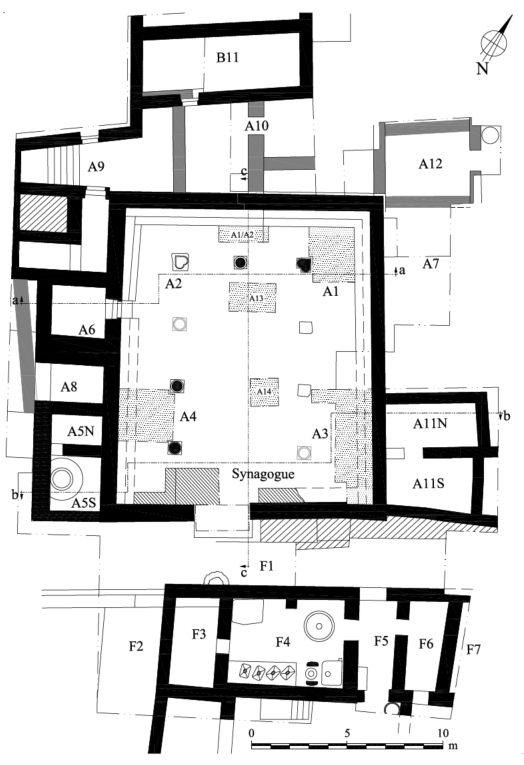
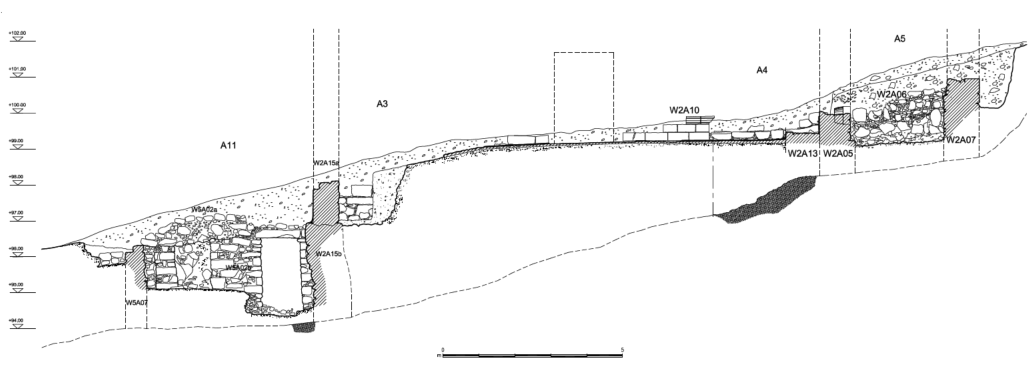
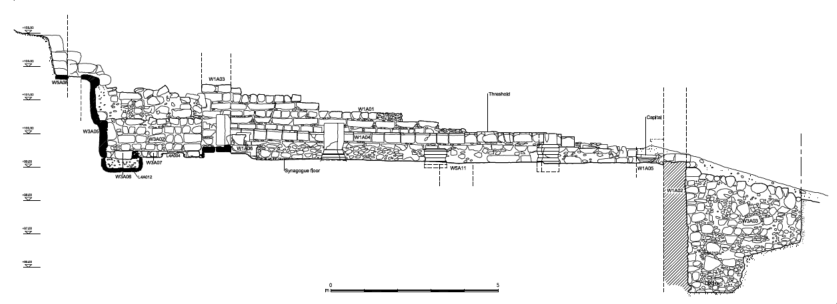
The current section presents a stratigraphic synthesis focusing on the main terrace and the monumental buildings that stood on it, based on the details and archaeological finds discussed above
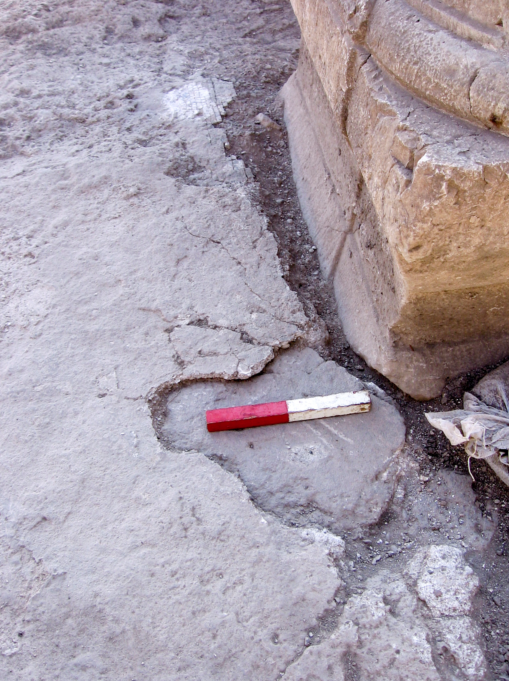
Limited restoration works in Synagogue II at the end of the fourth century were labeled Sub-Phase IIb, and include the addition of three stratigraphically related features: (1) a stone bema; (2) a low bench added against the southern wall; (3) a plaster floor, which replaced damaged portions of the mosaic. The cause and date of the damage that necessitated this renovation could not be precisely determined, but it clearly occurred in the late fourth century. The most plausible event is the earthquake of 363 CE, which was apparently responsible for the destruction of some of the surrounding domestic structures and devastated many sites in the region (see Chapter 6).19
19 For archaeological evidence of the earthquake of
363, see Russell 1980; Balouka 1999
20 Dothan 1983: 31–32;ugeneral, Weiss
1988.
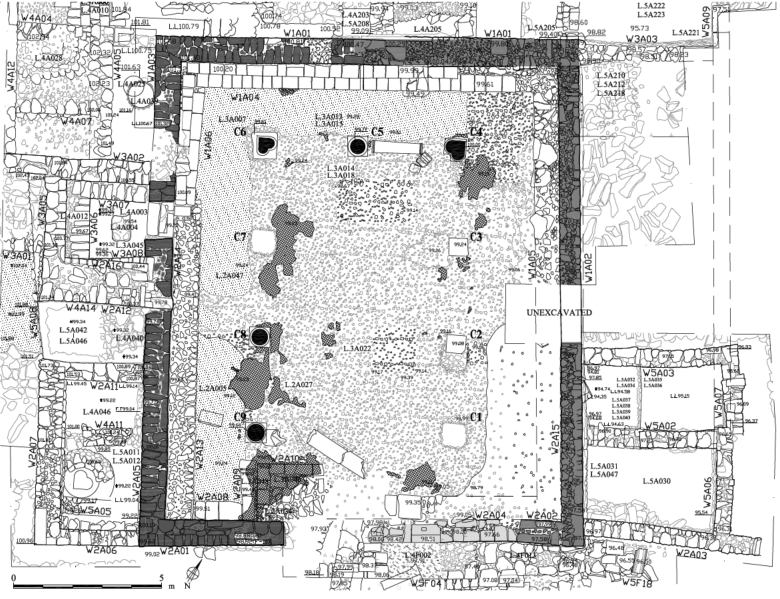
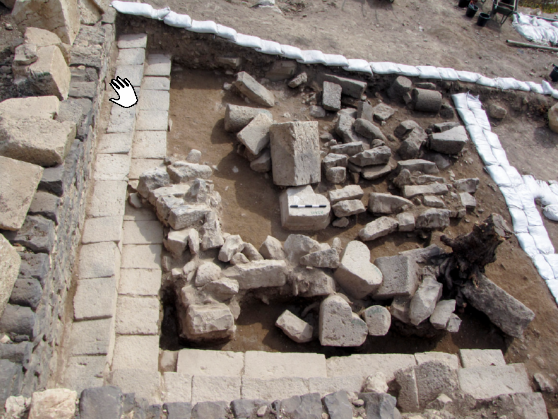
The debris in the northwestern quarter of the synagogue hall, which had accumulated to a maximal height of ca. 2.2 m above floor level, provided important information concerning the last stage of the building and its final collapse. The components of the corner column had fallen to the southwest, and courses of blocks from the walls, still bound together by mortar, were discovered lying on their sides among the debris. In the debris were hundreds of roof tiles and dozens of large construction nails that probably originated from the truss that supported the tiled roof. All this evidence seems to imply that the final collapse was caused by an earthquake. The latest pottery and small finds on the floor beneath the debris date to the fourth–early fifth centuries. These finds were probably washed in from above after the abandonment of the building, but before its collapse, and seem to have been sealed inside shortly thereafter, since no material of later date was recovered on the floor. Thus, the building probably collapsed in an earthquake in the early years of the fifth century (perhaps in 419?).21 The similarity between the material beneath the debris and that found inside the bema indicates that the renovations in Sub-Phase IIb took place shortly before the destruction of the building. As noted above, the two successive plaster floors in some places suggest two stages of renovation in this sub-phase.
21 The earthquake of 419 is mentioned in the Chronicon Marcellini (Mommsen 1894: 74); see also Russell 1985: 42–43; Amiran, Arieh and Turcotte 1994: 266.
A few finds provide evidence of limited activity that took place in and around the synagogue after its collapse. The nature of the finds, the small quantity and their location, indicate that these were sporadic activities reflecting stone robbers, squatters, or passersby who visited the site.
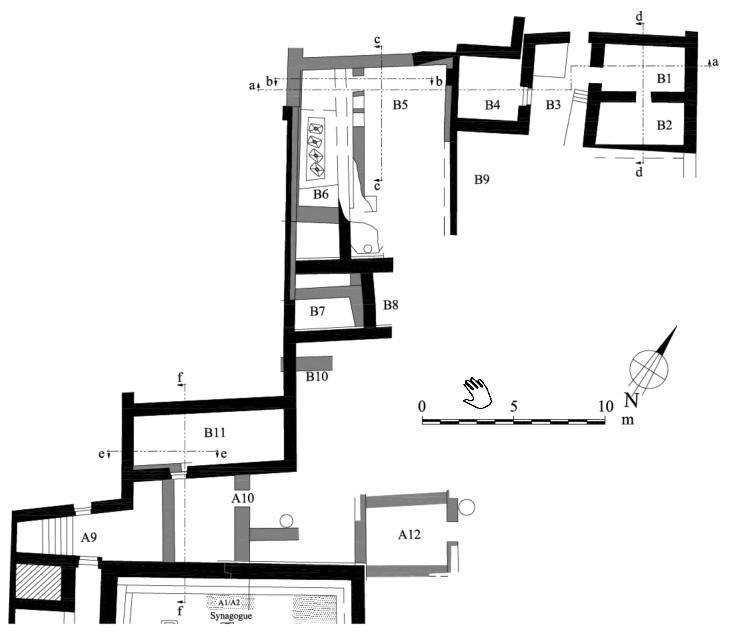
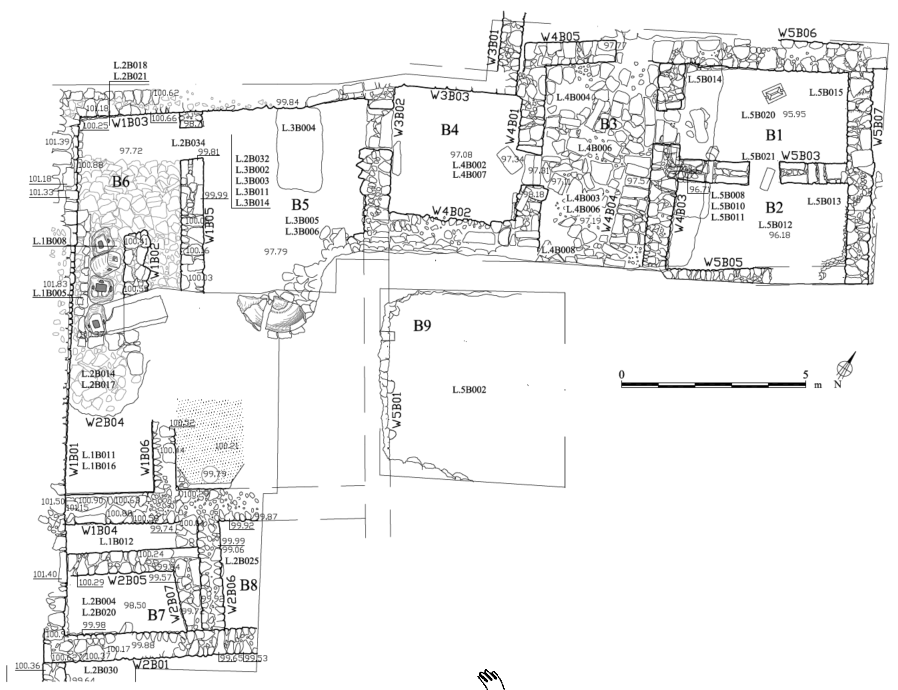
The plan and function of this area in Stratum 3 is unknown as only two of the walls here can be attributed to that period (W3B02, W3B03), and in both cases, it appears that our excavation only exposed their exterior faces. The abundant Early Roman finds, however, point to some activity here or in the immediate vicinity in that period. The complex as described above clearly belongs to Stratum 2 (Fig. 6.14), and the coherent plan and homogenous finds seem to indicate that all the units were built and functioned contemporaneously. Furthermore, as no changes or restorations were discerned, the entire complex apparently had only one phase. The entrances to the dwellings on both sides of the courtyard had lockable doors, suggesting that distinct families lived on either side of a shared courtyard. As the southern wall of the courtyard was not exposed, we may speculate on the existence of an additional structure that opened onto this courtyard.
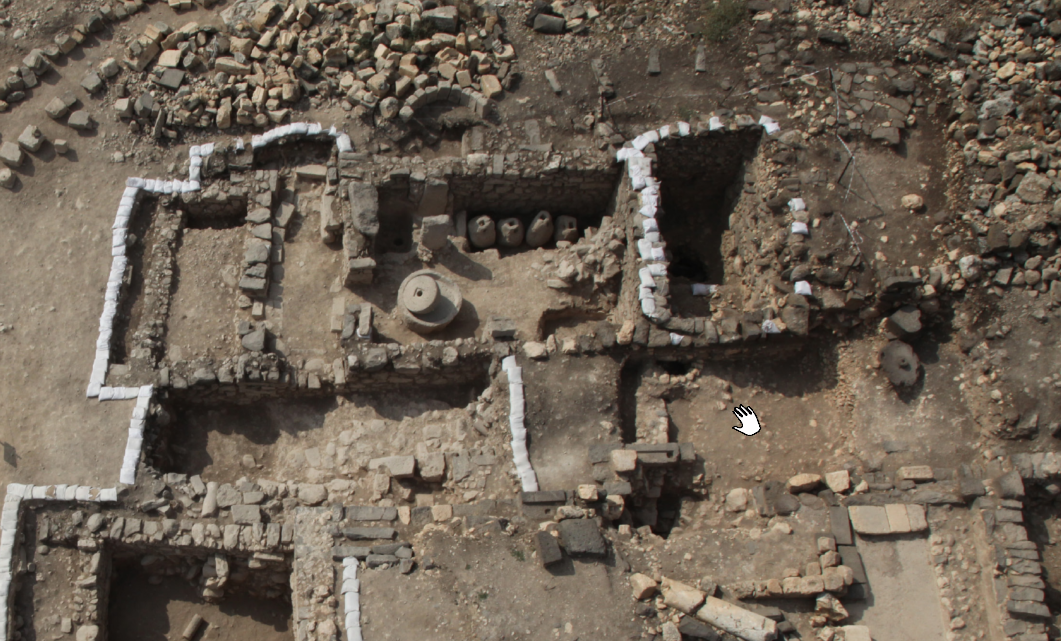
The area south of the oil press was excavated in the 2007 and 2008 seasons, starting with a 5.5 × 5 m square to the south of W1B04 and east of W1B01 (Units B7–B8), followed by an adjacent 4 × 4 m trench to the southwest, on both sides of W2B02 (Unit B10; Figs. 6.2, 6.29). As in Units B5–B6, excavation here revealed a Stratum 2 structure built on a huge fill that totally buried a Stratum 3 house up to the top of the first floor. The area consists of a dense series of walls belonging to both strata (see Fig. 6.1). Due to space limitations and safety constraints, the excavation reached the floor level of the Stratum 3 structure only in Unit B7. In general, the walls of the Stratum 3 structure are similar in building technique to the other structures of this stratum: they are founded on the talus slope and built of two faces of large fieldstones or partially dressed stones, of both basalt and hard limestone, with small stones in between them. The walls of Stratum 2, on the other hand, are built mainly of small stones and ‘float’ on the debris with almost no foundation courses beneath floor level.
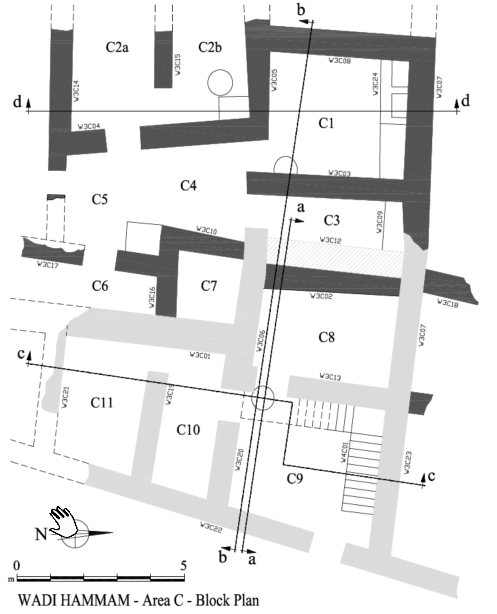
... In summary, although the plan of this area in Stratum 3 is unclear, the northern wall and the blocked underground chamber seem to date back to that period. Unit C 1, as it has survived, clearly belongs to Stratum 2. Based on the width of this unit, which would be difficult to roof, and on the storage installations along the northern wall, it was probably an inner courtyard fronting the dwelling to the west. The huge collapse that buried this unit hints of destruction caused by an earthquake, most likely that of 363 CE. The chronologically homogenous finds above the floor seem to indicate that the structure remained untouched until our excavation.
The plan and function of the structure on the upper terrace of Area C in Stratum 3 is unclear, although the wall bordering the area on the north (W3C07) and the subterranean chambers seem to date back to that period. These chambers, connected underground, were only partially excavated and their purpose could not be clarified (see further below).
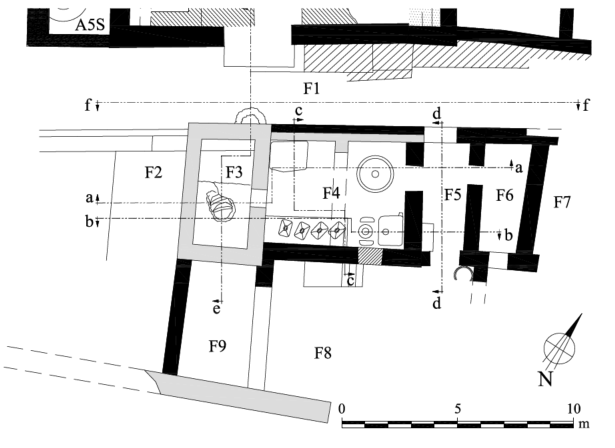
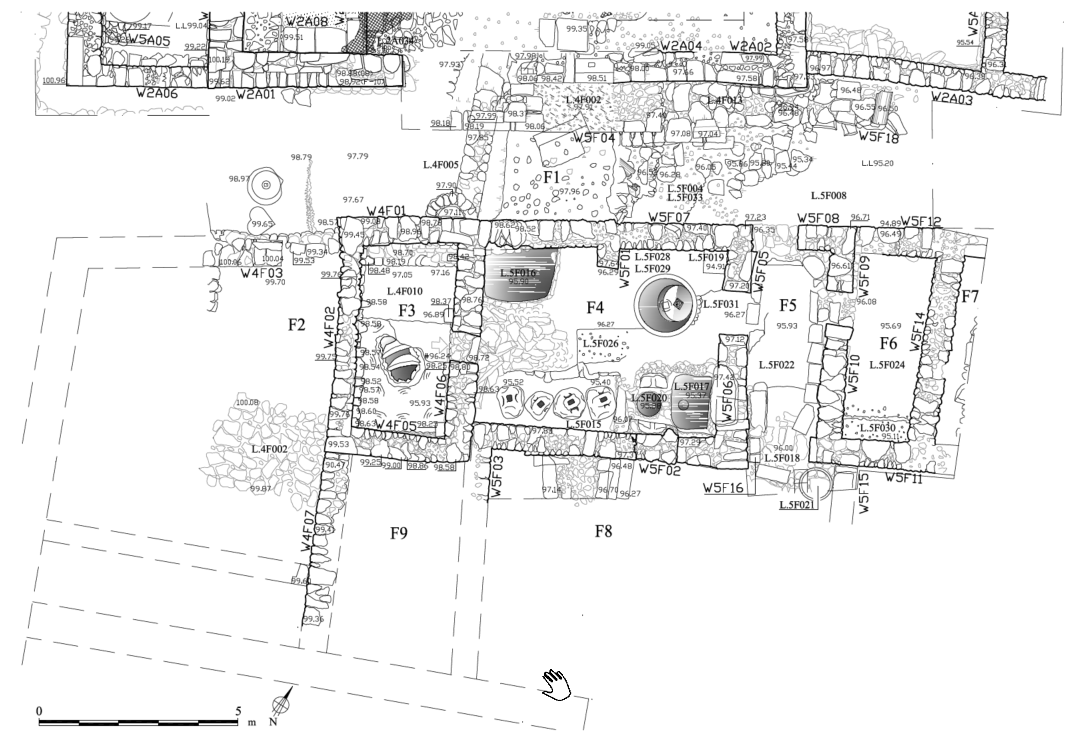
The northern wing of this large insula was excavated almost in its entirety, with some information of other parts also revealed (Fig. 6.60). Little is known of the plan of this area in Stratum 3, as only the western room (Unit F3), and perhaps the northern wall of Unit F4, could be dated securely to that period. The insula as a whole, as presented here in Fig. 6.40, belongs to Stratum 2, and the finds from probes beneath the floors and against wall foundations in several locations point to a date in the early third century for its construction. The existence of an olive-oil press in the midst of what seems to be a domestic complex is surprising, and even more intriguing is its location opposite the synagogue in the center of the village.
Despite its size, central location, and proximity to long-settled sites such as Magdala (2 km) and Tiberias (6 km), the ancient name of the site has long disappeared. The Arabic name Hamam (pigeon) derives from the flocks of pigeons nesting in the nearby cliffs, and was already recorded as the name of an agricultural plot in the Ottoman census of the sixteenth century— Mazraʿat Mugr al Hamam (Arabic “the sown land of the caves of Hamam”).7 In the British Survey of Western Palestine in the late nineteenth century, the site name was recorded as Kh. el-Wereidat (Arabic “the ruin of the small roses”).8 This peculiar name, alongside the better-known name Kh. Wadi el-Hamam, is also recorded in the first half of the twentieth century by the British Mandate Department of Antiquities and is the source of the current Hebrew name Horvat Veradim (Hebrew “ruin of the roses”).9 However, today the local Bedouin use the name el-Wereidat for a nearby burial site located 0.8 km to the north, also known as Waʿara el-Soda (see Chapter 20). Bedouin families who had settled in huts in the lower part of the site in the mid-twentieth century have since moved to the modern village of Wadi Hamam, to the east of the site (Fig. 1.5).
...He then departed to spend the Sabbath at home. Passing that Migdal Zaba` ayya14 he heard the voice of Nakai the Scribe saying: "have you not said that ben Yobai has purified Tiberias? Yet it is said that a corpse has been found there!" He (R. Shimon) said: "I swear that I know of innumerable (lit. as the hair on my head) laws attesting to the purity of Tiberias, except for certain places. (Besides) did you not vote (with those who declared Tiberias clean)? You have breached the fence of sages, `He who breaches a fence will be bitten by a snake' (Eccles. 10:8). Immediately one (a snake) emerged, and thus it had happened to him. He (R. Shimon) then passed through the valley of Beth Tofa.15 He saw a man standing and gathering the after-growth of the Sabbatical year. He said: "Is this not the after-growth of the Sabbatical year (and thus forbidden)?" He (the man) said: "Are you not the one who permitted it?" He (R. Shimon) said: "But do my colleagues not disagree with me?" Immediately he raised his eyebrows and looked at him, and (the man) became a heap of bones.16The most reasonable route of the (legendary?) journey of R. Shimon bar Yobai leads from Tiberias northward and then turns westward in Nabal Arbel, passing immediately below Kh. Wadi Hamam, and ascending directly to the Beth Netofa Valley. Migdal Zabaʿayya should be located somewhere along this route. The only substantial Roman-period sites along this course are el-Mejdel, Kh. Wadi Hamam and Kh. Umm el-`Amed (`Ammudim). As the first is clearly identified with Migdal Nunayya/Magdala/Tarichea, Migdal Zabaʿayya should probably be identified with one of the remaining two, whose ancient names are not preserved.
R. Hinena said: "All matters are a matter of custom". There were acacia trees in Migdal Zaba'ayya. They came and asked R. Hanina, associate of the rabbis, whether they might work with them (i.e., make use of them). He said to them: "since your forefathers have been accustomed to treat them as forbidden, do not change the custom of your forefathers, may they rest in peace".17In a similar story appearing in Song of Songs Rabbah (1.12 [55] Dunesky ed., p. 44), the reasoning for this refrainment is a tradition according to which the Children of Israel took from these trees when they went down to Egypt, and later built the holy ark from them. In any case, the only kind of acacia in northern Israel is the Acacia albida, which grows in small clusters in low, hot localities between the vicinity of Beth Shean and the Sea of Galilee basin.18 These conditions suit el-Mejdel and Kh. Wadi Hamam, but not Kh. Umm el-`Amed that is located ca. 300 m higher in elevation. Another hint as to the area in which the story takes place is the appeal of the locals of Migdal Zaba'ayya to `Rabbi Hanina associate of the rabbis', a relatively unknown sage who was active in Tiberias in the late third century CE.19
The kitmos20 of three villages would be brought up to Jerusalem in a wagon (i.e., due to its abundance): Kabul, Shikhin and Migdal Zaba'ayya, and all three were destroyed. Kabul because of contention; Shikhin because of witchcraft; and Migdal Zaba'ayya because of fornication... R. Yohanan said: there were eighty stores of palgas21 weavers in Migdal Zaba'ayya ...22Kabul and Shikhin (Asochis) are well known from both Josephus and rabbinic sources and their identification is clear: the first is located in the western Lower Galilee, near `Akko, and the second in the central Lower Galilee, near Sepphoris.23 Nearly a century ago, Press identified Migdal Zaba'ayya with el-Mejdel and suggested that this tradition is organized geographically from west to east, hence covering the entire Lower Galilee.24 This suggestion seems convincing, although as noted, el-Mejdel should clearly be identified with Migdal Nunayya/Magdala, hence Migdal Zaba'ayya is to be sought elsewhere in the eastern Lower Galilee. It would be helpful, of course, if we knew to what destruction the tradition alludes. The report by Josephus on the burning of Kabul by the Romans during the First Jewish Revolt,25 led Klein to attribute these destructions to that revolt.26 However, it is unclear if the rabbinic tradition is referring to a single event that brought about the devastation of all three villages. Furthermore, the literary context of the tradition seems actually to point to events connected to the Bar Kokhba Revolt rather than the First Jewish Revolt. It appears in a section that begins with a quo-tation from the Mishnah "Betar was captured", immediately after the dreadful legends about the siege and fall of Betar, and it is integrated in a series of stories about the wealth of various settlements, such as Tur Shim'on and Har ha-Melekh, which in all likelihood were destroyed during the Bar Kokhba Revolt.27
[a messenger came to Job and said...] the Sabeans made a raid and took them (the cattle) [and have slain the servants]' (Job 1.15). R. Abba bar Kahana said: They went from Kefar Kernos, and through all the Aulon and reached Migdal Zaba'ayya and died there. `And only I escaped to tell you' (ibid.): R. Yudan said: Wherever (in scripture) it is said `only', it implies a restriction. He (the messenger) too, was broken and stricken. R. Yudan said... and he too, as soon as he told his message, immediately died... `While he was still speaking, another messenger came and said: The Chaldeans formed three raiding parties [and swept down on your camels and made off with them] (Job 1.17). R. Samuel b. Nahman said: As soon as Job heard this he began marshalling his warriors... (but) when he was told `A fire of God is fallen from heaven' (Job 1.16) he said: What can I do. A voice has fallen from heaven! Who can do anything? ...32What is the meaning of this ambiguous midrash? And why does it elaborate on a journey of Jobs' servants through sites that are not mentioned either in the story or in the Bible in general? It seems that the rabbis are alluding to events in these places that were known to their contemporaneous audience but whose meaning is hidden from us today.33 In any case, two of the places mentioned here can be clearly identified: Kefar Kernos is mentioned in the Talmud Yerushalmi and in the halachic inscription from the Rebov synagogue, both pointing to a village adjacent to Beth Shean.34 Aulon is mentioned in the Septuagint (Deut. 1.1, Hebrew Hazeroth) and is identified in the Onomasticon of Eusebius as follows:
The great long plain is still called the Aulon (Aviv). It is bordered on both sides by mountains extending from Lebanon to the desert of Pharan. In the Aulon is the famous city [Tiberias] and nearby the lake, Scythopolis, Jericho and the Dead Sea and their surrounding regions. The Jordan flows through the midst of the whole region....35Thus, the Aulon is what is called today the Jordan Valley. According to the story, Job's servants began their journey near Beth Shean, passed through the Jordan Valley and all but one died at Migdal Zaba'ayya, again indicating that this village is located somewhere in the vicinity of the Sea of Galilee. In this context, it should be noted that a tradition appearing in the Babylonian Talmud, and in some manuscripts of Genesis Rabbah, states that Job lived in Tiberias.36 This may be the reason for the development of our story focusing on sites in this region. It is not clear why Migdal Zaba'ayya was chosen as the servants' death-place. The tradition, brought by R. Abba bar Kahana who lived in the Galilee in the late third—early fourth centuries CE, may allude to a known tragedy that occurred in that village, such as the early second-century destruction mentioned above or perhaps an earthquake (the `fire of God fallen from heaven' at the end of the story?). The excavations at Kh. Wadi Hamam revealed evidence of two destructive episodes that seem to be the result of earthquakes, the first in the late third or early years of the fourth century CE, and the second in the year 363 CE (see Chapters 2, 6).
7 Rhode 1979: 88.
8 Conder and Kitchener 1881: 409.
9 British Mandate Department of Antiquities Archive,
SRF 192 (7/7) and Jacket ATQ 1045 (3/3).
10 This suggestion was first raised in my Ph.D.
dissertation (Leibner 2004: 218–226), but later I
proposed identifying Migdal Zabaʿayya with a
different site, south of Tiberias (Leibner 2006).
The excavation results, however, have led me to
return to my initial suggestion.
11 Various identifications have been suggested by
scholars for this site, all in the vicinity of the Sea
of Galilee, see, e.g., Schwarz 1979: 228; Graetz
1880; Press 1930: 255–268; 1961: 162–170; Klein
1967: 199–201; Feliks 1981: 22. The suggestion of
Taylor (2014: 209–210) that the site be sought in
the vicinity of Jerusalem does not stand up to
scrutiny.
12 For a detailed discussion on the identification of
Migdal Nunayya/Magdala/Tarichea and the
etymology of the names, see de Luca and Lena
2015: 280–298, with references therein.
13 Neubauer 1868: 217; Press 1930; 1961: 164;
de Luca and Lena 2015: 289.
14 In the parallels (Yerushalmi Sheviʿit 9.1 [38d];
Pesikta de-Rav Kahana 11.16 [ed. Mandelbaum,
p. 193]; Kohelet Rabbah 10.8), the reading is
Magdala.
15 In some mss.: Beth Netofa / Beth Tifa.
16 Translation (with modifications) after Levine
1978, who provides a detailed comparison
between the parallel traditions and an extensive
discussion of the story.
17 A parallel with small variations appears in
Yerushalmi Pesahim 4.1 [30d].
18 Feliks 1981: 22.
19 See Yerushalmi Berakhot 7.3 [11b]; Moʿed Katan
3.5 [82c]; Terumot 8.3 [45c]; see also Beer 1983:
80–82; Rosenfeld 1998: 57–103.
20 Apparently from [Greek text], here meaning
revenue or donations.
21 Palgas, perhaps from [Greek text] — a cloak, see
Sperber 1993: 132–140.
22 A similar tradition, which apparently developed
from this source, appears in Lamentations Rabbah
2.2 (Buber edition p. 54): R. Huna said: There were
three hundred stores selling [food preserved in
the condition of] cultic cleanness in Migdal
Zabaʿayya …
23 Tsafrir et al. 1994: 102; Strange et al. 1995.
24 Press 1930; 1961: 164.
25 War 2.505.
26 Klein 1967: 50.
27 For Tur Shimʿon and Har ha-Melekh, see Zissu
2008 and Shahar 2000, respectively.
28 See the relevant entries in Tsafrir et al. 1994:
102, 70, 173.
29 The ancient Jewish text dubbed Toledot Yeshu
presents a derogatory version of the life of
Jesus. Interestingly, in the Aramaic version of
the text, presumably originating in the
Byzantine period, in a scene set in the
vicinity of Tiberias, John the Baptist is
called limn= pni, (Deutsch 2000: 186, Lines 4,
9, 15). This nickname is usually translated as
John the Dyer and is thought to be an
unarticulated use of the verb vn2 (Zab`a),
which means to dye but also to dip/immerse,
hence to baptize (idem.: 179). However, the
prefix h is usually used to designate the
place of origin, and could be understood as
John from Zaba'ana.
30 Genesis Rabbah 19.1 (ed. Theodor-Albeck
p. 170); see also Ilan and Izdarechet
(1988: 36), who suggest that pools identi-
fied at Arbel were used in flax processing.
31 For example, Yerushalmi Ma'aser Sheni 5.2
(56a); Kohelet Rabbah 1.8 (Hirshman ed.
p. 64).
32 Translation (with modifications) after
Freedman and Simon 1939: 217-218.
33 For a detailed discussion of this midrash,
see Leibner 2006: 41-49.
34 Yerushalmi Demai 2.1 [22c]; Sussmann
1973-74: 158; see also Leviticus Rabbah
28.6 (ed. Margulies p. 666); Yahalom and
Sokoloff 1999: 208-210.
35 Onomasticon, ed. Klostermann, p. 14.
Interestingly, in the Latin translation
(idem.: 15) Jerome emphasizes that Aulon
is not Greek, as one might think, but rather
a Hebrew word.
36 Bavli Bava Batra 15a; Genesis Rabbah 57.4
(ed. Theodor and Albeck, p. 617) according
to mss. Oxford 147, Oxford 2335, Paris 149.
The current section presents a stratigraphic synthesis focusing on the main terrace and the monumental buildings that stood on it, based on the details and archaeological finds discussed above
Limited restoration works in Synagogue II at the end of the fourth century were labeled Sub-Phase IIb, and include the addition of three stratigraphically related features: (1) a stone bema; (2) a low bench added against the southern wall; (3) a plaster floor, which replaced damaged portions of the mosaic. The cause and date of the damage that necessitated this renovation could not be precisely determined, but it clearly occurred in the late fourth century. The most plausible event is the earthquake of 363 CE, which was apparently responsible for the destruction of some of the surrounding domestic structures and devastated many sites in the region (see Chapter 6).19
19 For archaeological evidence of the earthquake of
363, see Russell 1980; Balouka 1999
20 Dothan 1983: 31–32;ugeneral, Weiss
1988.
The debris in the northwestern quarter of the synagogue hall, which had accumulated to a maximal height of ca. 2.2 m above floor level, provided important information concerning the last stage of the building and its final collapse. The components of the corner column had fallen to the southwest, and courses of blocks from the walls, still bound together by mortar, were discovered lying on their sides among the debris. In the debris were hundreds of roof tiles and dozens of large construction nails that probably originated from the truss that supported the tiled roof. All this evidence seems to imply that the final collapse was caused by an earthquake. The latest pottery and small finds on the floor beneath the debris date to the fourth–early fifth centuries. These finds were probably washed in from above after the abandonment of the building, but before its collapse, and seem to have been sealed inside shortly thereafter, since no material of later date was recovered on the floor. Thus, the building probably collapsed in an earthquake in the early years of the fifth century (perhaps in 419?).21 The similarity between the material beneath the debris and that found inside the bema indicates that the renovations in Sub-Phase IIb took place shortly before the destruction of the building. As noted above, the two successive plaster floors in some places suggest two stages of renovation in this sub-phase.
21 The earthquake of 419 is mentioned in the Chronicon Marcellini (Mommsen 1894: 74); see also Russell 1985: 42–43; Amiran, Arieh and Turcotte 1994: 266.
A few finds provide evidence of limited activity that took place in and around the synagogue after its collapse. The nature of the finds, the small quantity and their location, indicate that these were sporadic activities reflecting stone robbers, squatters, or passersby who visited the site.
The plan and function of this area in Stratum 3 is unknown as only two of the walls here can be attributed to that period (W3B02, W3B03), and in both cases, it appears that our excavation only exposed their exterior faces. The abundant Early Roman finds, however, point to some activity here or in the immediate vicinity in that period. The complex as described above clearly belongs to Stratum 2 (Fig. 6.14), and the coherent plan and homogenous finds seem to indicate that all the units were built and functioned contemporaneously. Furthermore, as no changes or restorations were discerned, the entire complex apparently had only one phase. The entrances to the dwellings on both sides of the courtyard had lockable doors, suggesting that distinct families lived on either side of a shared courtyard. As the southern wall of the courtyard was not exposed, we may speculate on the existence of an additional structure that opened onto this courtyard.
The area south of the oil press was excavated in the 2007 and 2008 seasons, starting with a 5.5 × 5 m square to the south of W1B04 and east of W1B01 (Units B7–B8), followed by an adjacent 4 × 4 m trench to the southwest, on both sides of W2B02 (Unit B10; Figs. 6.2, 6.29). As in Units B5–B6, excavation here revealed a Stratum 2 structure built on a huge fill that totally buried a Stratum 3 house up to the top of the first floor. The area consists of a dense series of walls belonging to both strata (see Fig. 6.1). Due to space limitations and safety constraints, the excavation reached the floor level of the Stratum 3 structure only in Unit B7. In general, the walls of the Stratum 3 structure are similar in building technique to the other structures of this stratum: they are founded on the talus slope and built of two faces of large fieldstones or partially dressed stones, of both basalt and hard limestone, with small stones in between them. The walls of Stratum 2, on the other hand, are built mainly of small stones and ‘float’ on the debris with almost no foundation courses beneath floor level.
... In summary, although the plan of this area in Stratum 3 is unclear, the northern wall and the blocked underground chamber seem to date back to that period. Unit C 1, as it has survived, clearly belongs to Stratum 2. Based on the width of this unit, which would be difficult to roof, and on the storage installations along the northern wall, it was probably an inner courtyard fronting the dwelling to the west. The huge collapse that buried this unit hints of destruction caused by an earthquake, most likely that of 363 CE. The chronologically homogenous finds above the floor seem to indicate that the structure remained untouched until our excavation.
The plan and function of the structure on the upper terrace of Area C in Stratum 3 is unclear, although the wall bordering the area on the north (W3C07) and the subterranean chambers seem to date back to that period. These chambers, connected underground, were only partially excavated and their purpose could not be clarified (see further below).
The northern wing of this large insula was excavated almost in its entirety, with some information of other parts also revealed (Fig. 6.60). Little is known of the plan of this area in Stratum 3, as only the western room (Unit F3), and perhaps the northern wall of Unit F4, could be dated securely to that period. The insula as a whole, as presented here in Fig. 6.40, belongs to Stratum 2, and the finds from probes beneath the floors and against wall foundations in several locations point to a date in the early third century for its construction. The existence of an olive-oil press in the midst of what seems to be a domestic complex is surprising, and even more intriguing is its location opposite the synagogue in the center of the village.
Despite its size, central location, and proximity to long-settled sites such as Magdala (2 km) and Tiberias (6 km), the ancient name of the site has long disappeared. The Arabic name Hamam (pigeon) derives from the flocks of pigeons nesting in the nearby cliffs, and was already recorded as the name of an agricultural plot in the Ottoman census of the sixteenth century— Mazraʿat Mugr al Hamam (Arabic “the sown land of the caves of Hamam”).7 In the British Survey of Western Palestine in the late nineteenth century, the site name was recorded as Kh. el-Wereidat (Arabic “the ruin of the small roses”).8 This peculiar name, alongside the better-known name Kh. Wadi el-Hamam, is also recorded in the first half of the twentieth century by the British Mandate Department of Antiquities and is the source of the current Hebrew name Horvat Veradim (Hebrew “ruin of the roses”).9 However, today the local Bedouin use the name el-Wereidat for a nearby burial site located 0.8 km to the north, also known as Waʿara el-Soda (see Chapter 20). Bedouin families who had settled in huts in the lower part of the site in the mid-twentieth century have since moved to the modern village of Wadi Hamam, to the east of the site (Fig. 1.5).
...He then departed to spend the Sabbath at home. Passing that Migdal Zaba` ayya14 he heard the voice of Nakai the Scribe saying: "have you not said that ben Yobai has purified Tiberias? Yet it is said that a corpse has been found there!" He (R. Shimon) said: "I swear that I know of innumerable (lit. as the hair on my head) laws attesting to the purity of Tiberias, except for certain places. (Besides) did you not vote (with those who declared Tiberias clean)? You have breached the fence of sages, `He who breaches a fence will be bitten by a snake' (Eccles. 10:8). Immediately one (a snake) emerged, and thus it had happened to him. He (R. Shimon) then passed through the valley of Beth Tofa.15 He saw a man standing and gathering the after-growth of the Sabbatical year. He said: "Is this not the after-growth of the Sabbatical year (and thus forbidden)?" He (the man) said: "Are you not the one who permitted it?" He (R. Shimon) said: "But do my colleagues not disagree with me?" Immediately he raised his eyebrows and looked at him, and (the man) became a heap of bones.16The most reasonable route of the (legendary?) journey of R. Shimon bar Yobai leads from Tiberias northward and then turns westward in Nabal Arbel, passing immediately below Kh. Wadi Hamam, and ascending directly to the Beth Netofa Valley. Migdal Zabaʿayya should be located somewhere along this route. The only substantial Roman-period sites along this course are el-Mejdel, Kh. Wadi Hamam and Kh. Umm el-`Amed (`Ammudim). As the first is clearly identified with Migdal Nunayya/Magdala/Tarichea, Migdal Zabaʿayya should probably be identified with one of the remaining two, whose ancient names are not preserved.
R. Hinena said: "All matters are a matter of custom". There were acacia trees in Migdal Zaba'ayya. They came and asked R. Hanina, associate of the rabbis, whether they might work with them (i.e., make use of them). He said to them: "since your forefathers have been accustomed to treat them as forbidden, do not change the custom of your forefathers, may they rest in peace".17In a similar story appearing in Song of Songs Rabbah (1.12 [55] Dunesky ed., p. 44), the reasoning for this refrainment is a tradition according to which the Children of Israel took from these trees when they went down to Egypt, and later built the holy ark from them. In any case, the only kind of acacia in northern Israel is the Acacia albida, which grows in small clusters in low, hot localities between the vicinity of Beth Shean and the Sea of Galilee basin.18 These conditions suit el-Mejdel and Kh. Wadi Hamam, but not Kh. Umm el-`Amed that is located ca. 300 m higher in elevation. Another hint as to the area in which the story takes place is the appeal of the locals of Migdal Zaba'ayya to `Rabbi Hanina associate of the rabbis', a relatively unknown sage who was active in Tiberias in the late third century CE.19
The kitmos20 of three villages would be brought up to Jerusalem in a wagon (i.e., due to its abundance): Kabul, Shikhin and Migdal Zaba'ayya, and all three were destroyed. Kabul because of contention; Shikhin because of witchcraft; and Migdal Zaba'ayya because of fornication... R. Yohanan said: there were eighty stores of palgas21 weavers in Migdal Zaba'ayya ...22Kabul and Shikhin (Asochis) are well known from both Josephus and rabbinic sources and their identification is clear: the first is located in the western Lower Galilee, near `Akko, and the second in the central Lower Galilee, near Sepphoris.23 Nearly a century ago, Press identified Migdal Zaba'ayya with el-Mejdel and suggested that this tradition is organized geographically from west to east, hence covering the entire Lower Galilee.24 This suggestion seems convincing, although as noted, el-Mejdel should clearly be identified with Migdal Nunayya/Magdala, hence Migdal Zaba'ayya is to be sought elsewhere in the eastern Lower Galilee. It would be helpful, of course, if we knew to what destruction the tradition alludes. The report by Josephus on the burning of Kabul by the Romans during the First Jewish Revolt,25 led Klein to attribute these destructions to that revolt.26 However, it is unclear if the rabbinic tradition is referring to a single event that brought about the devastation of all three villages. Furthermore, the literary context of the tradition seems actually to point to events connected to the Bar Kokhba Revolt rather than the First Jewish Revolt. It appears in a section that begins with a quo-tation from the Mishnah "Betar was captured", immediately after the dreadful legends about the siege and fall of Betar, and it is integrated in a series of stories about the wealth of various settlements, such as Tur Shim'on and Har ha-Melekh, which in all likelihood were destroyed during the Bar Kokhba Revolt.27
[a messenger came to Job and said...] the Sabeans made a raid and took them (the cattle) [and have slain the servants]' (Job 1.15). R. Abba bar Kahana said: They went from Kefar Kernos, and through all the Aulon and reached Migdal Zaba'ayya and died there. `And only I escaped to tell you' (ibid.): R. Yudan said: Wherever (in scripture) it is said `only', it implies a restriction. He (the messenger) too, was broken and stricken. R. Yudan said... and he too, as soon as he told his message, immediately died... `While he was still speaking, another messenger came and said: The Chaldeans formed three raiding parties [and swept down on your camels and made off with them] (Job 1.17). R. Samuel b. Nahman said: As soon as Job heard this he began marshalling his warriors... (but) when he was told `A fire of God is fallen from heaven' (Job 1.16) he said: What can I do. A voice has fallen from heaven! Who can do anything? ...32What is the meaning of this ambiguous midrash? And why does it elaborate on a journey of Jobs' servants through sites that are not mentioned either in the story or in the Bible in general? It seems that the rabbis are alluding to events in these places that were known to their contemporaneous audience but whose meaning is hidden from us today.33 In any case, two of the places mentioned here can be clearly identified: Kefar Kernos is mentioned in the Talmud Yerushalmi and in the halachic inscription from the Rebov synagogue, both pointing to a village adjacent to Beth Shean.34 Aulon is mentioned in the Septuagint (Deut. 1.1, Hebrew Hazeroth) and is identified in the Onomasticon of Eusebius as follows:
The great long plain is still called the Aulon (Aviv). It is bordered on both sides by mountains extending from Lebanon to the desert of Pharan. In the Aulon is the famous city [Tiberias] and nearby the lake, Scythopolis, Jericho and the Dead Sea and their surrounding regions. The Jordan flows through the midst of the whole region....35Thus, the Aulon is what is called today the Jordan Valley. According to the story, Job's servants began their journey near Beth Shean, passed through the Jordan Valley and all but one died at Migdal Zaba'ayya, again indicating that this village is located somewhere in the vicinity of the Sea of Galilee. In this context, it should be noted that a tradition appearing in the Babylonian Talmud, and in some manuscripts of Genesis Rabbah, states that Job lived in Tiberias.36 This may be the reason for the development of our story focusing on sites in this region. It is not clear why Migdal Zaba'ayya was chosen as the servants' death-place. The tradition, brought by R. Abba bar Kahana who lived in the Galilee in the late third—early fourth centuries CE, may allude to a known tragedy that occurred in that village, such as the early second-century destruction mentioned above or perhaps an earthquake (the `fire of God fallen from heaven' at the end of the story?). The excavations at Kh. Wadi Hamam revealed evidence of two destructive episodes that seem to be the result of earthquakes, the first in the late third or early years of the fourth century CE, and the second in the year 363 CE (see Chapters 2, 6).
7 Rhode 1979: 88.
8 Conder and Kitchener 1881: 409.
9 British Mandate Department of Antiquities Archive,
SRF 192 (7/7) and Jacket ATQ 1045 (3/3).
10 This suggestion was first raised in my Ph.D.
dissertation (Leibner 2004: 218–226), but later I
proposed identifying Migdal Zabaʿayya with a
different site, south of Tiberias (Leibner 2006).
The excavation results, however, have led me to
return to my initial suggestion.
11 Various identifications have been suggested by
scholars for this site, all in the vicinity of the Sea
of Galilee, see, e.g., Schwarz 1979: 228; Graetz
1880; Press 1930: 255–268; 1961: 162–170; Klein
1967: 199–201; Feliks 1981: 22. The suggestion of
Taylor (2014: 209–210) that the site be sought in
the vicinity of Jerusalem does not stand up to
scrutiny.
12 For a detailed discussion on the identification of
Migdal Nunayya/Magdala/Tarichea and the
etymology of the names, see de Luca and Lena
2015: 280–298, with references therein.
13 Neubauer 1868: 217; Press 1930; 1961: 164;
de Luca and Lena 2015: 289.
14 In the parallels (Yerushalmi Sheviʿit 9.1 [38d];
Pesikta de-Rav Kahana 11.16 [ed. Mandelbaum,
p. 193]; Kohelet Rabbah 10.8), the reading is
Magdala.
15 In some mss.: Beth Netofa / Beth Tifa.
16 Translation (with modifications) after Levine
1978, who provides a detailed comparison
between the parallel traditions and an extensive
discussion of the story.
17 A parallel with small variations appears in
Yerushalmi Pesahim 4.1 [30d].
18 Feliks 1981: 22.
19 See Yerushalmi Berakhot 7.3 [11b]; Moʿed Katan
3.5 [82c]; Terumot 8.3 [45c]; see also Beer 1983:
80–82; Rosenfeld 1998: 57–103.
20 Apparently from [Greek text], here meaning
revenue or donations.
21 Palgas, perhaps from [Greek text] — a cloak, see
Sperber 1993: 132–140.
22 A similar tradition, which apparently developed
from this source, appears in Lamentations Rabbah
2.2 (Buber edition p. 54): R. Huna said: There were
three hundred stores selling [food preserved in
the condition of] cultic cleanness in Migdal
Zabaʿayya …
23 Tsafrir et al. 1994: 102; Strange et al. 1995.
24 Press 1930; 1961: 164.
25 War 2.505.
26 Klein 1967: 50.
27 For Tur Shimʿon and Har ha-Melekh, see Zissu
2008 and Shahar 2000, respectively.
28 See the relevant entries in Tsafrir et al. 1994:
102, 70, 173.
29 The ancient Jewish text dubbed Toledot Yeshu
presents a derogatory version of the life of
Jesus. Interestingly, in the Aramaic version of
the text, presumably originating in the
Byzantine period, in a scene set in the
vicinity of Tiberias, John the Baptist is
called limn= pni, (Deutsch 2000: 186, Lines 4,
9, 15). This nickname is usually translated as
John the Dyer and is thought to be an
unarticulated use of the verb vn2 (Zab`a),
which means to dye but also to dip/immerse,
hence to baptize (idem.: 179). However, the
prefix h is usually used to designate the
place of origin, and could be understood as
John from Zaba'ana.
30 Genesis Rabbah 19.1 (ed. Theodor-Albeck
p. 170); see also Ilan and Izdarechet
(1988: 36), who suggest that pools identi-
fied at Arbel were used in flax processing.
31 For example, Yerushalmi Ma'aser Sheni 5.2
(56a); Kohelet Rabbah 1.8 (Hirshman ed.
p. 64).
32 Translation (with modifications) after
Freedman and Simon 1939: 217-218.
33 For a detailed discussion of this midrash,
see Leibner 2006: 41-49.
34 Yerushalmi Demai 2.1 [22c]; Sussmann
1973-74: 158; see also Leviticus Rabbah
28.6 (ed. Margulies p. 666); Yahalom and
Sokoloff 1999: 208-210.
35 Onomasticon, ed. Klostermann, p. 14.
Interestingly, in the Latin translation
(idem.: 15) Jerome emphasizes that Aulon
is not Greek, as one might think, but rather
a Hebrew word.
36 Bavli Bava Batra 15a; Genesis Rabbah 57.4
(ed. Theodor and Albeck, p. 617) according
to mss. Oxford 147, Oxford 2335, Paris 149.
The current section presents a stratigraphic synthesis focusing on the main terrace and the monumental buildings that stood on it, based on the details and archaeological finds discussed above
Limited restoration works in Synagogue II at the end of the fourth century were labeled Sub-Phase IIb, and include the addition of three stratigraphically related features: (1) a stone bema; (2) a low bench added against the southern wall; (3) a plaster floor, which replaced damaged portions of the mosaic. The cause and date of the damage that necessitated this renovation could not be precisely determined, but it clearly occurred in the late fourth century. The most plausible event is the earthquake of 363 CE, which was apparently responsible for the destruction of some of the surrounding domestic structures and devastated many sites in the region (see Chapter 6).19
19 For archaeological evidence of the earthquake of
363, see Russell 1980; Balouka 1999
20 Dothan 1983: 31–32;ugeneral, Weiss
1988.
The debris in the northwestern quarter of the synagogue hall, which had accumulated to a maximal height of ca. 2.2 m above floor level, provided important information concerning the last stage of the building and its final collapse. The components of the corner column had fallen to the southwest, and courses of blocks from the walls, still bound together by mortar, were discovered lying on their sides among the debris. In the debris were hundreds of roof tiles and dozens of large construction nails that probably originated from the truss that supported the tiled roof. All this evidence seems to imply that the final collapse was caused by an earthquake. The latest pottery and small finds on the floor beneath the debris date to the fourth–early fifth centuries. These finds were probably washed in from above after the abandonment of the building, but before its collapse, and seem to have been sealed inside shortly thereafter, since no material of later date was recovered on the floor. Thus, the building probably collapsed in an earthquake in the early years of the fifth century (perhaps in 419?).21 The similarity between the material beneath the debris and that found inside the bema indicates that the renovations in Sub-Phase IIb took place shortly before the destruction of the building. As noted above, the two successive plaster floors in some places suggest two stages of renovation in this sub-phase.
21 The earthquake of 419 is mentioned in the Chronicon Marcellini (Mommsen 1894: 74); see also Russell 1985: 42–43; Amiran, Arieh and Turcotte 1994: 266.
A few finds provide evidence of limited activity that took place in and around the synagogue after its collapse. The nature of the finds, the small quantity and their location, indicate that these were sporadic activities reflecting stone robbers, squatters, or passersby who visited the site.
The plan and function of this area in Stratum 3 is unknown as only two of the walls here can be attributed to that period (W3B02, W3B03), and in both cases, it appears that our excavation only exposed their exterior faces. The abundant Early Roman finds, however, point to some activity here or in the immediate vicinity in that period. The complex as described above clearly belongs to Stratum 2 (Fig. 6.14), and the coherent plan and homogenous finds seem to indicate that all the units were built and functioned contemporaneously. Furthermore, as no changes or restorations were discerned, the entire complex apparently had only one phase. The entrances to the dwellings on both sides of the courtyard had lockable doors, suggesting that distinct families lived on either side of a shared courtyard. As the southern wall of the courtyard was not exposed, we may speculate on the existence of an additional structure that opened onto this courtyard.
The area south of the oil press was excavated in the 2007 and 2008 seasons, starting with a 5.5 × 5 m square to the south of W1B04 and east of W1B01 (Units B7–B8), followed by an adjacent 4 × 4 m trench to the southwest, on both sides of W2B02 (Unit B10; Figs. 6.2, 6.29). As in Units B5–B6, excavation here revealed a Stratum 2 structure built on a huge fill that totally buried a Stratum 3 house up to the top of the first floor. The area consists of a dense series of walls belonging to both strata (see Fig. 6.1). Due to space limitations and safety constraints, the excavation reached the floor level of the Stratum 3 structure only in Unit B7. In general, the walls of the Stratum 3 structure are similar in building technique to the other structures of this stratum: they are founded on the talus slope and built of two faces of large fieldstones or partially dressed stones, of both basalt and hard limestone, with small stones in between them. The walls of Stratum 2, on the other hand, are built mainly of small stones and ‘float’ on the debris with almost no foundation courses beneath floor level.
... In summary, although the plan of this area in Stratum 3 is unclear, the northern wall and the blocked underground chamber seem to date back to that period. Unit C 1, as it has survived, clearly belongs to Stratum 2. Based on the width of this unit, which would be difficult to roof, and on the storage installations along the northern wall, it was probably an inner courtyard fronting the dwelling to the west. The huge collapse that buried this unit hints of destruction caused by an earthquake, most likely that of 363 CE. The chronologically homogenous finds above the floor seem to indicate that the structure remained untouched until our excavation.
The plan and function of the structure on the upper terrace of Area C in Stratum 3 is unclear, although the wall bordering the area on the north (W3C07) and the subterranean chambers seem to date back to that period. These chambers, connected underground, were only partially excavated and their purpose could not be clarified (see further below).
The northern wing of this large insula was excavated almost in its entirety, with some information of other parts also revealed (Fig. 6.60). Little is known of the plan of this area in Stratum 3, as only the western room (Unit F3), and perhaps the northern wall of Unit F4, could be dated securely to that period. The insula as a whole, as presented here in Fig. 6.40, belongs to Stratum 2, and the finds from probes beneath the floors and against wall foundations in several locations point to a date in the early third century for its construction. The existence of an olive-oil press in the midst of what seems to be a domestic complex is surprising, and even more intriguing is its location opposite the synagogue in the center of the village.
Jones (2021) notes that evidence for the 419 CE Monaxius and Plinta Earthquake has been reported at Khirbet Wadi Hamam, based on archaeological observations published by Leibner and Arubas (2018:97).
| Effect | Location | Image(s) | Description |
|---|---|---|---|
|
Northern Wing of Insula in Area F |
|
| Effect | Location | Image(s) | Description |
|---|---|---|---|
|
Synagogue
Fig. 2.4
Block plan of Synagogue II and surrounding Stratum 2 structures and alleys
click on image to open in a new tab Leibner et al. (2018)
Fig. 2.5
Block plan of the synagogue (in black) showing the excavation areas (A, B, F), units, soundings (dotted raster) and the major section lines through the building
click on image to open in a new tab Leibner et al. (2018) |
|
|
|
Northeastern Domestic Complex (Units B1–B4) and Unit B8 in Area B |
|
|
|
Upper Complex in Area C |
|
| Effect | Location | Image(s) | Description |
|---|---|---|---|
|
Synagogue
Fig. 2.4
Block plan of Synagogue II and surrounding Stratum 2 structures and alleys
click on image to open in a new tab Leibner et al. (2018)
Fig. 2.5
Block plan of the synagogue (in black) showing the excavation areas (A, B, F), units, soundings (dotted raster) and the major section lines through the building
click on image to open in a new tab Leibner et al. (2018) |
|
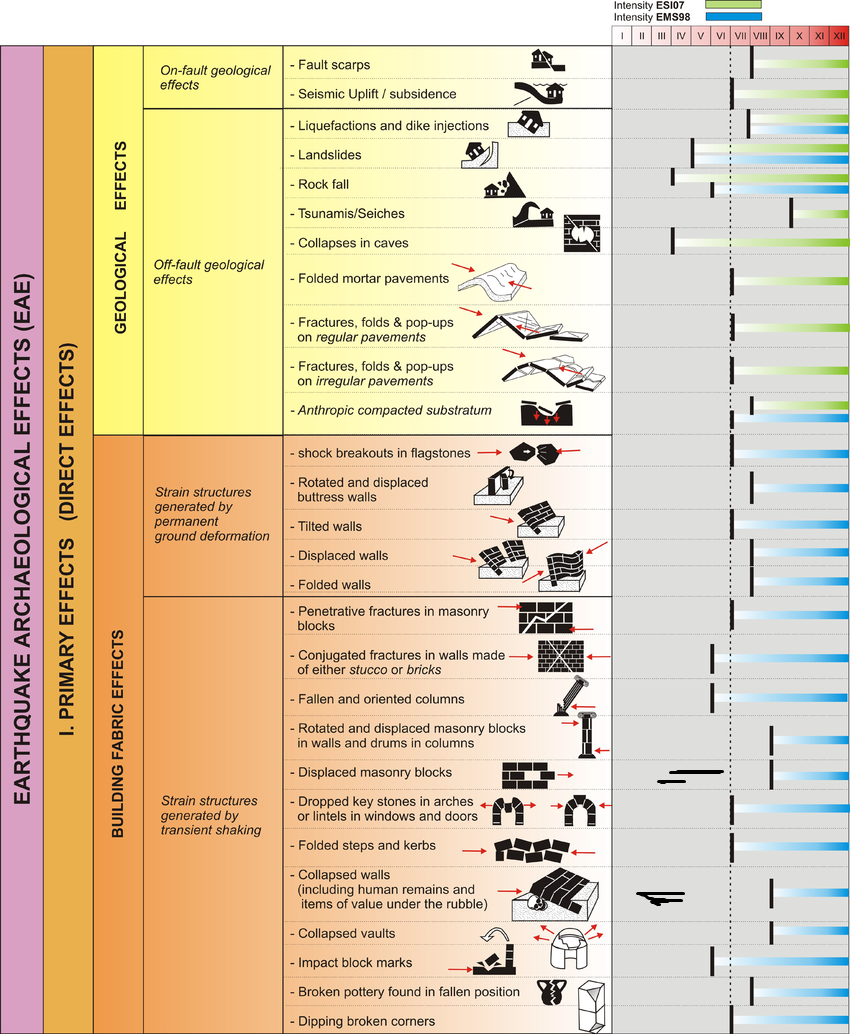
Earthquake Archeological Effects (EAE)| Effect | Location | Image(s) | Description | Intensity |
|---|---|---|---|---|
|
Northern Wing of Insula in Area F |
|
|
Earthquake Archeological Effects (EAE)| Effect | Location | Image(s) | Description | Intensity |
|---|---|---|---|---|
|
Synagogue
Fig. 2.4
Block plan of Synagogue II and surrounding Stratum 2 structures and alleys
click on image to open in a new tab Leibner et al. (2018)
Fig. 2.5
Block plan of the synagogue (in black) showing the excavation areas (A, B, F), units, soundings (dotted raster) and the major section lines through the building
click on image to open in a new tab Leibner et al. (2018) |
|
|
|
|
Northeastern Domestic Complex (Units B1–B4) and Unit B8 in Area B |
|
|
|
|
Upper Complex in Area C |
|
|
Earthquake Archeological Effects (EAE)| Effect | Location | Image(s) | Description | Intensity |
|---|---|---|---|---|
|
Synagogue
Fig. 2.4
Block plan of Synagogue II and surrounding Stratum 2 structures and alleys
click on image to open in a new tab Leibner et al. (2018)
Fig. 2.5
Block plan of the synagogue (in black) showing the excavation areas (A, B, F), units, soundings (dotted raster) and the major section lines through the building
click on image to open in a new tab Leibner et al. (2018) |
|
|
Jones, I. W. N. (2021). "The southern Levantine earthquake of 418/419 AD and the archaeology of Byzantine Petra." Levant: 1-15.
Leibner, Uzi (2015) “Excavations at Khirbet Wadi Hamam (Lower Galilee): the Synagogue and the Settlement,”
Journal of Roman Archaeology 23, pp. 220-237.
Magness, J. (1997). "Synagogue typology and earthquake chronology at Khirbet Shema ‘, Israel." Journal of field archaeology 24(2): 211-220.
Magness, J. (2005). Heaven on Earth: Helios and the Zodiac Cycle in Ancient Palestinian Synagogues. Dumbarton Oaks Papers, 59: 1–52.
Magness, J. (2007). “Did Galilee Decline in the Fifth Century? The Synagogue at Chorazin Reconsidered,”
in J. Zangenberg, H. W. Attridge & D. B. Martin (eds.), *Religion, Ethnicity, and Identity in
Ancient Galilee: A Region in Transition* (Wissenschaftliche Untersuchungen zum Neuen Testament, 210),
Tübingen: Mohr Siebeck, pp. 259–274.
Magness, J. (2012). “The Pottery from the Village of Capernaum and the Chronology of Galilean Synagogues.”
Tel Aviv, 39(2)
Leibner, U. (ed.) (2018) Khirbet Wadi Hamam: A Roman-Period Village and Synagogue in the Lower Galilee
. Jerusalem: Institute of Archaeology, Hebrew University of Jerusalem. - at JSTOR
Leibner, U. and Arubas, B. (2018). Chapter 1 Introduction
In, Leibner, U. (ed.), Khirbet Wadi Hamam: A Roman-Period Village and Synagogue in the Lower Galilee. Jerusalem: Institute of Archaeology, Hebrew University of Jerusalem.
Leibner, U., & Arubas, B. (2018). Chapter 2 Area A: the synagogue stratigraphy and architecture.
In Khirbet Wadi Ḥamam: a Roman-period village and synagogue in the lower Galilee (pp. 24-98).
(Qedem reports; Vol. 13). Institute of Archaeology, the Hebrew University of Jerusalem; Israel Exploration Society.
Leibner, U. (2018) Chapter 6. Areas B, C and F: Stratigraphy and Architecture.
In Khirbet Wadi Ḥamam: a Roman-period village and synagogue in the lower Galilee (pp. 195-254).
(Qedem reports; Vol. 13). Institute of Archaeology, the Hebrew University of Jerusalem; Israel Exploration Society.