Open this page in a new tab

Judean Desert

Judean Desert

click on image to explore in a new tab in Google Earth


Names
Transliterated Name Source Name
Judean Desert Modern English
Judaean Desert British English / alternate spelling
Judean Wilderness English / Biblical and historical
Wilderness of Judea English / Biblical
Midbar Yehuda Hebrew מִדְבַּר יְהוּדָה
Barriyat al-Khalil Arabic برية الخليل
Desert of Judah English / historical and Biblical
Wilderness of Judah English / Biblical
Introduction
Introduction

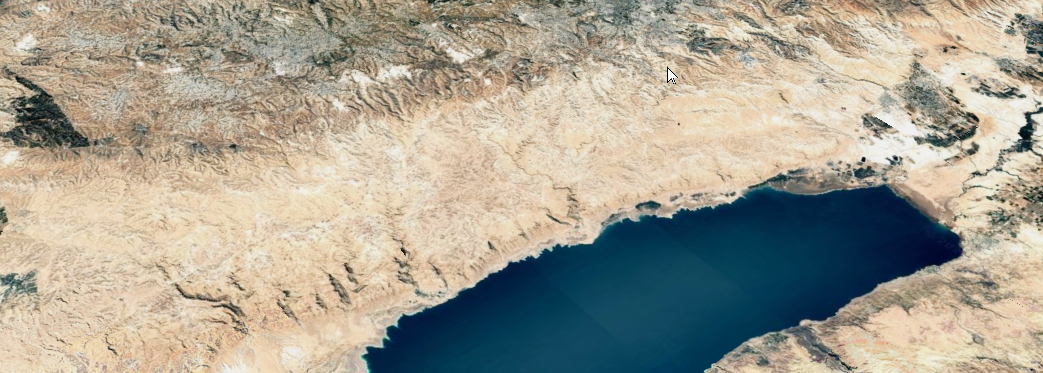
The Judean Desert is an arid region lying primarily east and southeast of Jerusalem between the Judean Mountains and the Dead Sea. It extends from the vicinity of Jerusalem and the northern Dead Sea southward toward the Negev. The landscape descends steeply eastward from the Judean highlands toward the Dead Sea and is characterized by barren limestone and chalk hills, steep escarpments, deeply incised wadis, cliffs, caves, and isolated plateaus. Along its eastern margin, the desert overlooks the Dead Sea from elevations that locally exceed several hundred meters above the basin floor.

The desert lies in the rain shadow of the Judean Mountains. Moisture-bearing air arriving from the Mediterranean loses much of its precipitation over the highlands to the west, producing a sharp climatic transition from the relatively well-watered Jerusalem region to the arid terrain descending toward the Dead Sea. Despite the generally dry environment, springs occur at several locations, most notably at En Gedi and Wadi Prat, where perennial water supported settlement and agriculture. Flash floods generated by rainfall in the highlands can also produce powerful flows through the normally dry wadis.

The eastern margin of the Judean Desert is strongly influenced by the tectonic and topographic development of the Dead Sea Transform. The dramatic escarpment overlooking the Dead Sea separates the Judean highlands from the deeply subsided Dead Sea basin. Erosion by wadis draining eastward has dissected this escarpment into a rugged landscape of canyons, cliffs, and isolated promontories, including the plateau occupied by Masada.

The Judean Desert has been occupied and used intermittently since prehistoric times. Its caves, springs, defensible landforms, and proximity to Jerusalem and Jericho made it important for settlement, refuge, travel, religious retreat, and monasticism. Major archaeological and historical sites include Qumran, Masada, En Gedi, Herodium, and numerous caves, fortresses, monasteries, churches, hermitages, and desert settlements.

During the Byzantine and Early Islamic periods the desert was particularly notable for its extensive Christian monastic landscape. Monasteries and hermitages were established in remote valleys, caves, and cliffs, especially in the desert east of Jerusalem and along routes descending toward Jericho and the Dead Sea. This concentration of religious communities is important when interpreting historical earthquake accounts that describe the collapse of churches and monasteries and state that destruction was particularly severe in the "wilderness" or "desert" surrounding Jerusalem.

The geographic term Judean Desert overlaps with the historical and religious expression Wilderness of Judea or Judean Wilderness. The precise boundaries vary according to geographic, historical, and archaeological usage. In DSEQC, the term is used broadly for the arid region east and southeast of the Judean highlands extending toward the western shore of the Dead Sea.

Aerial Views
Aerial Views

Aerial Views

  • Judean Desert in Google Earth

Textual Chronology
16 January 749 CE Sabbatical Year Earthquakes - Holy Desert Quake South

Discussion

Discussion

Textual Seismic Effects
16 January 749 CE Sabbatical Year Earthquakes - Holy Desert Quake South

  • Seismic Effects follow Williams (2024) in partitioning effects between the Holy Desert N, Holy Desert S, and Talking Mule Earthquake.
Effect                                                      Location Image(s) Description
  • Collapsed Walls
  • Fatalities (Collapsed Walls)
Jordan Valley
  • "In the 6th year of Constantine, there was a great earthquake in Palestine, by the Jordan, and in all of Syria; in the month of January at the 4th hour. An innumerable multitude perished - many tens of thousands. Churches and Monasteries collapsed. The worst was in the wilderness of the Holy City (Jerusalem)." – Paul the Deacon

  • "Anno Mundi 6238, divine incarnation year 738. In the 6th year of Constantine there was a powerful earthquake in Palestine, by the Jordan, and in all of Syria in January, at the 4th hour. Thousands died, an innumerable multitude perished, churches and monasteries collapsed, and it was worst in the desert of the Holy City." – Anastasius Bibliothecarius

  • "[A.M. 6238, AD 745/6] II In this year there was a great earthquake in Palestine, by the Jordan and in all of Syria on 18 January, in the 4th hour. Numberless multitudes perished, churches and monasteries collapsed, especially those in the desert of the Holy City. IIa

    II In the same year a pestilence that had started in Sicily and Calabria travelled like a spreading fire all through the 14th indiction1 to Monobasia2, Hellas, and the adjoining islands, thus scourging in advance the impious Constantine and restraining his fury against the Church and the holy icons, even though he remained unrepentant like Pharaoh of old. This disease of the bubonic plague spread to the Imperial City in the 15th3 indiction. All of a sudden, without visible cause, there appeared many oily crosslets upon men's garments, on the altar cloths of churches, and on hangings. The mysteriousness of this presage inspired great sorrow and despondency among the people. Then God's wrath started destroying not only the inhabitants of the City, but also those of all its outskirts. Many men had hallucinations and, being in ecstasy, imagined to be in the company of certain strangers of terrible aspect who, as it were, addressed in friendly fashion those they met and conversed with them. Taking note of their conversation, they later reported it. They also saw the same men entering houses, killing some of the inmates, and wounding others with the sword. Most of what they said came to pass just as they had seen it.

    In the spring of the 1st indiction4 the plague intensified and in the summer it flared up all at once so that entire households were completely shut up and there was no one to bury the dead. Because of extreme necessity a way was devised of placing planks upon animals saddled with four paniers each5 and so removing the dead or piling them likewise one upon the other in carts. When all the urban and suburban cemeteries had been filled as well as empty cisterns and ditches, and many vineyards had been dug up and even the orchards within the old walls6 to make room for the burial of human bodies, only then was the need satisfied7. When every household had been destroyed by this calamity on account of the impious removal of the holy icons by the rulers, straight away the fleet of the Hagarenes sailed from Alexandria to Cyprus, where the Roman fleet happened to be. The strategos of the Kibyraiots fell upon them suddenly in the harbour of Keramaia8 and seized the mouth of the harbour. Out of 1,000 dromones9 it is said that only three escaped. IIb
    Footnotes

    a Cf. Agapios, 261 (Jan.): earthquake in Palestine, esp. at Tiberias, where more than 100,000 were killed.

    Mich. Syr. ii. 509-10; Chr. 1234, 254. 33 ff. (without date): damage at Damascus, Tiberias, Mabbug, and elsewhere.

    Ps.-Dion. Chron. 42-3, AG 1059: Chalcedonian bishop of Mabbug crushed with his flock.

    b Cf. Nik. 67. 4-43,- 68. 3-11. Kleinchronik, 1. 17 (Schreiner, i. 45) abbreviates Theoph. as regards the plague.


    1 AD 745/6.

    2 Monemvasia on the east coast of the Peloponnese.

    3 dB mistakenly prints '5th'.

    4 AD 747/8. This is the date given for the plague in Kleinchronik, 2. 4 (Schreiner, i. 47).

    5 Reading Sia £AIA V aayp novp.4vu v vno TETpaKavdr/Xov. For the meaning of this expression see I. Rochow, Klio, 69 (1987), 571-2.

    6 The Constantinian walls.

    7 On the plague see also Theodore Studites, Laud. Platonis, PG 99: 805D. Nik. Antirrh. Ill, PG 100: 496B-D, adds that the emperor betook himself during the plague to the suburbs of Nicomedia. So also Geo. Mon. 754 and Epist. ad Theophilum, PG 95: 364B.

    8 Situation unknown. See Sir George Hill, A History of Cyprus, i (Cambridge, 1940); 262 n. 5; L. Philippou, KvnpiaKai Sirovhal, 6 (1942), 1-5, who believes the battle did not take place in Cyprus. According to Nik. the conflict was initiated by Constantine, who sent a fleet against the Arabs.

    9 Thirty in Anast., probably correctly.

    " – Theophanes

  • "1. In the reign of Copronymus, an earthquake occurred in Palestine and the Jordan and all the Syrian land. And many tens of thousands, innumerable people indeed, are dead, and churches and monasteries are fallen.

    And at the same time a pestilential disease, starting from Sicily and Calabria and spreading like a fire, crossed to Greece and the islands. ...12.

    Footnotes

    12 Earthquake in Levant and plague at Cpl. in 747; cf. Nic. 62. 24-64. 9; Theoph. 422. 25-424. 3; Cedr. ii. 7. 17-9. 1.

    GC is closer to Theophanes than to Nicephorus in that it records an earthquake in the Levant before turning to the plague, but both the other two have more information than is preserved in GC (including an exact date for the earthquake in Theophanes). The earthquake is not mentioned by Nicephorus, but he regularly omitted information that was available in the chronicle source which he shared with Theophanes. This common source did record some major events in the near east, including the earthquake of 750 (Nic. 64. 22-65. 7, Theoph. 426. 16-26; see below on GC 13), so that it could have contained a reference to the earthquake of 747. Theophanes also had an independent eastern chronicle source, which has parallels with Syriac chronicles down to 746, and contained further information probably added by a writer in Palestine c.780 (see E. W. Brooks, 'The Sources of Theophanes and the Syriac Chroniders', BZ xv, 1906, 578-87), but the example of the 750 earthquake shows that not all eastern information in Byzantine chronicles should be traced to it.

    GC 12, as it stands, cannot have been the common source of Theophanes and Nicephorus because of their fuller treatment (cf. Whitby, 'Chronographer' 11-12). However, GC's account of the plague is disordered when compared with the other versions, in that it mentions the burial arrangements for the victims before the apparition of oily crosses on the garments of the afflicted, and it does not contain any of the anti-iconoclast interpretations of the plague included by the orthodox authors. One must assume, therefore, either (i) that it is an inaccurate derivation from Theophanes by an excerptor who deliberately eliminated Theophanes' anti-iconoclast interpretation of the plague, although this would run counter to the excerptor's use of the epithet Copronymus for Constantine; or (ii) that it is an inaccurate and abbreviated version of the common source used by Theophanes and Nicephorus, the distortions being caused by the excerptor's belief that he was running out of space on folio 242r (cf. p.192 above). We find the latter assumption easier, but for the alternative, see Mango, Nicephorus' 546-7.

    Note by Williams: Copronymus or Copronym is a play on words with the name of Constantine combining the greek words κόπρος (kopros) which means feces and ὄνομα (onoma) which means name. The hostility of the authors who use this epithet against "Emperor Poop-onymous" derives from bitter doctrinal disputes within Christendom such as disputes over iconoclasm.

    " – Megas Chronographos

  • "Year 6 - There was a great earthquake in Palestine, by the Jordan and in all of Syria on 18 January at the 4th hour. An innumerable multitude perished - thousands. Churches and Monasteries collapsed. The worst was in the wilderness by the Holy City (Jerusalem)." – George Cedrenus

Textual Intensity Estimates
16 January 749 CE Sabbatical Year Earthquakes - Holy Desert Quake South

  • Seismic Effects follow Williams (2024) in partitioning effects between the Holy Desert N, Holy Desert S, and Talking Mule Earthquake.
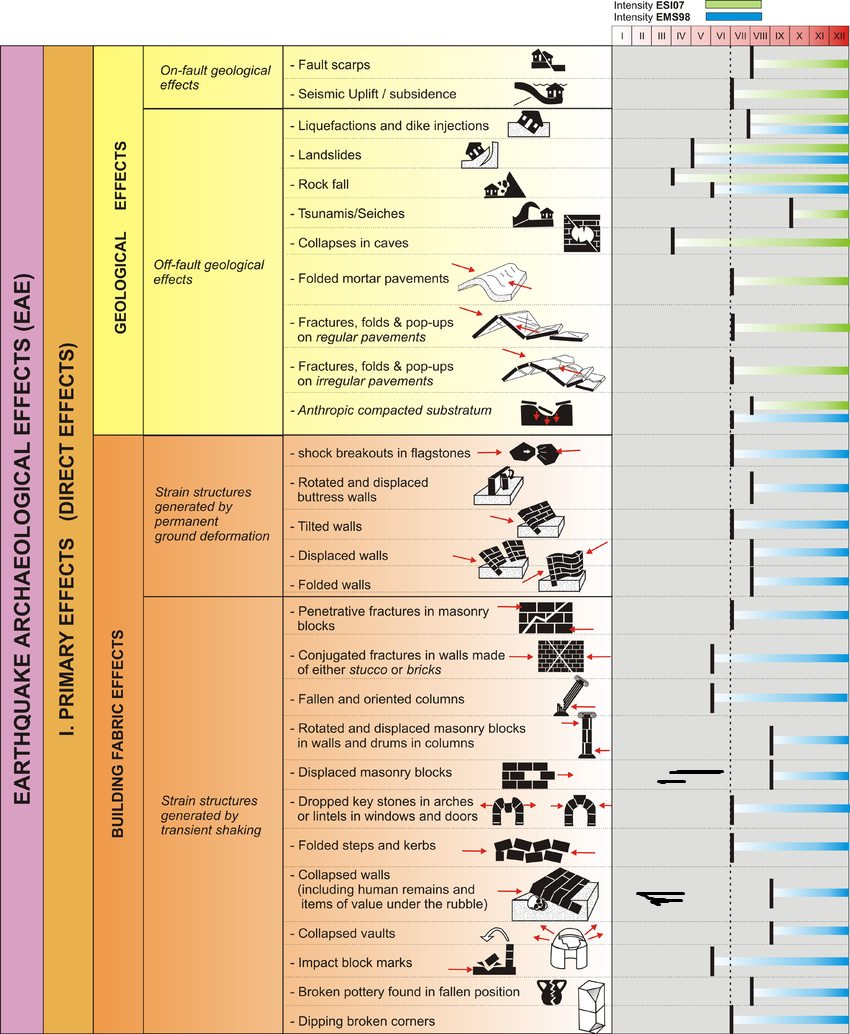
  • Earthquake Archeological Effects chart of Rodríguez-Pascua et al (2013: 221-224)
Effect                                                      Location Image(s) Description Intensity
  • Collapsed Walls
  • Fatalities (Collapsed Walls)
Jordan Valley
  • "In the 6th year of Constantine, there was a great earthquake in Palestine, by the Jordan, and in all of Syria; in the month of January at the 4th hour. An innumerable multitude perished - many tens of thousands. Churches and Monasteries collapsed. The worst was in the wilderness of the Holy City (Jerusalem)." – Paul the Deacon

  • "Anno Mundi 6238, divine incarnation year 738. In the 6th year of Constantine there was a powerful earthquake in Palestine, by the Jordan, and in all of Syria in January, at the 4th hour. Thousands died, an innumerable multitude perished, churches and monasteries collapsed, and it was worst in the desert of the Holy City." – Anastasius Bibliothecarius

  • "[A.M. 6238, AD 745/6] II In this year there was a great earthquake in Palestine, by the Jordan and in all of Syria on 18 January, in the 4th hour. Numberless multitudes perished, churches and monasteries collapsed, especially those in the desert of the Holy City. IIa

    II In the same year a pestilence that had started in Sicily and Calabria travelled like a spreading fire all through the 14th indiction1 to Monobasia2, Hellas, and the adjoining islands, thus scourging in advance the impious Constantine and restraining his fury against the Church and the holy icons, even though he remained unrepentant like Pharaoh of old. This disease of the bubonic plague spread to the Imperial City in the 15th3 indiction. All of a sudden, without visible cause, there appeared many oily crosslets upon men's garments, on the altar cloths of churches, and on hangings. The mysteriousness of this presage inspired great sorrow and despondency among the people. Then God's wrath started destroying not only the inhabitants of the City, but also those of all its outskirts. Many men had hallucinations and, being in ecstasy, imagined to be in the company of certain strangers of terrible aspect who, as it were, addressed in friendly fashion those they met and conversed with them. Taking note of their conversation, they later reported it. They also saw the same men entering houses, killing some of the inmates, and wounding others with the sword. Most of what they said came to pass just as they had seen it.

    In the spring of the 1st indiction4 the plague intensified and in the summer it flared up all at once so that entire households were completely shut up and there was no one to bury the dead. Because of extreme necessity a way was devised of placing planks upon animals saddled with four paniers each5 and so removing the dead or piling them likewise one upon the other in carts. When all the urban and suburban cemeteries had been filled as well as empty cisterns and ditches, and many vineyards had been dug up and even the orchards within the old walls6 to make room for the burial of human bodies, only then was the need satisfied7. When every household had been destroyed by this calamity on account of the impious removal of the holy icons by the rulers, straight away the fleet of the Hagarenes sailed from Alexandria to Cyprus, where the Roman fleet happened to be. The strategos of the Kibyraiots fell upon them suddenly in the harbour of Keramaia8 and seized the mouth of the harbour. Out of 1,000 dromones9 it is said that only three escaped. IIb
    Footnotes

    a Cf. Agapios, 261 (Jan.): earthquake in Palestine, esp. at Tiberias, where more than 100,000 were killed.

    Mich. Syr. ii. 509-10; Chr. 1234, 254. 33 ff. (without date): damage at Damascus, Tiberias, Mabbug, and elsewhere.

    Ps.-Dion. Chron. 42-3, AG 1059: Chalcedonian bishop of Mabbug crushed with his flock.

    b Cf. Nik. 67. 4-43,- 68. 3-11. Kleinchronik, 1. 17 (Schreiner, i. 45) abbreviates Theoph. as regards the plague.


    1 AD 745/6.

    2 Monemvasia on the east coast of the Peloponnese.

    3 dB mistakenly prints '5th'.

    4 AD 747/8. This is the date given for the plague in Kleinchronik, 2. 4 (Schreiner, i. 47).

    5 Reading Sia £AIA V aayp novp.4vu v vno TETpaKavdr/Xov. For the meaning of this expression see I. Rochow, Klio, 69 (1987), 571-2.

    6 The Constantinian walls.

    7 On the plague see also Theodore Studites, Laud. Platonis, PG 99: 805D. Nik. Antirrh. Ill, PG 100: 496B-D, adds that the emperor betook himself during the plague to the suburbs of Nicomedia. So also Geo. Mon. 754 and Epist. ad Theophilum, PG 95: 364B.

    8 Situation unknown. See Sir George Hill, A History of Cyprus, i (Cambridge, 1940); 262 n. 5; L. Philippou, KvnpiaKai Sirovhal, 6 (1942), 1-5, who believes the battle did not take place in Cyprus. According to Nik. the conflict was initiated by Constantine, who sent a fleet against the Arabs.

    9 Thirty in Anast., probably correctly.

    " – Theophanes

  • "1. In the reign of Copronymus, an earthquake occurred in Palestine and the Jordan and all the Syrian land. And many tens of thousands, innumerable people indeed, are dead, and churches and monasteries are fallen.

    And at the same time a pestilential disease, starting from Sicily and Calabria and spreading like a fire, crossed to Greece and the islands. ...12.

    Footnotes

    12 Earthquake in Levant and plague at Cpl. in 747; cf. Nic. 62. 24-64. 9; Theoph. 422. 25-424. 3; Cedr. ii. 7. 17-9. 1.

    GC is closer to Theophanes than to Nicephorus in that it records an earthquake in the Levant before turning to the plague, but both the other two have more information than is preserved in GC (including an exact date for the earthquake in Theophanes). The earthquake is not mentioned by Nicephorus, but he regularly omitted information that was available in the chronicle source which he shared with Theophanes. This common source did record some major events in the near east, including the earthquake of 750 (Nic. 64. 22-65. 7, Theoph. 426. 16-26; see below on GC 13), so that it could have contained a reference to the earthquake of 747. Theophanes also had an independent eastern chronicle source, which has parallels with Syriac chronicles down to 746, and contained further information probably added by a writer in Palestine c.780 (see E. W. Brooks, 'The Sources of Theophanes and the Syriac Chroniders', BZ xv, 1906, 578-87), but the example of the 750 earthquake shows that not all eastern information in Byzantine chronicles should be traced to it.

    GC 12, as it stands, cannot have been the common source of Theophanes and Nicephorus because of their fuller treatment (cf. Whitby, 'Chronographer' 11-12). However, GC's account of the plague is disordered when compared with the other versions, in that it mentions the burial arrangements for the victims before the apparition of oily crosses on the garments of the afflicted, and it does not contain any of the anti-iconoclast interpretations of the plague included by the orthodox authors. One must assume, therefore, either (i) that it is an inaccurate derivation from Theophanes by an excerptor who deliberately eliminated Theophanes' anti-iconoclast interpretation of the plague, although this would run counter to the excerptor's use of the epithet Copronymus for Constantine; or (ii) that it is an inaccurate and abbreviated version of the common source used by Theophanes and Nicephorus, the distortions being caused by the excerptor's belief that he was running out of space on folio 242r (cf. p.192 above). We find the latter assumption easier, but for the alternative, see Mango, Nicephorus' 546-7.

    Note by Williams: Copronymus or Copronym is a play on words with the name of Constantine combining the greek words κόπρος (kopros) which means feces and ὄνομα (onoma) which means name. The hostility of the authors who use this epithet against "Emperor Poop-onymous" derives from bitter doctrinal disputes within Christendom such as disputes over iconoclasm.

    " – Megas Chronographos

  • "Year 6 - There was a great earthquake in Palestine, by the Jordan and in all of Syria on 18 January at the 4th hour. An innumerable multitude perished - thousands. Churches and Monasteries collapsed. The worst was in the wilderness by the Holy City (Jerusalem)." – George Cedrenus

  • VIII+
  • VIII+
This evidence requires a minimum Intensity of VIII (8) when using the Earthquake Archeological Effects chart of Rodríguez-Pascua et al (2013: 221-224).

Notes and Further Reading
References
Wikipedia pages

Judaean Desert


Judaean Mountains


Dead Sea


Qumran


Masada