In the course of digging trenches for planting banana trees
near Tell es Sultan (ancient Jericho) a mosaic pavement was
discovered. The landlord reported the discovery to the
Department of Antiquities, who had the surrounding area
cleared.
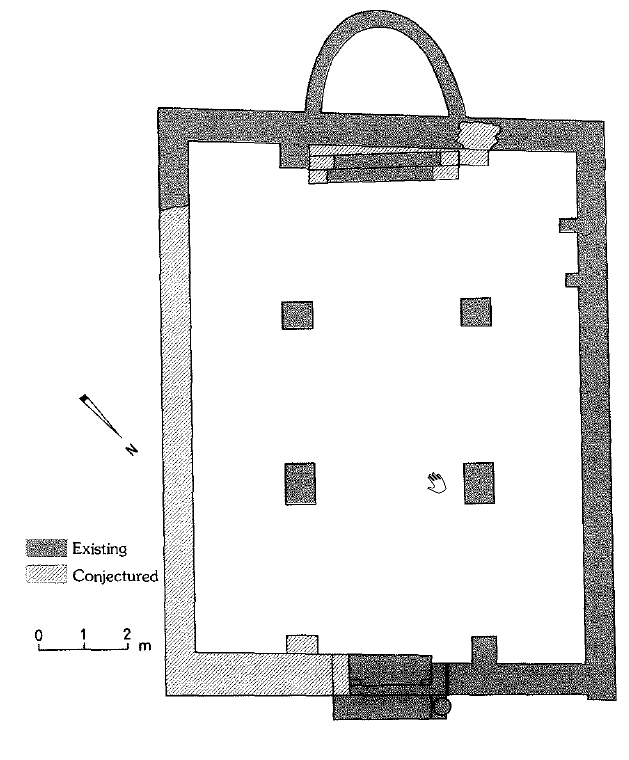
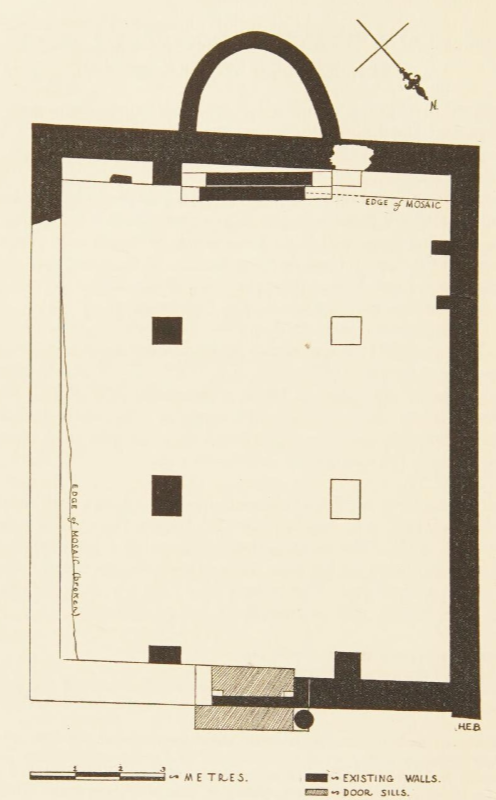
The site contains the foundations and floor of a Jewish
synagogue orientated approximately towards Jerusalem
(see Fig. 1 and Pl. XVIII, 1). It consists of an apse, a
central nave, and two lateral aisles. There is only one
entrance giving access to the nave on the north-east side.
It is approached by a step, to the right is a column base,
while the area on the left is destroyed. The threshold
contains two rectangular sockets for the doors.
The nave is separated from the aisles by two parallel rows
of piers and responds which probably carried arches; they
do not rest on a stylobate. The floor is paved with mosaics
(Pls. XIX, XX, XXI, 2). At the north-east end there is an
Aramaic inscription in Hebrew characters (Pl. XXIII)
mostly in black tesserae in six lines (translated below,
p. 76). It is enclosed in a rectangular panel with black
border, while on each side of it the tesserae form plant
designs (pomegranates and vines) in white, red, black,
brown, and blue (Pl. XIX).
The remainder of the floor of the nave consists of a white
surround, a guilloche border in white, red, black, brown,
and light blue; for the designs in the field see Pl. XIX.
The rectangular design capped by a semicircle and resting
on four supports, which is in front of the apse, represents
the Ark of the Law (Aron ha-edesh). The colours used
here are black for the border, and black, blue, brown, red,
and white for the groundwork.
Below this motif is a circular medallion containing a
menorah (seven-branched candlestick) in the middle, a
lulab (palm branch) to the left, and a shofar (ram’s horn)
to the right. Below is an inscription in Hebrew characters,
“Peace be upon Israel.” The outline of the above motifs,
including the letters of the inscription, is in black, while
the rest of the field is in red and blue (Pl. XIX).
At the south-west end of the nave there are two steps
leading to the semi-oval apse (Pl. XVIII, 2) the walls of
which are not bonded into those of the synagogue. The
apse was found destroyed to below floor-level, and thus it
has not been possible to ascertain the manner in which it
was paved.
The mosaic pavement in the north-west aisle is illustrated
in Pl. XXI, 2. The colours used are red, black, and white. A
gap, 65 cms. wide, was left between the south-west wall and
the mosaic pavement.
Two stones, built against the north-west wall of the aisle,
were probably for supporting a shelf.
The spaces between the piers were destroyed by the
landlord before the nature of the discovery became
apparent.
The pavement in the south-east aisle is illustrated in Pl.
XX. The colours used are the same as those in the
north-west aisle. A gap, of the same width as that in the
north-west aisle, was also left between the south-west wall
and the edge of the mosaic pavement.
Among the objects found were nine Cufic coins of the
early eighth century, a late Roman coin badly worn, three
whole glass bottles (Pl. XXI, 1) and several in fragments, a
bronze hanger of a glass lamp, and a bronze filler (Pl.
XXII). All these objects were found in the gap left in the
north-west aisle between the wall and the end of the mosaic
floor.
The mosaic pavement is in a fairly good state of
preservation and cannot have been used over a long period.
Judging by the evidence supplied by the coins, the basilica
form of the synagogue, and the character of the mosaics and
the letters, the building can be tentatively dated to the
beginning of the eighth century A.D.

 Jericho environs