
Jericho - Khirbet en-Nitla
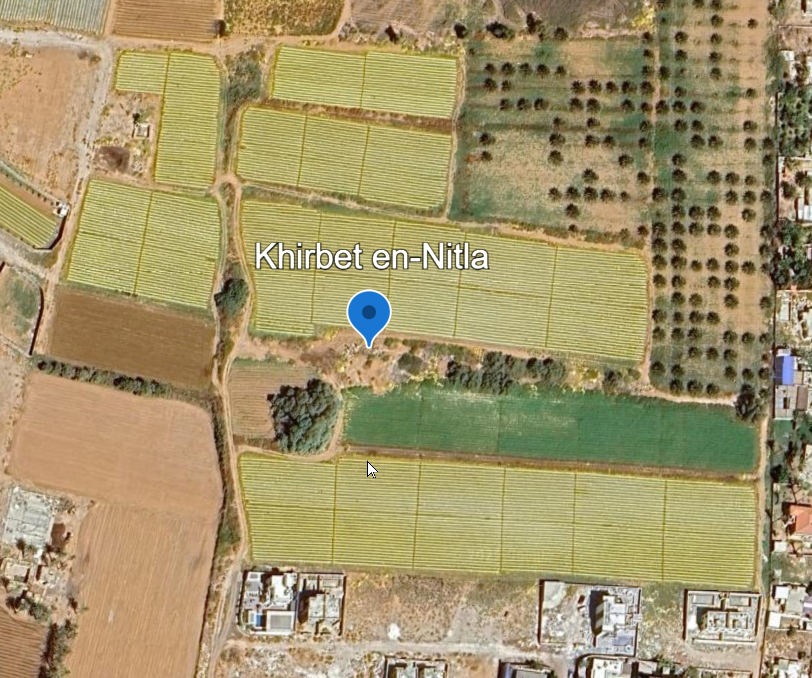 Khirbet en-Nitla
click on image to explore this site on a new tab in Google Earth
| Transliterated Name | Source | Name |
|---|---|---|
| Khirbet en-Nitla | Arabic |
ChatGPT Introduction
- from Chat GPT 5.1, 23 November 2025
- sources: Gideon Foerster in Stern et. al. (1993 v.2)
The first church was a basilica built of ashlars. Excavated remains included parts of the south wall, sections of a rectangular apse, fragments of a mosaic pavement, part of the atrium foundations, and portions of the monastery and diaconicon. Much of the nave and northern aisle had been destroyed. The decorated apse floor, badly damaged, included hexagons, squares, and a six-line Greek inscription. This church was erected in the fourth or fifth century and may have been destroyed during the Samaritan revolt in 529.
The second church comprised a single hall covering roughly the area of the southern aisle of the earlier basilica. The diaconicon of the first church became its apse. Reduced size may reflect diminished financial support. It may have been destroyed during the Persian invasion under Khosrau II in 614.
The third church was constructed immediately after the destruction of its predecessor. Although its walls do not survive, its plan could be inferred from foundation trenches and mosaic fragments. Smaller than the earlier structures, it was a small chapel with a narthex, built of dried, plaster-coated brick. The narthex had a white mosaic pavement with an inscription at the entrance. This church apparently was destroyed by the earthquake of 749.
The fourth church, built shortly thereafter, was also only a chapel of dried brick covered with plaster. Its area was slightly enlarged to the north and south, but the overall plan remained similar to that of the third church, and its mosaic pavement was reused. Small chambers on the south attest to a small monastery. This church was not destroyed but converted into a storage room for the fifth church, which was built above it.
The fifth church formed a small chapel constructed as a second story over the earlier building. A row of six square pillars set along the east–west axis supported the upper story. Entry was via an exterior stairway built against the northern wall of the fourth church. Built of dried brick and equivalent in area to the fourth church, it collapsed of its own accord in the ninth century. Debris included architectural fragments and fallen mosaic pieces. Finds such as a bituminous limestone altar pillar, glass window fragments, nails, a bronze shovel, and a small pottery incense burner were also recovered.
Near the church, modest dwellings were found that were contemporaneous with the various phases of construction. Ceramic finds indicate settlement continuing after the abandonment of Tulul Abu el-‘Alayiq. Material from both sites demonstrates a continuity of occupation from the end of the Hellenistic to the Arab period.
Aerial Views
Aerial Views
- Khirbet en-Nitla in Google Earth
Khirbet en-Nitla
click on image to explore this site on a new tab in Google Earth - Khirbet en-Nitla on govmap.gov.il
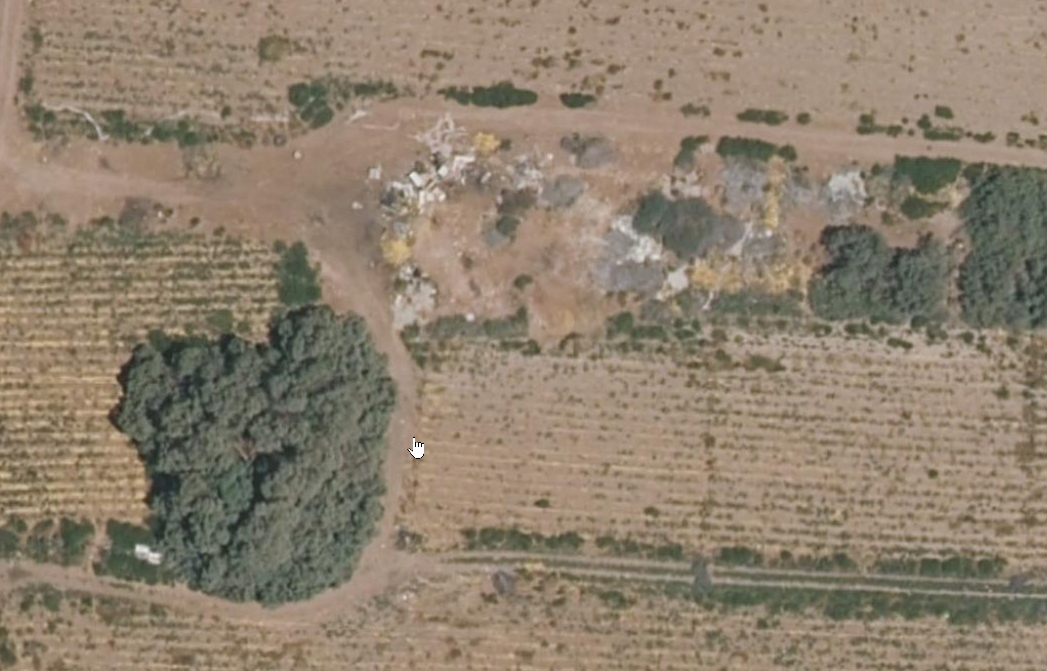 Khirbet en-Nitla
click on image to explore this site on a new tab in govmap.gov.il
Phasing
| Phase | Period | Date | Description |
|---|---|---|---|
| First Church | Basilica | 4th–5th c. CE | "The first church was a basilica built of ashlars. Sections of the south wall, parts of a rectangular apse, fragments of a mosaic pavement, part of the foundations of the atrium, and parts of the monastery and diaconicon were excavated. Most of the foundations of the nave and of the northern aisle had been destroyed. The width of the rectangular apse indicated that the nave had been wider than the aisles. The mosaic floor of the apse, which had been severely damaged, was decorated with a pattern of hexagons and squares and with a six-line Greek inscription in the center. At the facade of the church foundations for pillars and a stylobate were discovered. This church was erected in the fourth or fifth century and possibly was destroyed at the time of the Samaritan revolt in 529." |
| Second Church | Hall church | 6th–7th c. CE | "The second church contained a single hall that covered approximately the area of the southern aisle of the first church. The diaconicon of the first church became the apse of the second. This church may have been smaller than its predecessor because of insufficient financial support. The church may have been destroyed during the invasion of the Persian king Khosrau II in 614." |
| Third Church | Chapel with narthex | 7th–8th c. CE | "The third church was constructed immediately after the destruction of the previous church. Nothing remains of its walls, so the reconstruction of its plan was based on foundation trenches and extant fragments of a mosaic floor. The third church was smaller than its predecessor. In fact, it was only a small chapel with a narthex, apparently built of dried, plaster-coated brick. The narthex was paved with white mosaic with an inscription at the entrance. The church apparently was destroyed by the earthquake of 749." |
| Fourth Church | Chapel | 8th c. CE | "Erected a short time after the destruction of the previous church, the fourth church was also only a chapel. It was built of dried brick overlaid with a thin coating of plaster. Its area was enlarged somewhat to the north and south (roughly 30 cm in either direction), although the overall plan was similar to that of the previous church, and the earlier mosaic pavement was also reused. The small chambers adjacent to the southern side of the church testify to the existence of a small monastery. This church was not destroyed but was converted into a storage room for the fifth church, which was built on top of it." |
| Fifth Church | Upper-story chapel | Late 8th–early 9th c. CE | "The fifth church was a small chapel built as a second story over the previous church. This additional story was supported by a row of six square-shaped pillars set in the mosaic floor and running east–west along the building's central axis. The chapel was entered by means of an exterior stairway built against the northern wall of the fourth church. The walls of the chapel were also dried brick, and its area was equivalent to that of the fourth church. Architectural fragments and the debris of a mosaic floor that had fallen from the upper story were found above the ground-floor level. The fifth church, as well as the fourth, was erected at the end of the eighth or beginning of the ninth century—the period of Charlemagne. At that time, the country was already under Islamic rule, a fact that may explain the poverty of its construction. The church seems to have collapsed of its own accord, in the ninth century." |
Third Church Earthquake - 7th-9th century CE
Discussion
Kelso & Baramki (1955)
- from Kelso & Baramki (1955:50-52)
- Derived from a bad OCR - Chat GPT did some paraphrasing - check important details via link above
206. The first church to be constructed on the site was a three-aisled basilica built of ashlar. A small section of the south wall, the foundations of the central apse and part of its square corner were cleared, as well as part of the substructure of the colonnaded nave and the foundations. The two-meter stretch of the south wall of the church was built of soft limestone procured from the quarries at Kh. Mefjer. Toward the east end of the south side of the church, foundations were discovered indicating the position of the sacristy. As in most churches the sacristy was usually built at the east end of the south aisle. Most of the foundations of the central nave and the north aisle were destroyed. The remains of the mosaic pavement which were discovered in the square apse were in a very dilapidated condition. The mosaic originally consisted of a series of hexagons and octagons in red, blue and yellow. In the middle there was an inscription in Greek uncials in six lines; see Pl. 11. In front of the church the foundations of piers, distinguishable by their square plan, and the substructure of a stylobate were encountered (Pl. 12). Although the north aisle and the nave were destroyed, the foundations at the eastern end of the nave are preserved and the width of this space shows that the central nave was wider than the south aisle. In these early churches the central nave was normally wider than the flanking aisles. The church appears to have been erected in the fourth or fifth century and destroyed sometime in the sixth century.
207. The second church, like its predecessor, was built of ashlar, but the building was reduced to a single aisle, the new church occupying approximately the area of the old south aisle. The north wall was now constructed about a meter north of the northern limit of the old south aisle. The other walls of the southern part of the old church were retained, and presumably the old apse of the old church became the apse in the new. The new north wall was probably built from the masonry of the two destroyed aisles. This church succumbed to the fate of its predecessor and was destroyed in all probability by Chosroes II in A.D. 614.
208. A third church, however, must have been built soon afterwards. Except for the two-meter stretch of wall on the south which was retained all through the different vicissitudes that the church experienced, none of the walls of this church remain. However, the foundations of the walls, which were built of large river pebbles, about 0.20 m. in diameter and 0.06 m. to 0.10 m. deep, were discovered, as well as the mosaic pavement which was relaid at this time; and from these the ground plan of the church can be reconstructed. The church was reduced in size by about 2.30 m. on the north side, 0.30 m. on the south side and 3.50 m. on the east side. In fact it became a small chapel with a narthex. It seems to have been constructed of plastered sun-dried brick.
209. The narthex was paved with mosaics: the surround consisted of white tesserae interrupted inside the door by the inscription in Pl. 13. The field is a rectangle enclosed in a border consisting of a row of black tesserae and contains three squares connected together by hexagons. In the middle of each square there is a cross made of four blue squares with a white one at the crossing of the arms. In the center of each hexagon there is a cross formed of eight blue and five white tesserae.
210. The mosaic in the chapel consisted of a white surround interrupted inside the entrance by the inscription in Pl. 14. The letters are all in black. Further inside the door there is a band of grapes; the outline of each grape is in black, while the rest of the fruit is in pink and white. On either side of the band of grapes there is a bird in black, pink, green and white facing the grapes. The rest of the surround is decorated with indented squares. The border consists of two rows of black tesserae enclosing a row of white. The field is divided diagonally into rhomboids each enclosing an indented square.
211. The floor of the apse is destroyed, but presumably the floor was raised a few centimeters above the floor of the church and a chancel screen probably separated the apse from the rest of the chapel. This church was probably destroyed by the earthquake in 747.
212. The fourth church was constructed soon afterwards. It was built of sun-dried bricks and plastered with huwar. The existing mosaic pavement was retained, but the chapel was widened about 0.10 m. on both the north and south sides; otherwise the former plan was retained. During this stage some rooms were built abutting on the south wall (Pl. 40), indicating the presence of a small monastery.
213. This church was not destroyed, but was subdivided into a store-room; over it a small upper-storey chapel was constructed. Six square piers were erected along the central east–west axis of the fourth church to support a second storey which became the fifth church (Pl. 11). Access to this church was gained by means of a flight of stairs which was constructed against the north wall of Church IV, and of which the first two steps were found in situ, while the impressions of three others were left in the wall where they had been previously bedded. We know only a few facts about this chapel. It was constructed of sun-dried bricks and had a mosaic floor with a very thin bed. Its area was coterminous with the chapel on the ground floor, i.e., Church IV. That this was a second-storey chapel is borne out by several facts. In the debris of Church I several architectural features were discovered which obviously fell from an upper floor. These include parts of a chancel step and a chancel screen which were discovered in the debris between 0.40 m. and 0.60 m. above the floor. The angle at which they were discovered leaves no doubt that they fell from an upper floor. To the edges of the parts which formed the chancel step a row of white tesserae was attached, suggesting that the chancel of the upper chapel was paved with mosaics. In addition, many large pieces of a mosaic floor with a thin bed, 0.10 m. in thickness, such as one would expect to find over a wooden support, were found in the rooms to the south standing on their edges. The manner in which the pieces were laid indicates that they belonged to floors and were not wall mosaics. It is suggested that these mosaics were laid over the wooden beams of the lower chapel. Some of the pieces were very large, being as much as 2.0 or 3.0 m. in length, and they were extensive enough to cover the entire area of the chapel. From these large pieces it was possible to reconstruct the design. The floor consisted of a white surround, a border of two black rows of tesserae enclosing two rows of white, and a field divided into octagons and small squares, each enclosing a cross.
214. The mosaic pavement on the ground floor was broken into where the piers were constructed (Pl. 41), and the floor was covered with red earth and plastered with a thin coat of lime. The floor of the area formerly occupied by the chancel or sanctuary was plastered with lime, after the mosaic floor of the chancel and the chancel screen had been removed for use in the new chapel on the floor above. The pottery from the debris belongs to the ninth century A.D., giving the terminus ad quem to the life of the church.
215. The foundations of all these churches are of large river pebbles, somewhat round but not spherical, averaging 0.20 m. in diameter and 0.06 to 0.10 m. in height. The foundations of each of the churches were about 0.10 m. deep. The site had been thoroughly looted for building stone and only a little remained in situ. Each large hewn stone was found; there were only two worked stones—the lion of a chancel screen already referred to and a small altar column of bituminous limestone found in two pieces, having been sawn lengthwise. One small inscribed piece of marble was found, but it was no longer legible. The bricks used are all sun-dried and averaged 24 cm. in length and 12 cm. in width and height. The plaster is lime clay tempered with straw and sand added, and there are three coats on the existing walls. There was no attempt at keying, such as one finds elsewhere. On the whole, the workmanship is very poor.
216. Glass fragments from some of the church windows were found but none were of any size. A few large nails were discovered, which probably came from the church doors. Among the furnishings found there were parts of a bronze censor, two bronze chains and a small pottery lantern. The latter was square in shape with rectangular holes on three sides. Its height was 17.5 cm. and the diameter was 12.2 cm (Pl. 42: 1).
217. While it is not possible to date with accuracy the different changes the church has undergone, it is suggested that the destruction of the first church may have some connection with the Samaritan insurrection in the sixth century when many churches were destroyed. The refaction in six of the mosaic-decorated churches may be due to the curtailed resources received by the local clergy from Western Christendom as a result of the virtual failure between East and West in the time of Gregory the Great. This church was probably destroyed by Chosroes II when he invaded Palestine in 614 and destroyed many of the churches in the country. The third church was built sometime between 614 and 747 and was probably destroyed by the earthquake of 747. The fourth church was probably built in the late eighth or early ninth century during the time of Charlemagne when the resources of the local clergy were further restricted by the virtual cessation of income from abroad on account of the Moslem conquest of the country, a possibility which explains its poor construction. Such a modern and poorly built structure could not have survived for long and the church passed rapidly through its last stage and final destruction early in the ninth century. The pottery found on the site bears out this hypothetical reconstruction of the history of the church.
218. The other buildings discovered are architecturally of no consequence; the pottery found in them confirmed the evidence obtained from the excavation of the church. Very few objects except pottery were found in any of the trenches. Among the miscellaneous items discovered were a small stone bowl and a stamped glass weight which has given rise to a new reconstruction but not a certain one. One piece of small glass was found intact. Two pendants were the only bone objects found. In the field of copper finds, there were two pendants, a ring, a spatula and a pair of tweezers. A few pieces of copper wire were also found.
219. The pottery is of value in this excavation because they can be compared with the contemporary pottery at Tulul Abu el-Alayiq. The various types of pottery at the two sites give a cross section of Palestinian pottery from the close of the Hellenistic period through the Roman and Byzantine and into the Early Arabic. The local pottery is treated in detail in Chapter II.
220. The identification of this site with Byzantine GilGal must be abandoned. The synchronisation of this site with Byzantine Jericho is discussed in Chapter IV. None of the features of the church built at Tulul Abu el-Alayiq were present at Kh. en-Nitla. See Chapter VI on Khirbet en-Nitla and the GilGal Conclusions.
221. Of the eighty-four coins discovered at this small mound some were obliterated, and only thirteen pieces could be dated with certainty. Three belong to the fourth century, two to the fifth, three to the sixth and three to the seventh. Of the remainder, one belongs to a type of the fourth century and three to the sixth–seventh. The distribution of the coins confirms the conclusions drawn from the pottery. Comparison may be made with the contemporary poor structure put up at Jericho near the city by the local population.
Stern et. al. (1993 v.2)
| Phase | Period | Date | Description |
|---|---|---|---|
| First Church | Basilica | 4th–5th c. CE | "The first church was a basilica built of ashlars. Sections of the south wall, parts of a rectangular apse, fragments of a mosaic pavement, part of the foundations of the atrium, and parts of the monastery and diaconicon were excavated. Most of the foundations of the nave and of the northern aisle had been destroyed. The width of the rectangular apse indicated that the nave had been wider than the aisles. The mosaic floor of the apse, which had been severely damaged, was decorated with a pattern of hexagons and squares and with a six-line Greek inscription in the center. At the facade of the church foundations for pillars and a stylobate were discovered. This church was erected in the fourth or fifth century and possibly was destroyed at the time of the Samaritan revolt in 529." |
| Second Church | Hall church | 6th–7th c. CE | "The second church contained a single hall that covered approximately the area of the southern aisle of the first church. The diaconicon of the first church became the apse of the second. This church may have been smaller than its predecessor because of insufficient financial support. The church may have been destroyed during the invasion of the Persian king Khosrau II in 614." |
| Third Church | Chapel with narthex | 7th–8th c. CE | "The third church was constructed immediately after the destruction of the previous church. Nothing remains of its walls, so the reconstruction of its plan was based on foundation trenches and extant fragments of a mosaic floor. The third church was smaller than its predecessor. In fact, it was only a small chapel with a narthex, apparently built of dried, plaster-coated brick. The narthex was paved with white mosaic with an inscription at the entrance. The church apparently was destroyed by the earthquake of 749." |
| Fourth Church | Chapel | 8th c. CE | "Erected a short time after the destruction of the previous church, the fourth church was also only a chapel. It was built of dried brick overlaid with a thin coating of plaster. Its area was enlarged somewhat to the north and south (roughly 30 cm in either direction), although the overall plan was similar to that of the previous church, and the earlier mosaic pavement was also reused. The small chambers adjacent to the southern side of the church testify to the existence of a small monastery. This church was not destroyed but was converted into a storage room for the fifth church, which was built on top of it." |
| Fifth Church | Upper-story chapel | Late 8th–early 9th c. CE | "The fifth church was a small chapel built as a second story over the previous church. This additional story was supported by a row of six square-shaped pillars set in the mosaic floor and running east–west along the building's central axis. The chapel was entered by means of an exterior stairway built against the northern wall of the fourth church. The walls of the chapel were also dried brick, and its area was equivalent to that of the fourth church. Architectural fragments and the debris of a mosaic floor that had fallen from the upper story were found above the ground-floor level. The fifth church, as well as the fourth, was erected at the end of the eighth or beginning of the ninth century—the period of Charlemagne. At that time, the country was already under Islamic rule, a fact that may explain the poverty of its construction. The church seems to have collapsed of its own accord, in the ninth century." |
Third Church Earthquake - 7th-9th century CE
| Effect | Location | Image(s) | Description |
|---|---|---|---|
|
Church |
|
Third Church Earthquake - 7th-9th century CE
-
Earthquake Archeological Effects chart
of Rodríguez-Pascua et al (2013: 221-224)
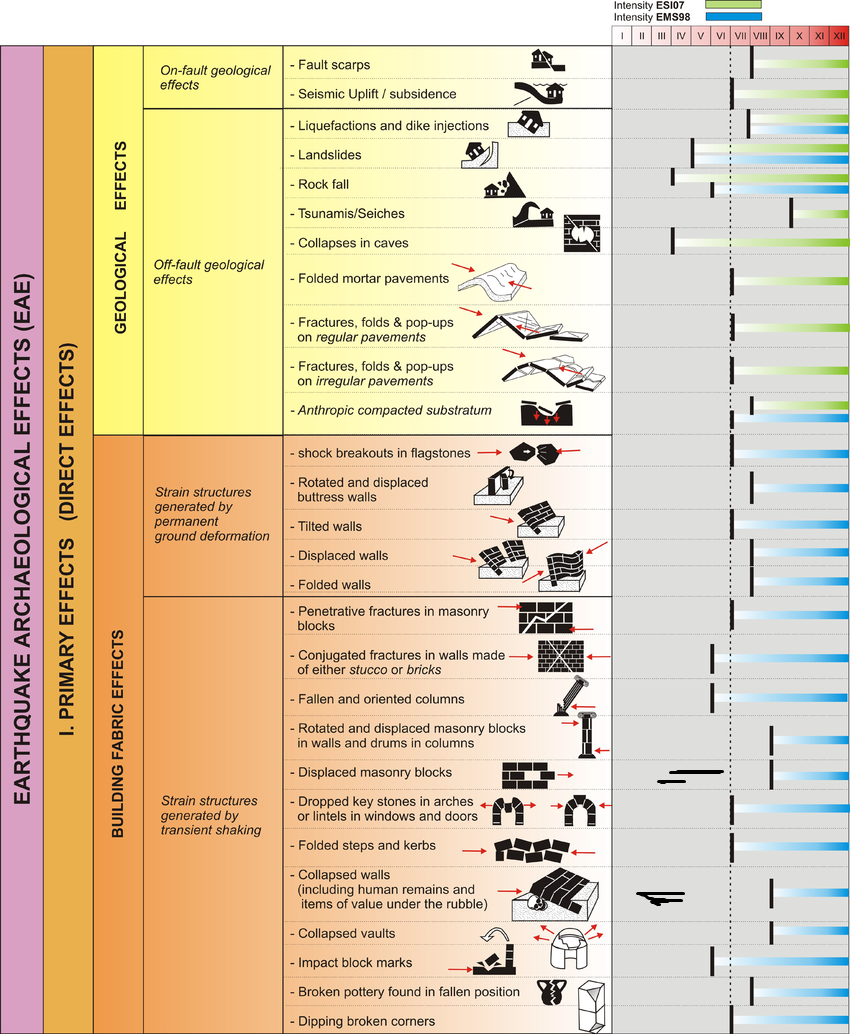 Earthquake Archeological Effects (EAE)
Rodríguez-Pascua et al (2013: 221-224)
| Effect | Location | Image(s) | Description | Intensity |
|---|---|---|---|---|
|
Church |
|
|
References
Articles and Books
Kelso, J. L. & Baramki, D. C. (1955) Excavations At New Testament Jericho And Khirbet En-Nitla
Annual of the American Schools of Oriental Research 29–30. - can be borrowed with a free account from archive.org
Bibliography from Stern et al. (1993 v.2)
Kelso, J. L. & Baramki, D. C. (1955) Excavations At New Testament Jericho And Khirbet En-Nitla
Annual of the American Schools of Oriental Research 29–30. - can be borrowed with a free account from archive.org