
Open this page in a new tab

Damietta

Damietta on the Nile, Postcard from 1911

Historic view of the city of Damietta at the eastern branch of the Nile Delta, looking across the river toward the city.

Source: Wikimedia Commons; from Douglas Sladen, Queer Things About Egypt (1911).

License: Public Domain (CC Public Domain Mark 1.0).

click on image to open in a new tab


Names
Transliterated Name Source Name
Damietta Modern English
Damiata Medieval Latin / Crusader
Damiate Medieval European
Damiata Medieval European Variant
Damiatta Medieval European Variant
Damieta Spanish / Portuguese / Medieval Latin
Damiete Old French
Damiattae Rare Latinized Form
Domiat Medieval European
Domyat Modern Transliteration
Dumyāṭ Arabic دمياط
Dimyāṭ Classical Arabic دمياط
Dumyat Arabic Transliteration
Dimyat Turkish / Arabic Transliteration
Damyat Modern Transliteration
Tamiati Coptic ⲧⲁⲙⲓⲁϯ
Tamiat Late Egyptian / Demotic
Ṯmꜣṱ Ancient Egyptian 𓏏𓅓𓄿𓏏
Tamiathis Greek Ταμίαθις
Thamiathis Byzantine Greek Θαμίαθις
Tamiathis Latin
Caphutkia Jewish / Aramaic Tradition קפוטקיא
Capotakia Jewish / Medieval Variant
Kapotakia Jewish / Medieval Variant
Introduction
Introduction

Damietta (Arabic: دمياط; Dumyāṭ) is a historic port city in northern Egypt situated near the Mediterranean coast at the eastern mouth of the Nile Delta, where the Damietta branch of the Nile enters the sea. Its strategic position at the interface between the Nile River and the Mediterranean made it one of Egypt's most important commercial, naval, and defensive centers throughout history.

The city has been continuously occupied since antiquity and was known to the ancient Egyptians, Greeks, Romans, Byzantines, and later Islamic states. During the Roman and Byzantine periods it served as an important regional port, while under the Umayyads, Abbasids, Fatimids, Ayyubids, and Mamluks it became a major center for Mediterranean trade linking Egypt with the Levant, Anatolia, and Europe. Damietta was also famous for its textiles and remained one of Egypt's principal ports for centuries.

Because of its strategic importance, Damietta was repeatedly attacked during the Crusades. It was captured by Crusader forces during the Fifth Crusade in 1219 and again during the Seventh Crusade in 1249 before being retaken by the Ayyubids and later the Mamluks. Following these invasions, the medieval city was rebuilt slightly away from its earlier location to improve its defenses against future attacks.

Aerial Views
Aerial Views

Aerial Views

  • Damietta in Google Earth

Textual Chronology
551 CE Earthquake

Based on the contemporaneous account of Myrinaei Historiarum by Agathias which described seismic shaking in the Nile Delta during to the 551 CE Beirut Quake, Ambraseys (2009) suggested that there might be archeoseismic evidence for the 551 CE Beirut Quake at Damietta. Although Damietta was far from the epicenter, the possibility of seismic amplification due to a site effect in certain parts of Damietta is likely. A simple google search for "subsidence in Damietta" reveals numerous reports of modern subsidence which speaks to weak underlying sediments.

January 749 CE Sabbatical Year Earthquakes

Discussion

Discussion

Textual Seismic Effects
January 749 CE Sabbatical Year Earthquakes

Effect                                                      Location Image(s) Description
  • Distorted Walls
  • Some damage
Damietta
  • "Then we returned to Misr [i.e. Egypt] on the night of the 21st of Tuba, the night on which our Lady, the Virgin Mary, went to her rest. And that night there came great wrath from God, for there was a great earthquake in the land, and many houses were ruined in all the cities, and none was saved from them, not a single soul, and likewise on the sea many ships were sunk on that night. This happened all over the East, from the city of Gaza to the furthest extremity of Persia. And they counted the cities that were wrecked that night, and they were six hundred cities and villages, with a vast destruction of men and beasts. But the land of Egypt was uninjured, except only Damietta. And at Misr there was only great fear, without any death or ruin of houses; for though the beams in the doorways and walls were moved out of their places, they went back again to their places after two hours. We were assured by one whose word we trust that none of the churches of the Orthodox nor of their dwellings was destroyed throughout the east." – Severus Ibn al‑Muqaffaʿ

Textual Intensity Estimates
January 749 CE Sabbatical Year Earthquakes

  • Earthquake Archeological Effects chart of Rodríguez-Pascua et al (2013: 221-224)
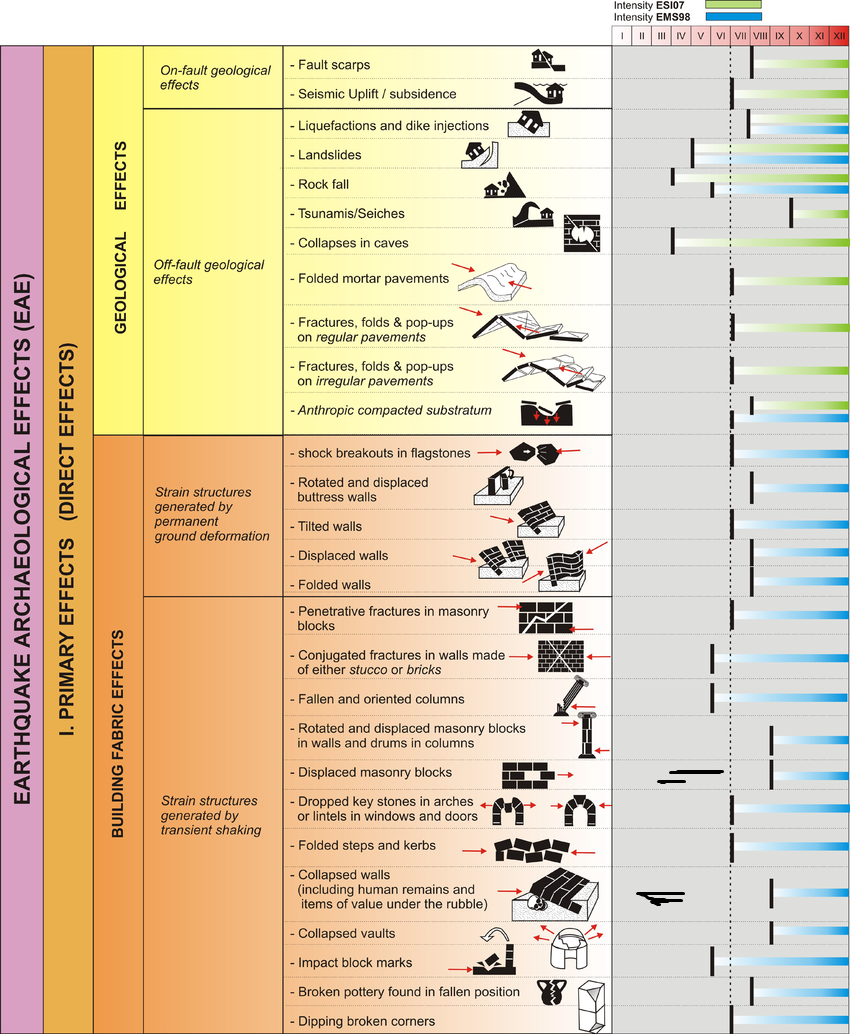
Effect                                                      Location Image(s) Description Intensity
  • Displaced or Folded Walls
  • Some damage
Damietta
  • "Then we returned to Misr [i.e. Egypt] on the night of the 21st of Tuba, the night on which our Lady, the Virgin Mary, went to her rest. And that night there came great wrath from God, for there was a great earthquake in the land, and many houses were ruined in all the cities, and none was saved from them, not a single soul, and likewise on the sea many ships were sunk on that night. This happened all over the East, from the city of Gaza to the furthest extremity of Persia. And they counted the cities that were wrecked that night, and they were six hundred cities and villages, with a vast destruction of men and beasts. But the land of Egypt was uninjured, except only Damietta. And at Misr there was only great fear, without any death or ruin of houses; for though the beams in the doorways and walls were moved out of their places, they went back again to their places after two hours. We were assured by one whose word we trust that none of the churches of the Orthodox nor of their dwellings was destroyed throughout the east." – Severus Ibn al‑Muqaffaʿ
  • VII+
  • ?
This evidence requires a minimum Intensity of VII (7) according to the Earthquake Archaeological Effects (EAE) classification of Rodríguez-Pascua et al. (2013:221–224). However, because Damietta lies only 1–2 m above sea level on the unconsolidated sediments of the Nile Delta, local site effects such as liquefaction and sediment amplification are expected to have increased the severity of ground failure. Consequently, the estimated bedrock intensity is reduced to VI (6).

Notes and Further Reading
Wikipedia pages

Damietta


Caphutkia (another name)


Caphtor